 Add to Chrome
 Add to Firefox
 Add to Edge
SYNAPSE: Empowering LLM Agents with Episodic-Semantic Memory via Spreading Activation
Jan 06, 2026
While Large Language Models (LLMs) excel at generalized reasoning, standard retrieval-augmented approaches fail to address the disconnected nature of long-term agentic memory. To bridge this gap, we introduce Synapse (Synergistic Associative Processing Semantic Encoding), a unified memory architecture that transcends static vector similarity. Drawing from cognitive science, Synapse models memory as a dynamic graph where relevance emerges from spreading activation rather than pre-computed links. By integrating lateral inhibition and temporal decay, the system dynamically highlights relevant sub-graphs while filtering interference. We implement a Triple Hybrid Retrieval strategy that fuses geometric embeddings with activation-based graph traversal. Comprehensive evaluations on the LoCoMo benchmark show that Synapse significantly outperforms state-of-the-art methods in complex temporal and multi-hop reasoning tasks, offering a robust solution to the "Contextual Tunneling" problem. Our code and data will be made publicly available upon acceptance.

Digital Twin AI: Opportunities and Challenges from Large Language Models to World Models
Jan 04, 2026Digital twins, as precise digital representations of physical systems, have evolved from passive simulation tools into intelligent and autonomous entities through the integration of artificial intelligence technologies. This paper presents a unified four-stage framework that systematically characterizes AI integration across the digital twin lifecycle, spanning modeling, mirroring, intervention, and autonomous management. By synthesizing existing technologies and practices, we distill a unified four-stage framework that systematically characterizes how AI methodologies are embedded across the digital twin lifecycle: (1) modeling the physical twin through physics-based and physics-informed AI approaches, (2) mirroring the physical system into a digital twin with real-time synchronization, (3) intervening in the physical twin through predictive modeling, anomaly detection, and optimization strategies, and (4) achieving autonomous management through large language models, foundation models, and intelligent agents. We analyze the synergy between physics-based modeling and data-driven learning, highlighting the shift from traditional numerical solvers to physics-informed and foundation models for physical systems. Furthermore, we examine how generative AI technologies, including large language models and generative world models, transform digital twins into proactive and self-improving cognitive systems capable of reasoning, communication, and creative scenario generation. Through a cross-domain review spanning eleven application domains, including healthcare, aerospace, smart manufacturing, robotics, and smart cities, we identify common challenges related to scalability, explainability, and trustworthiness, and outline directions for responsible AI-driven digital twin systems.
Large Language Models for Bioinformatics
Jan 10, 2025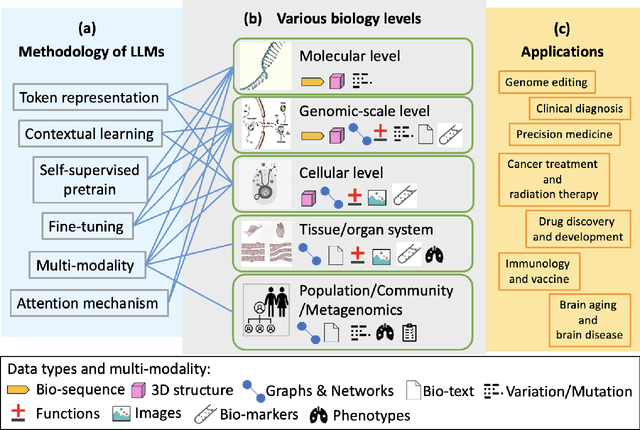
With the rapid advancements in large language model (LLM) technology and the emergence of bioinformatics-specific language models (BioLMs), there is a growing need for a comprehensive analysis of the current landscape, computational characteristics, and diverse applications. This survey aims to address this need by providing a thorough review of BioLMs, focusing on their evolution, classification, and distinguishing features, alongside a detailed examination of training methodologies, datasets, and evaluation frameworks. We explore the wide-ranging applications of BioLMs in critical areas such as disease diagnosis, drug discovery, and vaccine development, highlighting their impact and transformative potential in bioinformatics. We identify key challenges and limitations inherent in BioLMs, including data privacy and security concerns, interpretability issues, biases in training data and model outputs, and domain adaptation complexities. Finally, we highlight emerging trends and future directions, offering valuable insights to guide researchers and clinicians toward advancing BioLMs for increasingly sophisticated biological and clinical applications.
EG-SpikeFormer: Eye-Gaze Guided Transformer on Spiking Neural Networks for Medical Image Analysis
Oct 12, 2024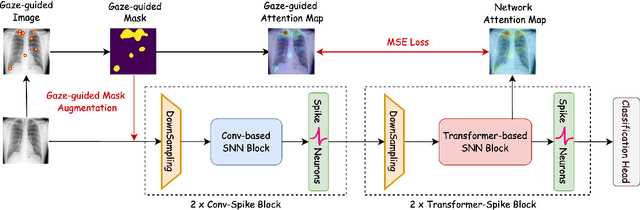


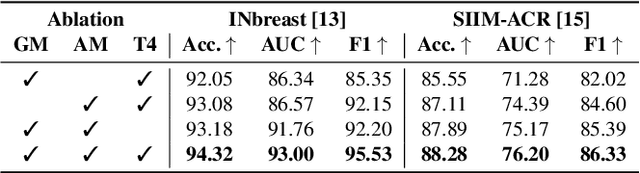
Neuromorphic computing has emerged as a promising energy-efficient alternative to traditional artificial intelligence, predominantly utilizing spiking neural networks (SNNs) implemented on neuromorphic hardware. Significant advancements have been made in SNN-based convolutional neural networks (CNNs) and Transformer architectures. However, their applications in the medical imaging domain remain underexplored. In this study, we introduce EG-SpikeFormer, an SNN architecture designed for clinical tasks that integrates eye-gaze data to guide the model's focus on diagnostically relevant regions in medical images. This approach effectively addresses shortcut learning issues commonly observed in conventional models, especially in scenarios with limited clinical data and high demands for model reliability, generalizability, and transparency. Our EG-SpikeFormer not only demonstrates superior energy efficiency and performance in medical image classification tasks but also enhances clinical relevance. By incorporating eye-gaze data, the model improves interpretability and generalization, opening new directions for the application of neuromorphic computing in healthcare.