 Add to Chrome
 Add to Firefox
 Add to Edge
World Models: A Comprehensive Survey of Architectures, Methodologies, Reasoning Paradigms, and Applications
May 28, 2026
World models, internal simulators that learn the structure and dynamics of an environment, have emerged as a central paradigm in the pursuit of artificial general intelligence, enabling agents to predict, plan, and reason within learned representations. Despite rapid progress across reinforcement learning, robotics, autonomous driving, and video generation, the field lacks a unified framework integrating its diverse architectural choices, training methods, reasoning mechanisms, and application settings. This survey addresses that gap with a multi-axis taxonomy organized along four dimensions: (i) architecture, encompassing representation format, dynamics formulation, input modality, learning paradigm, and downstream application; (ii) methodological family, including state-space and recurrent approaches, transformer-based models, diffusion-based generators, physics-informed networks, and language-augmented multimodal systems; (iii) reasoning strategy, covering imagination-based planning, latent policy learning, counterfactual reasoning, and planning under uncertainty; and (iv) application domain, spanning robotics, autonomous driving, video prediction, multimodal agents, reinforcement learning, scientific modeling, medical imaging, educational measurement, and business and finance. Tracing the field from early cognitive-science foundations to milestone systems such as PlaNet, the Dreamer family, MuZero, Sora, Cosmos, and Genie, we examine how these dimensions interact and highlight the recent convergence of chain-of-thought reasoning with world-model imagination. We review evaluation protocols and benchmarks, identify persistent challenges such as compounding prediction errors, sim-to-real transfer, and fragmented evaluation, and outline future directions toward unified multimodal world models, foundation-scale interactive simulators, and safe deployment in safety-critical domains.

ViThinker: Active Vision-Language Reasoning via Dynamic Perceptual Querying
Feb 02, 2026Chain-of-Thought (CoT) reasoning excels in language models but struggles in vision-language models due to premature visual-to-text conversion that discards continuous information such as geometry and spatial layout. While recent methods enhance CoT through static enumeration or attention-based selection, they remain passive, i.e., processing pre-computed inputs rather than actively seeking task-relevant details. Inspired by human active perception, we introduce ViThinker, a framework that enables vision-language models to autonomously generate decision (query) tokens triggering the synthesis of expert-aligned visual features on demand. ViThinker internalizes vision-expert capabilities during training, performing generative mental simulation during inference without external tool calls. Through a two-stage curriculum: first distilling frozen experts into model parameters, then learning task-driven querying via sparsity penalties, i.e., ViThinker discovers minimal sufficient perception for each reasoning step. Evaluations across vision-centric benchmarks demonstrate consistent improvements, validating that active query generation outperforms passive approaches in both perceptual grounding and reasoning accuracy.
SYNAPSE: Empowering LLM Agents with Episodic-Semantic Memory via Spreading Activation
Jan 06, 2026While Large Language Models (LLMs) excel at generalized reasoning, standard retrieval-augmented approaches fail to address the disconnected nature of long-term agentic memory. To bridge this gap, we introduce Synapse (Synergistic Associative Processing Semantic Encoding), a unified memory architecture that transcends static vector similarity. Drawing from cognitive science, Synapse models memory as a dynamic graph where relevance emerges from spreading activation rather than pre-computed links. By integrating lateral inhibition and temporal decay, the system dynamically highlights relevant sub-graphs while filtering interference. We implement a Triple Hybrid Retrieval strategy that fuses geometric embeddings with activation-based graph traversal. Comprehensive evaluations on the LoCoMo benchmark show that Synapse significantly outperforms state-of-the-art methods in complex temporal and multi-hop reasoning tasks, offering a robust solution to the "Contextual Tunneling" problem. Our code and data will be made publicly available upon acceptance.
Achieving Fine-grained Cross-modal Understanding through Brain-inspired Hierarchical Representation Learning
Jan 04, 2026Understanding neural responses to visual stimuli remains challenging due to the inherent complexity of brain representations and the modality gap between neural data and visual inputs. Existing methods, mainly based on reducing neural decoding to generation tasks or simple correlations, fail to reflect the hierarchical and temporal processes of visual processing in the brain. To address these limitations, we present NeuroAlign, a novel framework for fine-grained fMRI-video alignment inspired by the hierarchical organization of the human visual system. Our framework implements a two-stage mechanism that mirrors biological visual pathways: global semantic understanding through Neural-Temporal Contrastive Learning (NTCL) and fine-grained pattern matching through enhanced vector quantization. NTCL explicitly models temporal dynamics through bidirectional prediction between modalities, while our DynaSyncMM-EMA approach enables dynamic multi-modal fusion with adaptive weighting. Experiments demonstrate that NeuroAlign significantly outperforms existing methods in cross-modal retrieval tasks, establishing a new paradigm for understanding visual cognitive mechanisms.
MARAuder's Map: Motion-Aware Real-time Activity Recognition with Layout-Based Trajectories
Nov 08, 2025Ambient sensor-based human activity recognition (HAR) in smart homes remains challenging due to the need for real-time inference, spatially grounded reasoning, and context-aware temporal modeling. Existing approaches often rely on pre-segmented, within-activity data and overlook the physical layout of the environment, limiting their robustness in continuous, real-world deployments. In this paper, we propose MARAuder's Map, a novel framework for real-time activity recognition from raw, unsegmented sensor streams. Our method projects sensor activations onto the physical floorplan to generate trajectory-aware, image-like sequences that capture the spatial flow of human movement. These representations are processed by a hybrid deep learning model that jointly captures spatial structure and temporal dependencies. To enhance temporal awareness, we introduce a learnable time embedding module that encodes contextual cues such as hour-of-day and day-of-week. Additionally, an attention-based encoder selectively focuses on informative segments within each observation window, enabling accurate recognition even under cross-activity transitions and temporal ambiguity. Extensive experiments on multiple real-world smart home datasets demonstrate that our method outperforms strong baselines, offering a practical solution for real-time HAR in ambient sensor environments.
ADLGen: Synthesizing Symbolic, Event-Triggered Sensor Sequences for Human Activity Modeling
May 23, 2025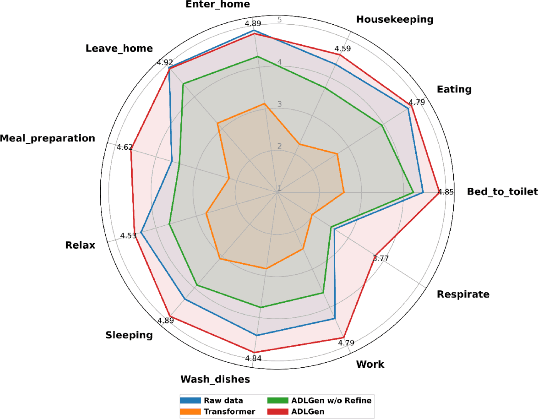

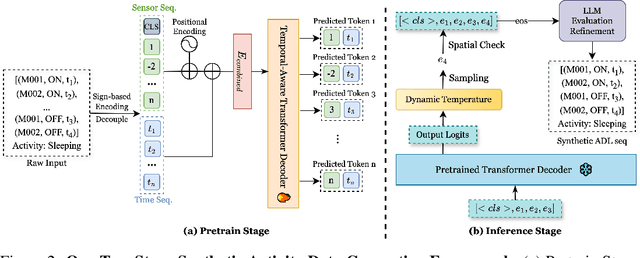
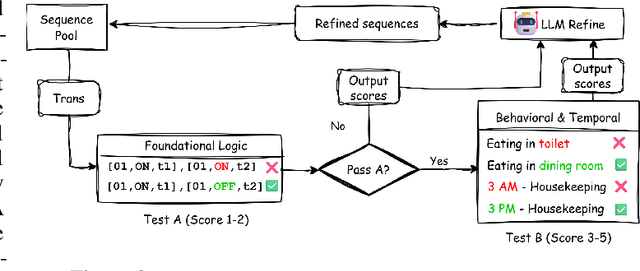
Real world collection of Activities of Daily Living data is challenging due to privacy concerns, costly deployment and labeling, and the inherent sparsity and imbalance of human behavior. We present ADLGen, a generative framework specifically designed to synthesize realistic, event triggered, and symbolic sensor sequences for ambient assistive environments. ADLGen integrates a decoder only Transformer with sign based symbolic temporal encoding, and a context and layout aware sampling mechanism to guide generation toward semantically rich and physically plausible sensor event sequences. To enhance semantic fidelity and correct structural inconsistencies, we further incorporate a large language model into an automatic generate evaluate refine loop, which verifies logical, behavioral, and temporal coherence and generates correction rules without manual intervention or environment specific tuning. Through comprehensive experiments with novel evaluation metrics, ADLGen is shown to outperform baseline generators in statistical fidelity, semantic richness, and downstream activity recognition, offering a scalable and privacy-preserving solution for ADL data synthesis.