 Add to Chrome
 Add to Firefox
 Add to Edge
Rechargeable UAV Trajectory Optimization for Real-Time Persistent Data Collection of Large-Scale Sensor Networks
Apr 24, 2024
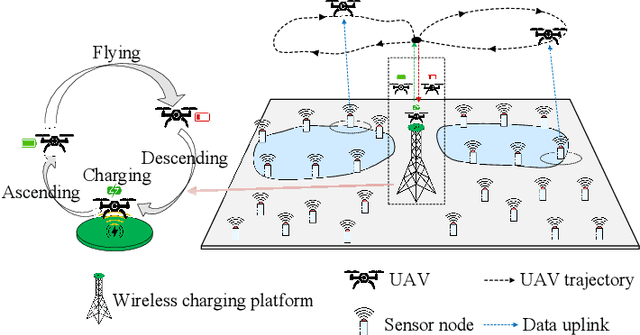
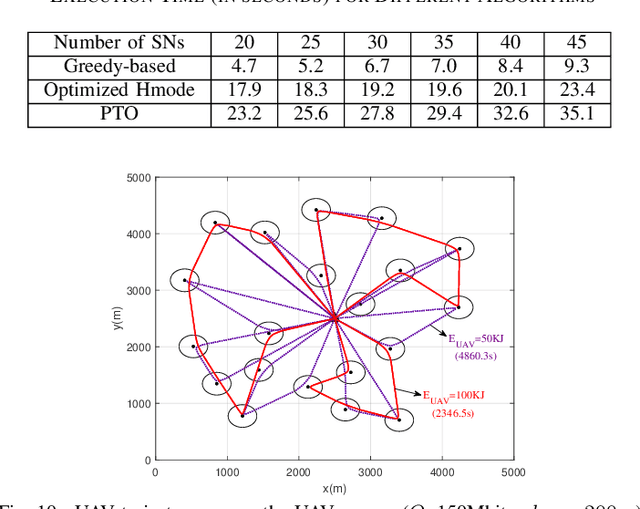
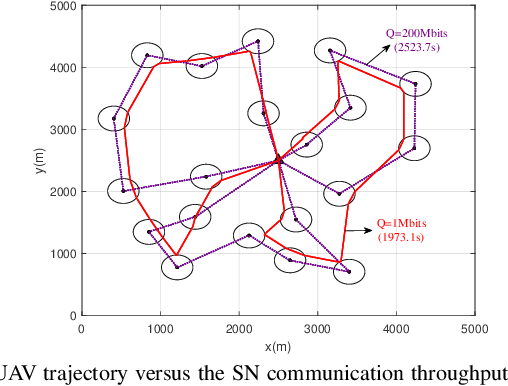
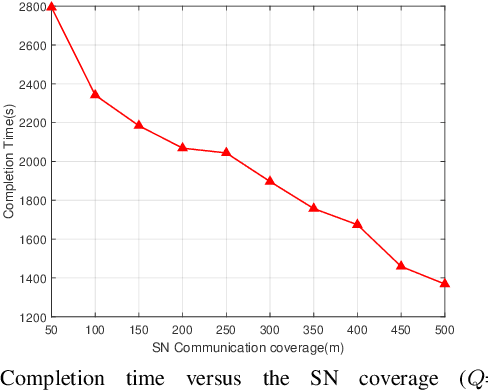
Continuous real-time data collection in wireless sensor networks is crucial for facilitating timely decision-making and environmental monitoring. Unmanned aerial vehicles (UAVs) have received plenty of attention for collecting data efficiently due to their high flexibility and enhanced communication ability, nonetheless, the limited onboard energy restricts UAVs' application on persistent missions, such as disaster search and rescue. In this paper, we propose a rechargeable UAV-assisted periodic data collection scheme, where the UAV replenishes energy through the wireless charging platform during the mission to provide persistent information services for the sensor nodes (SNs). Specifically, the total completion time is minimized by optimizing the trajectory of the UAV to reach the balance among the collecting time, flight time, and recharging time. However, optimally solving this problem is highly non-trivial due to the non-convex constraints and the involved integer variables. To address this issue, the formulated problem is decomposed into two subproblems, namely, UAV data collection trajectory optimization and SN clustering and UAV visiting order optimization. By exploiting the convex optimization techniques and proving the total time is non-decreasing with the cluster number, a periodic trajectory optimization algorithm based on successive convex approximation (SCA) and bisection search is proposed to solve the main problem. The simulation results show the efficiency of the proposed scheme in practical scenarios and the completion time of the proposed algorithm is on average 39% and 33% lower than the two benchmarks, respectively.

Nyonic Technical Report
Apr 24, 2024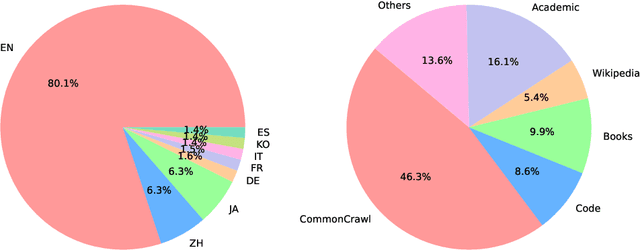
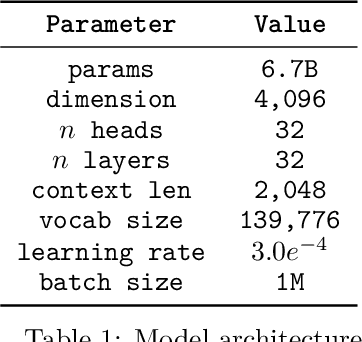
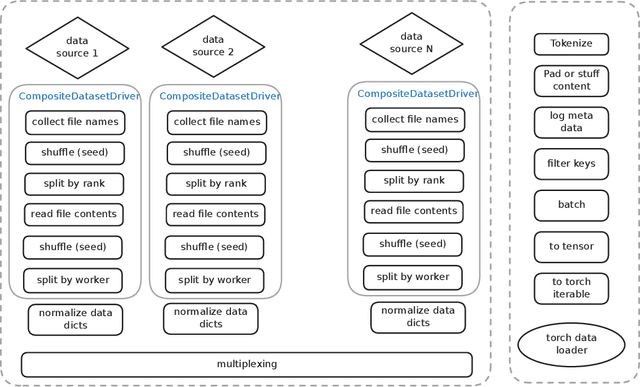
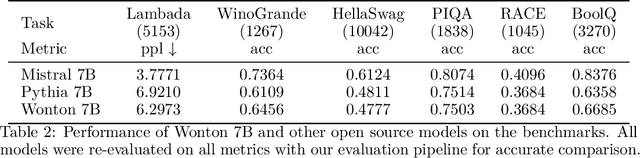
This report details the development and key achievements of our latest language model designed for custom large language models. The advancements introduced include a novel Online Data Scheduler that supports flexible training data adjustments and curriculum learning. The model's architecture is fortified with state-of-the-art techniques such as Rotary Positional Embeddings, QK-LayerNorm, and a specially crafted multilingual tokenizer to enhance stability and performance. Moreover, our robust training framework incorporates advanced monitoring and rapid recovery features to ensure optimal efficiency. Our Wonton 7B model has demonstrated competitive performance on a range of multilingual and English benchmarks. Future developments will prioritize narrowing the performance gap with more extensively trained models, thereby enhancing the model's real-world efficacy and adaptability.GitHub: \url{https://github.com/nyonicai/nyonic-public}
SNR Maximization and Localization for UAV-IRS-Assisted Near-Field Systems
Apr 24, 2024This letter introduces a novel unmanned aerial vehicle (UAV)-intelligent reflecting surface (IRS) structure into near-field localization systems to enhance the design flexibility of IRS, thereby obtaining additional performance gains. Specifically, a UAV-IRS is utilized to improve the harsh wireless environment and provide localization possibilities. To improve the localization accuracy, a joint optimization problem considering UAV position and UAV-IRS passive beamforming is formulated to maximize the receiving signal-to-noise ratio (SNR). An alternative optimization algorithm is proposed to solve the complex non-convex problem leveraging the projected gradient ascent (PGA) algorithm and the principle of minimizing the phase difference of the receiving signals. Closed-form expressions for UAV-IRS phase shift are derived to reduce the algorithm complexity. In the simulations, the proposed algorithm is compared with three different schemes and outperforms the others in both receiving SNR and localization accuracy.
Beyond Chain-of-Thought: A Survey of Chain-of-X Paradigms for LLMs
Apr 24, 2024Chain-of-Thought (CoT) has been a widely adopted prompting method, eliciting impressive reasoning abilities of Large Language Models (LLMs). Inspired by the sequential thought structure of CoT, a number of Chain-of-X (CoX) methods have been developed to address various challenges across diverse domains and tasks involving LLMs. In this paper, we provide a comprehensive survey of Chain-of-X methods for LLMs in different contexts. Specifically, we categorize them by taxonomies of nodes, i.e., the X in CoX, and application tasks. We also discuss the findings and implications of existing CoX methods, as well as potential future directions. Our survey aims to serve as a detailed and up-to-date resource for researchers seeking to apply the idea of CoT to broader scenarios.
A Spatiotemporal Hand-Eye Calibration for Trajectory Alignment in Visual(-Inertial) Odometry Evaluation
Apr 23, 2024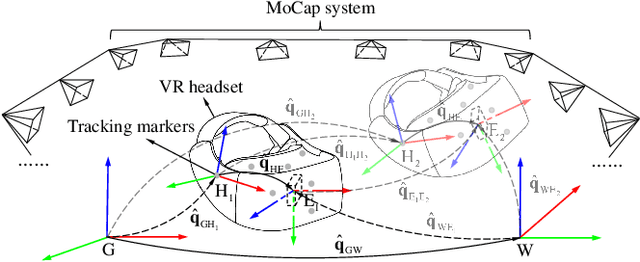
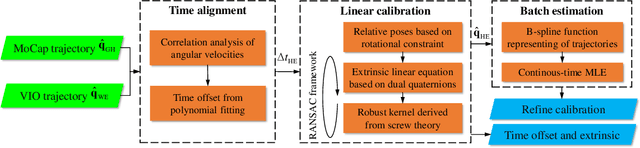
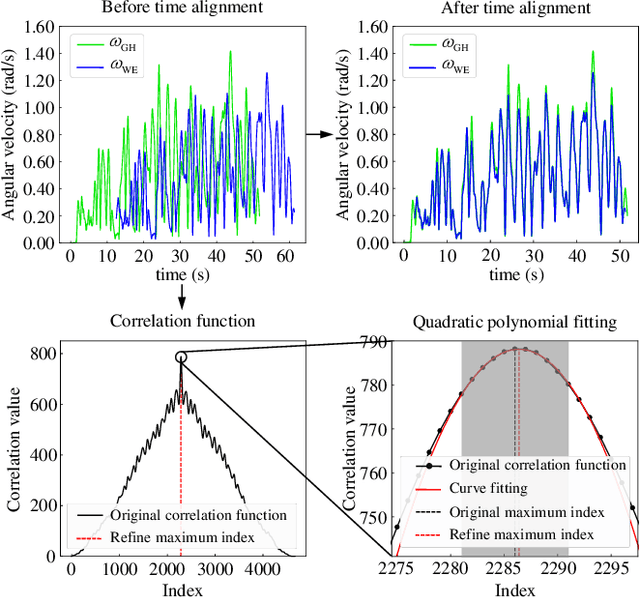
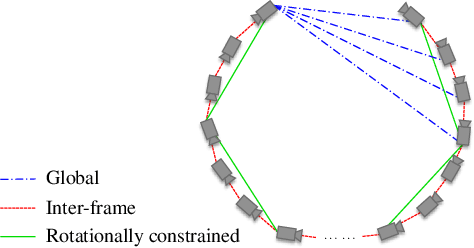
A common prerequisite for evaluating a visual(-inertial) odometry (VO/VIO) algorithm is to align the timestamps and the reference frame of its estimated trajectory with a reference ground-truth derived from a system of superior precision, such as a motion capture system. The trajectory-based alignment, typically modeled as a classic hand-eye calibration, significantly influences the accuracy of evaluation metrics. However, traditional calibration methods are susceptible to the quality of the input poses. Few studies have taken this into account when evaluating VO/VIO trajectories that usually suffer from noise and drift. To fill this gap, we propose a novel spatiotemporal hand-eye calibration algorithm that fully leverages multiple constraints from screw theory for enhanced accuracy and robustness. Experimental results show that our algorithm has better performance and is less noise-prone than state-of-the-art methods.
* 8 pages, 9 figures, 2 tables
AED-PADA:Improving Generalizability of Adversarial Example Detection via Principal Adversarial Domain Adaptation
Apr 19, 2024Adversarial example detection, which can be conveniently applied in many scenarios, is important in the area of adversarial defense. Unfortunately, existing detection methods suffer from poor generalization performance, because their training process usually relies on the examples generated from a single known adversarial attack and there exists a large discrepancy between the training and unseen testing adversarial examples. To address this issue, we propose a novel method, named Adversarial Example Detection via Principal Adversarial Domain Adaptation (AED-PADA). Specifically, our approach identifies the Principal Adversarial Domains (PADs), i.e., a combination of features of the adversarial examples from different attacks, which possesses large coverage of the entire adversarial feature space. Then, we pioneer to exploit multi-source domain adaptation in adversarial example detection with PADs as source domains. Experiments demonstrate the superior generalization ability of our proposed AED-PADA. Note that this superiority is particularly achieved in challenging scenarios characterized by employing the minimal magnitude constraint for the perturbations.
The Victim and The Beneficiary: Exploiting a Poisoned Model to Train a Clean Model on Poisoned Data
Apr 17, 2024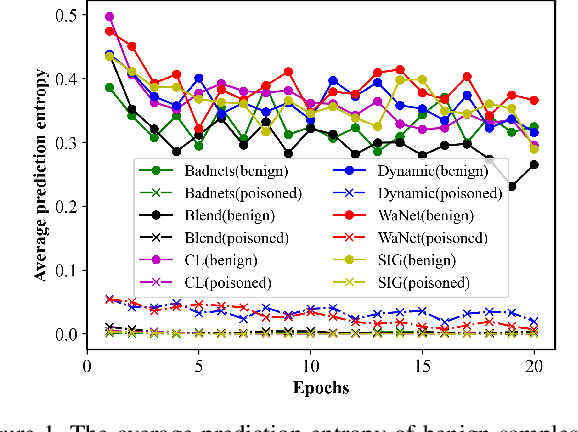

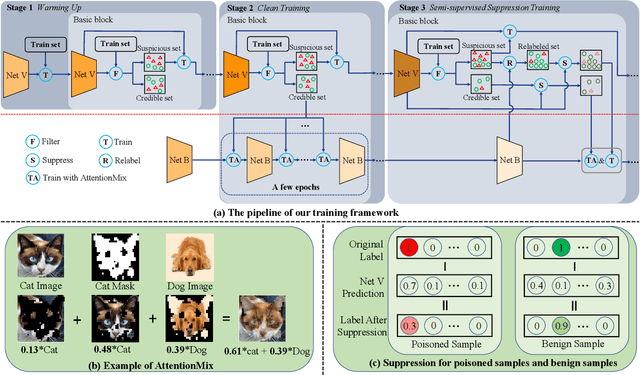
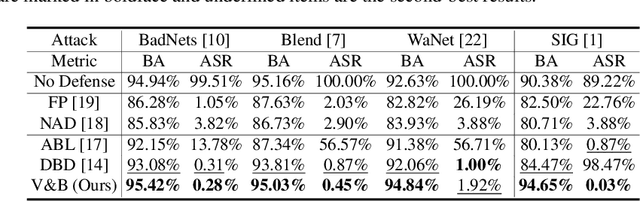
Recently, backdoor attacks have posed a serious security threat to the training process of deep neural networks (DNNs). The attacked model behaves normally on benign samples but outputs a specific result when the trigger is present. However, compared with the rocketing progress of backdoor attacks, existing defenses are difficult to deal with these threats effectively or require benign samples to work, which may be unavailable in real scenarios. In this paper, we find that the poisoned samples and benign samples can be distinguished with prediction entropy. This inspires us to propose a novel dual-network training framework: The Victim and The Beneficiary (V&B), which exploits a poisoned model to train a clean model without extra benign samples. Firstly, we sacrifice the Victim network to be a powerful poisoned sample detector by training on suspicious samples. Secondly, we train the Beneficiary network on the credible samples selected by the Victim to inhibit backdoor injection. Thirdly, a semi-supervised suppression strategy is adopted for erasing potential backdoors and improving model performance. Furthermore, to better inhibit missed poisoned samples, we propose a strong data augmentation method, AttentionMix, which works well with our proposed V&B framework. Extensive experiments on two widely used datasets against 6 state-of-the-art attacks demonstrate that our framework is effective in preventing backdoor injection and robust to various attacks while maintaining the performance on benign samples. Our code is available at https://github.com/Zixuan-Zhu/VaB.
* 13 pages, 6 figures, published to ICCV
Learn When to Trust Language Models: A Privacy-Centric Adaptive Model-Aware Approach
Apr 04, 2024Retrieval-augmented large language models (LLMs) have been remarkably competent in various NLP tasks. Despite their great success, the knowledge provided by the retrieval process is not always useful for improving the model prediction, since in some samples LLMs may already be quite knowledgeable and thus be able to answer the question correctly without retrieval. Aiming to save the cost of retrieval, previous work has proposed to determine when to do/skip the retrieval in a data-aware manner by analyzing the LLMs' pretraining data. However, these data-aware methods pose privacy risks and memory limitations, especially when requiring access to sensitive or extensive pretraining data. Moreover, these methods offer limited adaptability under fine-tuning or continual learning settings. We hypothesize that token embeddings are able to capture the model's intrinsic knowledge, which offers a safer and more straightforward way to judge the need for retrieval without the privacy risks associated with accessing pre-training data. Moreover, it alleviates the need to retain all the data utilized during model pre-training, necessitating only the upkeep of the token embeddings. Extensive experiments and in-depth analyses demonstrate the superiority of our model-aware approach.
Cross-Modality Gait Recognition: Bridging LiDAR and Camera Modalities for Human Identification
Apr 04, 2024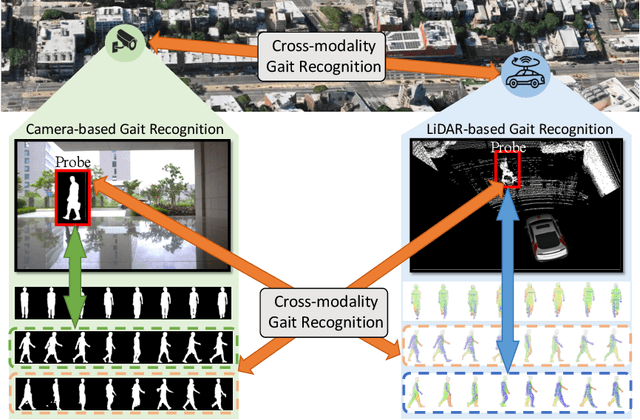
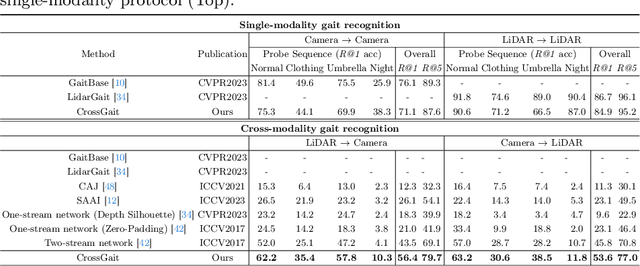
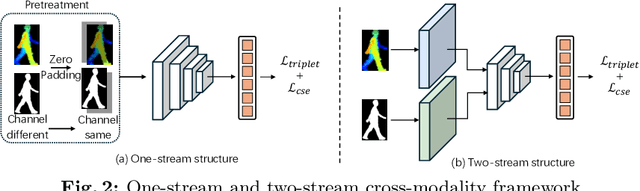
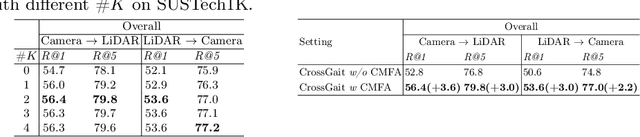
Current gait recognition research mainly focuses on identifying pedestrians captured by the same type of sensor, neglecting the fact that individuals may be captured by different sensors in order to adapt to various environments. A more practical approach should involve cross-modality matching across different sensors. Hence, this paper focuses on investigating the problem of cross-modality gait recognition, with the objective of accurately identifying pedestrians across diverse vision sensors. We present CrossGait inspired by the feature alignment strategy, capable of cross retrieving diverse data modalities. Specifically, we investigate the cross-modality recognition task by initially extracting features within each modality and subsequently aligning these features across modalities. To further enhance the cross-modality performance, we propose a Prototypical Modality-shared Attention Module that learns modality-shared features from two modality-specific features. Additionally, we design a Cross-modality Feature Adapter that transforms the learned modality-specific features into a unified feature space. Extensive experiments conducted on the SUSTech1K dataset demonstrate the effectiveness of CrossGait: (1) it exhibits promising cross-modality ability in retrieving pedestrians across various modalities from different sensors in diverse scenes, and (2) CrossGait not only learns modality-shared features for cross-modality gait recognition but also maintains modality-specific features for single-modality recognition.
Transformer-Lite: High-efficiency Deployment of Large Language Models on Mobile Phone GPUs
Mar 29, 2024The Large Language Model (LLM) is widely employed for tasks such as intelligent assistants, text summarization, translation, and multi-modality on mobile phones. However, the current methods for on-device LLM deployment maintain slow inference speed, which causes poor user experience. To facilitate high-efficiency LLM deployment on device GPUs, we propose four optimization techniques: (a) a symbolic expression-based approach to support dynamic shape model inference; (b) operator optimizations and execution priority setting to enhance inference speed and reduce phone lagging; (c) an FP4 quantization method termed M0E4 to reduce dequantization overhead; (d) a sub-tensor-based technique to eliminate the need for copying KV cache after LLM inference. Furthermore, we implement these methods in our mobile inference engine, Transformer-Lite, which is compatible with both Qualcomm and MTK processors. We evaluated Transformer-Lite's performance using LLMs with varied architectures and parameters ranging from 2B to 14B. Specifically, we achieved prefill and decoding speeds of 121 token/s and 14 token/s for ChatGLM2 6B, and 330 token/s and 30 token/s for smaller Gemma 2B, respectively. Compared with CPU-based FastLLM and GPU-based MLC-LLM, our engine attains over 10x speedup for the prefill speed and 2~3x speedup for the decoding speed.