 Add to Chrome
 Add to Firefox
 Add to Edge
NTIRE 2026 Challenge on Robust AI-Generated Image Detection in the Wild
Apr 13, 2026
This paper presents an overview of the NTIRE 2026 Challenge on Robust AI-Generated Image Detection in the Wild, held in conjunction with the NTIRE workshop at CVPR 2026. The goal of this challenge was to develop detection models capable of distinguishing real images from generated ones in realistic scenarios: the images are often transformed (cropped, resized, compressed, blurred) for practical usage, and therefore, the detection models should be robust to such transformations. The challenge is based on a novel dataset consisting of 108,750 real and 185,750 AI-generated images from 42 generators comprising a large variety of open-source and closed-source models of various architectures, augmented with 36 image transformations. Methods were evaluated using ROC AUC on the full test set, including both transformed and untransformed images. A total of 511 participants registered, with 20 teams submitting valid final solutions. This report provides a comprehensive overview of the challenge, describes the proposed solutions, and can be used as a valuable reference for researchers and practitioners in increasing the robustness of the detection models to real-world transformations.

FeatDistill: A Feature Distillation Enhanced Multi-Expert Ensemble Framework for Robust AI-generated Image Detection
Mar 23, 2026The rapid iteration and widespread dissemination of deepfake technology have posed severe challenges to information security, making robust and generalizable detection of AI-generated forged images increasingly important. In this paper, we propose FeatDistill, an AI-generated image detection framework that integrates feature distillation with a multi-expert ensemble, developed for the NTIRE Challenge on Robust AI-Generated Image Detection in the Wild. The framework explicitly targets three practical bottlenecks in real-world forensics: degradation interference, insufficient feature representation, and limited generalization. Concretely, we build a four-backbone Vision Transformer (ViT) ensemble composed of CLIP and SigLIP variants to capture complementary forensic cues. To improve data coverage, we expand the training set and introduce comprehensive degradation modeling, which exposes the detector to diverse quality variations and synthesis artifacts commonly encountered in unconstrained scenarios. We further adopt a two-stage training paradigm: the model is first optimized with a standard binary classification objective, then refined by dense feature-level self-distillation for representation alignment. This design effectively mitigates overfitting and enhances semantic consistency of learned features. At inference time, the final prediction is obtained by averaging the probabilities from four independently trained experts, yielding stable and reliable decisions across unseen generators and complex degradations. Despite the ensemble design, the framework remains efficient, requiring only about 10 GB peak GPU memory. Extensive evaluations in the NTIRE challenge setting demonstrate that FeatDistill achieves strong robustness and generalization under diverse ``in-the-wild'' conditions, offering an effective and practical solution for real-world deepfake image detection.
AEGIS: Adversarial Target-Guided Retention-Data-Free Robust Concept Erasure from Diffusion Models
Feb 06, 2026Concept erasure helps stop diffusion models (DMs) from generating harmful content; but current methods face robustness retention trade off. Robustness means the model fine-tuned by concept erasure methods resists reactivation of erased concepts, even under semantically related prompts. Retention means unrelated concepts are preserved so the model's overall utility stays intact. Both are critical for concept erasure in practice, yet addressing them simultaneously is challenging, as existing works typically improve one factor while sacrificing the other. Prior work typically strengthens one while degrading the other, e.g., mapping a single erased prompt to a fixed safe target leaves class level remnants exploitable by prompt attacks, whereas retention-oriented schemes underperform against adaptive adversaries. This paper introduces Adversarial Erasure with Gradient Informed Synergy (AEGIS), a retention-data-free framework that advances both robustness and retention.
* 30 pages,12 figures
Gradient Structure Estimation under Label-Only Oracles via Spectral Sensitivity
Jan 17, 2026Hard-label black-box settings, where only top-1 predicted labels are observable, pose a fundamentally constrained yet practically important feedback model for understanding model behavior. A central challenge in this regime is whether meaningful gradient information can be recovered from such discrete responses. In this work, we develop a unified theoretical perspective showing that a wide range of existing sign-flipping hard-label attacks can be interpreted as implicitly approximating the sign of the true loss gradient. This observation reframes hard-label attacks from heuristic search procedures into instances of gradient sign recovery under extremely limited feedback. Motivated by this first-principles understanding, we propose a new attack framework that combines a zero-query frequency-domain initialization with a Pattern-Driven Optimization (PDO) strategy. We establish theoretical guarantees demonstrating that, under mild assumptions, our initialization achieves higher expected cosine similarity to the true gradient sign compared to random baselines, while the proposed PDO procedure attains substantially lower query complexity than existing structured search approaches. We empirically validate our framework through extensive experiments on CIFAR-10, ImageNet, and ObjectNet, covering standard and adversarially trained models, commercial APIs, and CLIP-based models. The results show that our method consistently surpasses SOTA hard-label attacks in both attack success rate and query efficiency, particularly in low-query regimes. Beyond image classification, our approach generalizes effectively to corrupted data, biomedical datasets, and dense prediction tasks. Notably, it also successfully circumvents Blacklight, a SOTA stateful defense, resulting in a $0\%$ detection rate. Our code will be released publicly soon at https://github.com/csjunjun/DPAttack.git.
DAT: Improving Adversarial Robustness via Generative Amplitude Mix-up in Frequency Domain
Oct 16, 2024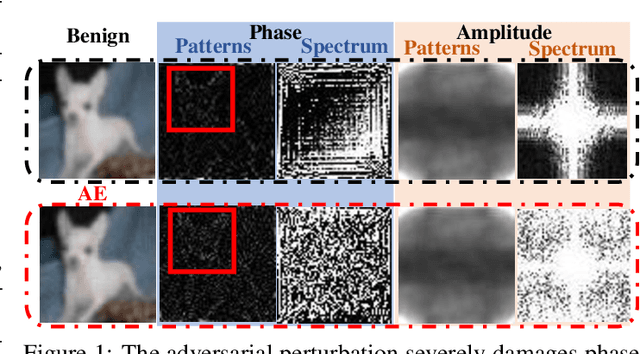

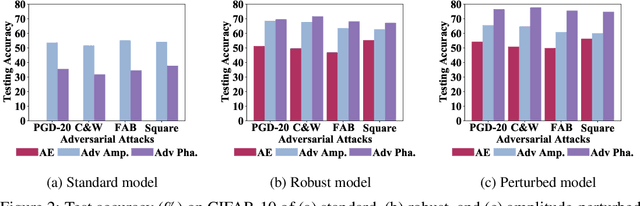
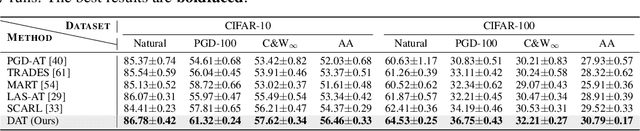
To protect deep neural networks (DNNs) from adversarial attacks, adversarial training (AT) is developed by incorporating adversarial examples (AEs) into model training. Recent studies show that adversarial attacks disproportionately impact the patterns within the phase of the sample's frequency spectrum -- typically containing crucial semantic information -- more than those in the amplitude, resulting in the model's erroneous categorization of AEs. We find that, by mixing the amplitude of training samples' frequency spectrum with those of distractor images for AT, the model can be guided to focus on phase patterns unaffected by adversarial perturbations. As a result, the model's robustness can be improved. Unfortunately, it is still challenging to select appropriate distractor images, which should mix the amplitude without affecting the phase patterns. To this end, in this paper, we propose an optimized Adversarial Amplitude Generator (AAG) to achieve a better tradeoff between improving the model's robustness and retaining phase patterns. Based on this generator, together with an efficient AE production procedure, we design a new Dual Adversarial Training (DAT) strategy. Experiments on various datasets show that our proposed DAT leads to significantly improved robustness against diverse adversarial attacks.
Regroup Median Loss for Combating Label Noise
Dec 11, 2023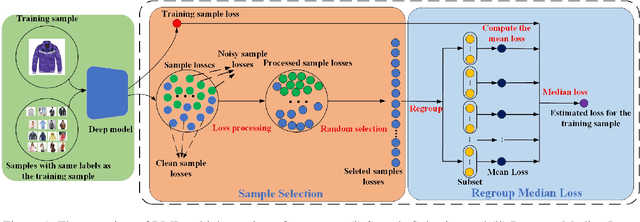

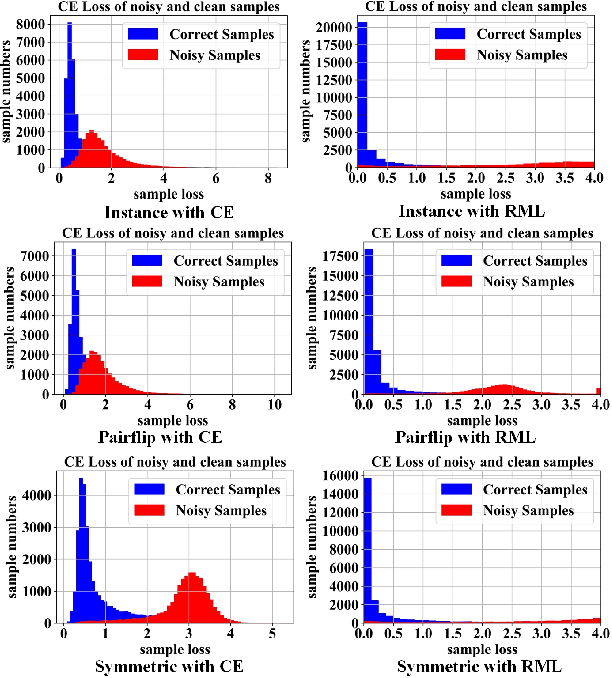

The deep model training procedure requires large-scale datasets of annotated data. Due to the difficulty of annotating a large number of samples, label noise caused by incorrect annotations is inevitable, resulting in low model performance and poor model generalization. To combat label noise, current methods usually select clean samples based on the small-loss criterion and use these samples for training. Due to some noisy samples similar to clean ones, these small-loss criterion-based methods are still affected by label noise. To address this issue, in this work, we propose Regroup Median Loss (RML) to reduce the probability of selecting noisy samples and correct losses of noisy samples. RML randomly selects samples with the same label as the training samples based on a new loss processing method. Then, we combine the stable mean loss and the robust median loss through a proposed regrouping strategy to obtain robust loss estimation for noisy samples. To further improve the model performance against label noise, we propose a new sample selection strategy and build a semi-supervised method based on RML. Compared to state-of-the-art methods, for both the traditionally trained and semi-supervised models, RML achieves a significant improvement on synthetic and complex real-world datasets. The source code of the paper has been released.