 Add to Chrome
 Add to Firefox
 Add to Edge
AudioMosaic: Contrastive Masked Audio Representation Learning
May 14, 2026
Audio self-supervised learning (SSL) aims to learn general-purpose representations from large-scale unlabeled audio data. While recent advances have been driven mainly by generative reconstruction objectives, contrastive approaches remain less explored, partly due to the difficulty of designing effective audio augmentations and the large batch sizes required for contrastive pre-training. We introduce \textbf{AudioMosaic}, a contrastive learning-based audio encoder for general audio understanding. During pre-training, AudioMosaic constructs positive pairs by applying structured time-frequency masking to spectrogram patches, which reduces memory usage and enables efficient large-batch training. Compared with generative approaches, the AudioMosaic encoder learns more discriminative utterance-level representations that demonstrate strong transferability across datasets, domains, and acoustic conditions. Extensive experiments show that AudioMosaic achieves state-of-the-art performance on several standard audio benchmarks under both linear probing and fine-tuning. We further show that integrating the pretrained AudioMosaic encoder into audio-language models improves performance on audio-language tasks. The code is publicly available in our \href{https://github.com/HanxunH/AudioMosaic}{GitHub repository}.

Mechanistic Anomaly Detection via Functional Attribution
Apr 21, 2026We can often verify the correctness of neural network outputs using ground truth labels, but we cannot reliably determine whether the output was produced by normal or anomalous internal mechanisms. Mechanistic anomaly detection (MAD) aims to flag these cases, but existing methods either depend on latent space analysis, which is vulnerable to obfuscation, or are specific to particular architectures and modalities. We reframe MAD as a functional attribution problem: asking to what extent samples from a trusted set can explain the model's output, where attribution failure signals anomalous behavior. We operationalize this using influence functions, measuring functional coupling between test samples and a small reference set via parameter-space sampling. We evaluate across multiple anomaly types and modalities. For backdoors in vision models, our method achieves state-of-the-art detection on BackdoorBench, with an average Defense Effectiveness Rating (DER) of 0.93 across seven attacks and four datasets (next best 0.83). For LLMs, we similarly achieve a significant improvement over baselines for several backdoor types, including on explicitly obfuscated models. Beyond backdoors, our method can detect adversarial and out-of-distribution samples, and distinguishes multiple anomalous mechanisms within a single model. Our results establish functional attribution as an effective, modality-agnostic tool for detecting anomalous behavior in deployed models.
SurFITR: A Dataset for Surveillance Image Forgery Detection and Localisation
Apr 08, 2026We present the Surveillance Forgery Image Test Range (SurFITR), a dataset for surveillance-style image forgery detection and localisation, in response to recent advances in open-access image generation models that raise concerns about falsifying visual evidence. Existing forgery models, trained on datasets with full-image synthesis or large manipulated regions in object-centric images, struggle to generalise to surveillance scenarios. This is because tampering in surveillance imagery is typically localised and subtle, occurring in scenes with varied viewpoints, small or occluded subjects, and lower visual quality. To address this gap, SurFITR provides a large collection of forensically valuable imagery generated via a multimodal LLM-powered pipeline, enabling semantically aware, fine-grained editing across diverse surveillance scenes. It contains over 137k tampered images with varying resolutions and edit types, generated using multiple image editing models. Extensive experiments show that existing detectors degrade significantly on SurFITR, while training on SurFITR yields substantial improvements in both in-domain and cross-domain performance. SurFITR is publicly available on GitHub.
Toward Universal and Transferable Jailbreak Attacks on Vision-Language Models
Feb 01, 2026Vision-language models (VLMs) extend large language models (LLMs) with vision encoders, enabling text generation conditioned on both images and text. However, this multimodal integration expands the attack surface by exposing the model to image-based jailbreaks crafted to induce harmful responses. Existing gradient-based jailbreak methods transfer poorly, as adversarial patterns overfit to a single white-box surrogate and fail to generalise to black-box models. In this work, we propose Universal and transferable jailbreak (UltraBreak), a framework that constrains adversarial patterns through transformations and regularisation in the vision space, while relaxing textual targets through semantic-based objectives. By defining its loss in the textual embedding space of the target LLM, UltraBreak discovers universal adversarial patterns that generalise across diverse jailbreak objectives. This combination of vision-level regularisation and semantically guided textual supervision mitigates surrogate overfitting and enables strong transferability across both models and attack targets. Extensive experiments show that UltraBreak consistently outperforms prior jailbreak methods. Further analysis reveals why earlier approaches fail to transfer, highlighting that smoothing the loss landscape via semantic objectives is crucial for enabling universal and transferable jailbreaks. The code is publicly available in our \href{https://github.com/kaiyuanCui/UltraBreak}{GitHub repository}.
HierCon: Hierarchical Contrastive Attention for Audio Deepfake Detection
Feb 01, 2026Audio deepfakes generated by modern TTS and voice conversion systems are increasingly difficult to distinguish from real speech, raising serious risks for security and online trust. While state-of-the-art self-supervised models provide rich multi-layer representations, existing detectors treat layers independently and overlook temporal and hierarchical dependencies critical for identifying synthetic artefacts. We propose HierCon, a hierarchical layer attention framework combined with margin-based contrastive learning that models dependencies across temporal frames, neighbouring layers, and layer groups, while encouraging domain-invariant embeddings. Evaluated on ASVspoof 2021 DF and In-the-Wild datasets, our method achieves state-of-the-art performance (1.93% and 6.87% EER), improving over independent layer weighting by 36.6% and 22.5% respectively. The results and attention visualisations confirm that hierarchical modelling enhances generalisation to cross-domain generation techniques and recording conditions.
CoLSE: A Lightweight and Robust Hybrid Learned Model for Single-Table Cardinality Estimation using Joint CDF
Dec 14, 2025Cardinality estimation (CE), the task of predicting the result size of queries is a critical component of query optimization. Accurate estimates are essential for generating efficient query execution plans. Recently, machine learning techniques have been applied to CE, broadly categorized into query-driven and data-driven approaches. Data-driven methods learn the joint distribution of data, while query-driven methods construct regression models that map query features to cardinalities. Ideally, a CE technique should strike a balance among three key factors: accuracy, efficiency, and memory footprint. However, existing state-of-the-art models often fail to achieve this balance. To address this, we propose CoLSE, a hybrid learned approach for single-table cardinality estimation. CoLSE directly models the joint probability over queried intervals using a novel algorithm based on copula theory and integrates a lightweight neural network to correct residual estimation errors. Experimental results show that CoLSE achieves a favorable trade-off among accuracy, training time, inference latency, and model size, outperforming existing state-of-the-art methods.
AUDETER: A Large-scale Dataset for Deepfake Audio Detection in Open Worlds
Sep 04, 2025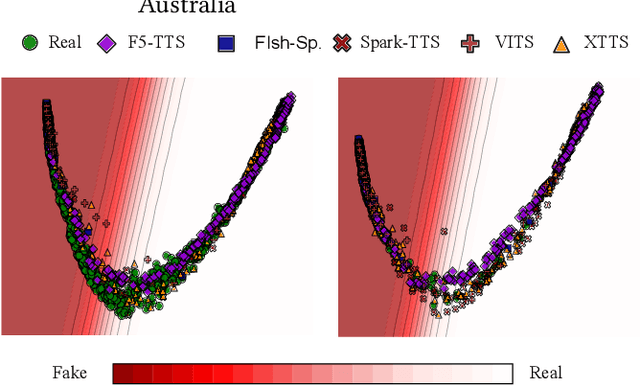
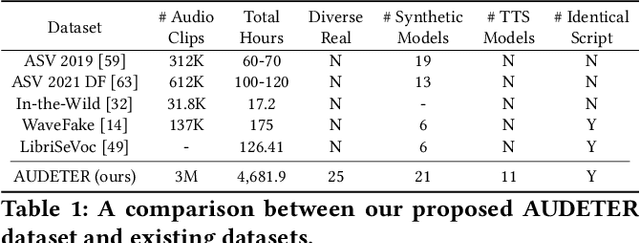
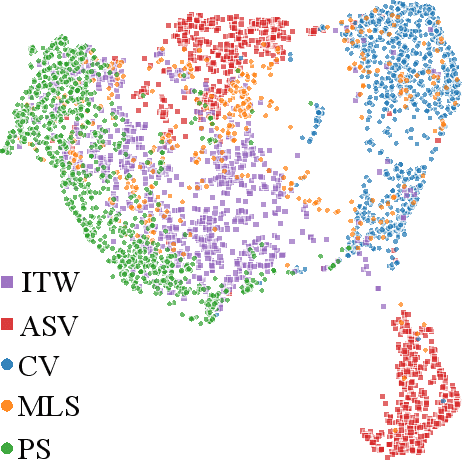
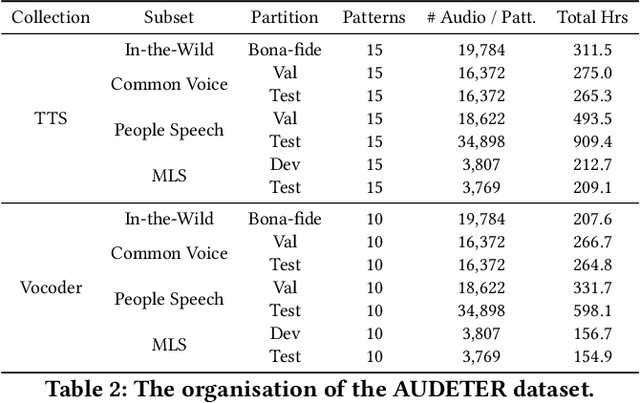
Speech generation systems can produce remarkably realistic vocalisations that are often indistinguishable from human speech, posing significant authenticity challenges. Although numerous deepfake detection methods have been developed, their effectiveness in real-world environments remains unrealiable due to the domain shift between training and test samples arising from diverse human speech and fast evolving speech synthesis systems. This is not adequately addressed by current datasets, which lack real-world application challenges with diverse and up-to-date audios in both real and deep-fake categories. To fill this gap, we introduce AUDETER (AUdio DEepfake TEst Range), a large-scale, highly diverse deepfake audio dataset for comprehensive evaluation and robust development of generalised models for deepfake audio detection. It consists of over 4,500 hours of synthetic audio generated by 11 recent TTS models and 10 vocoders with a broad range of TTS/vocoder patterns, totalling 3 million audio clips, making it the largest deepfake audio dataset by scale. Through extensive experiments with AUDETER, we reveal that i) state-of-the-art (SOTA) methods trained on existing datasets struggle to generalise to novel deepfake audio samples and suffer from high false positive rates on unseen human voice, underscoring the need for a comprehensive dataset; and ii) these methods trained on AUDETER achieve highly generalised detection performance and significantly reduce detection error rate by 44.1% to 51.6%, achieving an error rate of only 4.17% on diverse cross-domain samples in the popular In-the-Wild dataset, paving the way for training generalist deepfake audio detectors. AUDETER is available on GitHub.
EMMM, Explain Me My Model! Explainable Machine Generated Text Detection in Dialogues
Aug 26, 2025The rapid adoption of large language models (LLMs) in customer service introduces new risks, as malicious actors can exploit them to conduct large-scale user impersonation through machine-generated text (MGT). Current MGT detection methods often struggle in online conversational settings, reducing the reliability and interpretability essential for trustworthy AI deployment. In customer service scenarios where operators are typically non-expert users, explanation become crucial for trustworthy MGT detection. In this paper, we propose EMMM, an explanation-then-detection framework that balances latency, accuracy, and non-expert-oriented interpretability. Experimental results demonstrate that EMMM provides explanations accessible to non-expert users, with 70\% of human evaluators preferring its outputs, while achieving competitive accuracy compared to state-of-the-art models and maintaining low latency, generating outputs within 1 second. Our code and dataset are open-sourced at https://github.com/AngieYYF/EMMM-explainable-chatbot-detection.
SPADE: Systematic Prompt Framework for Automated Dialogue Expansion in Machine-Generated Text Detection
Mar 19, 2025The increasing capability of large language models (LLMs) to generate synthetic content has heightened concerns about their misuse, driving the development of Machine-Generated Text (MGT) detection models. However, these detectors face significant challenges due to the lack of systematically generated, high-quality datasets for training. To address this issue, we propose five novel data augmentation frameworks for synthetic user dialogue generation through a structured prompting approach, reducing the costs associated with traditional data collection methods. Our proposed method yields 14 new dialogue datasets, which we benchmark against seven MGT detection models. The results demonstrate improved generalization performance when utilizing a mixed dataset produced by our proposed augmentation framework. Furthermore, considering that real-world agents lack knowledge of future opponent utterances, we simulate online dialogue detection and examine the relationship between chat history length and detection accuracy. We also benchmark online detection performance with limited chat history on our frameworks. Our open-source datasets can be downloaded from https://github.com/AngieYYF/SPADE-customer-service-dialogue.
CURVALID: Geometrically-guided Adversarial Prompt Detection
Mar 05, 2025Adversarial prompts capable of jailbreaking large language models (LLMs) and inducing undesirable behaviours pose a significant obstacle to their safe deployment. Current mitigation strategies rely on activating built-in defence mechanisms or fine-tuning the LLMs, but the fundamental distinctions between adversarial and benign prompts are yet to be understood. In this work, we introduce CurvaLID, a novel defense framework that efficiently detects adversarial prompts by leveraging their geometric properties. It is agnostic to the type of LLM, offering a unified detection framework across diverse adversarial prompts and LLM architectures. CurvaLID builds on the geometric analysis of text prompts to uncover their underlying differences. We theoretically extend the concept of curvature via the Whewell equation into an $n$-dimensional word embedding space, enabling us to quantify local geometric properties, including semantic shifts and curvature in the underlying manifolds. Additionally, we employ Local Intrinsic Dimensionality (LID) to capture geometric features of text prompts within adversarial subspaces. Our findings reveal that adversarial prompts differ fundamentally from benign prompts in terms of their geometric characteristics. Our results demonstrate that CurvaLID delivers superior detection and rejection of adversarial queries, paving the way for safer LLM deployment. The source code can be found at https://github.com/Cancanxxx/CurvaLID