 Add to Chrome
 Add to Firefox
 Add to Edge
When Modalities Fail to Tango: Conformal Backdoor Detection in Multimodal Contrastive Learning
Aug 04, 2026
Backdoor attacks in multimodal contrastive learning (MCL) have garnered growing attention in recent years, as many downstream tasks critically depend on pre-trained MCL models. Existing detection-based defenses predominantly rely on the CLIPScore metric, under the assumption that poisoned pairs exhibit lower semantic similarity between the image and the caption. However, we identify two critical flaws remaining in existing methods: (1) the substantial overlap between CLIPScore distributions of benign and poisoned pairs undermines the reliability of this metric, and (2) fixed-threshold detection cannot provide statistical guarantees for ambiguous samples within overlapping regions. To overcome these limitations, we propose integrating conformal prediction (CP), a statistical framework that quantifies uncertainty through nonconformity scores (NCSs), to establish provable confidence bounds for detecting poisoned image-caption pairs. Building on CP, we introduce CASCADE, a novel two-stage Coarse-to-Fine Conformal Backdoor Detection framework. The coarse-grained stage uses cross-modality consistency to identify high-confidence benign and poisoned pairs. In the fine-grained stage, a reference set is constructed from high-confidence poisoned pairs, and instance-level NCSs based on text-space similarity are computed for each sample in the unidentified subset. These NCSs measure conformity to the poisoning distribution and enable precise identification of latent poisoned pairs within the unidentified subset. Extensive experiments on the large-scale CC3M dataset demonstrate that CASCADE achieves an average FPR of 5.79% at 100% TPR and an average AUROC of 0.9867 across diverse attacks, while remaining effective against adaptive attacks.

SEED: Simple ViT and Evolving Harness for Explainable Text Forgery Detection
Jun 19, 2026AI-assisted image editing threatens trust in financial, legal, and identity records. The GenText-Forensics Challenge at ACM MM 2026 addresses this by requiring structured forensic reports, in which integrating detection, pixel-level localization, and natural language explanation for multilingual text-centric forgery images. We present SEED, a modular system with three components. First, a similarity-guided pipeline augments training with diverse synthetic forgeries. Second, a single ViT, built on DINOv3 with LoRA adaptation, jointly performs detection and pixel-level localization while preserving pre-trained priors with minimal trainable parameters. Third, an evolving harness takes the detector's predictions and generates a complete forensic report via an MLLM, iteratively improved through a proposer-evaluator loop optimizing report quality. SEED ranked 3rd in the GenText-Forensics Challenge. Code and data are available at https://github.com/KahimWong/GenText-Forensics-3rd-Place.
NTIRE 2026 Challenge on Robust AI-Generated Image Detection in the Wild
Apr 13, 2026This paper presents an overview of the NTIRE 2026 Challenge on Robust AI-Generated Image Detection in the Wild, held in conjunction with the NTIRE workshop at CVPR 2026. The goal of this challenge was to develop detection models capable of distinguishing real images from generated ones in realistic scenarios: the images are often transformed (cropped, resized, compressed, blurred) for practical usage, and therefore, the detection models should be robust to such transformations. The challenge is based on a novel dataset consisting of 108,750 real and 185,750 AI-generated images from 42 generators comprising a large variety of open-source and closed-source models of various architectures, augmented with 36 image transformations. Methods were evaluated using ROC AUC on the full test set, including both transformed and untransformed images. A total of 511 participants registered, with 20 teams submitting valid final solutions. This report provides a comprehensive overview of the challenge, describes the proposed solutions, and can be used as a valuable reference for researchers and practitioners in increasing the robustness of the detection models to real-world transformations.
$k$NNProxy: Efficient Training-Free Proxy Alignment for Black-Box Zero-Shot LLM-Generated Text Detection
Apr 02, 2026LLM-generated text (LGT) detection is essential for reliable forensic analysis and for mitigating LLM misuse. Existing LGT detectors can generally be categorized into two broad classes: learning-based approaches and zero-shot methods. Compared with learning-based detectors, zero-shot methods are particularly promising because they eliminate the need to train task-specific classifiers. However, the reliability of zero-shot methods fundamentally relies on the assumption that an off-the-shelf proxy LLM is well aligned with the often unknown source LLM, a premise that rarely holds in real-world black-box scenarios. To address this discrepancy, existing proxy alignment methods typically rely on supervised fine-tuning of the proxy or repeated interactions with commercial APIs, thereby increasing deployment costs, exposing detectors to silent API changes, and limiting robustness under domain shift. Motivated by these limitations, we propose the $k$-nearest neighbor proxy ($k$NNProxy), a training-free and query-efficient proxy alignment framework that repurposes the $k$NN language model ($k$NN-LM) retrieval mechanism as a domain adapter for a fixed proxy LLM. Specifically, a lightweight datastore is constructed once from a target-reflective LGT corpus, either via fixed-budget querying or from existing datasets. During inference, nearest-neighbor evidence induces a token-level predictive distribution that is interpolated with the proxy output, yielding an aligned prediction without proxy fine-tuning or per-token API outputs. To improve robustness under domain shift, we extend $k$NNProxy into a mixture of proxies (MoP) that routes each input to a domain-specific datastore for domain-consistent retrieval. Extensive experiments demonstrate strong detection performance of our method.
FeatDistill: A Feature Distillation Enhanced Multi-Expert Ensemble Framework for Robust AI-generated Image Detection
Mar 23, 2026The rapid iteration and widespread dissemination of deepfake technology have posed severe challenges to information security, making robust and generalizable detection of AI-generated forged images increasingly important. In this paper, we propose FeatDistill, an AI-generated image detection framework that integrates feature distillation with a multi-expert ensemble, developed for the NTIRE Challenge on Robust AI-Generated Image Detection in the Wild. The framework explicitly targets three practical bottlenecks in real-world forensics: degradation interference, insufficient feature representation, and limited generalization. Concretely, we build a four-backbone Vision Transformer (ViT) ensemble composed of CLIP and SigLIP variants to capture complementary forensic cues. To improve data coverage, we expand the training set and introduce comprehensive degradation modeling, which exposes the detector to diverse quality variations and synthesis artifacts commonly encountered in unconstrained scenarios. We further adopt a two-stage training paradigm: the model is first optimized with a standard binary classification objective, then refined by dense feature-level self-distillation for representation alignment. This design effectively mitigates overfitting and enhances semantic consistency of learned features. At inference time, the final prediction is obtained by averaging the probabilities from four independently trained experts, yielding stable and reliable decisions across unseen generators and complex degradations. Despite the ensemble design, the framework remains efficient, requiring only about 10 GB peak GPU memory. Extensive evaluations in the NTIRE challenge setting demonstrate that FeatDistill achieves strong robustness and generalization under diverse ``in-the-wild'' conditions, offering an effective and practical solution for real-world deepfake image detection.
AEGIS: Adversarial Target-Guided Retention-Data-Free Robust Concept Erasure from Diffusion Models
Feb 06, 2026Concept erasure helps stop diffusion models (DMs) from generating harmful content; but current methods face robustness retention trade off. Robustness means the model fine-tuned by concept erasure methods resists reactivation of erased concepts, even under semantically related prompts. Retention means unrelated concepts are preserved so the model's overall utility stays intact. Both are critical for concept erasure in practice, yet addressing them simultaneously is challenging, as existing works typically improve one factor while sacrificing the other. Prior work typically strengthens one while degrading the other, e.g., mapping a single erased prompt to a fixed safe target leaves class level remnants exploitable by prompt attacks, whereas retention-oriented schemes underperform against adaptive adversaries. This paper introduces Adversarial Erasure with Gradient Informed Synergy (AEGIS), a retention-data-free framework that advances both robustness and retention.
* 30 pages,12 figures
FontGuard: A Robust Font Watermarking Approach Leveraging Deep Font Knowledge
Apr 04, 2025The proliferation of AI-generated content brings significant concerns on the forensic and security issues such as source tracing, copyright protection, etc, highlighting the need for effective watermarking technologies. Font-based text watermarking has emerged as an effective solution to embed information, which could ensure copyright, traceability, and compliance of the generated text content. Existing font watermarking methods usually neglect essential font knowledge, which leads to watermarked fonts of low quality and limited embedding capacity. These methods are also vulnerable to real-world distortions, low-resolution fonts, and inaccurate character segmentation. In this paper, we introduce FontGuard, a novel font watermarking model that harnesses the capabilities of font models and language-guided contrastive learning. Unlike previous methods that focus solely on the pixel-level alteration, FontGuard modifies fonts by altering hidden style features, resulting in better font quality upon watermark embedding. We also leverage the font manifold to increase the embedding capacity of our proposed method by generating substantial font variants closely resembling the original font. Furthermore, in the decoder, we employ an image-text contrastive learning to reconstruct the embedded bits, which can achieve desirable robustness against various real-world transmission distortions. FontGuard outperforms state-of-the-art methods by +5.4%, +7.4%, and +5.8% in decoding accuracy under synthetic, cross-media, and online social network distortions, respectively, while improving the visual quality by 52.7% in terms of LPIPS. Moreover, FontGuard uniquely allows the generation of watermarked fonts for unseen fonts without re-training the network. The code and dataset are available at https://github.com/KAHIMWONG/FontGuard.
DAT: Improving Adversarial Robustness via Generative Amplitude Mix-up in Frequency Domain
Oct 16, 2024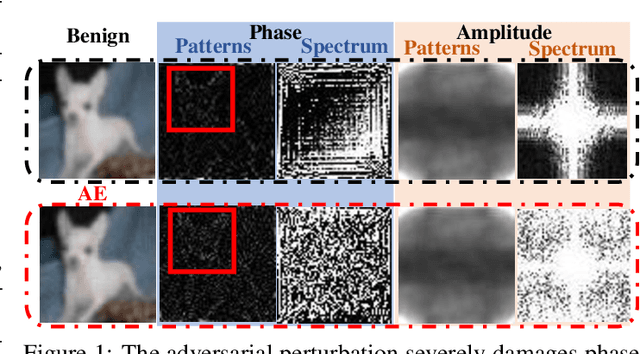

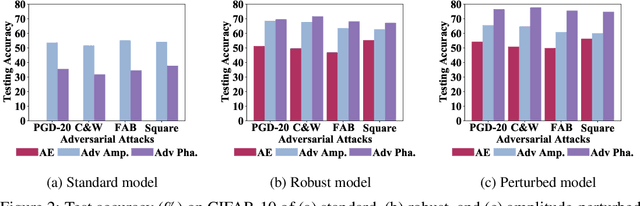
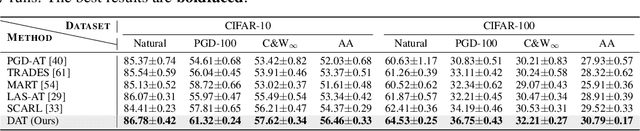
To protect deep neural networks (DNNs) from adversarial attacks, adversarial training (AT) is developed by incorporating adversarial examples (AEs) into model training. Recent studies show that adversarial attacks disproportionately impact the patterns within the phase of the sample's frequency spectrum -- typically containing crucial semantic information -- more than those in the amplitude, resulting in the model's erroneous categorization of AEs. We find that, by mixing the amplitude of training samples' frequency spectrum with those of distractor images for AT, the model can be guided to focus on phase patterns unaffected by adversarial perturbations. As a result, the model's robustness can be improved. Unfortunately, it is still challenging to select appropriate distractor images, which should mix the amplitude without affecting the phase patterns. To this end, in this paper, we propose an optimized Adversarial Amplitude Generator (AAG) to achieve a better tradeoff between improving the model's robustness and retaining phase patterns. Based on this generator, together with an efficient AE production procedure, we design a new Dual Adversarial Training (DAT) strategy. Experiments on various datasets show that our proposed DAT leads to significantly improved robustness against diverse adversarial attacks.
Regroup Median Loss for Combating Label Noise
Dec 11, 2023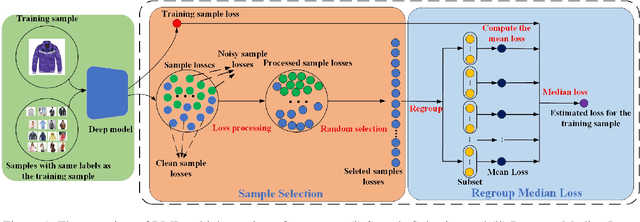

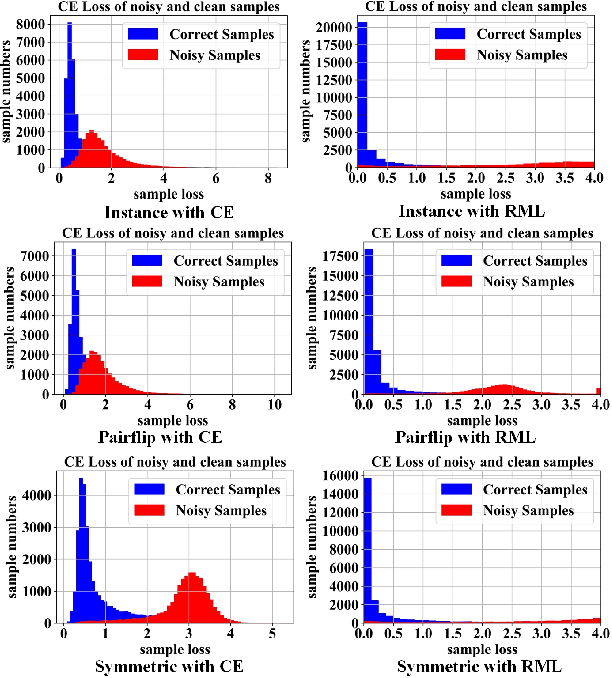

The deep model training procedure requires large-scale datasets of annotated data. Due to the difficulty of annotating a large number of samples, label noise caused by incorrect annotations is inevitable, resulting in low model performance and poor model generalization. To combat label noise, current methods usually select clean samples based on the small-loss criterion and use these samples for training. Due to some noisy samples similar to clean ones, these small-loss criterion-based methods are still affected by label noise. To address this issue, in this work, we propose Regroup Median Loss (RML) to reduce the probability of selecting noisy samples and correct losses of noisy samples. RML randomly selects samples with the same label as the training samples based on a new loss processing method. Then, we combine the stable mean loss and the robust median loss through a proposed regrouping strategy to obtain robust loss estimation for noisy samples. To further improve the model performance against label noise, we propose a new sample selection strategy and build a semi-supervised method based on RML. Compared to state-of-the-art methods, for both the traditionally trained and semi-supervised models, RML achieves a significant improvement on synthetic and complex real-world datasets. The source code of the paper has been released.