 Add to Chrome
 Add to Firefox
 Add to Edge
Enabling Ultra-Fast Cardiovascular Imaging Across Heterogeneous Clinical Environments with a Generalist Foundation Model and Multimodal Database
Dec 25, 2025
Multimodal cardiovascular magnetic resonance (CMR) imaging provides comprehensive and non-invasive insights into cardiovascular disease (CVD) diagnosis and underlying mechanisms. Despite decades of advancements, its widespread clinical adoption remains constrained by prolonged scan times and heterogeneity across medical environments. This underscores the urgent need for a generalist reconstruction foundation model for ultra-fast CMR imaging, one capable of adapting across diverse imaging scenarios and serving as the essential substrate for all downstream analyses. To enable this goal, we curate MMCMR-427K, the largest and most comprehensive multimodal CMR k-space database to date, comprising 427,465 multi-coil k-space data paired with structured metadata across 13 international centers, 12 CMR modalities, 15 scanners, and 17 CVD categories in populations across three continents. Building on this unprecedented resource, we introduce CardioMM, a generalist reconstruction foundation model capable of dynamically adapting to heterogeneous fast CMR imaging scenarios. CardioMM unifies semantic contextual understanding with physics-informed data consistency to deliver robust reconstructions across varied scanners, protocols, and patient presentations. Comprehensive evaluations demonstrate that CardioMM achieves state-of-the-art performance in the internal centers and exhibits strong zero-shot generalization to unseen external settings. Even at imaging acceleration up to 24x, CardioMM reliably preserves key cardiac phenotypes, quantitative myocardial biomarkers, and diagnostic image quality, enabling a substantial increase in CMR examination throughput without compromising clinical integrity. Together, our open-access MMCMR-427K database and CardioMM framework establish a scalable pathway toward high-throughput, high-quality, and clinically accessible cardiovascular imaging.

Adaptive Radar Detection and Bearing Estimation in the Presence of Unknown Mutual Coupling
Dec 08, 2022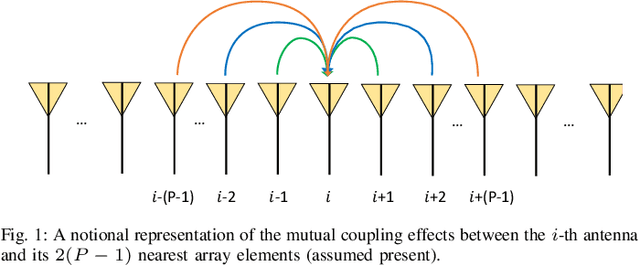
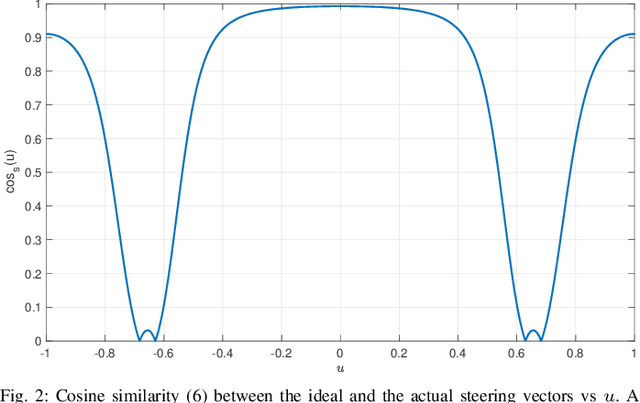
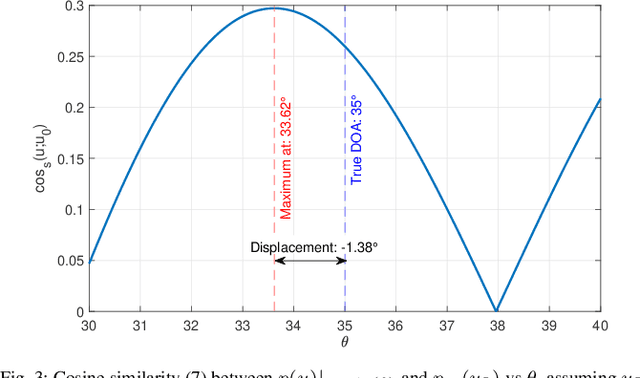
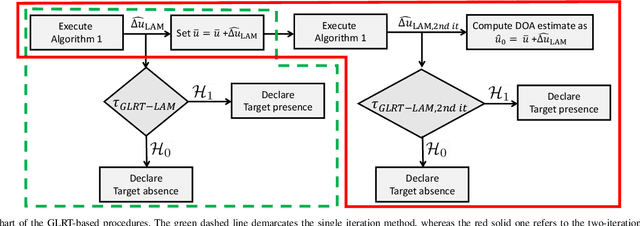
This paper deals with joint adaptive radar detection and target bearing estimation in the presence of mutual coupling among the array elements. First of all, a suitable model of the signal received by the multichannel radar is developed via a linearization procedure of the Uniform Linear Array (ULA) manifold around the nominal array looking direction together with the use of symmetric Toeplitz structured matrices to represent the mutual coupling effects. Hence, the Generalized Likelihood Ratio Test (GLRT) detector is evaluated under the assumption of homogeneous radar environment. Its computation leverages a specific Minorization-Maximization (MM) framework, with proven convergence properties, to optimize the concentrated likelihood function under the target presence hypothesis. Besides, when the number of active mutual coupling coefficients is unknown, a Multifamily Likelihood Ratio Test (MFLRT) approach is invoked. During the analysis phase, the performance of the new detectors is compared with benchmarks as well as with counterparts available in the open literature which neglect the mutual coupling phenomenon. The results indicate that it is necessary to consider judiciously the coupling effect since the design phase, to guarantee performance levels close to the benchmark.