 Add to Chrome
 Add to Firefox
 Add to Edge
ClockRoPE: Random Fourier Rotations for Temporal Routine Modeling
Jul 29, 2026
Rotary Position Embedding (RoPE) has been widely adopted in transformer-based large language models. However, its log-linear frequency schedule, originally designed to produce long-term attention decay, limits its adoption in domains with more complex distance-correlation patterns, such as temporal periodicity in sequential recommendation. We investigate the expressiveness of general query/key rotations and find that any normalized continuous positive-definite attention modulation function can be approximated by random rotations induced by its own Fourier transform, which we term Random Fourier Rotations. Building on this theory, we propose ClockRoPE for routine modeling in sequential recommendation, where rotation frequencies are derived from periodic attention modulation functions. In online A/B tests, ClockRoPE demonstrates consistent improvements in valued engagement metrics, and has been successfully deployed in production-scale generative retrieval system at a major video-sharing platform.

RMISC: A Large-scale Real-world Multivariate Corpus for Time Series Foundation Models
Jul 07, 2026Recent years have witnessed the emergence of multivariate modeling using time series foundation models (TSFMs), which achieve advanced zero-shot generalization. Modern multivariate TSFMs are predominantly pretrained on multivariate synthetic data, which is easier to scale but may fail to capture the complex temporal dynamics and cross-variable relationships present in real-world time series. This raises a key question: Whether and to what extent the leading TSFMs trained with the real-world corpus perform better than those trained with synthetic data? To answer this, we establish the RMISC corpus, a considerably large-scale, high-quality, openly accessible, real-world, and multivariate time series archive that contains around 200 datasets and 142 billion time points across diverse domains. Furthermore, we pretrain four advanced TSFMs on univariate, synthetic multivariate, and real-world multivariate data and evaluate their zero-shot generalization capabilities on standard in-distribution and out-of-distribution benchmarks. Experimental results show that incorporating real-world multivariate data predominantly improves the generalization performance for both univariate and multivariate TSFMs. These results provide a deeper understanding of how real-world multivariate data contributes to the development of stronger TSFMs.
TP-Spikformer: Token Pruned Spiking Transformer
Feb 28, 2026Spiking neural networks (SNNs) offer an energy-efficient alternative to traditional neural networks due to their event-driven computing paradigm. However, recent advancements in spiking transformers have focused on improving accuracy with large-scale architectures, which require significant computational resources and limit deployment on resource-constrained devices. In this paper, we propose a simple yet effective token pruning method for spiking transformers, termed TP-Spikformer, that reduces storage and computational overhead while maintaining competitive performance. Specifically, we first introduce a heuristic spatiotemporal information-retaining criterion that comprehensively evaluates tokens' importance, assigning higher scores to informative tokens for retention and lower scores to uninformative ones for pruning. Based on this criterion, we propose an information-retaining token pruning framework that employs a block-level early stopping strategy for uninformative tokens, instead of removing them outright. This also helps preserve more information during token pruning. We demonstrate the effectiveness, efficiency and scalability of TP-Spikformer through extensive experiments across diverse architectures, including Spikformer, QKFormer and Spike-driven Transformer V1 and V3, and a range of tasks such as image classification, object detection, semantic segmentation and event-based object tracking. Particularly, TP-Spikformer performs well in a training-free manner. These results reveal its potential as an efficient and practical solution for deploying SNNs in real-world applications with limited computational resources.
The Llama 4 Herd: Architecture, Training, Evaluation, and Deployment Notes
Jan 15, 2026This document consolidates publicly reported technical details about Metas Llama 4 model family. It summarizes (i) released variants (Scout and Maverick) and the broader herd context including the previewed Behemoth teacher model, (ii) architectural characteristics beyond a high-level MoE description covering routed/shared-expert structure, early-fusion multimodality, and long-context design elements reported for Scout (iRoPE and length generalization strategies), (iii) training disclosures spanning pre-training, mid-training for long-context extension, and post-training methodology (lightweight SFT, online RL, and lightweight DPO) as described in release materials, (iv) developer-reported benchmark results for both base and instruction-tuned checkpoints, and (v) practical deployment constraints observed across major serving environments, including provider-specific context limits and quantization packaging. The manuscript also summarizes licensing obligations relevant to redistribution and derivative naming, and reviews publicly described safeguards and evaluation practices. The goal is to provide a compact technical reference for researchers and practitioners who need precise, source-backed facts about Llama 4.
Training-Free ANN-to-SNN Conversion for High-Performance Spiking Transformer
Aug 11, 2025Leveraging the event-driven paradigm, Spiking Neural Networks (SNNs) offer a promising approach for constructing energy-efficient Transformer architectures. Compared to directly trained Spiking Transformers, ANN-to-SNN conversion methods bypass the high training costs. However, existing methods still suffer from notable limitations, failing to effectively handle nonlinear operations in Transformer architectures and requiring additional fine-tuning processes for pre-trained ANNs. To address these issues, we propose a high-performance and training-free ANN-to-SNN conversion framework tailored for Transformer architectures. Specifically, we introduce a Multi-basis Exponential Decay (MBE) neuron, which employs an exponential decay strategy and multi-basis encoding method to efficiently approximate various nonlinear operations. It removes the requirement for weight modifications in pre-trained ANNs. Extensive experiments across diverse tasks (CV, NLU, NLG) and mainstream Transformer architectures (ViT, RoBERTa, GPT-2) demonstrate that our method achieves near-lossless conversion accuracy with significantly lower latency. This provides a promising pathway for the efficient and scalable deployment of Spiking Transformers in real-world applications.
Spiking Vision Transformer with Saccadic Attention
Feb 18, 2025
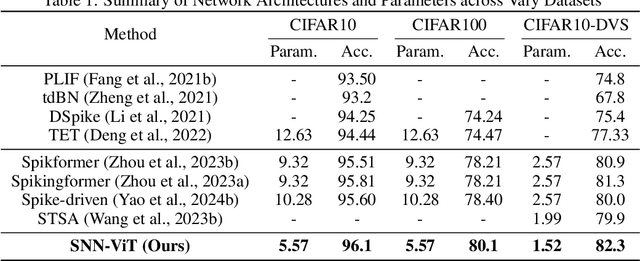
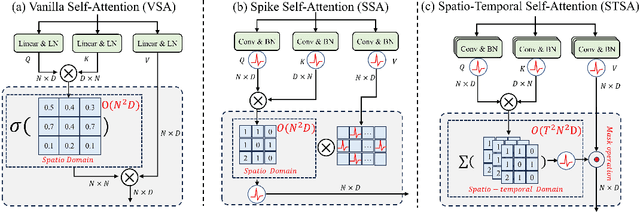
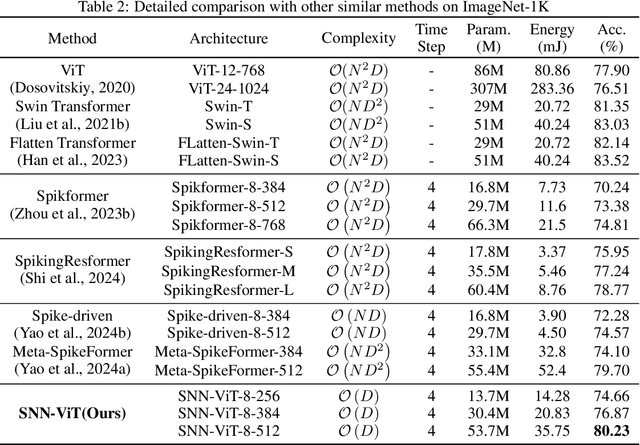
The combination of Spiking Neural Networks (SNNs) and Vision Transformers (ViTs) holds potential for achieving both energy efficiency and high performance, particularly suitable for edge vision applications. However, a significant performance gap still exists between SNN-based ViTs and their ANN counterparts. Here, we first analyze why SNN-based ViTs suffer from limited performance and identify a mismatch between the vanilla self-attention mechanism and spatio-temporal spike trains. This mismatch results in degraded spatial relevance and limited temporal interactions. To address these issues, we draw inspiration from biological saccadic attention mechanisms and introduce an innovative Saccadic Spike Self-Attention (SSSA) method. Specifically, in the spatial domain, SSSA employs a novel spike distribution-based method to effectively assess the relevance between Query and Key pairs in SNN-based ViTs. Temporally, SSSA employs a saccadic interaction module that dynamically focuses on selected visual areas at each timestep and significantly enhances whole scene understanding through temporal interactions. Building on the SSSA mechanism, we develop a SNN-based Vision Transformer (SNN-ViT). Extensive experiments across various visual tasks demonstrate that SNN-ViT achieves state-of-the-art performance with linear computational complexity. The effectiveness and efficiency of the SNN-ViT highlight its potential for power-critical edge vision applications.
On Active Privacy Auditing in Supervised Fine-tuning for White-Box Language Models
Nov 12, 2024
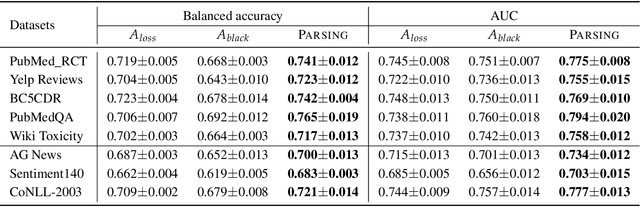
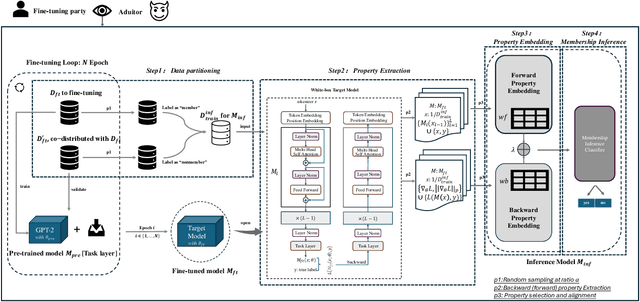
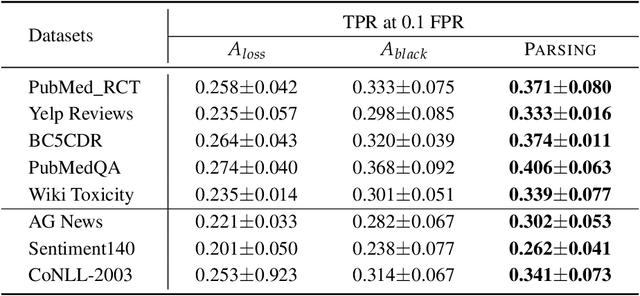
The pretraining and fine-tuning approach has become the leading technique for various NLP applications. However, recent studies reveal that fine-tuning data, due to their sensitive nature, domain-specific characteristics, and identifiability, pose significant privacy concerns. To help develop more privacy-resilient fine-tuning models, we introduce a novel active privacy auditing framework, dubbed Parsing, designed to identify and quantify privacy leakage risks during the supervised fine-tuning (SFT) of language models (LMs). The framework leverages improved white-box membership inference attacks (MIAs) as the core technology, utilizing novel learning objectives and a two-stage pipeline to monitor the privacy of the LMs' fine-tuning process, maximizing the exposure of privacy risks. Additionally, we have improved the effectiveness of MIAs on large LMs including GPT-2, Llama2, and certain variants of them. Our research aims to provide the SFT community of LMs with a reliable, ready-to-use privacy auditing tool, and to offer valuable insights into safeguarding privacy during the fine-tuning process. Experimental results confirm the framework's efficiency across various models and tasks, emphasizing notable privacy concerns in the fine-tuning process. Project code available for https://anonymous.4open.science/r/PARSING-4817/.
Horizon-wise Learning Paradigm Promotes Gene Splicing Identification
Jun 15, 2024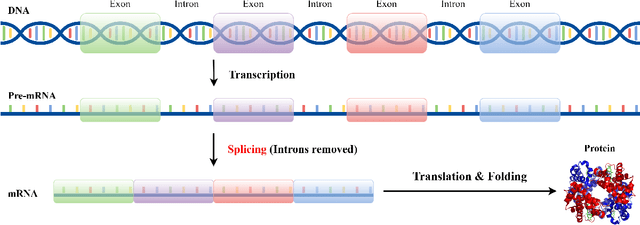
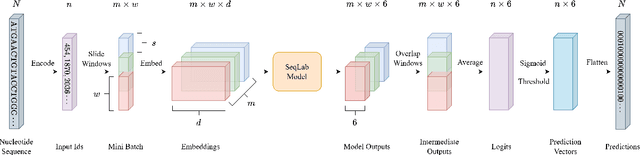
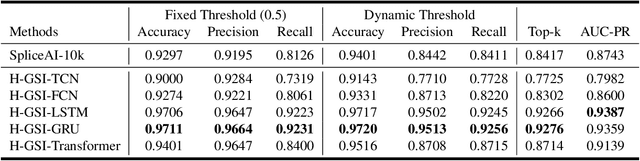
Identifying gene splicing is a core and significant task confronted in modern collaboration between artificial intelligence and bioinformatics. Past decades have witnessed great efforts on this concern, such as the bio-plausible splicing pattern AT-CG and the famous SpliceAI. In this paper, we propose a novel framework for the task of gene splicing identification, named Horizon-wise Gene Splicing Identification (H-GSI). The proposed H-GSI follows the horizon-wise identification paradigm and comprises four components: the pre-processing procedure transforming string data into tensors, the sliding window technique handling long sequences, the SeqLab model, and the predictor. In contrast to existing studies that process gene information with a truncated fixed-length sequence, H-GSI employs a horizon-wise identification paradigm in which all positions in a sequence are predicted with only one forward computation, improving accuracy and efficiency. The experiments conducted on the real-world Human dataset show that our proposed H-GSI outperforms SpliceAI and achieves the best accuracy of 97.20\%. The source code is available from this link.
Semi-Weakly Supervised Object Kinematic Motion Prediction
Apr 03, 2023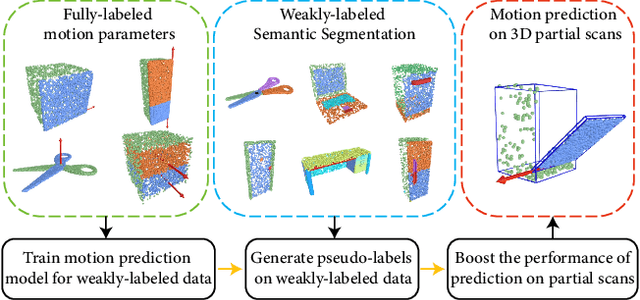
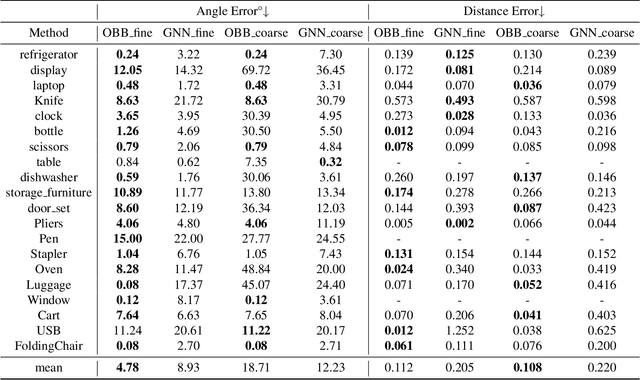
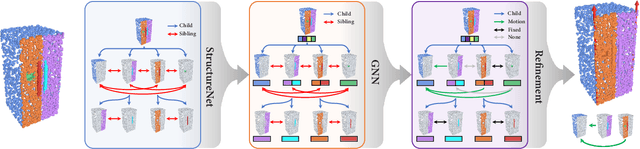
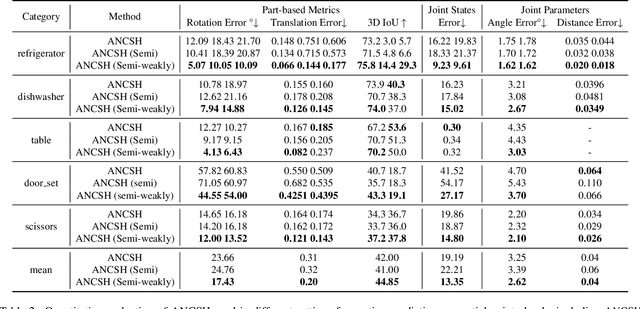
Given a 3D object, kinematic motion prediction aims to identify the mobile parts as well as the corresponding motion parameters. Due to the large variations in both topological structure and geometric details of 3D objects, this remains a challenging task and the lack of large scale labeled data also constrain the performance of deep learning based approaches. In this paper, we tackle the task of object kinematic motion prediction problem in a semi-weakly supervised manner. Our key observations are two-fold. First, although 3D dataset with fully annotated motion labels is limited, there are existing datasets and methods for object part semantic segmentation at large scale. Second, semantic part segmentation and mobile part segmentation is not always consistent but it is possible to detect the mobile parts from the underlying 3D structure. Towards this end, we propose a graph neural network to learn the map between hierarchical part-level segmentation and mobile parts parameters, which are further refined based on geometric alignment. This network can be first trained on PartNet-Mobility dataset with fully labeled mobility information and then applied on PartNet dataset with fine-grained and hierarchical part-level segmentation. The network predictions yield a large scale of 3D objects with pseudo labeled mobility information and can further be used for weakly-supervised learning with pre-existing segmentation. Our experiments show there are significant performance boosts with the augmented data for previous method designed for kinematic motion prediction on 3D partial scans.
Search By Image: Deeply Exploring Beneficial Features for Beauty Product Retrieval
Mar 24, 2023Searching by image is popular yet still challenging due to the extensive interference arose from i) data variations (e.g., background, pose, visual angle, brightness) of real-world captured images and ii) similar images in the query dataset. This paper studies a practically meaningful problem of beauty product retrieval (BPR) by neural networks. We broadly extract different types of image features, and raise an intriguing question that whether these features are beneficial to i) suppress data variations of real-world captured images, and ii) distinguish one image from others which look very similar but are intrinsically different beauty products in the dataset, therefore leading to an enhanced capability of BPR. To answer it, we present a novel variable-attention neural network to understand the combination of multiple features (termed VM-Net) of beauty product images. Considering that there are few publicly released training datasets for BPR, we establish a new dataset with more than one million images classified into more than 20K categories to improve both the generalization and anti-interference abilities of VM-Net and other methods. We verify the performance of VM-Net and its competitors on the benchmark dataset Perfect-500K, where VM-Net shows clear improvements over the competitors in terms of MAP@7. The source code and dataset will be released upon publication.