 Add to Chrome
 Add to Firefox
 Add to Edge
CutVerse: A Compositional GUI Agents Benchmark for Media Post-Production Editing
May 19, 2026
While GUI agents have made significant progress in web navigation and basic operating system tasks, their capabilities in professional creative workflows remain largely underexplored. To bridge this gap, we introduce Cutverse, a benchmark designed to systematically evaluate autonomous GUI agents in realistic media post-production environments. We curate expert demonstrations across 7 professional applications (e.g., Premiere Pro, Photoshop), covering 186 complex, long-horizon tasks grounded in authentic editing workflows, involving dense multimodal interfaces and tightly coupled interaction sequences. To support scalable evaluation, we develop a lightweight parser that transforms raw screen recordings and low-level interaction logs into structured, compositional GUI action trajectories with precise grounding. Extensive evaluations reveal that existing agents achieve only 36.0\% task success on realistic media editing tasks, underscoring the challenges posed by complex, long-horizon media post-production workflows in our benchmark.While current models demonstrate promising spatial grounding, multimodal alignment, and coordinated action execution, they remain limited in long-horizon reliability and domain-specific planning.

Camera Artist: A Multi-Agent Framework for Cinematic Language Storytelling Video Generation
Apr 10, 2026We propose Camera Artist, a multi-agent framework that models a real-world filmmaking workflow to generate narrative videos with explicit cinematic language. While recent multi-agent systems have made substantial progress in automating filmmaking workflows from scripts to videos, they often lack explicit mechanisms to structure narrative progression across adjacent shots and deliberate use of cinematic language, resulting in fragmented storytelling and limited filmic quality. To address this, Camera Artist builds upon established agentic pipelines and introduces a dedicated Cinematography Shot Agent, which integrates recursive storyboard generation to strengthen shot-to-shot narrative continuity and cinematic language injection to produce more expressive, film-oriented shot designs. Extensive quantitative and qualitative results demonstrate that our approach consistently outperforms existing baselines in narrative consistency, dynamic expressiveness, and perceived film quality.
EmoAgent: Multi-Agent Collaboration of Plan, Edit, and Critic, for Affective Image Manipulation
Mar 14, 2025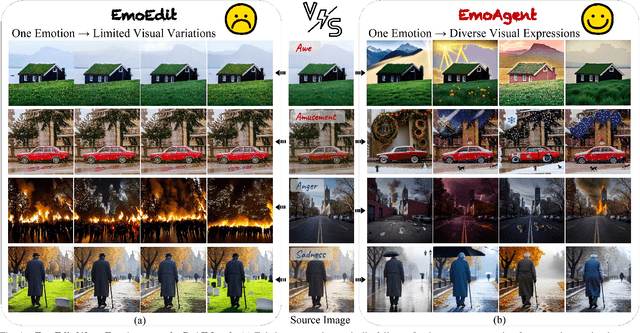
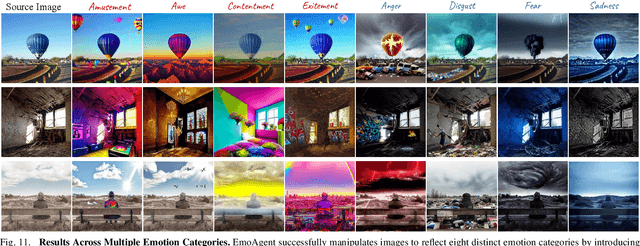
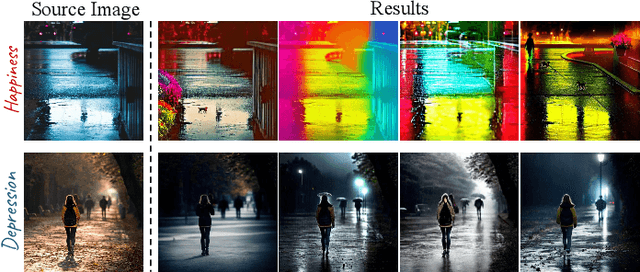
Affective Image Manipulation (AIM) aims to alter an image's emotional impact by adjusting multiple visual elements to evoke specific feelings.Effective AIM is inherently complex, necessitating a collaborative approach that involves identifying semantic cues within source images, manipulating these elements to elicit desired emotional responses, and verifying that the combined adjustments successfully evoke the target emotion.To address these challenges, we introduce EmoAgent, the first multi-agent collaboration framework for AIM. By emulating the cognitive behaviors of a human painter, EmoAgent incorporates three specialized agents responsible for planning, editing, and critical evaluation. Furthermore, we develop an emotion-factor knowledge retriever, a decision-making tree space, and a tool library to enhance EmoAgent's effectiveness in handling AIM. Experiments demonstrate that the proposed multi-agent framework outperforms existing methods, offering more reasonable and effective emotional expression.