 Add to Chrome
 Add to Firefox
 Add to Edge
Sedentary Behavior Classification for Wearable Sensors with a CNN-BiLSTM Model
Aug 03, 2026
Accurate detection of sedentary behavior is important for studying health risks related to prolonged sitting, but posture-based classification remains challenging with wearable sensors, especially at the wrist. We study whether a deep learning model trained on hip-worn accelerometer data can transfer to wrist-worn accelerometer data for sitting versus non-sitting classification. We use CHAP, a CNN-BiLSTM model originally developed for hip accelerometers, and evaluate its zero-shot performance on wrist data as well as its adaptation through finetuning with varying amounts of labeled wrist data. Experiments are conducted on the iWatch dataset with ground-truth posture labels derived from wearable cameras. The hip-trained model performs strongly on hip data without retraining, but accuracy drops on wrist data due to sensor placement shift. Finetuning CHAP provides consistent advantages over transformer models trained from scratch. These findings suggest that hip-based pretraining provides a useful starting point for wrist deployment, while highlighting the need for wrist-specific adaptation to handle higher signal variability.

Hidden Decoding at Scale: Latent Computation Scaling for Large Language Models
Jul 09, 2026Scaling Large Language Models (LLMs) has been driven mainly by enlarging the Transformer backbone, but for an already-strong model this requires another round of costly pretraining. We study whether an existing backbone can keep improving by allocating more computation to each token while leaving the Transformer backbone fixed. Depth-recurrent (looped) Transformers pursue this goal but are hard to scale, because looped computation does not fit naturally with the pipeline parallelism used to train the largest models. We add computation along the sequence-length dimension, where the extra computation is simply a longer input and stays compatible with standard large-model training. We propose Hidden Decoding, a sequence-length scaling method applied during continued pretraining (CPT). It expands each token into n streams with independent embedding tables and keeps the intermediate streams' key-value cache as context, so each token performs more internal computation without adding or widening Transformer layers. To keep this affordable at scale, we introduce Stream-Factorized Attention, in which most layers attend only within each stream and only a few layers mix across streams, reducing the attention cost from quadratic to roughly linear in n. Experiments support two scaling results. At frontier scale, we train WeLM-HD4-80B and WeLM-HD4-617B at n=4 and improve their matched non-HD baselines, making Hidden Decoding the first demonstrated sequence-length scaling method at the 100B+ MoE scale. Across expansion factors, the gains grow as n increases, showing that sequence-length expansion is a practical fixed-backbone scaling path for frontier-scale LLMs.
Mirror contrastive loss based sliding window transformer for subject-independent motor imagery based EEG signal recognition
Aug 29, 2024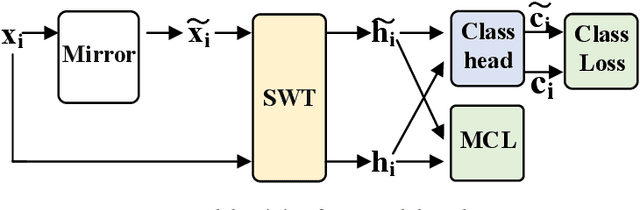
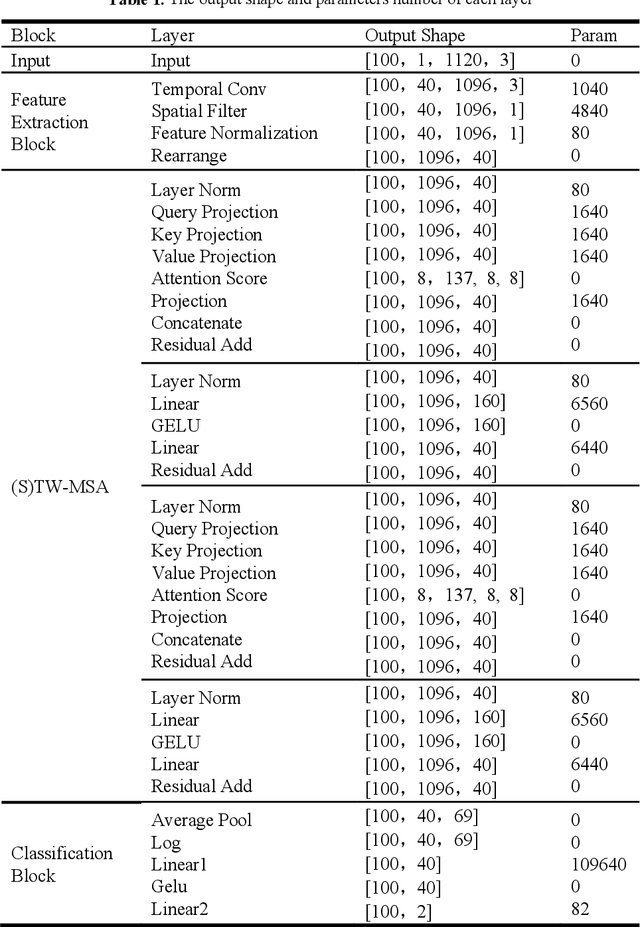
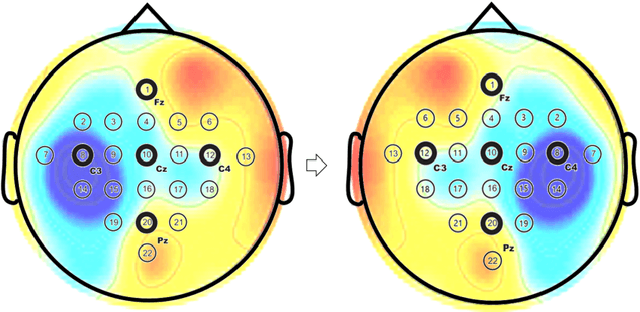
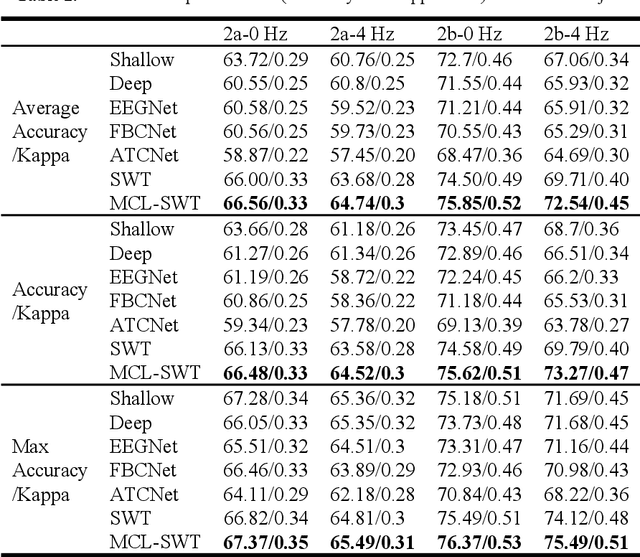
While deep learning models have been extensively utilized in motor imagery based EEG signal recognition, they often operate as black boxes. Motivated by neurological findings indicating that the mental imagery of left or right-hand movement induces event-related desynchronization (ERD) in the contralateral sensorimotor area of the brain, we propose a Mirror Contrastive Loss based Sliding Window Transformer (MCL-SWT) to enhance subject-independent motor imagery-based EEG signal recognition. Specifically, our proposed mirror contrastive loss enhances sensitivity to the spatial location of ERD by contrasting the original EEG signals with their mirror counterparts-mirror EEG signals generated by interchanging the channels of the left and right hemispheres of the EEG signals. Moreover, we introduce a temporal sliding window transformer that computes self-attention scores from high temporal resolution features, thereby improving model performance with manageable computational complexity. We evaluate the performance of MCL-SWT on subject-independent motor imagery EEG signal recognition tasks, and our experimental results demonstrate that MCL-SWT achieved accuracies of 66.48% and 75.62%, surpassing the state-of-the-art (SOTA) model by 2.82% and 2.17%, respectively. Furthermore, ablation experiments confirm the effectiveness of the proposed mirror contrastive loss. A code demo of MCL-SWT is available at https://github.com/roniusLuo/MCL_SWT.
Deep Feature Learning via Structured Graph Laplacian Embedding for Person Re-Identification
Jul 25, 2017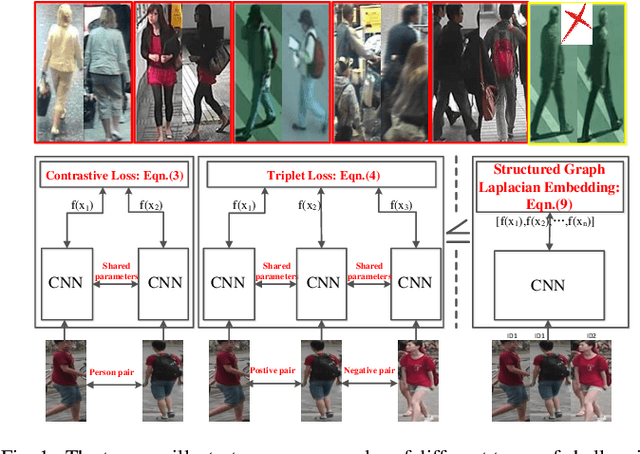

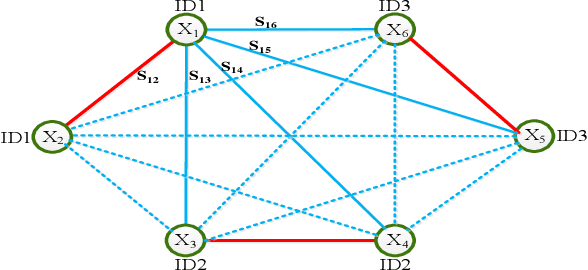
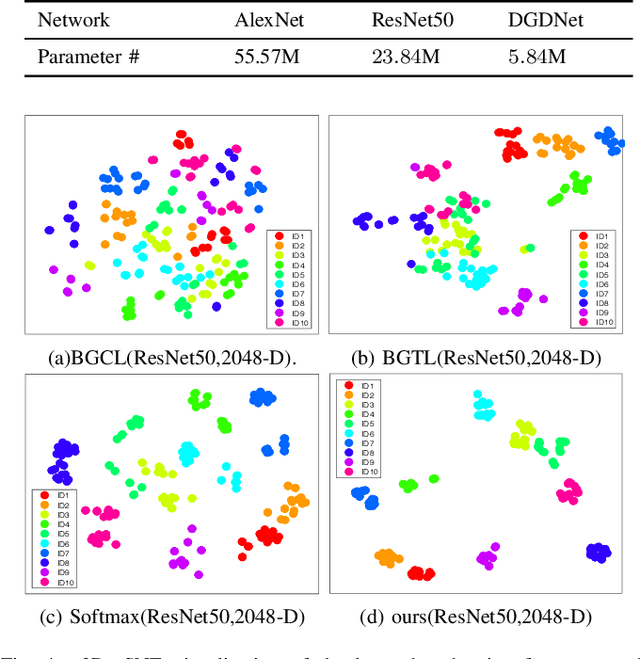
Learning the distance metric between pairs of examples is of great importance for visual recognition, especially for person re-identification (Re-Id). Recently, the contrastive and triplet loss are proposed to enhance the discriminative power of the deeply learned features, and have achieved remarkable success. As can be seen, either the contrastive or triplet loss is just one special case of the Euclidean distance relationships among these training samples. Therefore, we propose a structured graph Laplacian embedding algorithm, which can formulate all these structured distance relationships into the graph Laplacian form. The proposed method can take full advantages of the structured distance relationships among these training samples, with the constructed complete graph. Besides, this formulation makes our method easy-to-implement and super-effective. When embedding the proposed algorithm with the softmax loss for the CNN training, our method can obtain much more robust and discriminative deep features with inter-personal dispersion and intra-personal compactness, which is essential to person Re-Id. We illustrate the effectiveness of our proposed method on top of three popular networks, namely AlexNet, DGDNet and ResNet50, on recent four widely used Re-Id benchmark datasets. Our proposed method achieves state-of-the-art performances.