 Add to Chrome
 Add to Firefox
 Add to Edge
OrthoReg: Improving Graph-regularized MLPs via Orthogonality Regularization
Jan 31, 2023
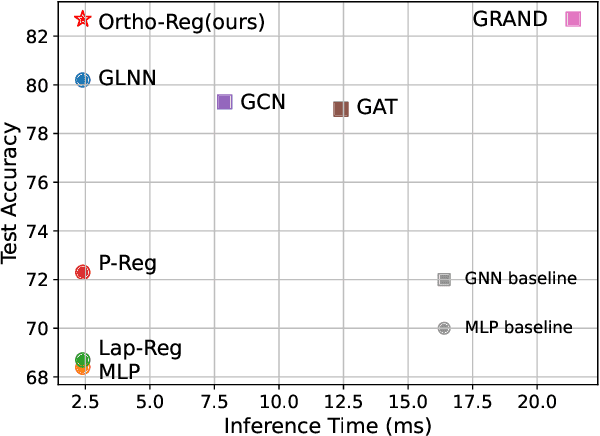
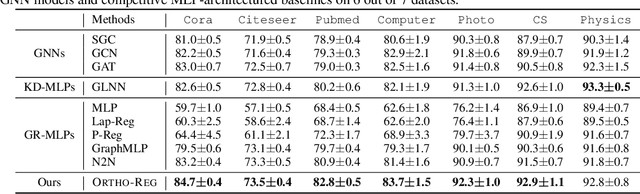
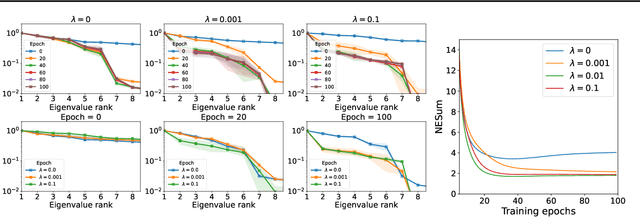

Graph Neural Networks (GNNs) are currently dominating in modeling graph-structure data, while their high reliance on graph structure for inference significantly impedes them from widespread applications. By contrast, Graph-regularized MLPs (GR-MLPs) implicitly inject the graph structure information into model weights, while their performance can hardly match that of GNNs in most tasks. This motivates us to study the causes of the limited performance of GR-MLPs. In this paper, we first demonstrate that node embeddings learned from conventional GR-MLPs suffer from dimensional collapse, a phenomenon in which the largest a few eigenvalues dominate the embedding space, through empirical observations and theoretical analysis. As a result, the expressive power of the learned node representations is constrained. We further propose OrthoReg, a novel GR-MLP model to mitigate the dimensional collapse issue. Through a soft regularization loss on the correlation matrix of node embeddings, OrthoReg explicitly encourages orthogonal node representations and thus can naturally avoid dimensionally collapsed representations. Experiments on traditional transductive semi-supervised classification tasks and inductive node classification for cold-start scenarios demonstrate its effectiveness and superiority.

Provable Unrestricted Adversarial Training without Compromise with Generalizability
Jan 22, 2023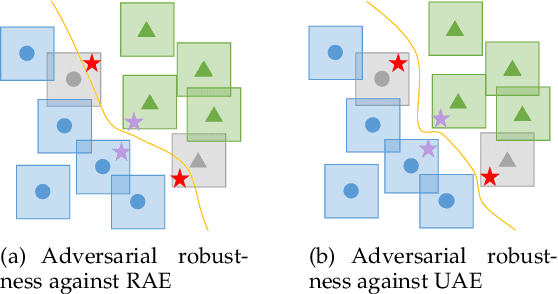
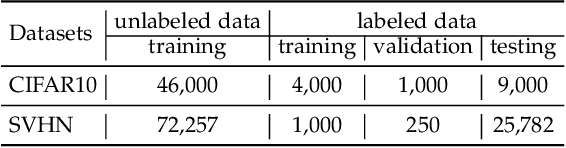
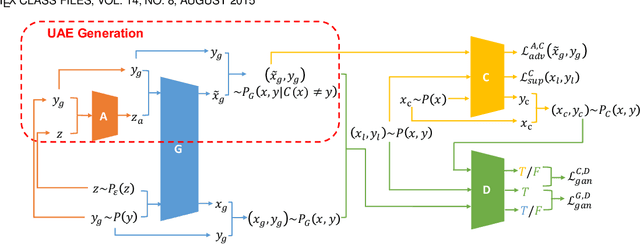
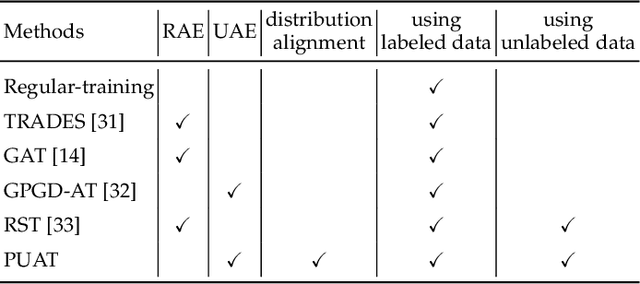
Adversarial training (AT) is widely considered as the most promising strategy to defend against adversarial attacks and has drawn increasing interest from researchers. However, the existing AT methods still suffer from two challenges. First, they are unable to handle unrestricted adversarial examples (UAEs), which are built from scratch, as opposed to restricted adversarial examples (RAEs), which are created by adding perturbations bound by an $l_p$ norm to observed examples. Second, the existing AT methods often achieve adversarial robustness at the expense of standard generalizability (i.e., the accuracy on natural examples) because they make a tradeoff between them. To overcome these challenges, we propose a unique viewpoint that understands UAEs as imperceptibly perturbed unobserved examples. Also, we find that the tradeoff results from the separation of the distributions of adversarial examples and natural examples. Based on these ideas, we propose a novel AT approach called Provable Unrestricted Adversarial Training (PUAT), which can provide a target classifier with comprehensive adversarial robustness against both UAE and RAE, and simultaneously improve its standard generalizability. Particularly, PUAT utilizes partially labeled data to achieve effective UAE generation by accurately capturing the natural data distribution through a novel augmented triple-GAN. At the same time, PUAT extends the traditional AT by introducing the supervised loss of the target classifier into the adversarial loss and achieves the alignment between the UAE distribution, the natural data distribution, and the distribution learned by the classifier, with the collaboration of the augmented triple-GAN. Finally, the solid theoretical analysis and extensive experiments conducted on widely-used benchmarks demonstrate the superiority of PUAT.
Time-aware Hyperbolic Graph Attention Network for Session-based Recommendation
Jan 10, 2023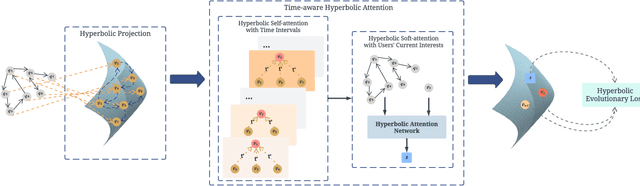
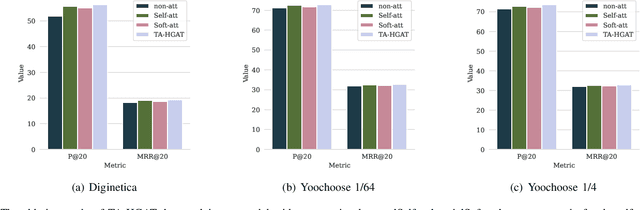
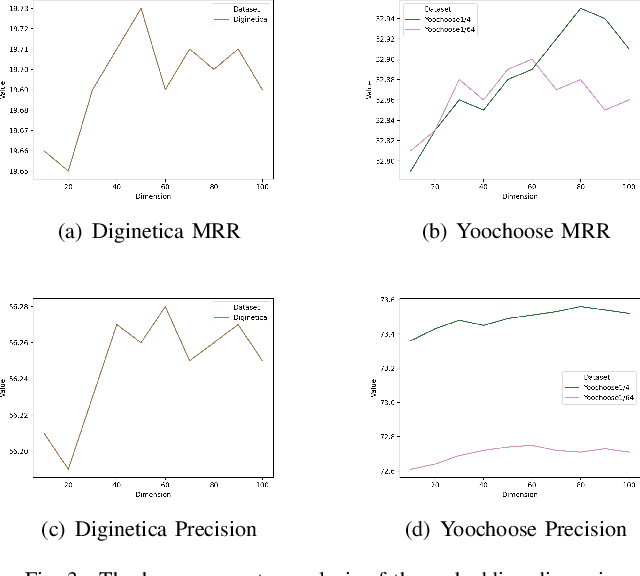

Session-based Recommendation (SBR) is to predict users' next interested items based on their previous browsing sessions. Existing methods model sessions as graphs or sequences to estimate user interests based on their interacted items to make recommendations. In recent years, graph-based methods have achieved outstanding performance on SBR. However, none of these methods consider temporal information, which is a crucial feature in SBR as it indicates timeliness or currency. Besides, the session graphs exhibit a hierarchical structure and are demonstrated to be suitable in hyperbolic geometry. But few papers design the models in hyperbolic spaces and this direction is still under exploration. In this paper, we propose Time-aware Hyperbolic Graph Attention Network (TA-HGAT) - a novel hyperbolic graph neural network framework to build a session-based recommendation model considering temporal information. More specifically, there are three components in TA-HGAT. First, a hyperbolic projection module transforms the item features into hyperbolic space. Second, the time-aware graph attention module models time intervals between items and the users' current interests. Third, an evolutionary loss at the end of the model provides an accurate prediction of the recommended item based on the given timestamp. TA-HGAT is built in a hyperbolic space to learn the hierarchical structure of session graphs. Experimental results show that the proposed TA-HGAT has the best performance compared to ten baseline models on two real-world datasets.
Self-organization Preserved Graph Structure Learning with Principle of Relevant Information
Dec 30, 2022
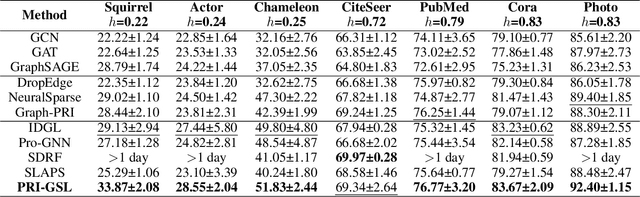


Most Graph Neural Networks follow the message-passing paradigm, assuming the observed structure depicts the ground-truth node relationships. However, this fundamental assumption cannot always be satisfied, as real-world graphs are always incomplete, noisy, or redundant. How to reveal the inherent graph structure in a unified way remains under-explored. We proposed PRI-GSL, a Graph Structure Learning framework guided by the Principle of Relevant Information, providing a simple and unified framework for identifying the self-organization and revealing the hidden structure. PRI-GSL learns a structure that contains the most relevant yet least redundant information quantified by von Neumann entropy and Quantum Jensen-Shannon divergence. PRI-GSL incorporates the evolution of quantum continuous walk with graph wavelets to encode node structural roles, showing in which way the nodes interplay and self-organize with the graph structure. Extensive experiments demonstrate the superior effectiveness and robustness of PRI-GSL.
HUSP-SP: Faster Utility Mining on Sequence Data
Dec 29, 2022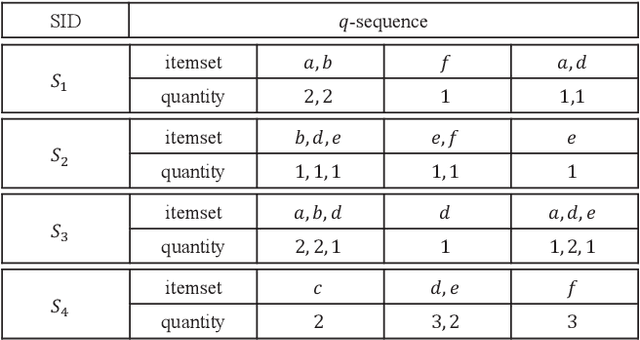
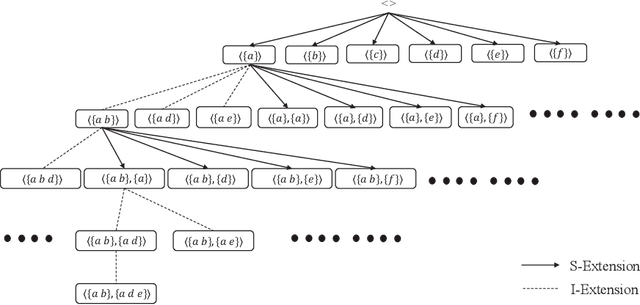
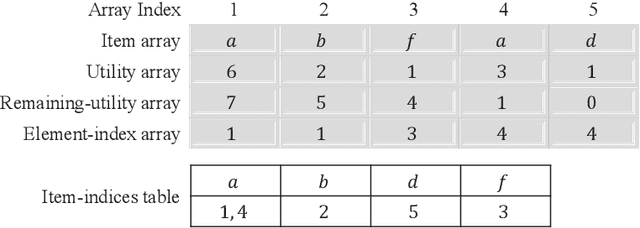
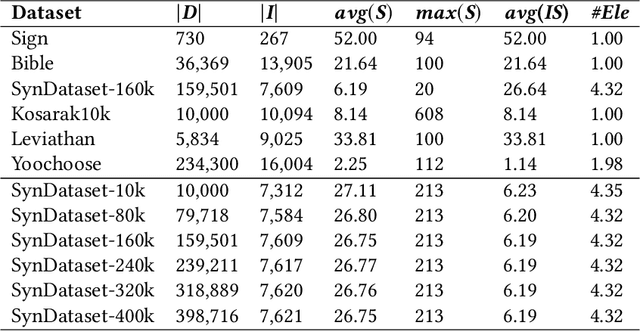
High-utility sequential pattern mining (HUSPM) has emerged as an important topic due to its wide application and considerable popularity. However, due to the combinatorial explosion of the search space when the HUSPM problem encounters a low utility threshold or large-scale data, it may be time-consuming and memory-costly to address the HUSPM problem. Several algorithms have been proposed for addressing this problem, but they still cost a lot in terms of running time and memory usage. In this paper, to further solve this problem efficiently, we design a compact structure called sequence projection (seqPro) and propose an efficient algorithm, namely discovering high-utility sequential patterns with the seqPro structure (HUSP-SP). HUSP-SP utilizes the compact seq-array to store the necessary information in a sequence database. The seqPro structure is designed to efficiently calculate candidate patterns' utilities and upper bound values. Furthermore, a new upper bound on utility, namely tighter reduced sequence utility (TRSU) and two pruning strategies in search space, are utilized to improve the mining performance of HUSP-SP. Experimental results on both synthetic and real-life datasets show that HUSP-SP can significantly outperform the state-of-the-art algorithms in terms of running time, memory usage, search space pruning efficiency, and scalability.
Towards Sequence Utility Maximization under Utility Occupancy Measure
Dec 20, 2022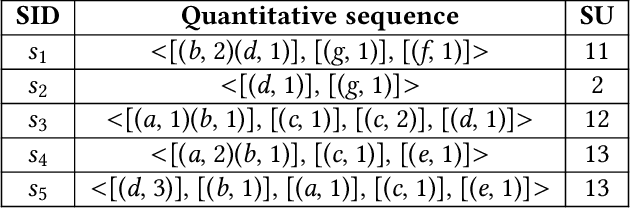

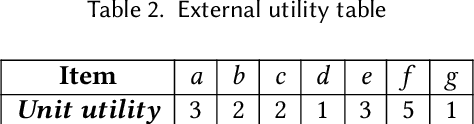

The discovery of utility-driven patterns is a useful and difficult research topic. It can extract significant and interesting information from specific and varied databases, increasing the value of the services provided. In practice, the measure of utility is often used to demonstrate the importance, profit, or risk of an object or a pattern. In the database, although utility is a flexible criterion for each pattern, it is a more absolute criterion due to the neglect of utility sharing. This leads to the derived patterns only exploring partial and local knowledge from a database. Utility occupancy is a recently proposed model that considers the problem of mining with high utility but low occupancy. However, existing studies are concentrated on itemsets that do not reveal the temporal relationship of object occurrences. Therefore, this paper towards sequence utility maximization. We first define utility occupancy on sequence data and raise the problem of High Utility-Occupancy Sequential Pattern Mining (HUOSPM). Three dimensions, including frequency, utility, and occupancy, are comprehensively evaluated in HUOSPM. An algorithm called Sequence Utility Maximization with Utility occupancy measure (SUMU) is proposed. Furthermore, two data structures for storing related information about a pattern, Utility-Occupancy-List-Chain (UOL-Chain) and Utility-Occupancy-Table (UO-Table) with six associated upper bounds, are designed to improve efficiency. Empirical experiments are carried out to evaluate the novel algorithm's efficiency and effectiveness. The influence of different upper bounds and pruning strategies is analyzed and discussed. The comprehensive results suggest that the work of our algorithm is intelligent and effective.
Localized Contrastive Learning on Graphs
Dec 08, 2022Contrastive learning methods based on InfoNCE loss are popular in node representation learning tasks on graph-structured data. However, its reliance on data augmentation and its quadratic computational complexity might lead to inconsistency and inefficiency problems. To mitigate these limitations, in this paper, we introduce a simple yet effective contrastive model named Localized Graph Contrastive Learning (Local-GCL in short). Local-GCL consists of two key designs: 1) We fabricate the positive examples for each node directly using its first-order neighbors, which frees our method from the reliance on carefully-designed graph augmentations; 2) To improve the efficiency of contrastive learning on graphs, we devise a kernelized contrastive loss, which could be approximately computed in linear time and space complexity with respect to the graph size. We provide theoretical analysis to justify the effectiveness and rationality of the proposed methods. Experiments on various datasets with different scales and properties demonstrate that in spite of its simplicity, Local-GCL achieves quite competitive performance in self-supervised node representation learning tasks on graphs with various scales and properties.
Learning to Select from Multiple Options
Dec 01, 2022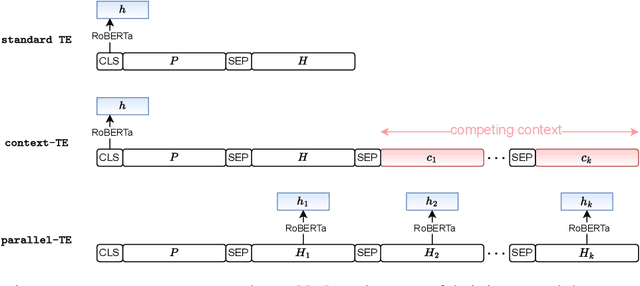
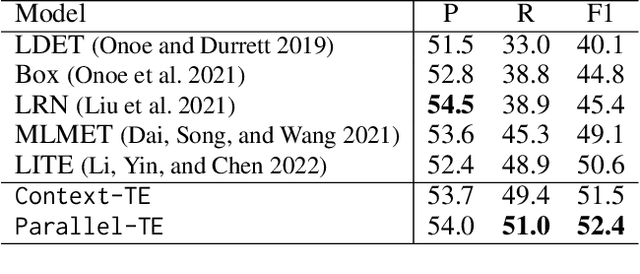
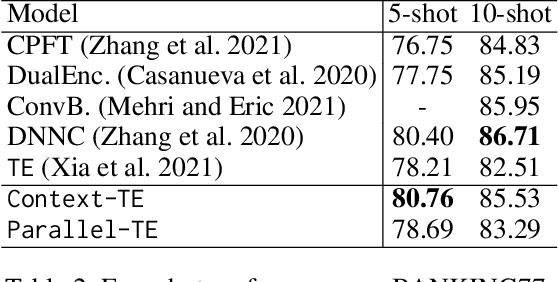
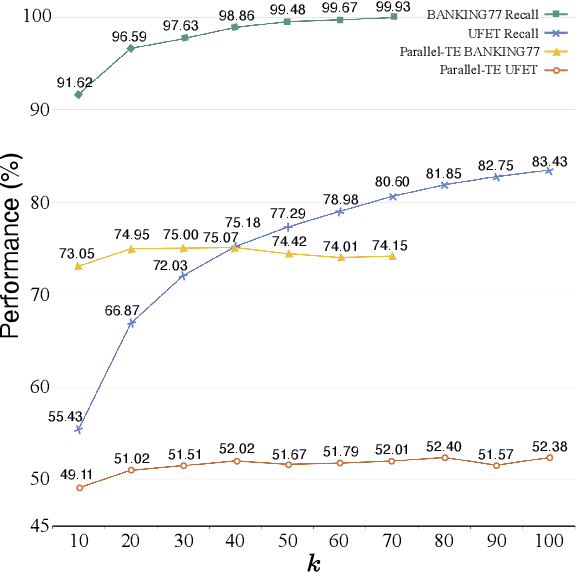
Many NLP tasks can be regarded as a selection problem from a set of options, such as classification tasks, multi-choice question answering, etc. Textual entailment (TE) has been shown as the state-of-the-art (SOTA) approach to dealing with those selection problems. TE treats input texts as premises (P), options as hypotheses (H), then handles the selection problem by modeling (P, H) pairwise. Two limitations: first, the pairwise modeling is unaware of other options, which is less intuitive since humans often determine the best options by comparing competing candidates; second, the inference process of pairwise TE is time-consuming, especially when the option space is large. To deal with the two issues, this work first proposes a contextualized TE model (Context-TE) by appending other k options as the context of the current (P, H) modeling. Context-TE is able to learn more reliable decision for the H since it considers various context. Second, we speed up Context-TE by coming up with Parallel-TE, which learns the decisions of multiple options simultaneously. Parallel-TE significantly improves the inference speed while keeping comparable performance with Context-TE. Our methods are evaluated on three tasks (ultra-fine entity typing, intent detection and multi-choice QA) that are typical selection problems with different sizes of options. Experiments show our models set new SOTA performance; particularly, Parallel-TE is faster than the pairwise TE by k times in inference. Our code is publicly available at https://github.com/jiangshdd/LearningToSelect.
Self-Supervised Continual Graph Learning in Adaptive Riemannian Spaces
Nov 30, 2022Continual graph learning routinely finds its role in a variety of real-world applications where the graph data with different tasks come sequentially. Despite the success of prior works, it still faces great challenges. On the one hand, existing methods work with the zero-curvature Euclidean space, and largely ignore the fact that curvature varies over the coming graph sequence. On the other hand, continual learners in the literature rely on abundant labels, but labeling graph in practice is particularly hard especially for the continuously emerging graphs on-the-fly. To address the aforementioned challenges, we propose to explore a challenging yet practical problem, the self-supervised continual graph learning in adaptive Riemannian spaces. In this paper, we propose a novel self-supervised Riemannian Graph Continual Learner (RieGrace). In RieGrace, we first design an Adaptive Riemannian GCN (AdaRGCN), a unified GCN coupled with a neural curvature adapter, so that Riemannian space is shaped by the learnt curvature adaptive to each graph. Then, we present a Label-free Lorentz Distillation approach, in which we create teacher-student AdaRGCN for the graph sequence. The student successively performs intra-distillation from itself and inter-distillation from the teacher so as to consolidate knowledge without catastrophic forgetting. In particular, we propose a theoretically grounded Generalized Lorentz Projection for the contrastive distillation in Riemannian space. Extensive experiments on the benchmark datasets show the superiority of RieGrace, and additionally, we investigate on how curvature changes over the graph sequence.
DGRec: Graph Neural Network for Recommendation with Diversified Embedding Generation
Nov 27, 2022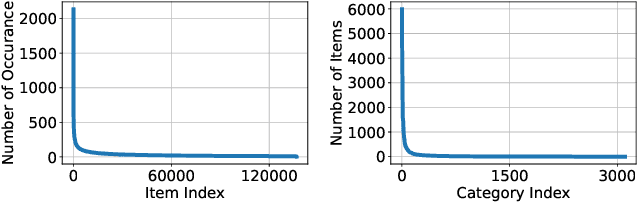
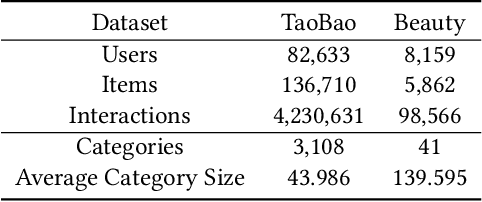

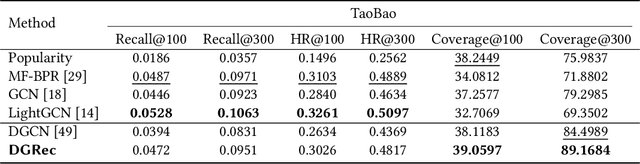
Graph Neural Network (GNN) based recommender systems have been attracting more and more attention in recent years due to their excellent performance in accuracy. Representing user-item interactions as a bipartite graph, a GNN model generates user and item representations by aggregating embeddings of their neighbors. However, such an aggregation procedure often accumulates information purely based on the graph structure, overlooking the redundancy of the aggregated neighbors and resulting in poor diversity of the recommended list. In this paper, we propose diversifying GNN-based recommender systems by directly improving the embedding generation procedure. Particularly, we utilize the following three modules: submodular neighbor selection to find a subset of diverse neighbors to aggregate for each GNN node, layer attention to assign attention weights for each layer, and loss reweighting to focus on the learning of items belonging to long-tail categories. Blending the three modules into GNN, we present DGRec(Diversified GNN-based Recommender System) for diversified recommendation. Experiments on real-world datasets demonstrate that the proposed method can achieve the best diversity while keeping the accuracy comparable to state-of-the-art GNN-based recommender systems.