 Add to Chrome
 Add to Firefox
 Add to Edge
UFVideo: Towards Unified Fine-Grained Video Cooperative Understanding with Large Language Models
Dec 12, 2025
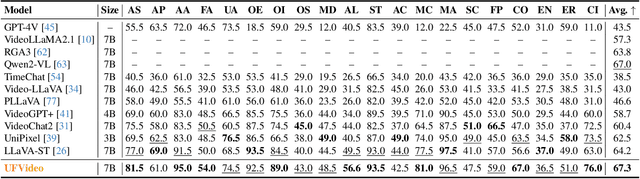
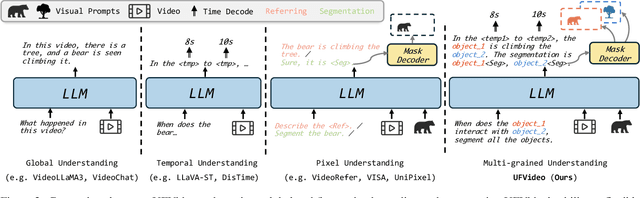
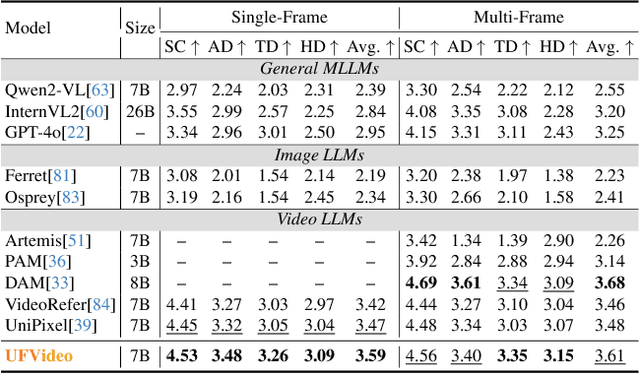
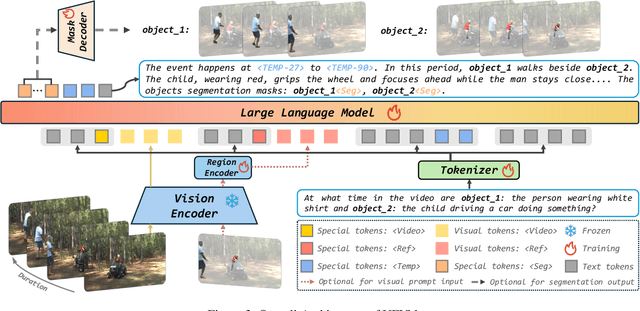
With the advancement of multi-modal Large Language Models (LLMs), Video LLMs have been further developed to perform on holistic and specialized video understanding. However, existing works are limited to specialized video understanding tasks, failing to achieve a comprehensive and multi-grained video perception. To bridge this gap, we introduce UFVideo, the first Video LLM with unified multi-grained cooperative understanding capabilities. Specifically, we design unified visual-language guided alignment to flexibly handle video understanding across global, pixel and temporal scales within a single model. UFVideo dynamically encodes the visual and text inputs of different tasks and generates the textual response, temporal localization, or grounded mask. Additionally, to evaluate challenging multi-grained video understanding tasks, we construct the UFVideo-Bench consisting of three distinct collaborative tasks within the scales, which demonstrates UFVideo's flexibility and advantages over GPT-4o. Furthermore, we validate the effectiveness of our model across 9 public benchmarks covering various common video understanding tasks, providing valuable insights for future Video LLMs.

DisTime: Distribution-based Time Representation for Video Large Language Models
May 30, 2025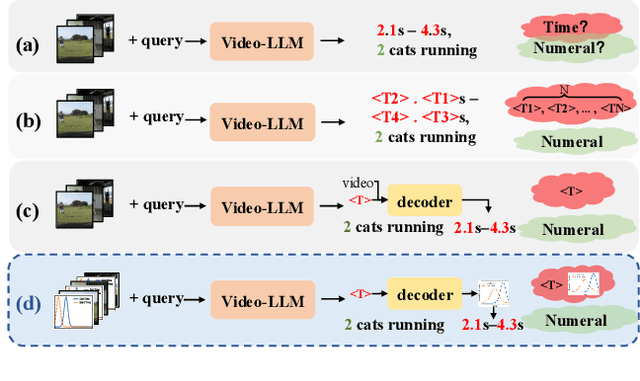
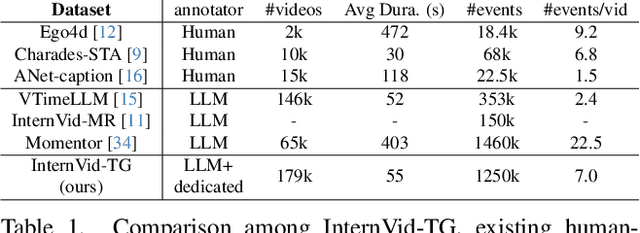
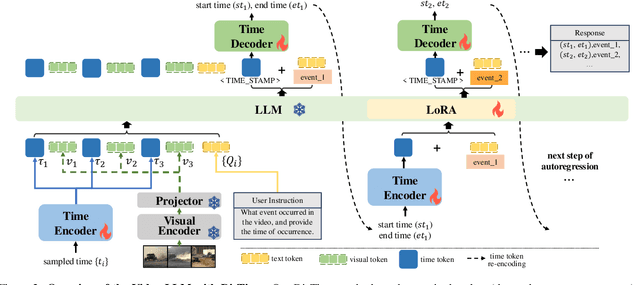
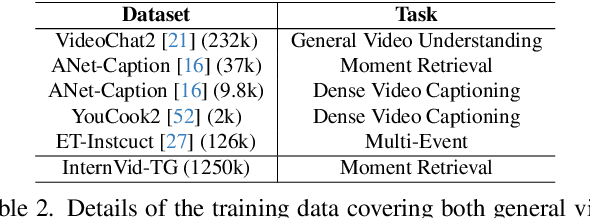
Despite advances in general video understanding, Video Large Language Models (Video-LLMs) face challenges in precise temporal localization due to discrete time representations and limited temporally aware datasets. Existing methods for temporal expression either conflate time with text-based numerical values, add a series of dedicated temporal tokens, or regress time using specialized temporal grounding heads. To address these issues, we introduce DisTime, a lightweight framework designed to enhance temporal comprehension in Video-LLMs. DisTime employs a learnable token to create a continuous temporal embedding space and incorporates a Distribution-based Time Decoder that generates temporal probability distributions, effectively mitigating boundary ambiguities and maintaining temporal continuity. Additionally, the Distribution-based Time Encoder re-encodes timestamps to provide time markers for Video-LLMs. To overcome temporal granularity limitations in existing datasets, we propose an automated annotation paradigm that combines the captioning capabilities of Video-LLMs with the localization expertise of dedicated temporal models. This leads to the creation of InternVid-TG, a substantial dataset with 1.25M temporally grounded events across 179k videos, surpassing ActivityNet-Caption by 55 times. Extensive experiments demonstrate that DisTime achieves state-of-the-art performance across benchmarks in three time-sensitive tasks while maintaining competitive performance in Video QA tasks. Code and data are released at https://github.com/josephzpng/DisTime.