 Add to Chrome
 Add to Firefox
 Add to Edge
IntRR: A Framework for Integrating SID Redistribution and Length Reduction
Feb 24, 2026
Generative Recommendation (GR) has emerged as a transformative paradigm that reformulates the traditional cascade ranking system into a sequence-to-item generation task, facilitated by the use of discrete Semantic IDs (SIDs). However, current SIDs are suboptimal as the indexing objectives (Stage 1) are misaligned with the actual recommendation goals (Stage 2). Since these identifiers remain static (Stage 2), the backbone model lacks the flexibility to adapt them to the evolving complexities of user interactions. Furthermore, the prevailing strategy of flattening hierarchical SIDs into token sequences leads to sequence length inflation, resulting in prohibitive computational overhead and inference latency. To address these challenges, we propose IntRR, a novel framework that integrates objective-aligned SID Redistribution and structural Length Reduction. By leveraging item-specific Unique IDs (UIDs) as collaborative anchors, this approach dynamically redistributes semantic weights across hierarchical codebook layers. Concurrently, IntRR handles the SID hierarchy recursively, eliminating the need to flatten sequences. This ensures a fixed cost of one token per item. Extensive experiments on benchmark datasets demonstrate that IntRR yields substantial improvements over representative generative baselines, achieving superior performance in both recommendation accuracy and efficiency.

Dropping Anchor and Spherical Harmonics for Sparse-view Gaussian Splatting
Feb 24, 2026Recent 3D Gaussian Splatting (3DGS) Dropout methods address overfitting under sparse-view conditions by randomly nullifying Gaussian opacities. However, we identify a neighbor compensation effect in these approaches: dropped Gaussians are often compensated by their neighbors, weakening the intended regularization. Moreover, these methods overlook the contribution of high-degree spherical harmonic coefficients (SH) to overfitting. To address these issues, we propose DropAnSH-GS, a novel anchor-based Dropout strategy. Rather than dropping Gaussians independently, our method randomly selects certain Gaussians as anchors and simultaneously removes their spatial neighbors. This effectively disrupts local redundancies near anchors and encourages the model to learn more robust, globally informed representations. Furthermore, we extend the Dropout to color attributes by randomly dropping higher-degree SH to concentrate appearance information in lower-degree SH. This strategy further mitigates overfitting and enables flexible post-training model compression via SH truncation. Experimental results demonstrate that DropAnSH-GS substantially outperforms existing Dropout methods with negligible computational overhead, and can be readily integrated into various 3DGS variants to enhance their performances. Project Website: https://sk-fun.fun/DropAnSH-GS
WaterClear-GS: Optical-Aware Gaussian Splatting for Underwater Reconstruction and Restoration
Jan 27, 2026Underwater 3D reconstruction and appearance restoration are hindered by the complex optical properties of water, such as wavelength-dependent attenuation and scattering. Existing Neural Radiance Fields (NeRF)-based methods struggle with slow rendering speeds and suboptimal color restoration, while 3D Gaussian Splatting (3DGS) inherently lacks the capability to model complex volumetric scattering effects. To address these issues, we introduce WaterClear-GS, the first pure 3DGS-based framework that explicitly integrates underwater optical properties of local attenuation and scattering into Gaussian primitives, eliminating the need for an auxiliary medium network. Our method employs a dual-branch optimization strategy to ensure underwater photometric consistency while naturally recovering water-free appearances. This strategy is enhanced by depth-guided geometry regularization and perception-driven image loss, together with exposure constraints, spatially-adaptive regularization, and physically guided spectral regularization, which collectively enforce local 3D coherence and maintain natural visual perception. Experiments on standard benchmarks and our newly collected dataset demonstrate that WaterClear-GS achieves outstanding performance on both novel view synthesis (NVS) and underwater image restoration (UIR) tasks, while maintaining real-time rendering. The code will be available at https://buaaxrzhang.github.io/WaterClear-GS/.
Efficient Listener: Dyadic Facial Motion Synthesis via Action Diffusion
Apr 29, 2025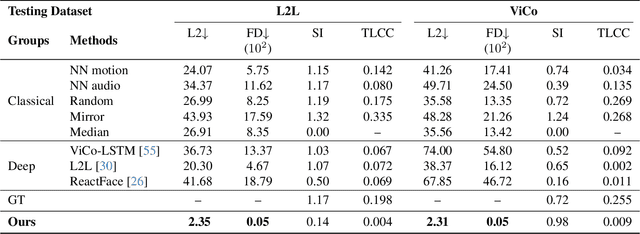
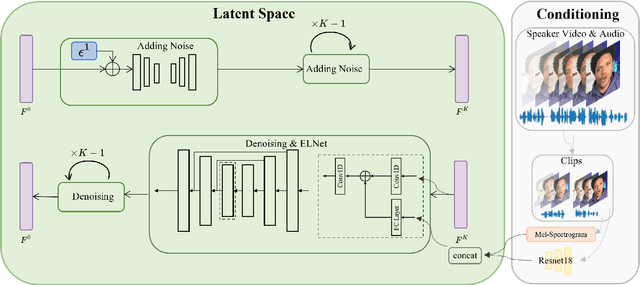
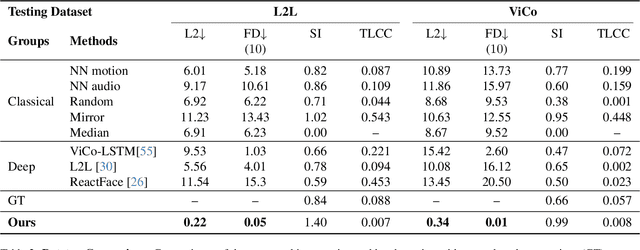
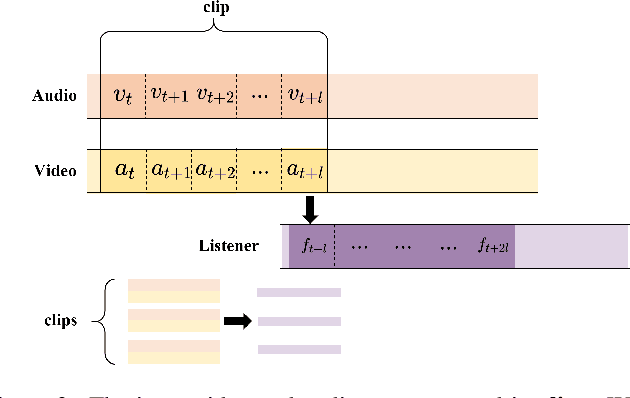
Generating realistic listener facial motions in dyadic conversations remains challenging due to the high-dimensional action space and temporal dependency requirements. Existing approaches usually consider extracting 3D Morphable Model (3DMM) coefficients and modeling in the 3DMM space. However, this makes the computational speed of the 3DMM a bottleneck, making it difficult to achieve real-time interactive responses. To tackle this problem, we propose Facial Action Diffusion (FAD), which introduces the diffusion methods from the field of image generation to achieve efficient facial action generation. We further build the Efficient Listener Network (ELNet) specially designed to accommodate both the visual and audio information of the speaker as input. Considering of FAD and ELNet, the proposed method learns effective listener facial motion representations and leads to improvements of performance over the state-of-the-art methods while reducing 99% computational time.