 Add to Chrome
 Add to Firefox
 Add to Edge
PO-PDDL: Learning Symbolic POMDPs from Visual Demonstrations for Robot Planning Under Uncertainty
Jun 14, 2026
Real-world robot task planning must operate under both stochastic action execution and partial observability, yet constructing Partially Observable Markov Decision Process (POMDP) models for real robotics domains remains difficult and labor-intensive. We introduce PO-PDDL, a symbolic formulation of POMDPs that preserves the relational structure and LLM-friendly syntax of the Planning Domain Definition Language (PDDL), while explicitly modeling partial observability, stochasticity, and beliefs. Building on this formulation, we propose a demonstration-driven pipeline for learning PO-PDDL models. The proposed method reconstructs latent symbolic state trajectories from real-robot execution videos, identifies partial observability via inconsistencies between inferred states and visual observations, and learns stochastic transition and observation models accordingly. The resulting PO-PDDL domains are reusable across tasks and enable online belief-space planning under both perception and execution uncertainty. Experiments on real-world long-horizon manipulation tasks show that our method consistently outperforms existing PDDL and POMDP model-learning approaches, achieving robust task planning under uncertainty with significantly lower planning cost.

I-Perceive: A Foundation Model for Active Perception with Language Instructions
Feb 28, 2026Active perception, the ability of a robot to proactively adjust its viewpoint to acquire task-relevant information, is essential for robust operation in unstructured real-world environments. While critical for downstream tasks such as manipulation, existing approaches have largely been confined to local settings (e.g., table-top scenes) with fixed perception objectives (e.g., occlusion reduction). Addressing active perception with open-ended intents in large-scale environments remains an open challenge. To bridge this gap, we propose I-Perceive, a foundation model for active perception conditioned on natural language instructions, designed for mobile manipulators and indoor environments. I-Perceive predicts camera views that follows open-ended language instructions, based on image-based scene contexts. By fusing a Vision-Language Model (VLM) backbone with a geometric foundation model, I-Perceive bridges semantic and geometric understanding, thus enabling effective reasoning for active perception. We train I-Perceive on a diverse dataset comprising real-world scene-scanning data and simulation data, both processed via an automated and scalable data generation pipeline. Experiments demonstrate that I-Perceive significantly outperforms state-of-the-art VLMs in both prediction accuracy and instruction following of generated camera views, and exhibits strong zero-shot generalization to novel scenes and tasks.
Any House Any Task: Scalable Long-Horizon Planning for Abstract Human Tasks
Feb 12, 2026Open world language conditioned task planning is crucial for robots operating in large-scale household environments. While many recent works attempt to address this problem using Large Language Models (LLMs) via prompting or training, a key challenge remains scalability. Performance often degrades rapidly with increasing environment size, plan length, instruction ambiguity, and constraint complexity. In this work, we propose Any House Any Task (AHAT), a household task planner optimized for long-horizon planning in large environments given ambiguous human instructions. At its core, AHAT utilizes an LLM trained to map task instructions and textual scene graphs into grounded subgoals defined in the Planning Domain Definition Language (PDDL). These subgoals are subsequently solved to generate feasible and optimal long-horizon plans through explicit symbolic reasoning. To enhance the model's ability to decompose complex and ambiguous intentions, we introduce TGPO, a novel reinforcement learning algorithm that integrates external correction of intermediate reasoning traces into Group Relative Policy Optimization (GRPO). Experiments demonstrate that AHAT achieves significant performance gains over state-of-the-art prompting, planning, and learning methods, particularly in human-style household tasks characterized by brief instructions but requiring complex execution plans.
Mimic Intent, Not Just Trajectories
Feb 09, 2026While imitation learning (IL) has achieved impressive success in dexterous manipulation through generative modeling and pretraining, state-of-the-art approaches like Vision-Language-Action (VLA) models still struggle with adaptation to environmental changes and skill transfer. We argue this stems from mimicking raw trajectories without understanding the underlying intent. To address this, we propose explicitly disentangling behavior intent from execution details in end-2-end IL: \textit{``Mimic Intent, Not just Trajectories'' (MINT)}. We achieve this via \textit{multi-scale frequency-space tokenization}, which enforces a spectral decomposition of action chunk representation. We learn action tokens with a multi-scale coarse-to-fine structure, and force the coarsest token to capture low-frequency global structure and finer tokens to encode high-frequency details. This yields an abstract \textit{Intent token} that facilitates planning and transfer, and multi-scale \textit{Execution tokens} that enable precise adaptation to environmental dynamics. Building on this hierarchy, our policy generates trajectories through \textit{next-scale autoregression}, performing progressive \textit{intent-to-execution reasoning}, thus boosting learning efficiency and generalization. Crucially, this disentanglement enables \textit{one-shot transfer} of skills, by simply injecting the Intent token from a demonstration into the autoregressive generation process. Experiments on several manipulation benchmarks and on a real robot demonstrate state-of-the-art success rates, superior inference efficiency, robust generalization against disturbances, and effective one-shot transfer.
Vec-QMDP: Vectorized POMDP Planning on CPUs for Real-Time Autonomous Driving
Feb 09, 2026Planning under uncertainty for real-world robotics tasks, such as autonomous driving, requires reasoning in enormous high-dimensional belief spaces, rendering the problem computationally intensive. While parallelization offers scalability, existing hybrid CPU-GPU solvers face critical bottlenecks due to host-device synchronization latency and branch divergence on SIMT architectures, limiting their utility for real-time planning and hindering real-robot deployment. We present Vec-QMDP, a CPU-native parallel planner that aligns POMDP search with modern CPUs' SIMD architecture, achieving $227\times$--$1073\times$ speedup over state-of-the-art serial planners. Vec-QMDP adopts a Data-Oriented Design (DOD), refactoring scattered, pointer-based data structures into contiguous, cache-efficient memory layouts. We further introduce a hierarchical parallelism scheme: distributing sub-trees across independent CPU cores and SIMD lanes, enabling fully vectorized tree expansion and collision checking. Efficiency is maximized with the help of UCB load balancing across trees and a vectorized STR-tree for coarse-level collision checking. Evaluated on large-scale autonomous driving benchmarks, Vec-QMDP achieves state-of-the-art planning performance with millisecond-level latency, establishing CPUs as a high-performance computing platform for large-scale planning under uncertainty.
UniPlan: Vision-Language Task Planning for Mobile Manipulation with Unified PDDL Formulation
Feb 09, 2026Integration of VLM reasoning with symbolic planning has proven to be a promising approach to real-world robot task planning. Existing work like UniDomain effectively learns symbolic manipulation domains from real-world demonstrations, described in Planning Domain Definition Language (PDDL), and has successfully applied them to real-world tasks. These domains, however, are restricted to tabletop manipulation. We propose UniPlan, a vision-language task planning system for long-horizon mobile-manipulation in large-scale indoor environments, that unifies scene topology, visuals, and robot capabilities into a holistic PDDL representation. UniPlan programmatically extends learned tabletop domains from UniDomain to support navigation, door traversal, and bimanual coordination. It operates on a visual-topological map, comprising navigation landmarks anchored with scene images. Given a language instruction, UniPlan retrieves task-relevant nodes from the map and uses a VLM to ground the anchored image into task-relevant objects and their PDDL states; next, it reconnects these nodes to a compressed, densely-connected topological map, also represented in PDDL, with connectivity and costs derived from the original map; Finally, a mobile-manipulation plan is generated using off-the-shelf PDDL solvers. Evaluated on human-raised tasks in a large-scale map with real-world imagery, UniPlan significantly outperforms VLM and LLM+PDDL planning in success rate, plan quality, and computational efficiency.
ForceVLA: Enhancing VLA Models with a Force-aware MoE for Contact-rich Manipulation
May 28, 2025Vision-Language-Action (VLA) models have advanced general-purpose robotic manipulation by leveraging pretrained visual and linguistic representations. However, they struggle with contact-rich tasks that require fine-grained control involving force, especially under visual occlusion or dynamic uncertainty. To address these limitations, we propose \textbf{ForceVLA}, a novel end-to-end manipulation framework that treats external force sensing as a first-class modality within VLA systems. ForceVLA introduces \textbf{FVLMoE}, a force-aware Mixture-of-Experts fusion module that dynamically integrates pretrained visual-language embeddings with real-time 6-axis force feedback during action decoding. This enables context-aware routing across modality-specific experts, enhancing the robot's ability to adapt to subtle contact dynamics. We also introduce \textbf{ForceVLA-Data}, a new dataset comprising synchronized vision, proprioception, and force-torque signals across five contact-rich manipulation tasks. ForceVLA improves average task success by 23.2\% over strong $\pi_0$-based baselines, achieving up to 80\% success in tasks such as plug insertion. Our approach highlights the importance of multimodal integration for dexterous manipulation and sets a new benchmark for physically intelligent robotic control. Code and data will be released at https://sites.google.com/view/forcevla2025.
World Modeling Makes a Better Planner: Dual Preference Optimization for Embodied Task Planning
Mar 13, 2025Recent advances in large vision-language models (LVLMs) have shown promise for embodied task planning, yet they struggle with fundamental challenges like dependency constraints and efficiency. Existing approaches either solely optimize action selection or leverage world models during inference, overlooking the benefits of learning to model the world as a way to enhance planning capabilities. We propose Dual Preference Optimization (D$^2$PO), a new learning framework that jointly optimizes state prediction and action selection through preference learning, enabling LVLMs to understand environment dynamics for better planning. To automatically collect trajectories and stepwise preference data without human annotation, we introduce a tree search mechanism for extensive exploration via trial-and-error. Extensive experiments on VoTa-Bench demonstrate that our D$^2$PO-based method significantly outperforms existing methods and GPT-4o when applied to Qwen2-VL (7B), LLaVA-1.6 (7B), and LLaMA-3.2 (11B), achieving superior task success rates with more efficient execution paths.
BoT-Drive: Hierarchical Behavior and Trajectory Planning for Autonomous Driving using POMDPs
Sep 27, 2024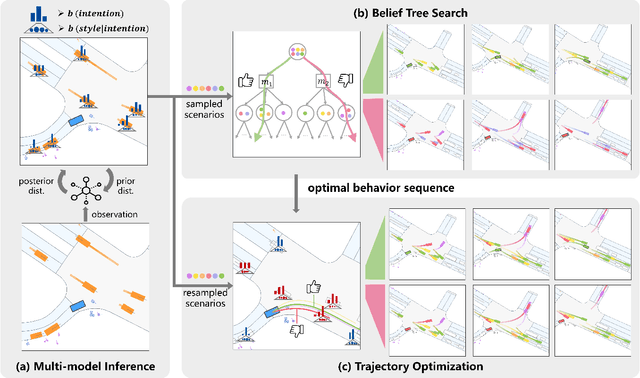
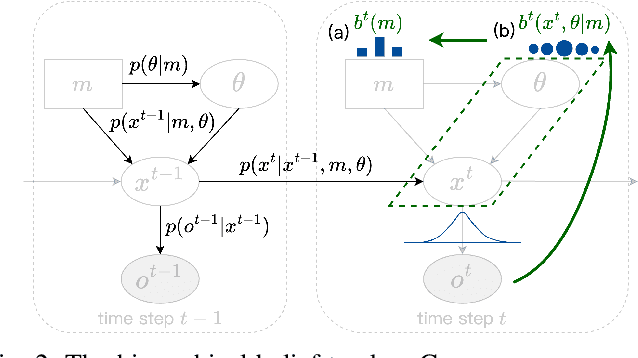

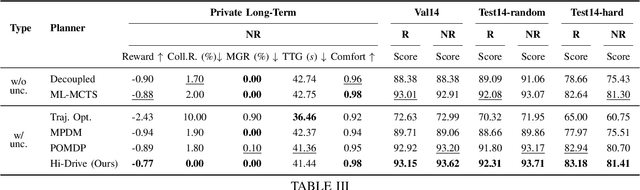
Uncertainties in dynamic road environments pose significant challenges for behavior and trajectory planning in autonomous driving. This paper introduces BoT-Drive, a planning algorithm that addresses uncertainties at both behavior and trajectory levels within a Partially Observable Markov Decision Process (POMDP) framework. BoT-Drive employs driver models to characterize unknown behavioral intentions and utilizes their model parameters to infer hidden driving styles. By also treating driver models as decision-making actions for the autonomous vehicle, BoT-Drive effectively tackles the exponential complexity inherent in POMDPs. To enhance safety and robustness, the planner further applies importance sampling to refine the driving trajectory conditioned on the planned high-level behavior. Evaluation on real-world data shows that BoT-Drive consistently outperforms both existing planning methods and learning-based methods in regular and complex urban driving scenes, demonstrating significant improvements in driving safety and reliability.
RI-MAE: Rotation-Invariant Masked AutoEncoders for Self-Supervised Point Cloud Representation Learning
Aug 31, 2024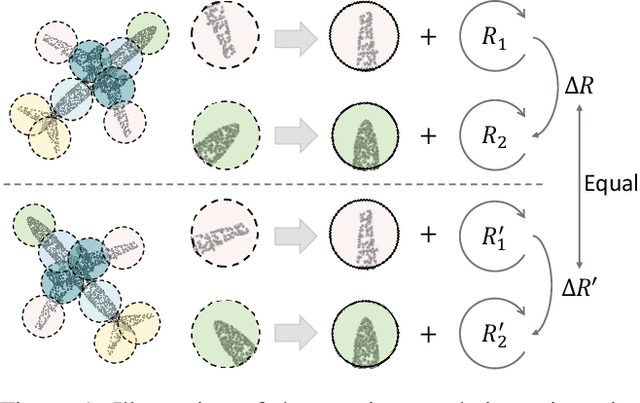
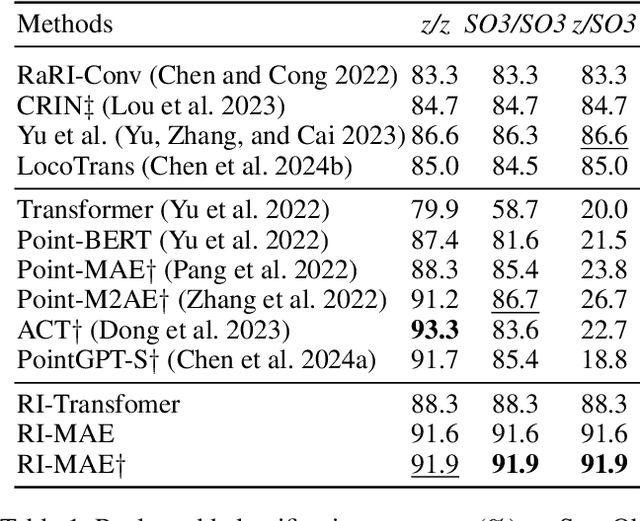
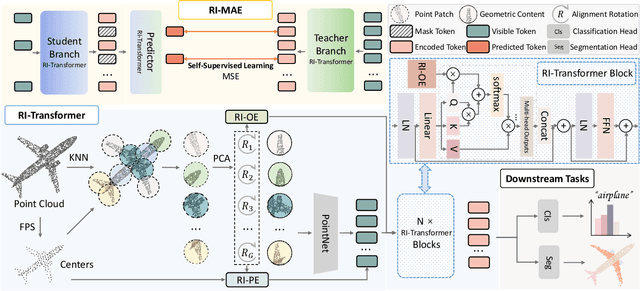
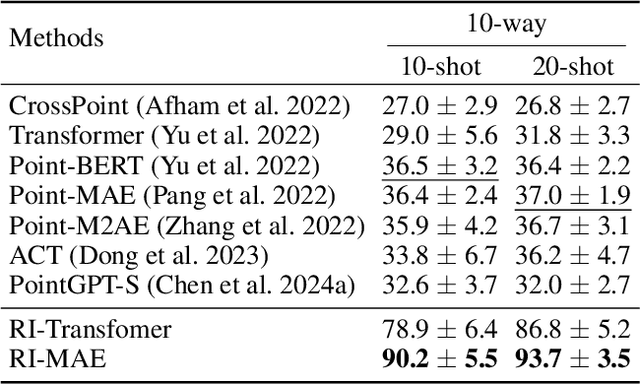
Masked point modeling methods have recently achieved great success in self-supervised learning for point cloud data. However, these methods are sensitive to rotations and often exhibit sharp performance drops when encountering rotational variations. In this paper, we propose a novel Rotation-Invariant Masked AutoEncoders (RI-MAE) to address two major challenges: 1) achieving rotation-invariant latent representations, and 2) facilitating self-supervised reconstruction in a rotation-invariant manner. For the first challenge, we introduce RI-Transformer, which features disentangled geometry content, rotation-invariant relative orientation and position embedding mechanisms for constructing rotation-invariant point cloud latent space. For the second challenge, a novel dual-branch student-teacher architecture is devised. It enables the self-supervised learning via the reconstruction of masked patches within the learned rotation-invariant latent space. Each branch is based on an RI-Transformer, and they are connected with an additional RI-Transformer predictor. The teacher encodes all point patches, while the student solely encodes unmasked ones. Finally, the predictor predicts the latent features of the masked patches using the output latent embeddings from the student, supervised by the outputs from the teacher. Extensive experiments demonstrate that our method is robust to rotations, achieving the state-of-the-art performance on various downstream tasks.