 Add to Chrome
 Add to Firefox
 Add to Edge
PO-PDDL: Learning Symbolic POMDPs from Visual Demonstrations for Robot Planning Under Uncertainty
Jun 14, 2026
Real-world robot task planning must operate under both stochastic action execution and partial observability, yet constructing Partially Observable Markov Decision Process (POMDP) models for real robotics domains remains difficult and labor-intensive. We introduce PO-PDDL, a symbolic formulation of POMDPs that preserves the relational structure and LLM-friendly syntax of the Planning Domain Definition Language (PDDL), while explicitly modeling partial observability, stochasticity, and beliefs. Building on this formulation, we propose a demonstration-driven pipeline for learning PO-PDDL models. The proposed method reconstructs latent symbolic state trajectories from real-robot execution videos, identifies partial observability via inconsistencies between inferred states and visual observations, and learns stochastic transition and observation models accordingly. The resulting PO-PDDL domains are reusable across tasks and enable online belief-space planning under both perception and execution uncertainty. Experiments on real-world long-horizon manipulation tasks show that our method consistently outperforms existing PDDL and POMDP model-learning approaches, achieving robust task planning under uncertainty with significantly lower planning cost.

Mimic Intent, Not Just Trajectories
Feb 09, 2026While imitation learning (IL) has achieved impressive success in dexterous manipulation through generative modeling and pretraining, state-of-the-art approaches like Vision-Language-Action (VLA) models still struggle with adaptation to environmental changes and skill transfer. We argue this stems from mimicking raw trajectories without understanding the underlying intent. To address this, we propose explicitly disentangling behavior intent from execution details in end-2-end IL: \textit{``Mimic Intent, Not just Trajectories'' (MINT)}. We achieve this via \textit{multi-scale frequency-space tokenization}, which enforces a spectral decomposition of action chunk representation. We learn action tokens with a multi-scale coarse-to-fine structure, and force the coarsest token to capture low-frequency global structure and finer tokens to encode high-frequency details. This yields an abstract \textit{Intent token} that facilitates planning and transfer, and multi-scale \textit{Execution tokens} that enable precise adaptation to environmental dynamics. Building on this hierarchy, our policy generates trajectories through \textit{next-scale autoregression}, performing progressive \textit{intent-to-execution reasoning}, thus boosting learning efficiency and generalization. Crucially, this disentanglement enables \textit{one-shot transfer} of skills, by simply injecting the Intent token from a demonstration into the autoregressive generation process. Experiments on several manipulation benchmarks and on a real robot demonstrate state-of-the-art success rates, superior inference efficiency, robust generalization against disturbances, and effective one-shot transfer.
Diffusion Models as Optimizers for Efficient Planning in Offline RL
Jul 23, 2024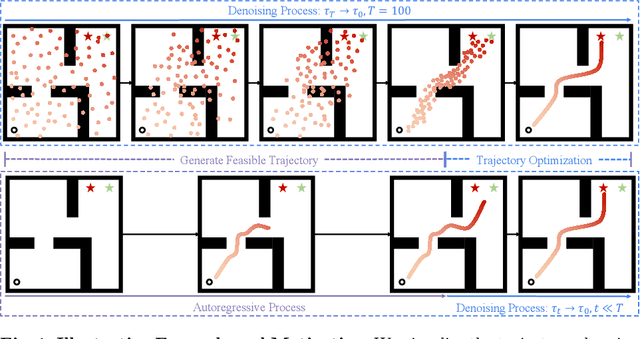
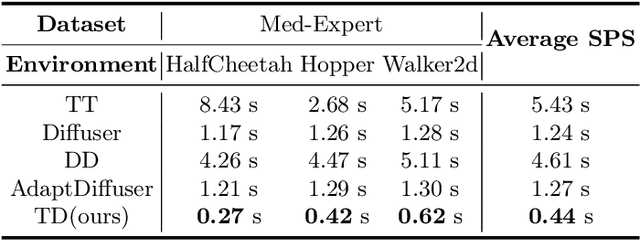
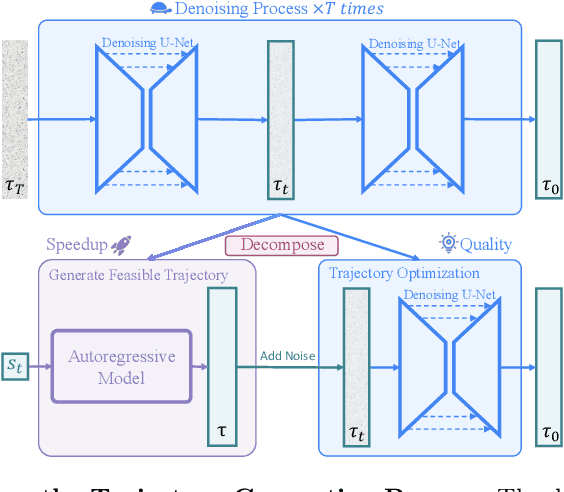
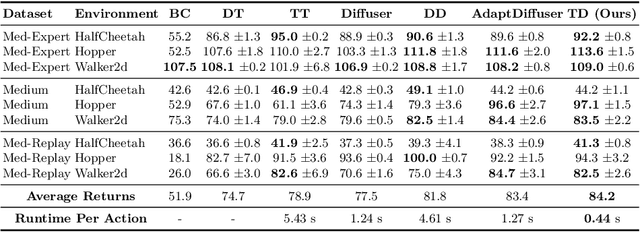
Diffusion models have shown strong competitiveness in offline reinforcement learning tasks by formulating decision-making as sequential generation. However, the practicality of these methods is limited due to the lengthy inference processes they require. In this paper, we address this problem by decomposing the sampling process of diffusion models into two decoupled subprocesses: 1) generating a feasible trajectory, which is a time-consuming process, and 2) optimizing the trajectory. With this decomposition approach, we are able to partially separate efficiency and quality factors, enabling us to simultaneously gain efficiency advantages and ensure quality assurance. We propose the Trajectory Diffuser, which utilizes a faster autoregressive model to handle the generation of feasible trajectories while retaining the trajectory optimization process of diffusion models. This allows us to achieve more efficient planning without sacrificing capability. To evaluate the effectiveness and efficiency of the Trajectory Diffuser, we conduct experiments on the D4RL benchmarks. The results demonstrate that our method achieves $\it 3$-$\it 10 \times$ faster inference speed compared to previous sequence modeling methods, while also outperforming them in terms of overall performance. https://github.com/RenMing-Huang/TrajectoryDiffuser Keywords: Reinforcement Learning and Efficient Planning and Diffusion Model