 Add to Chrome
 Add to Firefox
 Add to Edge
DriveMamba: Task-Centric Scalable State Space Model for Efficient End-to-End Autonomous Driving
Feb 09, 2026
Recent advances towards End-to-End Autonomous Driving (E2E-AD) have been often devoted on integrating modular designs into a unified framework for joint optimization e.g. UniAD, which follow a sequential paradigm (i.e., perception-prediction-planning) based on separable Transformer decoders and rely on dense BEV features to encode scene representations. However, such manual ordering design can inevitably cause information loss and cumulative errors, lacking flexible and diverse relation modeling among different modules and sensors. Meanwhile, insufficient training of image backbone and quadratic-complexity of attention mechanism also hinder the scalability and efficiency of E2E-AD system to handle spatiotemporal input. To this end, we propose DriveMamba, a Task-Centric Scalable paradigm for efficient E2E-AD, which integrates dynamic task relation modeling, implicit view correspondence learning and long-term temporal fusion into a single-stage Unified Mamba decoder. Specifically, both extracted image features and expected task outputs are converted into token-level sparse representations in advance, which are then sorted by their instantiated positions in 3D space. The linear-complexity operator enables efficient long-context sequential token modeling to capture task-related inter-dependencies simultaneously. Additionally, a bidirectional trajectory-guided "local-to-global" scan method is designed to preserve spatial locality from ego-perspective, thus facilitating the ego-planning. Extensive experiments conducted on nuScenes and Bench2Drive datasets demonstrate the superiority, generalizability and great efficiency of DriveMamba.

RoboSense: Large-scale Dataset and Benchmark for Multi-sensor Low-speed Autonomous Driving
Aug 28, 2024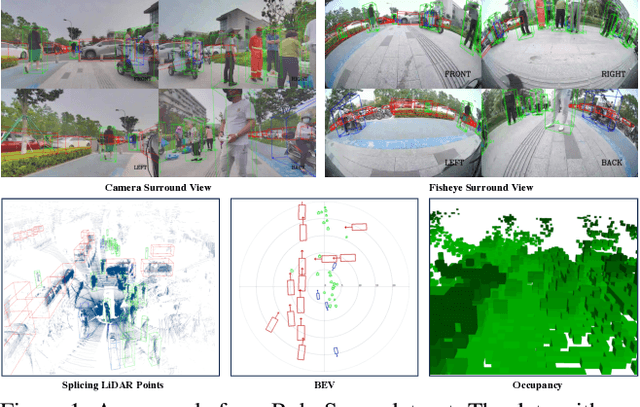
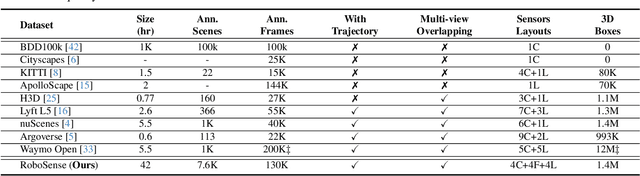
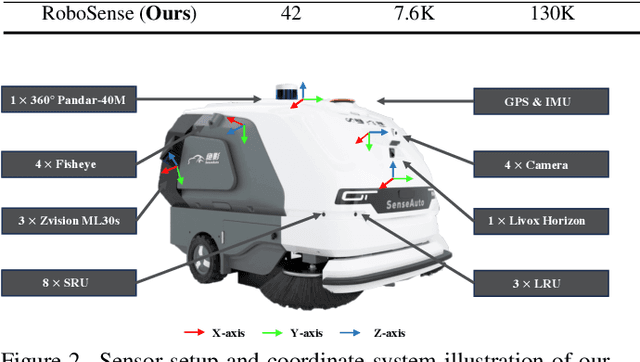
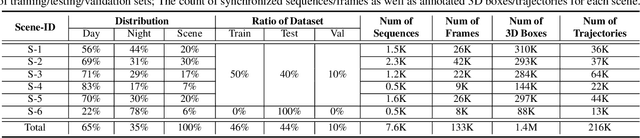
Robust object detection and tracking under arbitrary sight of view is challenging yet essential for the development of Autonomous Vehicle technology. With the growing demand of unmanned function vehicles, near-field scene understanding becomes an important research topic in the areas of low-speed autonomous driving. Due to the complexity of driving conditions and diversity of near obstacles such as blind spots and high occlusion, the perception capability of near-field environment is still inferior than its farther counterpart. To further enhance the intelligent ability of unmanned vehicles, in this paper, we construct a multimodal data collection platform based on 3 main types of sensors (Camera, LiDAR and Fisheye), which supports flexible sensor configurations to enable dynamic sight of view for ego vehicle, either global view or local view. Meanwhile, a large-scale multi-sensor dataset is built, named RoboSense, to facilitate near-field scene understanding. RoboSense contains more than 133K synchronized data with 1.4M 3D bounding box and IDs annotated in the full $360^{\circ}$ view, forming 216K trajectories across 7.6K temporal sequences. It has $270\times$ and $18\times$ as many annotations of near-field obstacles within 5$m$ as the previous single-vehicle datasets such as KITTI and nuScenes. Moreover, we define a novel matching criterion for near-field 3D perception and prediction metrics. Based on RoboSense, we formulate 6 popular tasks to facilitate the future development of related research, where the detailed data analysis as well as benchmarks are also provided accordingly.