 Add to Chrome
 Add to Firefox
 Add to Edge
PO-PDDL: Learning Symbolic POMDPs from Visual Demonstrations for Robot Planning Under Uncertainty
Jun 14, 2026
Real-world robot task planning must operate under both stochastic action execution and partial observability, yet constructing Partially Observable Markov Decision Process (POMDP) models for real robotics domains remains difficult and labor-intensive. We introduce PO-PDDL, a symbolic formulation of POMDPs that preserves the relational structure and LLM-friendly syntax of the Planning Domain Definition Language (PDDL), while explicitly modeling partial observability, stochasticity, and beliefs. Building on this formulation, we propose a demonstration-driven pipeline for learning PO-PDDL models. The proposed method reconstructs latent symbolic state trajectories from real-robot execution videos, identifies partial observability via inconsistencies between inferred states and visual observations, and learns stochastic transition and observation models accordingly. The resulting PO-PDDL domains are reusable across tasks and enable online belief-space planning under both perception and execution uncertainty. Experiments on real-world long-horizon manipulation tasks show that our method consistently outperforms existing PDDL and POMDP model-learning approaches, achieving robust task planning under uncertainty with significantly lower planning cost.

Vec-QMDP: Vectorized POMDP Planning on CPUs for Real-Time Autonomous Driving
Feb 09, 2026Planning under uncertainty for real-world robotics tasks, such as autonomous driving, requires reasoning in enormous high-dimensional belief spaces, rendering the problem computationally intensive. While parallelization offers scalability, existing hybrid CPU-GPU solvers face critical bottlenecks due to host-device synchronization latency and branch divergence on SIMT architectures, limiting their utility for real-time planning and hindering real-robot deployment. We present Vec-QMDP, a CPU-native parallel planner that aligns POMDP search with modern CPUs' SIMD architecture, achieving $227\times$--$1073\times$ speedup over state-of-the-art serial planners. Vec-QMDP adopts a Data-Oriented Design (DOD), refactoring scattered, pointer-based data structures into contiguous, cache-efficient memory layouts. We further introduce a hierarchical parallelism scheme: distributing sub-trees across independent CPU cores and SIMD lanes, enabling fully vectorized tree expansion and collision checking. Efficiency is maximized with the help of UCB load balancing across trees and a vectorized STR-tree for coarse-level collision checking. Evaluated on large-scale autonomous driving benchmarks, Vec-QMDP achieves state-of-the-art planning performance with millisecond-level latency, establishing CPUs as a high-performance computing platform for large-scale planning under uncertainty.
BoT-Drive: Hierarchical Behavior and Trajectory Planning for Autonomous Driving using POMDPs
Sep 27, 2024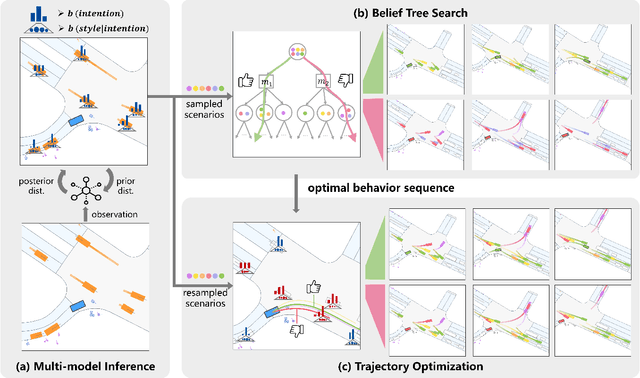
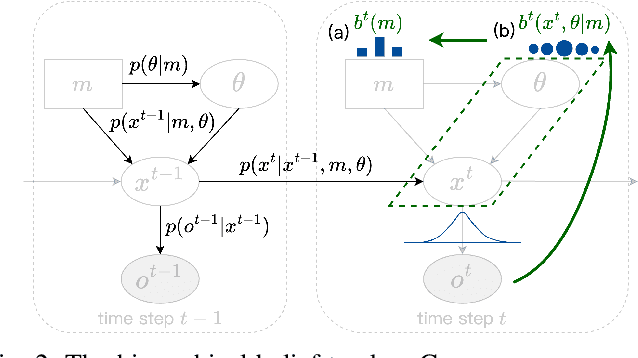

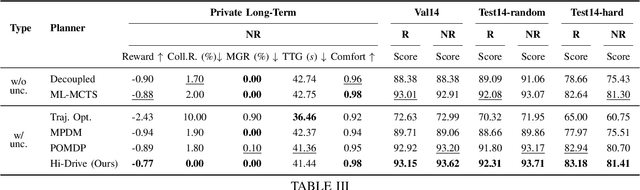
Uncertainties in dynamic road environments pose significant challenges for behavior and trajectory planning in autonomous driving. This paper introduces BoT-Drive, a planning algorithm that addresses uncertainties at both behavior and trajectory levels within a Partially Observable Markov Decision Process (POMDP) framework. BoT-Drive employs driver models to characterize unknown behavioral intentions and utilizes their model parameters to infer hidden driving styles. By also treating driver models as decision-making actions for the autonomous vehicle, BoT-Drive effectively tackles the exponential complexity inherent in POMDPs. To enhance safety and robustness, the planner further applies importance sampling to refine the driving trajectory conditioned on the planned high-level behavior. Evaluation on real-world data shows that BoT-Drive consistently outperforms both existing planning methods and learning-based methods in regular and complex urban driving scenes, demonstrating significant improvements in driving safety and reliability.