 Add to Chrome
 Add to Firefox
 Add to Edge
Mimic Intent, Not Just Trajectories
Feb 09, 2026
While imitation learning (IL) has achieved impressive success in dexterous manipulation through generative modeling and pretraining, state-of-the-art approaches like Vision-Language-Action (VLA) models still struggle with adaptation to environmental changes and skill transfer. We argue this stems from mimicking raw trajectories without understanding the underlying intent. To address this, we propose explicitly disentangling behavior intent from execution details in end-2-end IL: \textit{``Mimic Intent, Not just Trajectories'' (MINT)}. We achieve this via \textit{multi-scale frequency-space tokenization}, which enforces a spectral decomposition of action chunk representation. We learn action tokens with a multi-scale coarse-to-fine structure, and force the coarsest token to capture low-frequency global structure and finer tokens to encode high-frequency details. This yields an abstract \textit{Intent token} that facilitates planning and transfer, and multi-scale \textit{Execution tokens} that enable precise adaptation to environmental dynamics. Building on this hierarchy, our policy generates trajectories through \textit{next-scale autoregression}, performing progressive \textit{intent-to-execution reasoning}, thus boosting learning efficiency and generalization. Crucially, this disentanglement enables \textit{one-shot transfer} of skills, by simply injecting the Intent token from a demonstration into the autoregressive generation process. Experiments on several manipulation benchmarks and on a real robot demonstrate state-of-the-art success rates, superior inference efficiency, robust generalization against disturbances, and effective one-shot transfer.

BoT-Drive: Hierarchical Behavior and Trajectory Planning for Autonomous Driving using POMDPs
Sep 27, 2024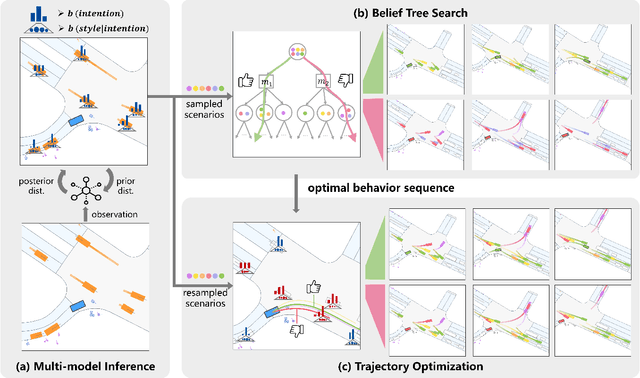
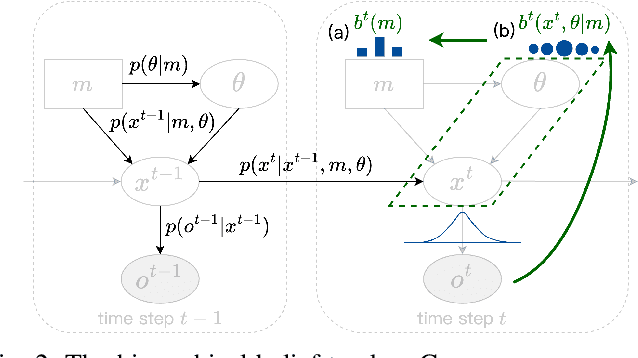

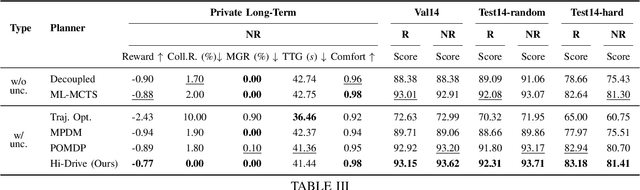
Uncertainties in dynamic road environments pose significant challenges for behavior and trajectory planning in autonomous driving. This paper introduces BoT-Drive, a planning algorithm that addresses uncertainties at both behavior and trajectory levels within a Partially Observable Markov Decision Process (POMDP) framework. BoT-Drive employs driver models to characterize unknown behavioral intentions and utilizes their model parameters to infer hidden driving styles. By also treating driver models as decision-making actions for the autonomous vehicle, BoT-Drive effectively tackles the exponential complexity inherent in POMDPs. To enhance safety and robustness, the planner further applies importance sampling to refine the driving trajectory conditioned on the planned high-level behavior. Evaluation on real-world data shows that BoT-Drive consistently outperforms both existing planning methods and learning-based methods in regular and complex urban driving scenes, demonstrating significant improvements in driving safety and reliability.