 Add to Chrome
 Add to Firefox
 Add to Edge
DIG-MILP: a Deep Instance Generator for Mixed-Integer Linear Programming with Feasibility Guarantee
Oct 20, 2023
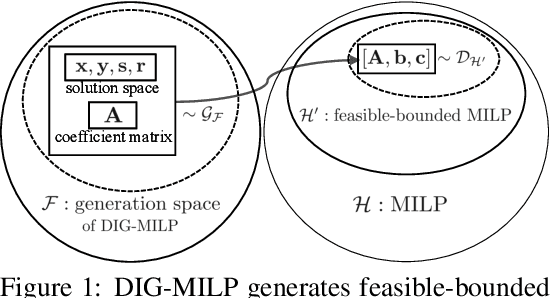
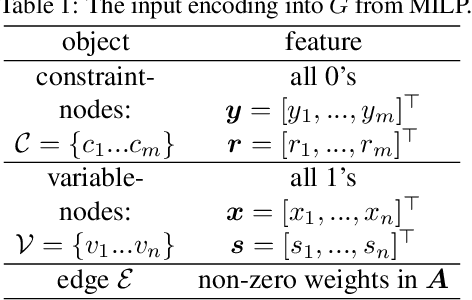
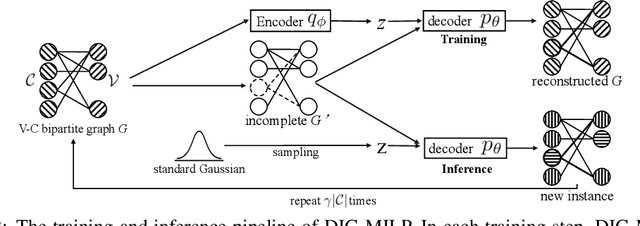

Mixed-integer linear programming (MILP) stands as a notable NP-hard problem pivotal to numerous crucial industrial applications. The development of effective algorithms, the tuning of solvers, and the training of machine learning models for MILP resolution all hinge on access to extensive, diverse, and representative data. Yet compared to the abundant naturally occurring data in image and text realms, MILP is markedly data deficient, underscoring the vital role of synthetic MILP generation. We present DIG-MILP, a deep generative framework based on variational auto-encoder (VAE), adept at extracting deep-level structural features from highly limited MILP data and producing instances that closely mirror the target data. Notably, by leveraging the MILP duality, DIG-MILP guarantees a correct and complete generation space as well as ensures the boundedness and feasibility of the generated instances. Our empirical study highlights the novelty and quality of the instances generated by DIG-MILP through two distinct downstream tasks: (S1) Data sharing, where solver solution times correlate highly positive between original and DIG-MILP-generated instances, allowing data sharing for solver tuning without publishing the original data; (S2) Data Augmentation, wherein the DIG-MILP-generated instances bolster the generalization performance of machine learning models tasked with resolving MILP problems.

GDL-DS: A Benchmark for Geometric Deep Learning under Distribution Shifts
Oct 12, 2023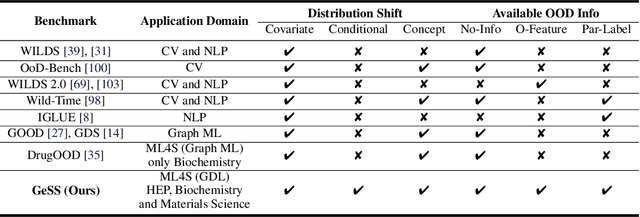
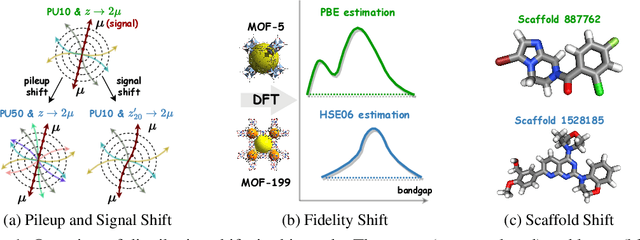
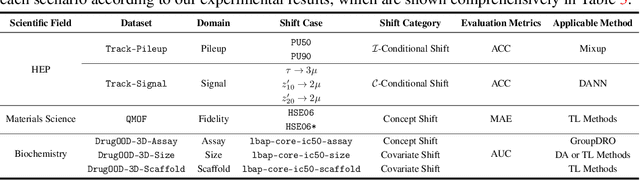
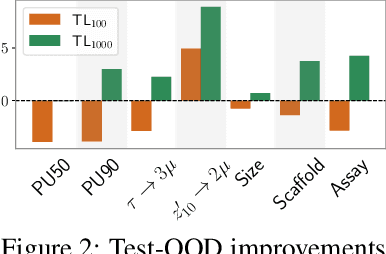
Geometric deep learning (GDL) has gained significant attention in various scientific fields, chiefly for its proficiency in modeling data with intricate geometric structures. Yet, very few works have delved into its capability of tackling the distribution shift problem, a prevalent challenge in many relevant applications. To bridge this gap, we propose GDL-DS, a comprehensive benchmark designed for evaluating the performance of GDL models in scenarios with distribution shifts. Our evaluation datasets cover diverse scientific domains from particle physics and materials science to biochemistry, and encapsulate a broad spectrum of distribution shifts including conditional, covariate, and concept shifts. Furthermore, we study three levels of information access from the out-of-distribution (OOD) testing data, including no OOD information, only OOD features without labels, and OOD features with a few labels. Overall, our benchmark results in 30 different experiment settings, and evaluates 3 GDL backbones and 11 learning algorithms in each setting. A thorough analysis of the evaluation results is provided, poised to illuminate insights for DGL researchers and domain practitioners who are to use DGL in their applications.
On the Stability of Expressive Positional Encodings for Graph Neural Networks
Oct 04, 2023Designing effective positional encodings for graphs is key to building powerful graph transformers and enhancing message-passing graph neural networks. Although widespread, using Laplacian eigenvectors as positional encodings faces two fundamental challenges: (1) \emph{Non-uniqueness}: there are many different eigendecompositions of the same Laplacian, and (2) \emph{Instability}: small perturbations to the Laplacian could result in completely different eigenspaces, leading to unpredictable changes in positional encoding. Despite many attempts to address non-uniqueness, most methods overlook stability, leading to poor generalization on unseen graph structures. We identify the cause of instability to be a "hard partition" of eigenspaces. Hence, we introduce Stable and Expressive Positional Encodings (SPE), an architecture for processing eigenvectors that uses eigenvalues to "softly partition" eigenspaces. SPE is the first architecture that is (1) provably stable, and (2) universally expressive for basis invariant functions whilst respecting all symmetries of eigenvectors. Besides guaranteed stability, we prove that SPE is at least as expressive as existing methods, and highly capable of counting graph structures. Finally, we evaluate the effectiveness of our method on molecular property prediction, and out-of-distribution generalization tasks, finding improved generalization compared to existing positional encoding methods.
Towards Poisoning Fair Representations
Sep 28, 2023Fair machine learning seeks to mitigate model prediction bias against certain demographic subgroups such as elder and female. Recently, fair representation learning (FRL) trained by deep neural networks has demonstrated superior performance, whereby representations containing no demographic information are inferred from the data and then used as the input to classification or other downstream tasks. Despite the development of FRL methods, their vulnerability under data poisoning attack, a popular protocol to benchmark model robustness under adversarial scenarios, is under-explored. Data poisoning attacks have been developed for classical fair machine learning methods which incorporate fairness constraints into shallow-model classifiers. Nonetheless, these attacks fall short in FRL due to notably different fairness goals and model architectures. This work proposes the first data poisoning framework attacking FRL. We induce the model to output unfair representations that contain as much demographic information as possible by injecting carefully crafted poisoning samples into the training data. This attack entails a prohibitive bilevel optimization, wherefore an effective approximated solution is proposed. A theoretical analysis on the needed number of poisoning samples is derived and sheds light on defending against the attack. Experiments on benchmark fairness datasets and state-of-the-art fair representation learning models demonstrate the superiority of our attack.
Optimal Resource Allocation for U-Shaped Parallel Split Learning
Aug 17, 2023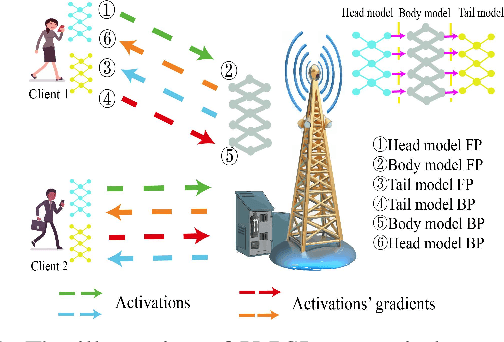
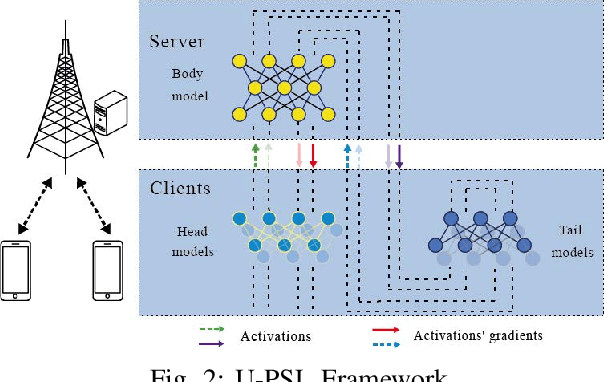
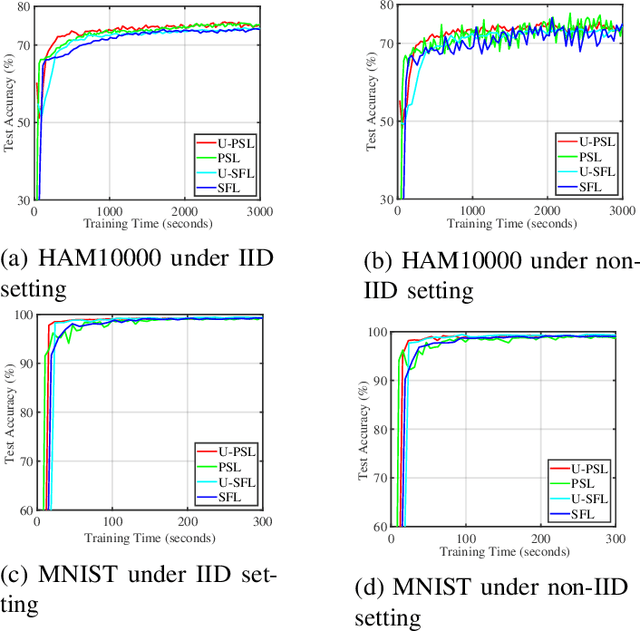
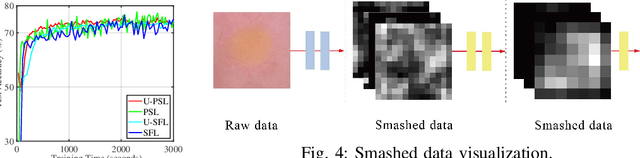
Split learning (SL) has emerged as a promising approach for model training without revealing the raw data samples from the data owners. However, traditional SL inevitably leaks label privacy as the tail model (with the last layers) should be placed on the server. To overcome this limitation, one promising solution is to utilize U-shaped architecture to leave both early layers and last layers on the user side. In this paper, we develop a novel parallel U-shaped split learning and devise the optimal resource optimization scheme to improve the performance of edge networks. In the proposed framework, multiple users communicate with an edge server for SL. We analyze the end-to-end delay of each client during the training process and design an efficient resource allocation algorithm, called LSCRA, which finds the optimal computing resource allocation and split layers. Our experimental results show the effectiveness of LSCRA and that U-shaped PSL can achieve a similar performance with other SL baselines while preserving label privacy. Index Terms: U-shaped network, split learning, label privacy, resource allocation, 5G/6G edge networks.
Polynomial Width is Sufficient for Set Representation with High-dimensional Features
Jul 19, 2023Set representation has become ubiquitous in deep learning for modeling the inductive bias of neural networks that are insensitive to the input order. DeepSets is the most widely used neural network architecture for set representation. It involves embedding each set element into a latent space with dimension $L$, followed by a sum pooling to obtain a whole-set embedding, and finally mapping the whole-set embedding to the output. In this work, we investigate the impact of the dimension $L$ on the expressive power of DeepSets. Previous analyses either oversimplified high-dimensional features to be one-dimensional features or were limited to analytic activations, thereby diverging from practical use or resulting in $L$ that grows exponentially with the set size $N$ and feature dimension $D$. To investigate the minimal value of $L$ that achieves sufficient expressive power, we present two set-element embedding layers: (a) linear + power activation (LP) and (b) linear + exponential activations (LE). We demonstrate that $L$ being poly$(N, D)$ is sufficient for set representation using both embedding layers. We also provide a lower bound of $L$ for the LP embedding layer. Furthermore, we extend our results to permutation-equivariant set functions and the complex field.
Differentially Private Decoupled Graph Convolutions for Multigranular Topology Protection
Jul 12, 2023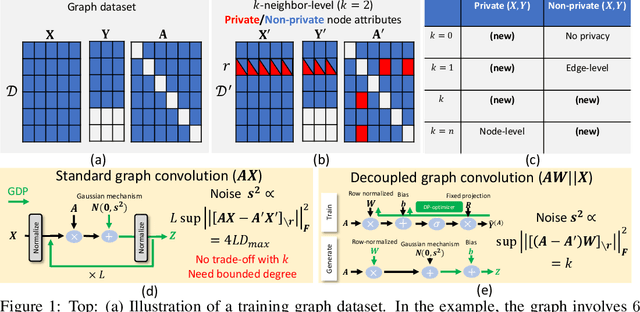
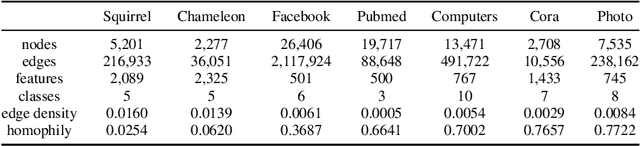
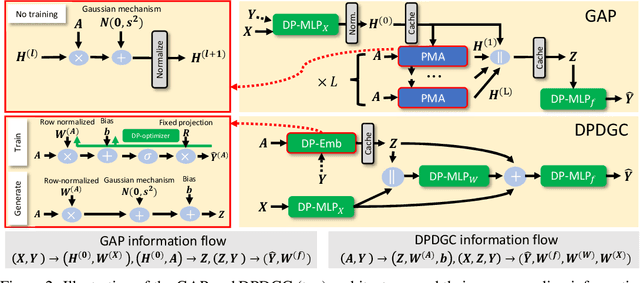
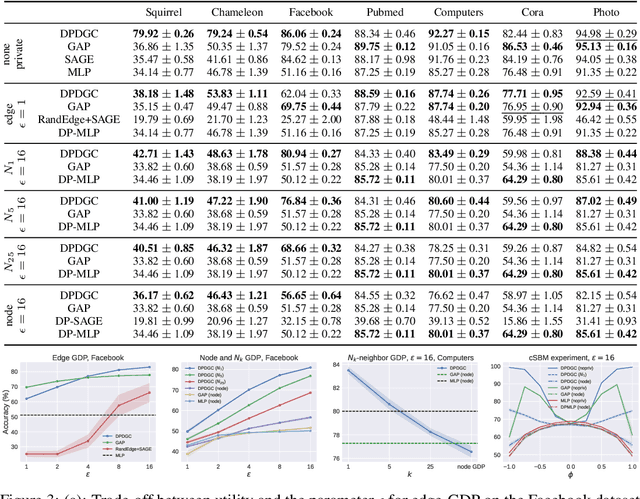
Graph learning methods, such as Graph Neural Networks (GNNs) based on graph convolutions, are highly successful in solving real-world learning problems involving graph-structured data. However, graph learning methods expose sensitive user information and interactions not only through their model parameters but also through their model predictions. Consequently, standard Differential Privacy (DP) techniques that merely offer model weight privacy are inadequate. This is especially the case for node predictions that leverage neighboring node attributes directly via graph convolutions that create additional risks of privacy leakage. To address this problem, we introduce Graph Differential Privacy (GDP), a new formal DP framework tailored to graph learning settings that ensures both provably private model parameters and predictions. Furthermore, since there may be different privacy requirements for the node attributes and graph structure, we introduce a novel notion of relaxed node-level data adjacency. This relaxation can be used for establishing guarantees for different degrees of graph topology privacy while maintaining node attribute privacy. Importantly, this relaxation reveals a useful trade-off between utility and topology privacy for graph learning methods. In addition, our analysis of GDP reveals that existing DP-GNNs fail to exploit this trade-off due to the complex interplay between graph topology and attribute data in standard graph convolution designs. To mitigate this problem, we introduce the Differentially Private Decoupled Graph Convolution (DPDGC) model, which benefits from decoupled graph convolution while providing GDP guarantees. Extensive experiments on seven node classification benchmarking datasets demonstrate the superior privacy-utility trade-off of DPDGC over existing DP-GNNs based on standard graph convolution design.
GAD-NR: Graph Anomaly Detection via Neighborhood Reconstruction
Jun 07, 2023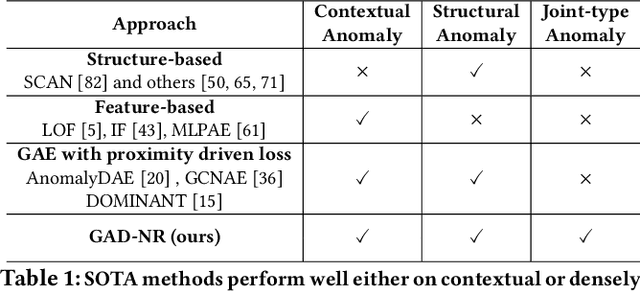
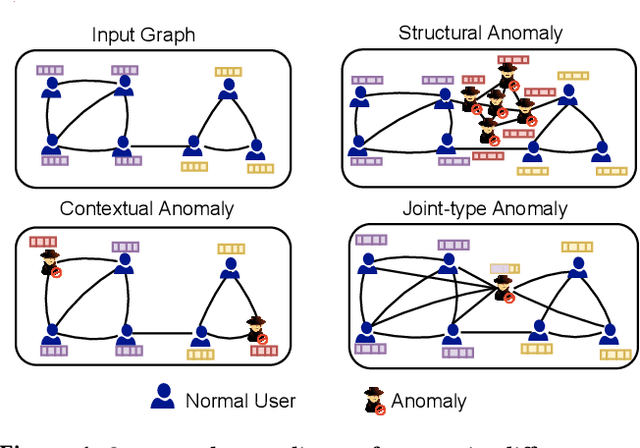
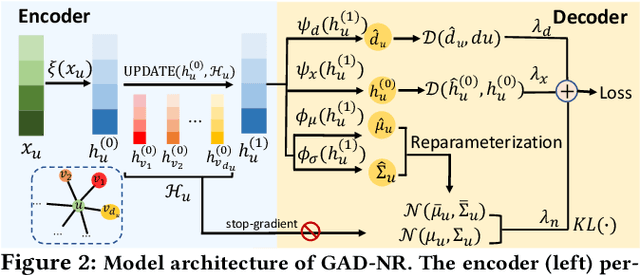
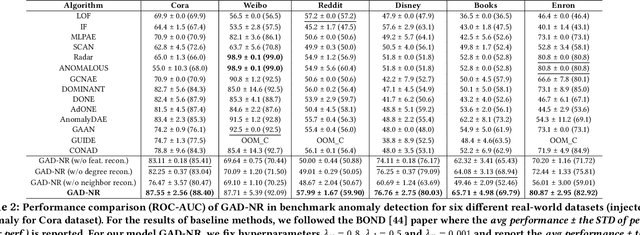
Graph Anomaly Detection (GAD) is a technique used to identify abnormal nodes within graphs, finding applications in network security, fraud detection, social media spam detection, and various other domains. A common method for GAD is Graph Auto-Encoders (GAEs), which encode graph data into node representations and identify anomalies by assessing the reconstruction quality of the graphs based on these representations. However, existing GAE models are primarily optimized for direct link reconstruction, resulting in nodes connected in the graph being clustered in the latent space. As a result, they excel at detecting cluster-type structural anomalies but struggle with more complex structural anomalies that do not conform to clusters. To address this limitation, we propose a novel solution called GAD-NR, a new variant of GAE that incorporates neighborhood reconstruction for graph anomaly detection. GAD-NR aims to reconstruct the entire neighborhood of a node, encompassing the local structure, self-attributes, and neighbor attributes, based on the corresponding node representation. By comparing the neighborhood reconstruction loss between anomalous nodes and normal nodes, GAD-NR can effectively detect any anomalies. Extensive experimentation conducted on six real-world datasets validates the effectiveness of GAD-NR, showcasing significant improvements (by up to 30% in AUC) over state-of-the-art competitors. The source code for GAD-NR is openly available. Importantly, the comparative analysis reveals that the existing methods perform well only in detecting one or two types of anomalies out of the three types studied. In contrast, GAD-NR excels at detecting all three types of anomalies across the datasets, demonstrating its comprehensive anomaly detection capabilities.
Structural Re-weighting Improves Graph Domain Adaptation
Jun 05, 2023In many real-world applications, graph-structured data used for training and testing have differences in distribution, such as in high energy physics (HEP) where simulation data used for training may not match real experiments. Graph domain adaptation (GDA) is a method used to address these differences. However, current GDA primarily works by aligning the distributions of node representations output by a single graph neural network encoder shared across the training and testing domains, which may often yield sub-optimal solutions. This work examines different impacts of distribution shifts caused by either graph structure or node attributes and identifies a new type of shift, named conditional structure shift (CSS), which current GDA approaches are provably sub-optimal to deal with. A novel approach, called structural reweighting (StruRW), is proposed to address this issue and is tested on synthetic graphs, four benchmark datasets, and a new application in HEP. StruRW has shown significant performance improvement over the baselines in the settings with large graph structure shifts, and reasonable performance improvement when node attribute shift dominates.
Hierarchical Reinforcement Learning for Modeling User Novelty-Seeking Intent in Recommender Systems
Jun 02, 2023Recommending novel content, which expands user horizons by introducing them to new interests, has been shown to improve users' long-term experience on recommendation platforms \cite{chen2021values}. Users however are not constantly looking to explore novel content. It is therefore crucial to understand their novelty-seeking intent and adjust the recommendation policy accordingly. Most existing literature models a user's propensity to choose novel content or to prefer a more diverse set of recommendations at individual interactions. Hierarchical structure, on the other hand, exists in a user's novelty-seeking intent, which is manifested as a static and intrinsic user preference for seeking novelty along with a dynamic session-based propensity. To this end, we propose a novel hierarchical reinforcement learning-based method to model the hierarchical user novelty-seeking intent, and to adapt the recommendation policy accordingly based on the extracted user novelty-seeking propensity. We further incorporate diversity and novelty-related measurement in the reward function of the hierarchical RL (HRL) agent to encourage user exploration \cite{chen2021values}. We demonstrate the benefits of explicitly modeling hierarchical user novelty-seeking intent in recommendations through extensive experiments on simulated and real-world datasets. In particular, we demonstrate that the effectiveness of our proposed hierarchical RL-based method lies in its ability to capture such hierarchically-structured intent. As a result, the proposed HRL model achieves superior performance on several public datasets, compared with state-of-art baselines.