 Add to Chrome
 Add to Firefox
 Add to Edge
Multi-task Just Recognizable Difference for Video Coding for Machines: Database, Model, and Coding Application
Apr 10, 2026
Just Recognizable Difference (JRD) boosts coding efficiency for machine vision through visibility threshold modeling, but is currently limited to a single-task scenario. To address this issue, we propose a Multi-Task JRD (MT-JRD) dataset and an Attribute-assisted MT-JRD (AMT-JRD) model for Video Coding for Machines (VCM), enhancing both prediction accuracy and coding efficiency. First, we construct a dataset comprising 27,264 JRD annotations from machines, supporting three representative tasks including object detection, instance segmentation, and keypoint detection. Secondly, we propose the AMT-JRD prediction model, which integrates Generalized Feature Extraction Module (GFEM) and Specialized Feature Extraction Module (SFEM) to facilitate joint learning across multiple tasks. Thirdly, we innovatively incorporate object attribute information into object-wise JRD prediction through the Attribute Feature Fusion Module (AFFM), which introduces prior knowledge about object size and location. This design effectively compensates for the limitations of relying solely on image features and enhances the model's capacity to represent the perceptual mechanisms of machine vision. Finally, we apply the AMT-JRD model to VCM, where the accurately predicted JRDs are applied to reduce the coding bit rate while preserving accuracy across multiple machine vision tasks. Extensive experimental results demonstrate that AMT-JRD achieves precise and robust multi-task prediction with a mean absolute error of 3.781 and error variance of 5.332 across three tasks, outperforming the state-of-the-art single-task prediction model by 6.7% and 6.3%, respectively. Coding experiments further reveal that compared to the baseline VVC and JPEG, the AMT-JRD-based VCM improves an average of 3.861% and 7.886% Bjontegaard Delta-mean Average Precision (BD-mAP), respectively.

Learning-Based User Association for MmWave Vehicular Networks With Kernelized Contextual Bandits
Apr 15, 2025Vehicles require timely channel conditions to determine the base station (BS) to communicate with, but it is costly to estimate the fast-fading mmWave channels frequently. Without additional channel estimations, the proposed Distributed Kernelized Upper Confidence Bound (DK-UCB) algorithm estimates the current instantaneous transmission rates utilizing past contexts, such as the vehicle's location and velocity, along with past instantaneous transmission rates. To capture the nonlinear mapping from a context to the instantaneous transmission rate, DK-UCB maps a context into the reproducing kernel Hilbert space (RKHS) where a linear mapping becomes observable. To improve estimation accuracy, we propose a novel kernel function in RKHS which incorporates the propagation characteristics of the mmWave signals. Moreover, DK-UCB encourages a vehicle to share necessary information when it has conducted significant explorations, which speeds up the learning process while maintaining affordable communication costs.
Contextual Bandits with Non-Stationary Correlated Rewards for User Association in MmWave Vehicular Networks
Oct 08, 2024

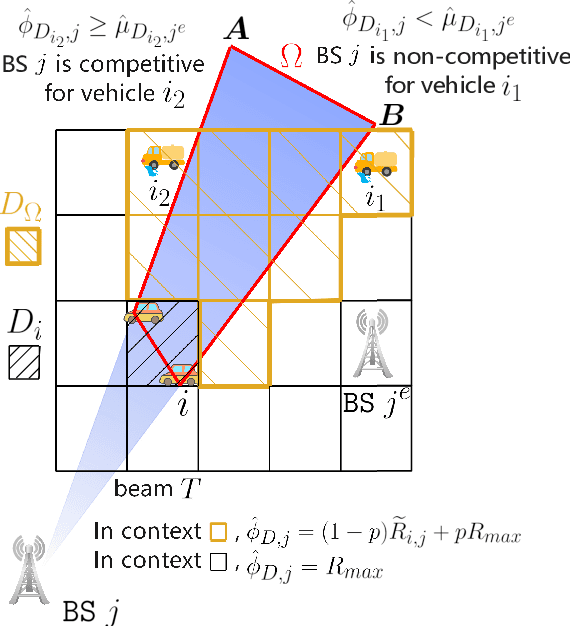

Millimeter wave (mmWave) communication has emerged as a propelling technology in vehicular communication. Usually, an appropriate decision on user association requires timely channel information between vehicles and base stations (BSs), which is challenging given a fast-fading mmWave vehicular channel. In this paper, relying solely on learning transmission rate, we propose a low-complexity semi-distributed contextual correlated upper confidence bound (SD-CC-UCB) algorithm to establish an up-to-date user association without explicit measurement of channel state information (CSI). Under a contextual multi-arm bandits framework, SD-CC-UCB learns and predicts the transmission rate given the location and velocity of the vehicle, which can adequately capture the intricate channel condition for a prompt decision on user association. Further, SD-CC-UCB efficiently identifies the set of candidate BSs which probably support supreme transmission rate by leveraging the correlated distributions of transmission rates on different locations. To further refine the learning transmission rate over the link to candidate BSs, each vehicle deploys the Thompson Sampling algorithm by taking the interference among vehicles and handover overhead into consideration. Numerical results show that our proposed algorithm achieves the network throughput within 100%-103% of a benchmark algorithm which requires perfect instantaneous CSI, demonstrating the effectiveness of SD-CC-UCB in vehicular communications.
Optimal Resource Allocation for U-Shaped Parallel Split Learning
Aug 17, 2023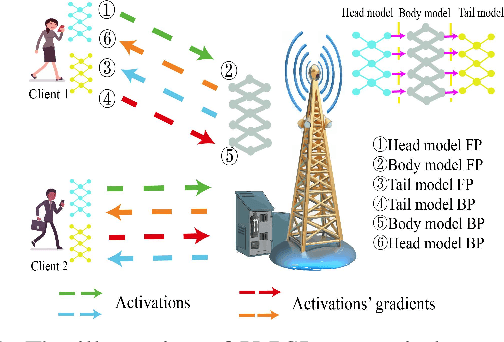
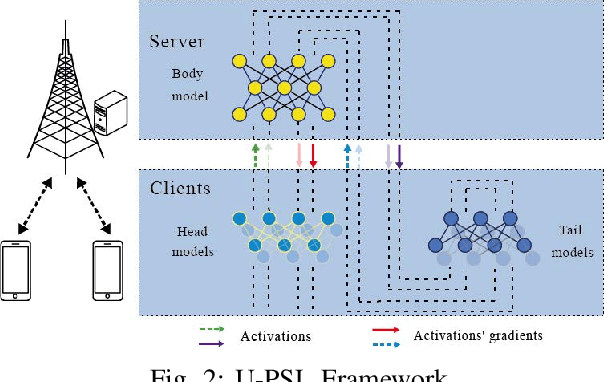
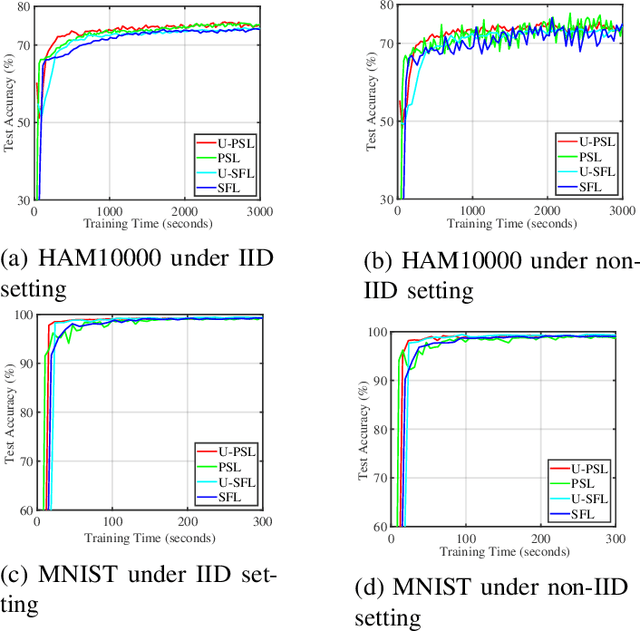
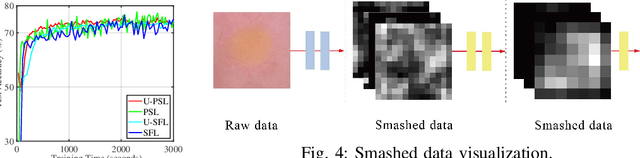
Split learning (SL) has emerged as a promising approach for model training without revealing the raw data samples from the data owners. However, traditional SL inevitably leaks label privacy as the tail model (with the last layers) should be placed on the server. To overcome this limitation, one promising solution is to utilize U-shaped architecture to leave both early layers and last layers on the user side. In this paper, we develop a novel parallel U-shaped split learning and devise the optimal resource optimization scheme to improve the performance of edge networks. In the proposed framework, multiple users communicate with an edge server for SL. We analyze the end-to-end delay of each client during the training process and design an efficient resource allocation algorithm, called LSCRA, which finds the optimal computing resource allocation and split layers. Our experimental results show the effectiveness of LSCRA and that U-shaped PSL can achieve a similar performance with other SL baselines while preserving label privacy. Index Terms: U-shaped network, split learning, label privacy, resource allocation, 5G/6G edge networks.