 Add to Chrome
 Add to Firefox
 Add to Edge
Machine Learning on Heterogeneous, Edge, and Quantum Hardware for Particle Physics (ML-HEQUPP)
Feb 24, 2026
The next generation of particle physics experiments will face a new era of challenges in data acquisition, due to unprecedented data rates and volumes along with extreme environments and operational constraints. Harnessing this data for scientific discovery demands real-time inference and decision-making, intelligent data reduction, and efficient processing architectures beyond current capabilities. Crucial to the success of this experimental paradigm are several emerging technologies, such as artificial intelligence and machine learning (AI/ML) and silicon microelectronics, and the advent of quantum algorithms and processing. Their intersection includes areas of research such as low-power and low-latency devices for edge computing, heterogeneous accelerator systems, reconfigurable hardware, novel codesign and synthesis strategies, readout for cryogenic or high-radiation environments, and analog computing. This white paper presents a community-driven vision to identify and prioritize research and development opportunities in hardware-based ML systems and corresponding physics applications, contributing towards a successful transition to the new data frontier of fundamental science.

Structural Re-weighting Improves Graph Domain Adaptation
Jun 05, 2023In many real-world applications, graph-structured data used for training and testing have differences in distribution, such as in high energy physics (HEP) where simulation data used for training may not match real experiments. Graph domain adaptation (GDA) is a method used to address these differences. However, current GDA primarily works by aligning the distributions of node representations output by a single graph neural network encoder shared across the training and testing domains, which may often yield sub-optimal solutions. This work examines different impacts of distribution shifts caused by either graph structure or node attributes and identifies a new type of shift, named conditional structure shift (CSS), which current GDA approaches are provably sub-optimal to deal with. A novel approach, called structural reweighting (StruRW), is proposed to address this issue and is tested on synthetic graphs, four benchmark datasets, and a new application in HEP. StruRW has shown significant performance improvement over the baselines in the settings with large graph structure shifts, and reasonable performance improvement when node attribute shift dominates.
Physics Community Needs, Tools, and Resources for Machine Learning
Mar 30, 2022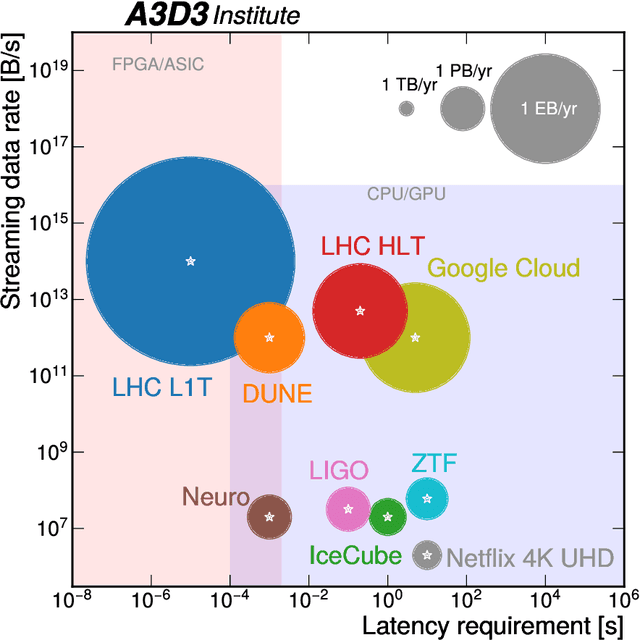
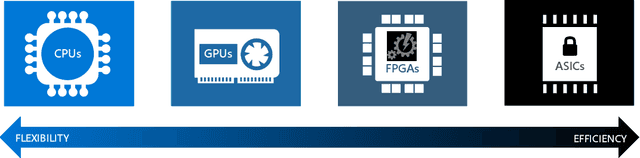
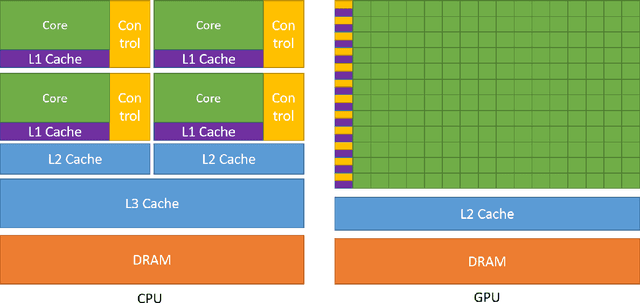
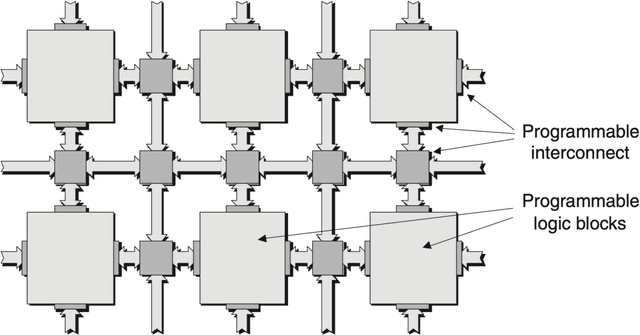
Machine learning (ML) is becoming an increasingly important component of cutting-edge physics research, but its computational requirements present significant challenges. In this white paper, we discuss the needs of the physics community regarding ML across latency and throughput regimes, the tools and resources that offer the possibility of addressing these needs, and how these can be best utilized and accessed in the coming years.