 Add to Chrome
 Add to Firefox
 Add to Edge
Lip Reading Sentences in the Wild
Jan 30, 2017
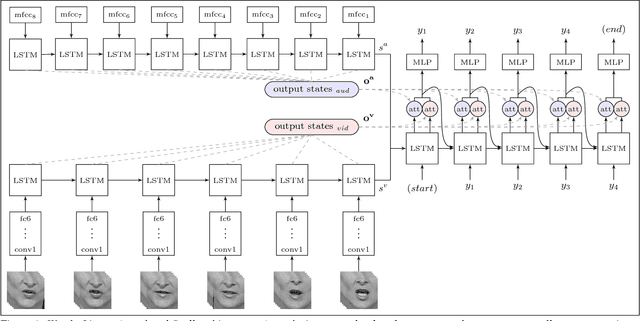
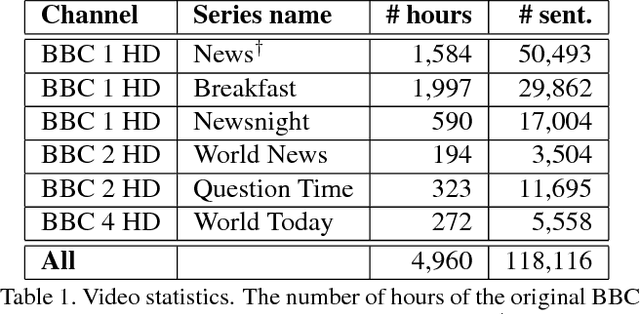
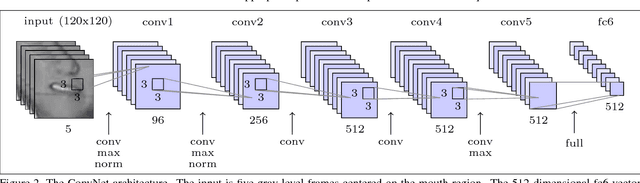
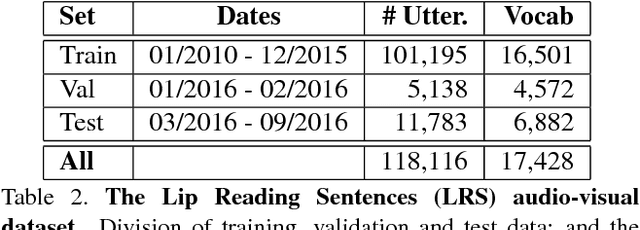
The goal of this work is to recognise phrases and sentences being spoken by a talking face, with or without the audio. Unlike previous works that have focussed on recognising a limited number of words or phrases, we tackle lip reading as an open-world problem - unconstrained natural language sentences, and in the wild videos. Our key contributions are: (1) a 'Watch, Listen, Attend and Spell' (WLAS) network that learns to transcribe videos of mouth motion to characters; (2) a curriculum learning strategy to accelerate training and to reduce overfitting; (3) a 'Lip Reading Sentences' (LRS) dataset for visual speech recognition, consisting of over 100,000 natural sentences from British television. The WLAS model trained on the LRS dataset surpasses the performance of all previous work on standard lip reading benchmark datasets, often by a significant margin. This lip reading performance beats a professional lip reader on videos from BBC television, and we also demonstrate that visual information helps to improve speech recognition performance even when the audio is available.

Adversarial Evaluation of Dialogue Models
Jan 27, 2017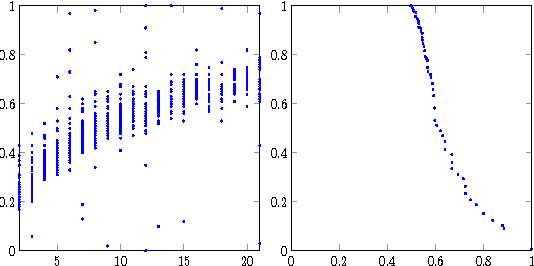
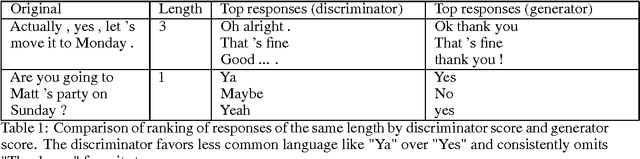
The recent application of RNN encoder-decoder models has resulted in substantial progress in fully data-driven dialogue systems, but evaluation remains a challenge. An adversarial loss could be a way to directly evaluate the extent to which generated dialogue responses sound like they came from a human. This could reduce the need for human evaluation, while more directly evaluating on a generative task. In this work, we investigate this idea by training an RNN to discriminate a dialogue model's samples from human-generated samples. Although we find some evidence this setup could be viable, we also note that many issues remain in its practical application. We discuss both aspects and conclude that future work is warranted.
Connecting Generative Adversarial Networks and Actor-Critic Methods
Jan 18, 2017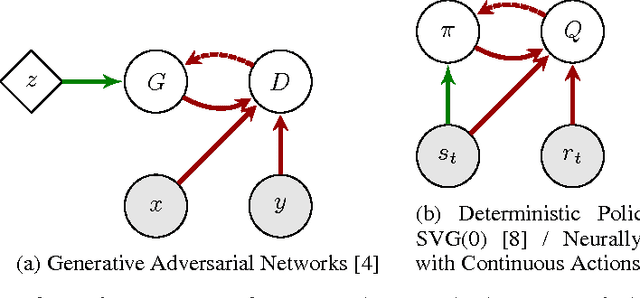
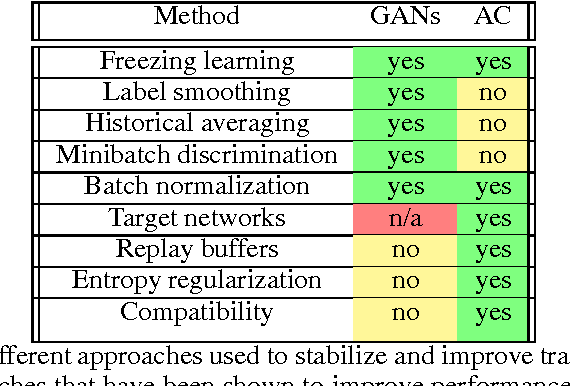
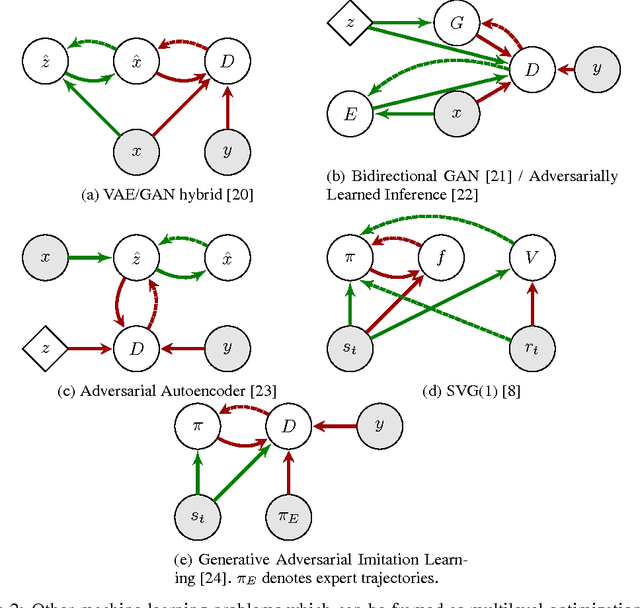
Both generative adversarial networks (GAN) in unsupervised learning and actor-critic methods in reinforcement learning (RL) have gained a reputation for being difficult to optimize. Practitioners in both fields have amassed a large number of strategies to mitigate these instabilities and improve training. Here we show that GANs can be viewed as actor-critic methods in an environment where the actor cannot affect the reward. We review the strategies for stabilizing training for each class of models, both those that generalize between the two and those that are particular to that model. We also review a number of extensions to GANs and RL algorithms with even more complicated information flow. We hope that by highlighting this formal connection we will encourage both GAN and RL communities to develop general, scalable, and stable algorithms for multilevel optimization with deep networks, and to draw inspiration across communities.
Pointer Networks
Jan 02, 2017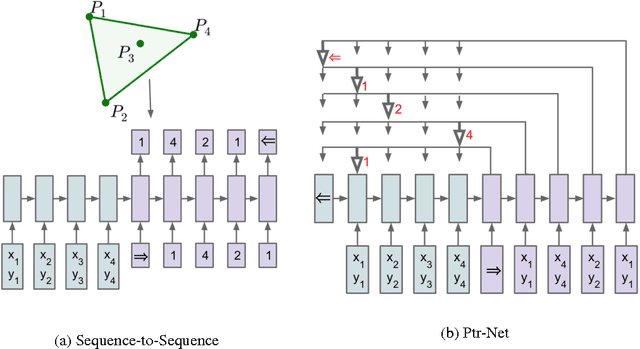
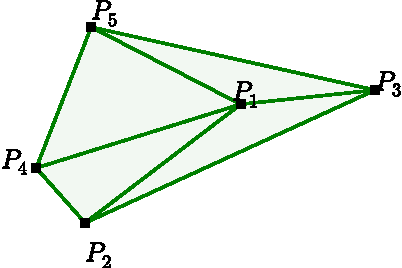
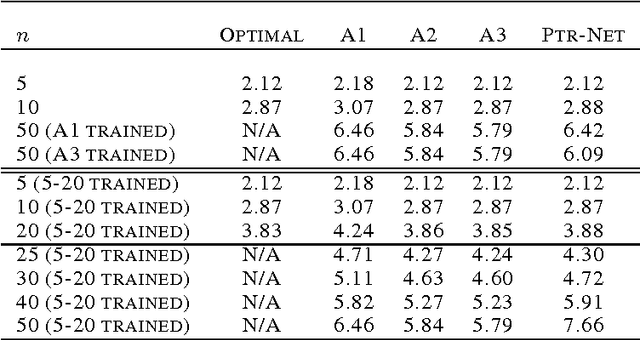
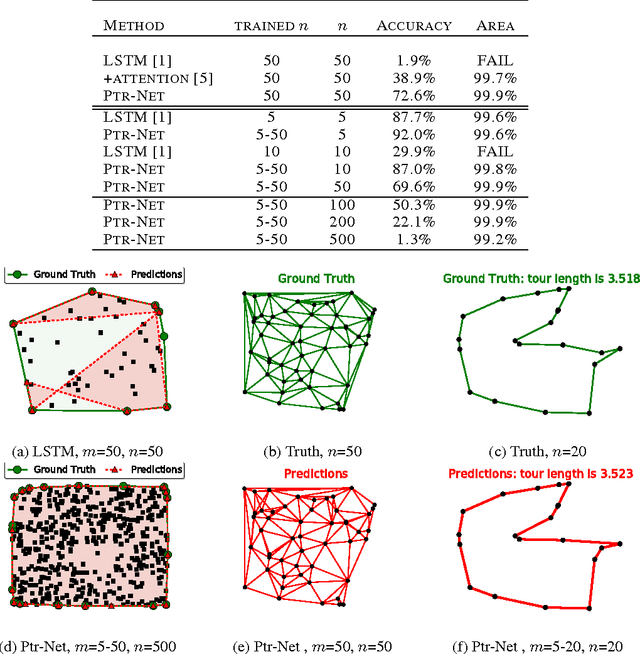
We introduce a new neural architecture to learn the conditional probability of an output sequence with elements that are discrete tokens corresponding to positions in an input sequence. Such problems cannot be trivially addressed by existent approaches such as sequence-to-sequence and Neural Turing Machines, because the number of target classes in each step of the output depends on the length of the input, which is variable. Problems such as sorting variable sized sequences, and various combinatorial optimization problems belong to this class. Our model solves the problem of variable size output dictionaries using a recently proposed mechanism of neural attention. It differs from the previous attention attempts in that, instead of using attention to blend hidden units of an encoder to a context vector at each decoder step, it uses attention as a pointer to select a member of the input sequence as the output. We call this architecture a Pointer Net (Ptr-Net). We show Ptr-Nets can be used to learn approximate solutions to three challenging geometric problems -- finding planar convex hulls, computing Delaunay triangulations, and the planar Travelling Salesman Problem -- using training examples alone. Ptr-Nets not only improve over sequence-to-sequence with input attention, but also allow us to generalize to variable size output dictionaries. We show that the learnt models generalize beyond the maximum lengths they were trained on. We hope our results on these tasks will encourage a broader exploration of neural learning for discrete problems.
Google's Neural Machine Translation System: Bridging the Gap between Human and Machine Translation
Oct 08, 2016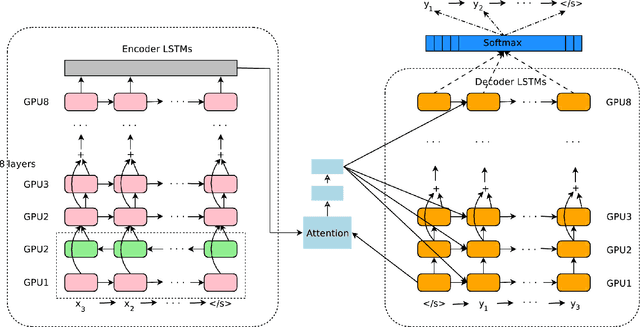
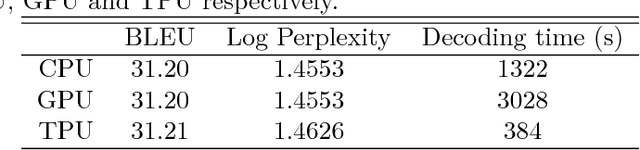
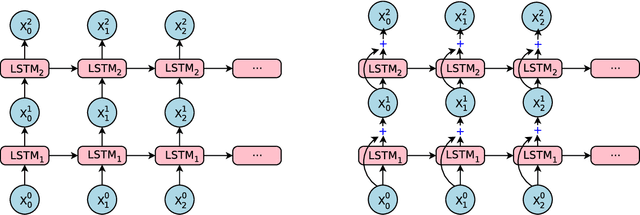
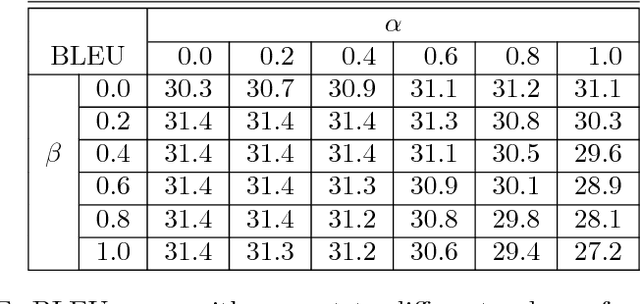
Neural Machine Translation (NMT) is an end-to-end learning approach for automated translation, with the potential to overcome many of the weaknesses of conventional phrase-based translation systems. Unfortunately, NMT systems are known to be computationally expensive both in training and in translation inference. Also, most NMT systems have difficulty with rare words. These issues have hindered NMT's use in practical deployments and services, where both accuracy and speed are essential. In this work, we present GNMT, Google's Neural Machine Translation system, which attempts to address many of these issues. Our model consists of a deep LSTM network with 8 encoder and 8 decoder layers using attention and residual connections. To improve parallelism and therefore decrease training time, our attention mechanism connects the bottom layer of the decoder to the top layer of the encoder. To accelerate the final translation speed, we employ low-precision arithmetic during inference computations. To improve handling of rare words, we divide words into a limited set of common sub-word units ("wordpieces") for both input and output. This method provides a good balance between the flexibility of "character"-delimited models and the efficiency of "word"-delimited models, naturally handles translation of rare words, and ultimately improves the overall accuracy of the system. Our beam search technique employs a length-normalization procedure and uses a coverage penalty, which encourages generation of an output sentence that is most likely to cover all the words in the source sentence. On the WMT'14 English-to-French and English-to-German benchmarks, GNMT achieves competitive results to state-of-the-art. Using a human side-by-side evaluation on a set of isolated simple sentences, it reduces translation errors by an average of 60% compared to Google's phrase-based production system.
Video Pixel Networks
Oct 03, 2016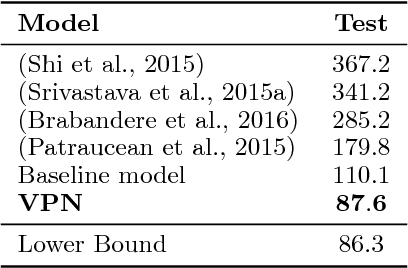
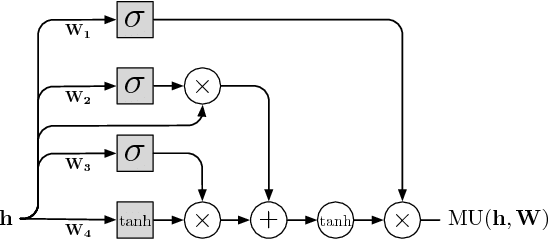
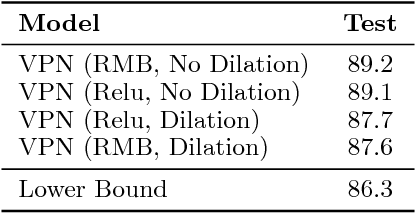

We propose a probabilistic video model, the Video Pixel Network (VPN), that estimates the discrete joint distribution of the raw pixel values in a video. The model and the neural architecture reflect the time, space and color structure of video tensors and encode it as a four-dimensional dependency chain. The VPN approaches the best possible performance on the Moving MNIST benchmark, a leap over the previous state of the art, and the generated videos show only minor deviations from the ground truth. The VPN also produces detailed samples on the action-conditional Robotic Pushing benchmark and generalizes to the motion of novel objects.
Show and Tell: Lessons learned from the 2015 MSCOCO Image Captioning Challenge
Sep 21, 2016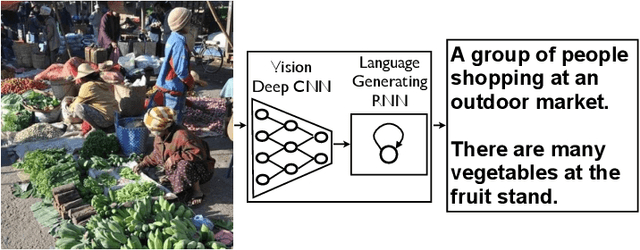
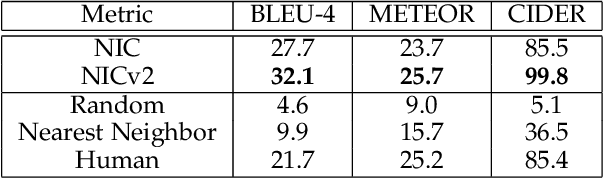
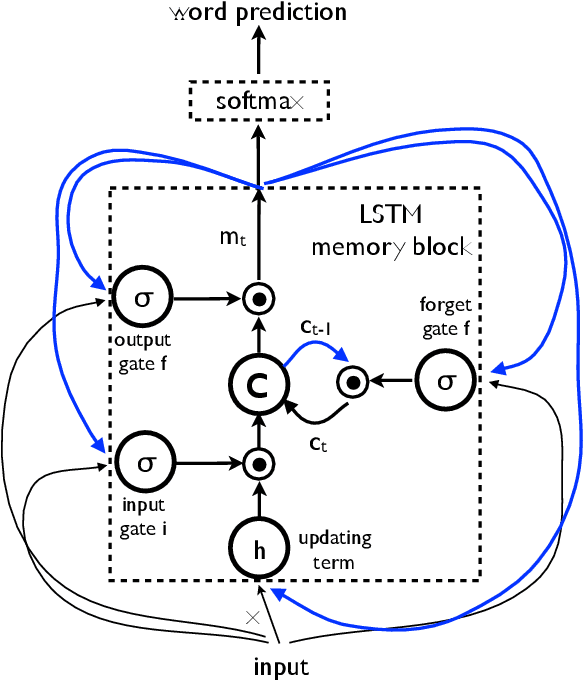
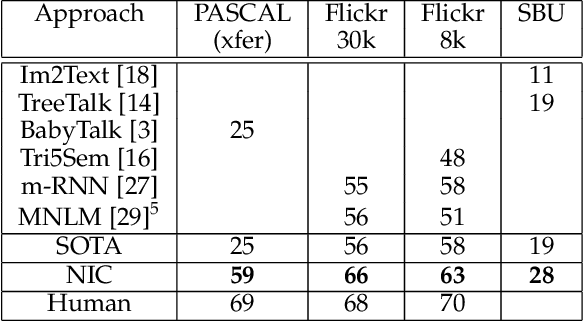
Automatically describing the content of an image is a fundamental problem in artificial intelligence that connects computer vision and natural language processing. In this paper, we present a generative model based on a deep recurrent architecture that combines recent advances in computer vision and machine translation and that can be used to generate natural sentences describing an image. The model is trained to maximize the likelihood of the target description sentence given the training image. Experiments on several datasets show the accuracy of the model and the fluency of the language it learns solely from image descriptions. Our model is often quite accurate, which we verify both qualitatively and quantitatively. Finally, given the recent surge of interest in this task, a competition was organized in 2015 using the newly released COCO dataset. We describe and analyze the various improvements we applied to our own baseline and show the resulting performance in the competition, which we won ex-aequo with a team from Microsoft Research, and provide an open source implementation in TensorFlow.
* arXiv admin note: substantial text overlap with arXiv:1411.4555
WaveNet: A Generative Model for Raw Audio
Sep 19, 2016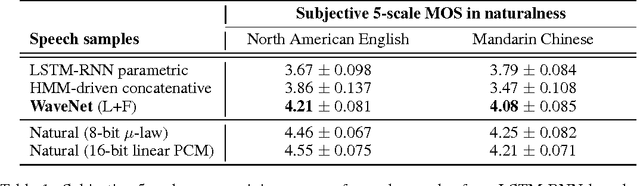
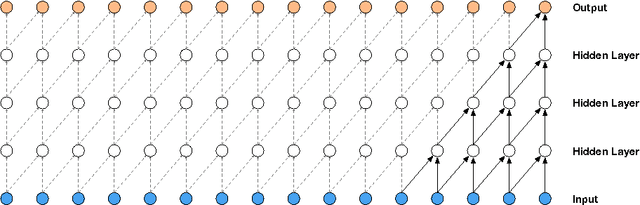
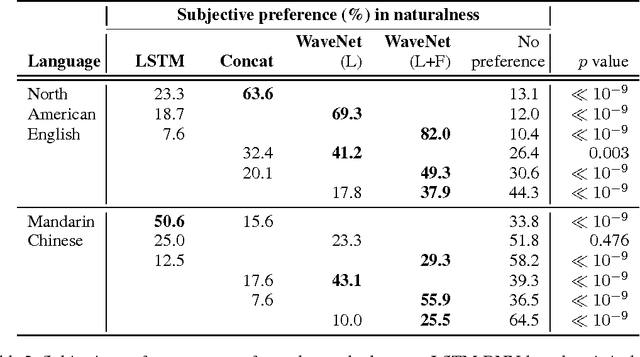
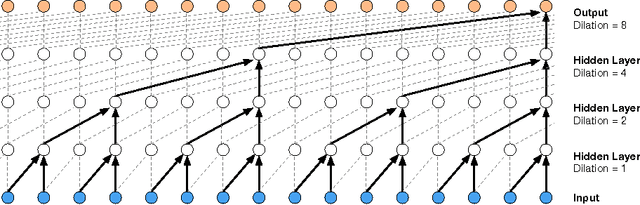
This paper introduces WaveNet, a deep neural network for generating raw audio waveforms. The model is fully probabilistic and autoregressive, with the predictive distribution for each audio sample conditioned on all previous ones; nonetheless we show that it can be efficiently trained on data with tens of thousands of samples per second of audio. When applied to text-to-speech, it yields state-of-the-art performance, with human listeners rating it as significantly more natural sounding than the best parametric and concatenative systems for both English and Mandarin. A single WaveNet can capture the characteristics of many different speakers with equal fidelity, and can switch between them by conditioning on the speaker identity. When trained to model music, we find that it generates novel and often highly realistic musical fragments. We also show that it can be employed as a discriminative model, returning promising results for phoneme recognition.
A Neural Transducer
Aug 04, 2016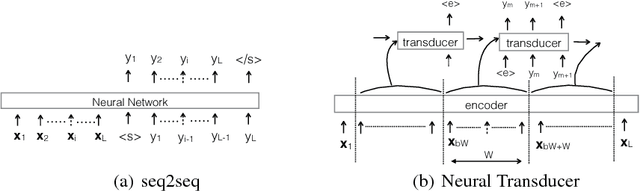

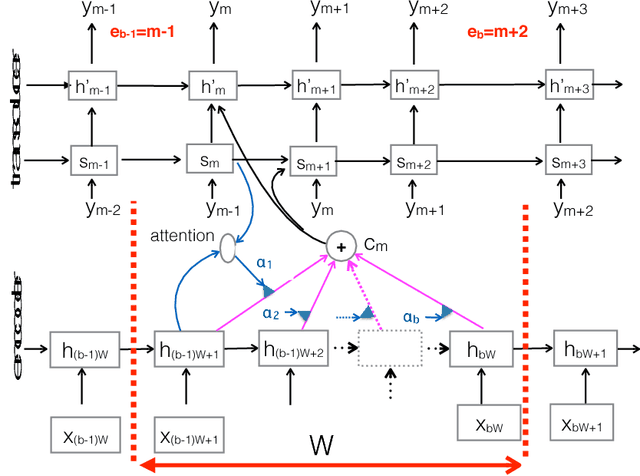
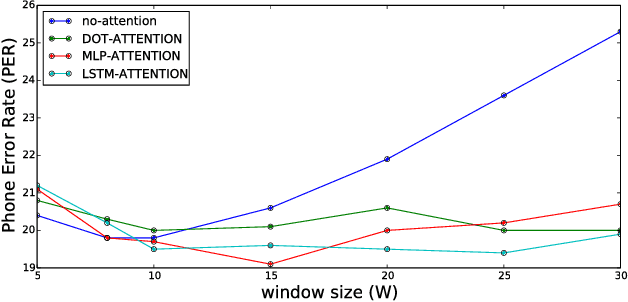
Sequence-to-sequence models have achieved impressive results on various tasks. However, they are unsuitable for tasks that require incremental predictions to be made as more data arrives or tasks that have long input sequences and output sequences. This is because they generate an output sequence conditioned on an entire input sequence. In this paper, we present a Neural Transducer that can make incremental predictions as more input arrives, without redoing the entire computation. Unlike sequence-to-sequence models, the Neural Transducer computes the next-step distribution conditioned on the partially observed input sequence and the partially generated sequence. At each time step, the transducer can decide to emit zero to many output symbols. The data can be processed using an encoder and presented as input to the transducer. The discrete decision to emit a symbol at every time step makes it difficult to learn with conventional backpropagation. It is however possible to train the transducer by using a dynamic programming algorithm to generate target discrete decisions. Our experiments show that the Neural Transducer works well in settings where it is required to produce output predictions as data come in. We also find that the Neural Transducer performs well for long sequences even when attention mechanisms are not used.
Conditional Image Generation with PixelCNN Decoders
Jun 18, 2016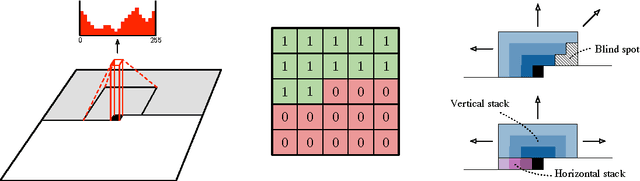
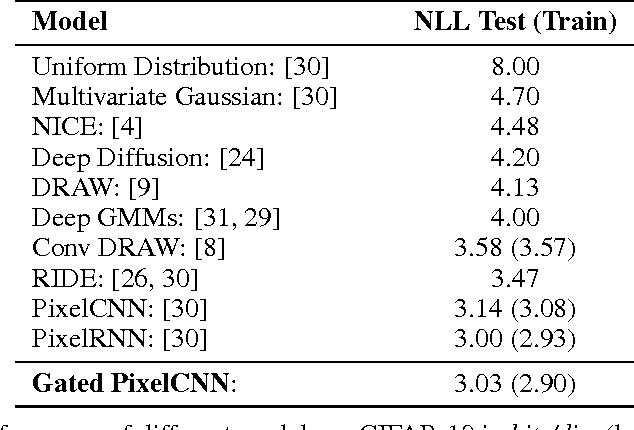
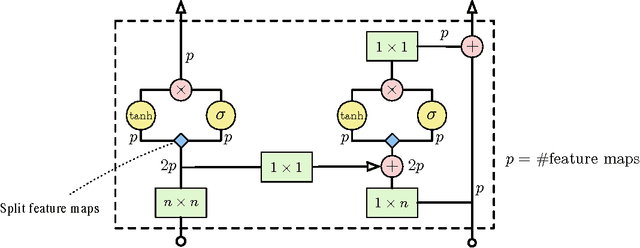
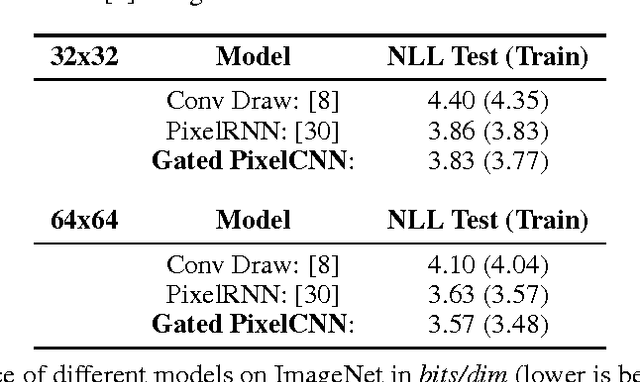
This work explores conditional image generation with a new image density model based on the PixelCNN architecture. The model can be conditioned on any vector, including descriptive labels or tags, or latent embeddings created by other networks. When conditioned on class labels from the ImageNet database, the model is able to generate diverse, realistic scenes representing distinct animals, objects, landscapes and structures. When conditioned on an embedding produced by a convolutional network given a single image of an unseen face, it generates a variety of new portraits of the same person with different facial expressions, poses and lighting conditions. We also show that conditional PixelCNN can serve as a powerful decoder in an image autoencoder. Additionally, the gated convolutional layers in the proposed model improve the log-likelihood of PixelCNN to match the state-of-the-art performance of PixelRNN on ImageNet, with greatly reduced computational cost.