 Add to Chrome
 Add to Firefox
 Add to Edge
Retraining Seeks Stable Signals
Jul 17, 2026
Predictive models deployed at scale influence future data, a phenomenon called performativity. And there is always one way to cope: Train the model on new data, deploy it again, and repeat. This process, called retraining or repeated risk minimization, creates a feedback loop between model and data that real-world learning systems can't avoid. Results on performative prediction shed light on this dynamic: If the model's influence on the data is small, retraining reaches a fixed point. What remains open is why fixed points should naturally exist, and what governs retraining when the model's influence is strong. In this work we develop a new perspective on retraining -- the stable signal principle -- that addresses these questions. We start from the assumption that the prediction target has at least some small model-independent component, a stable signal, such as the intrinsic quality of an item. We prove that when a nonzero stable signal exists, repeated risk minimization, suitably regularized, converges geometrically to the direction of this stable signal. This is true even if the model's influence on the target is arbitrarily large relative to the stable signal. Regularization emerges naturally as a force to control performativity, rather than to promote generalization, revealing a new facet of an old concept. We extend the analysis to a broad family of affine retraining operators under arbitrary model-induced feature changes, heterogeneous time-varying effects, and nonlinear responses. The stable signal perspective also applies to data feedback loops in language modeling, providing new explanations for the stability of language model training from model-generated data.

Correct Looks Better: Pairwise Comparisons Reveal Accuracy Rankings
Jun 08, 2026Pairwise comparisons combined with aggregation methods like Elo have become central to evaluating generative models, yet concerns remain that they reward superficial stylistic cues or display judge biases. In a more positive turn, we show that model rankings from pairwise comparisons strongly agree with ground-truth-based accuracy rankings when such ground truth is available for comparison. By converting five well-known benchmarks into free-form generative evaluations, we find that Elo rankings achieve a Spearman correlation above 0.9 with accuracy rankings and substantially outperform direct evaluation when the judge is weak. Furthermore, style and judge bias have only minor effects on model rankings, despite most judgments occurring on pairs where both candidate answers are correct (or incorrect). On such pairs, we find that repetition after the final answer (echo) is a causal driver of judge preference.
FutureSim: Replaying World Events to Evaluate Adaptive Agents
May 14, 2026AI agents are being increasingly deployed in dynamic, open-ended environments that require adapting to new information as it arrives. To efficiently measure this capability for realistic use-cases, we propose building grounded simulations that replay real-world events in the order they occurred. We build FutureSim, where agents forecast world events beyond their knowledge cutoff while interacting with a chronological replay of the world: real news articles arriving and questions resolving over the simulated period. We evaluate frontier agents in their native harness, testing their ability to predict world events over a three-month period from January to March 2026. FutureSim reveals a clear separation in their capabilities, with the best agent's accuracy being 25%, and many having worse Brier skill score than making no prediction at all. Through careful ablations, we show how FutureSim offers a realistic setting to study emerging research directions like long-horizon test-time adaptation, search, memory, and reasoning about uncertainty. Overall, we hope our benchmark design paves the way to measure AI progress on open-ended adaptation spanning long time-horizons in the real world.
Computational Arbitrage in AI Model Markets
Mar 23, 2026Consider a market of competing model providers selling query access to models with varying costs and capabilities. Customers submit problem instances and are willing to pay up to a budget for a verifiable solution. An arbitrageur efficiently allocates inference budget across providers to undercut the market, thus creating a competitive offering with no model-development risk. In this work, we initiate the study of arbitrage in AI model markets, empirically demonstrating the viability of arbitrage and illustrating its economic consequences. We conduct an in-depth case study of SWE-bench GitHub issue resolution using two representative models, GPT-5 mini and DeepSeek v3.2. In this verifiable domain, simple arbitrage strategies generate net profit margins of up to 40%. Robust arbitrage strategies that generalize across different domains remain profitable. Distillation further creates strong arbitrage opportunities, potentially at the expense of the teacher model's revenue. Multiple competing arbitrageurs drive down consumer prices, reducing the marginal revenue of model providers. At the same time, arbitrage reduces market segmentation and facilitates market entry for smaller model providers by enabling earlier revenue capture. Our results suggest that arbitrage can be a powerful force in AI model markets with implications for model development, distillation, and deployment.
Leaderboard Incentives: Model Rankings under Strategic Post-Training
Mar 09, 2026Influential benchmarks incentivize competing model developers to strategically allocate post-training resources toward improvements on the leaderboard, a phenomenon dubbed benchmaxxing or training on the test task. In this work, we initiate a principled study of the incentive structure that benchmarks induce. We model benchmarking as a Stackelberg game between a benchmark designer who chooses an evaluation protocol and multiple model developers who compete simultaneously in a subgame given by the designer's choice. Each competitor has a model of unknown latent quality and can inflate its observed score by allocating resources to benchmark-specific improvements. First, we prove that current benchmarks induce games for which no Nash equilibrium between model developers exists. This result suggests one explanation for why current practice leads to misaligned incentives, prompting model developers to strategize in opaque ways. However, we prove that under mild conditions, a recently proposed evaluation protocol, called tune-before-test, induces a benchmark with a unique Nash equilibrium that ranks models by latent quality. This positive result demonstrates that benchmarks need not set bad incentives, even if current evaluations do.
Good Allocations from Bad Estimates
Jan 09, 2026Conditional average treatment effect (CATE) estimation is the de facto gold standard for targeting a treatment to a heterogeneous population. The method estimates treatment effects up to an error $ε> 0$ in each of $M$ different strata of the population, targeting individuals in decreasing order of estimated treatment effect until the budget runs out. In general, this method requires $O(M/ε^2)$ samples. This is best possible if the goal is to estimate all treatment effects up to an $ε$ error. In this work, we show how to achieve the same total treatment effect as CATE with only $O(M/ε)$ samples for natural distributions of treatment effects. The key insight is that coarse estimates suffice for near-optimal treatment allocations. In addition, we show that budget flexibility can further reduce the sample complexity of allocation. Finally, we evaluate our algorithm on various real-world RCT datasets. In all cases, it finds nearly optimal treatment allocations with surprisingly few samples. Our work highlights the fundamental distinction between treatment effect estimation and treatment allocation: the latter requires far fewer samples.
Scaling Open-Ended Reasoning to Predict the Future
Dec 31, 2025High-stakes decision making involves reasoning under uncertainty about the future. In this work, we train language models to make predictions on open-ended forecasting questions. To scale up training data, we synthesize novel forecasting questions from global events reported in daily news, using a fully automated, careful curation recipe. We train the Qwen3 thinking models on our dataset, OpenForesight. To prevent leakage of future information during training and evaluation, we use an offline news corpus, both for data generation and retrieval in our forecasting system. Guided by a small validation set, we show the benefits of retrieval, and an improved reward function for reinforcement learning (RL). Once we obtain our final forecasting system, we perform held-out testing between May to August 2025. Our specialized model, OpenForecaster 8B, matches much larger proprietary models, with our training improving the accuracy, calibration, and consistency of predictions. We find calibration improvements from forecasting training generalize across popular benchmarks. We open-source all our models, code, and data to make research on language model forecasting broadly accessible.
Learning on the Job: Test-Time Curricula for Targeted Reinforcement Learning
Oct 06, 2025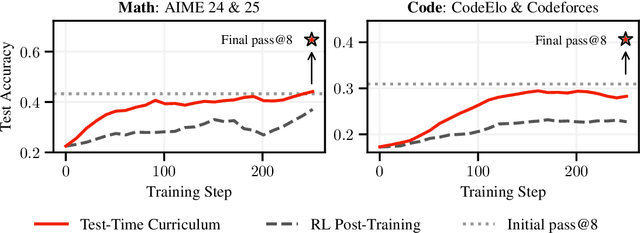
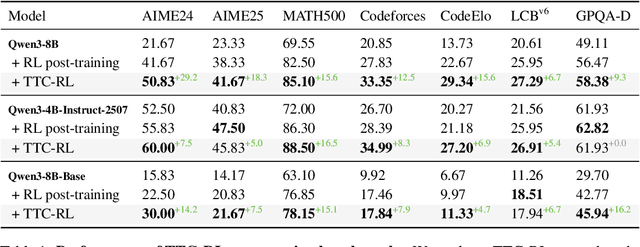
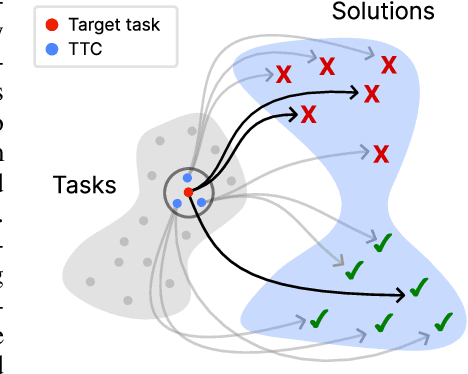
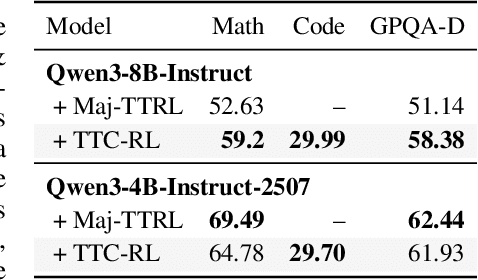
Humans are good at learning on the job: We learn how to solve the tasks we face as we go along. Can a model do the same? We propose an agent that assembles a task-specific curriculum, called test-time curriculum (TTC-RL), and applies reinforcement learning to continue training the model for its target task. The test-time curriculum avoids time-consuming human curation of datasets by automatically selecting the most task-relevant data from a large pool of available training data. Our experiments demonstrate that reinforcement learning on a test-time curriculum consistently improves the model on its target tasks, across a variety of evaluations and models. Notably, on challenging math and coding benchmarks, TTC-RL improves the pass@1 of Qwen3-8B by approximately 1.8x on AIME25 and 2.1x on CodeElo. Moreover, we find that TTC-RL significantly raises the performance ceiling compared to the initial model, increasing pass@8 on AIME25 from 40% to 62% and on CodeElo from 28% to 43%. Our findings show the potential of test-time curricula in extending the test-time scaling paradigm to continual training on thousands of task-relevant experiences during test-time.
Answer Matching Outperforms Multiple Choice for Language Model Evaluation
Jul 03, 2025Multiple choice benchmarks have long been the workhorse of language model evaluation because grading multiple choice is objective and easy to automate. However, we show multiple choice questions from popular benchmarks can often be answered without even seeing the question. These shortcuts arise from a fundamental limitation of discriminative evaluation not shared by evaluations of the model's free-form, generative answers. Until recently, there appeared to be no viable, scalable alternative to multiple choice--but, we show that this has changed. We consider generative evaluation via what we call answer matching: Give the candidate model the question without the options, have it generate a free-form response, then use a modern language model with the reference answer to determine if the response matches the reference. To compare the validity of different evaluation strategies, we annotate MMLU-Pro and GPQA-Diamond to obtain human grading data, and measure the agreement of each evaluation approach. We find answer matching using recent models--even small ones--achieves near-perfect agreement, in the range of inter-annotator agreement. In contrast, both multiple choice evaluation and using LLM-as-a-judge without reference answers aligns poorly with human grading. Improving evaluations via answer matching is not merely a conceptual concern: the rankings of several models change significantly when evaluating their free-form responses with answer matching. In light of these findings, we discuss how to move the evaluation ecosystem from multiple choice to answer matching.
How Benchmark Prediction from Fewer Data Misses the Mark
Jun 09, 2025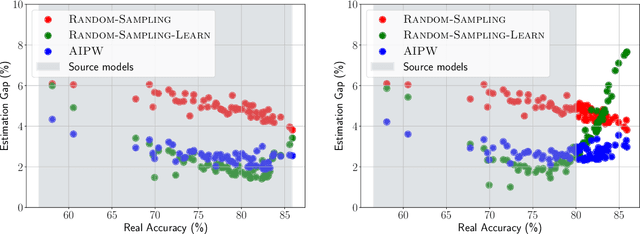
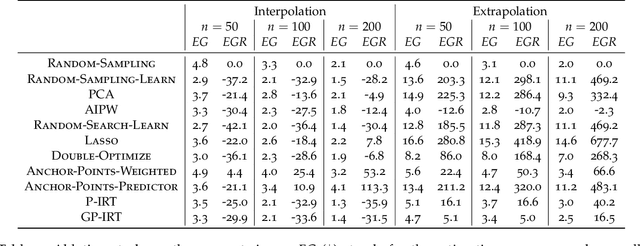
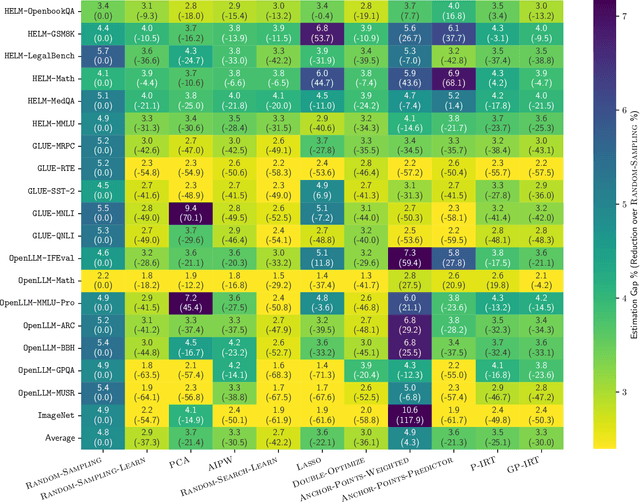
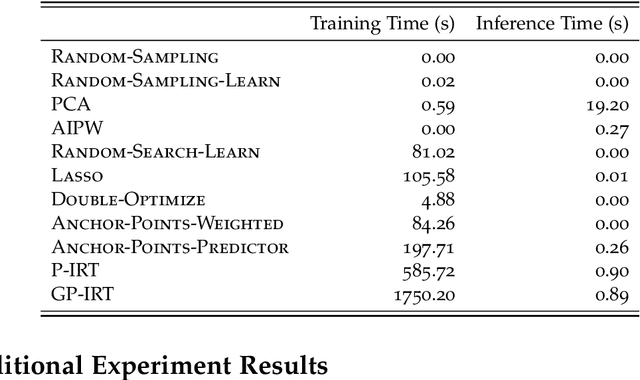
Large language model (LLM) evaluation is increasingly costly, prompting interest in methods that speed up evaluation by shrinking benchmark datasets. Benchmark prediction (also called efficient LLM evaluation) aims to select a small subset of evaluation points and predict overall benchmark performance from that subset. In this paper, we systematically assess the strengths and limitations of 11 benchmark prediction methods across 19 diverse benchmarks. First, we identify a highly competitive baseline: Take a random sample and fit a regression model on the sample to predict missing entries. Outperforming most existing methods, this baseline challenges the assumption that careful subset selection is necessary for benchmark prediction. Second, we discover that all existing methods crucially depend on model similarity. They work best when interpolating scores among similar models. The effectiveness of benchmark prediction sharply declines when new models have higher accuracy than previously seen models. In this setting of extrapolation, none of the previous methods consistently beat a simple average over random samples. To improve over the sample average, we introduce a new method inspired by augmented inverse propensity weighting. This method consistently outperforms the random sample average even for extrapolation. However, its performance still relies on model similarity and the gains are modest in general. This shows that benchmark prediction fails just when it is most needed: at the evaluation frontier, where the goal is to evaluate new models of unknown capabilities.