 Add to Chrome
 Add to Firefox
 Add to Edge
Scalable Maximum Entropy Reinforcement Learning for Diffusion Policies via Adjoint Matching
Jun 21, 2026
Diffusion policies have recently emerged as a powerful paradigm for representing complex action distributions in reinforcement learning (RL). However, their application to online RL remains limited by the challenge of scalable training in the absence of ground-truth data, where standard optimization techniques such as score matching are not directly applicable. In this work, we introduce a highly efficient algorithm for optimizing diffusion policies by leveraging recent advances in stochastic optimal control. Our approach is based on adjoint matching, which enables simulation-free training and circumvents the need for explicit likelihood estimation or costly backpropagation through the diffusion process. Furthermore, we propose several extensions that improve the robustness and stability of the method in practical settings. Empirical results demonstrate that our approach achieves competitive performance while significantly reducing computational overhead, making diffusion policies more viable for online RL scenarios.

Trust-Region Diffusion Policies for Massively Parallel On-Policy RL
Jun 13, 2026Reinforcement learning with massively parallel simulations has become a standard framework for developing robust, deployable policies; however, most existing approaches still rely on simple Gaussian policy parameterizations. Diffusion models provide a more expressive policy class and have shown strong performance on challenging control problems, yet most diffusion-based RL methods are designed for offline or off-policy training. In this work, we ask whether diffusion policies can be trained effectively in the massively parallel, on-policy regime. To this end, we introduce Trust-region Diffusion Policies (TruDi), which enables diffusion policies for on-policy RL with massively parallel simulations. This setting is particularly challenging because the data distribution changes quickly across updates, making stable training with complex policies difficult. TruDi addresses this by integrating a trust-region optimization rule to enforce a KL-divergence constraint over the entire diffusion trajectory. Empirically, we evaluate TruDi on a diverse set of 4 massively parallel RL benchmarks comprising a total of 73 tasks. Across these tasks, TruDi consistently outperforms or is on-par with strong baselines on standard tasks and achieves clear gains on more challenging humanoid control tasks, establishing a strong new baseline for massively parallel on-policy RL.
PAWS: Preference Learning with Advantage-Weighted Segments
Jun 10, 2026Preference-based reinforcement learning (PbRL) learns policies from human trajectory-level comparisons, avoiding explicit reward design and expert demonstrations. Existing methods typically train utility functions on trajectory or segment-level preferences while relying on per-step utility estimates during policy optimization. This training and inference mismatch induces a distribution shift that severely degrades temporal credit assignment and limits policy learning. We analyze this issue and propose PAWS, a segment-based preference learning method that performs policy updates directly using segment-level advantage functions. By aligning utility training with policy optimization, PAWS preserves trajectory-level preference information and avoids unreliable per-step learning signals. Experiments on simulated robotic manipulation and locomotion tasks demonstrate that PAWS consistently outperforms existing PbRL approaches, highlighting the importance of distribution-consistent preference learning.
SEAR: Sample Efficient Action Chunking Reinforcement Learning
Mar 02, 2026Action chunking can improve exploration and value estimation in long horizon reinforcement learning, but makes learning substantially harder since the critic must evaluate action sequences rather than single actions, greatly increasing approximation and data efficiency challenges. As a result, existing action chunking methods, primarily designed for the offline and offline-to-online settings, have not achieved strong performance in purely online reinforcement learning. We introduce SEAR, an off policy online reinforcement learning algorithm for action chunking. It exploits the temporal structure of action chunks and operates with a receding horizon, effectively combining the benefits of small and large chunk sizes. SEAR outperforms state of the art online reinforcement learning methods on Metaworld, training with chunk sizes up to 20.
Scaffolding Dexterous Manipulation with Vision-Language Models
Jun 24, 2025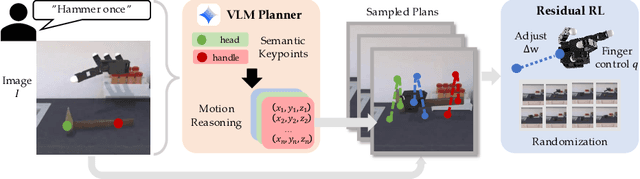
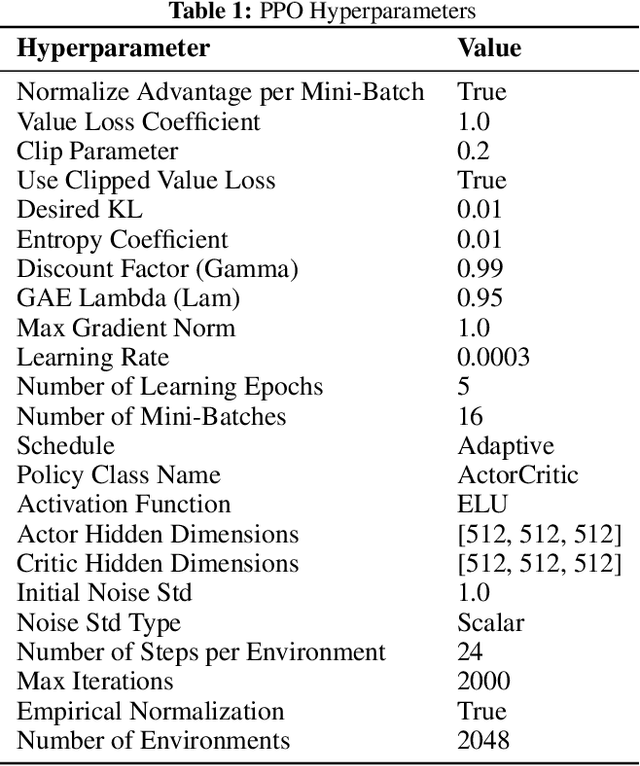
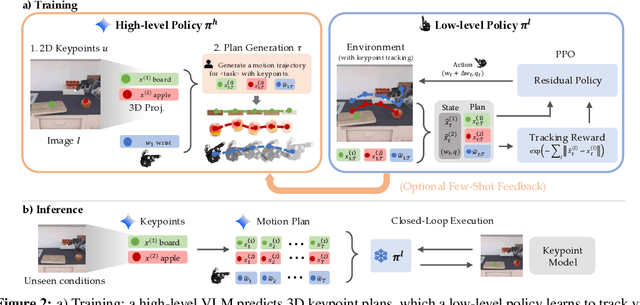
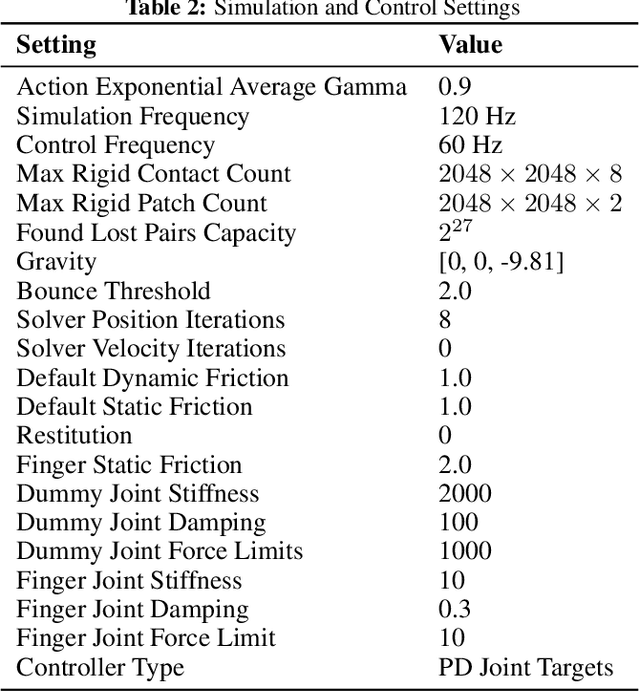
Dexterous robotic hands are essential for performing complex manipulation tasks, yet remain difficult to train due to the challenges of demonstration collection and high-dimensional control. While reinforcement learning (RL) can alleviate the data bottleneck by generating experience in simulation, it typically relies on carefully designed, task-specific reward functions, which hinder scalability and generalization. Thus, contemporary works in dexterous manipulation have often bootstrapped from reference trajectories. These trajectories specify target hand poses that guide the exploration of RL policies and object poses that enable dense, task-agnostic rewards. However, sourcing suitable trajectories - particularly for dexterous hands - remains a significant challenge. Yet, the precise details in explicit reference trajectories are often unnecessary, as RL ultimately refines the motion. Our key insight is that modern vision-language models (VLMs) already encode the commonsense spatial and semantic knowledge needed to specify tasks and guide exploration effectively. Given a task description (e.g., "open the cabinet") and a visual scene, our method uses an off-the-shelf VLM to first identify task-relevant keypoints (e.g., handles, buttons) and then synthesize 3D trajectories for hand motion and object motion. Subsequently, we train a low-level residual RL policy in simulation to track these coarse trajectories or "scaffolds" with high fidelity. Across a number of simulated tasks involving articulated objects and semantic understanding, we demonstrate that our method is able to learn robust dexterous manipulation policies. Moreover, we showcase that our method transfers to real-world robotic hands without any human demonstrations or handcrafted rewards.
Chunking the Critic: A Transformer-based Soft Actor-Critic with N-Step Returns
Mar 05, 2025Soft Actor-Critic (SAC) critically depends on its critic network, which typically evaluates a single state-action pair to guide policy updates. Using N-step returns is a common practice to reduce the bias in the target values of the critic. However, using N-step returns can again introduce high variance and necessitates importance sampling, often destabilizing training. Recent algorithms have also explored action chunking-such as direct action repetition and movement primitives-to enhance exploration. In this paper, we propose a Transformer-based Critic Network for SAC that integrates the N-returns framework in a stable and efficient manner. Unlike approaches that perform chunking in the actor network, we feed chunked actions into the critic network to explore potential performance gains. Our architecture leverages the Transformer's ability to process sequential information, facilitating more robust value estimation. Empirical results show that this method not only achieves efficient, stable training but also excels in sparse reward/multi-phase environments-traditionally a challenge for step-based methods. These findings underscore the promise of combining Transformer-based critics with N-returns to advance reinforcement learning performance
DIME:Diffusion-Based Maximum Entropy Reinforcement Learning
Feb 04, 2025Maximum entropy reinforcement learning (MaxEnt-RL) has become the standard approach to RL due to its beneficial exploration properties. Traditionally, policies are parameterized using Gaussian distributions, which significantly limits their representational capacity. Diffusion-based policies offer a more expressive alternative, yet integrating them into MaxEnt-RL poses challenges--primarily due to the intractability of computing their marginal entropy. To overcome this, we propose Diffusion-Based Maximum Entropy RL (DIME). DIME leverages recent advances in approximate inference with diffusion models to derive a lower bound on the maximum entropy objective. Additionally, we propose a policy iteration scheme that provably converges to the optimal diffusion policy. Our method enables the use of expressive diffusion-based policies while retaining the principled exploration benefits of MaxEnt-RL, significantly outperforming other diffusion-based methods on challenging high-dimensional control benchmarks. It is also competitive with state-of-the-art non-diffusion based RL methods while requiring fewer algorithmic design choices and smaller update-to-data ratios, reducing computational complexity.
MuTT: A Multimodal Trajectory Transformer for Robot Skills
Jul 22, 2024

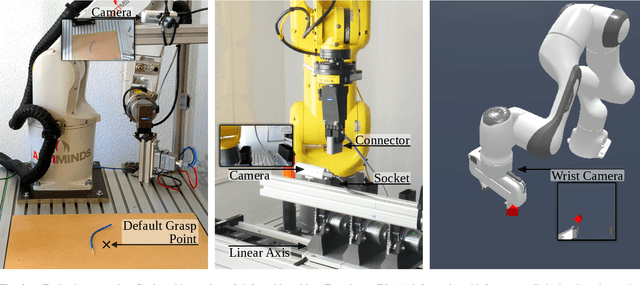

High-level robot skills represent an increasingly popular paradigm in robot programming. However, configuring the skills' parameters for a specific task remains a manual and time-consuming endeavor. Existing approaches for learning or optimizing these parameters often require numerous real-world executions or do not work in dynamic environments. To address these challenges, we propose MuTT, a novel encoder-decoder transformer architecture designed to predict environment-aware executions of robot skills by integrating vision, trajectory, and robot skill parameters. Notably, we pioneer the fusion of vision and trajectory, introducing a novel trajectory projection. Furthermore, we illustrate MuTT's efficacy as a predictor when combined with a model-based robot skill optimizer. This approach facilitates the optimization of robot skill parameters for the current environment, without the need for real-world executions during optimization. Designed for compatibility with any representation of robot skills, MuTT demonstrates its versatility across three comprehensive experiments, showcasing superior performance across two different skill representations.
Variational Distillation of Diffusion Policies into Mixture of Experts
Jun 18, 2024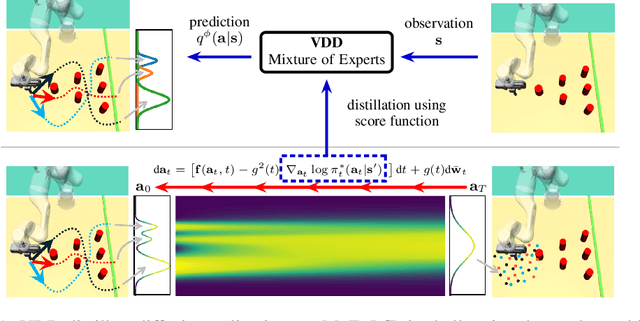
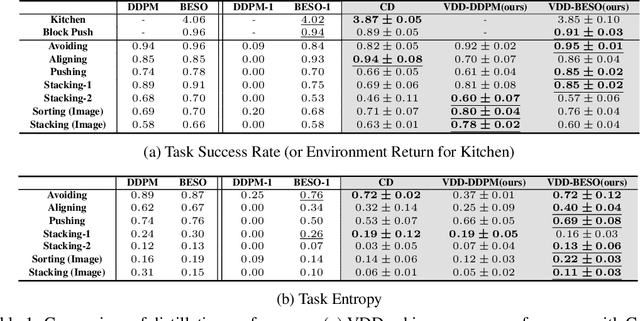
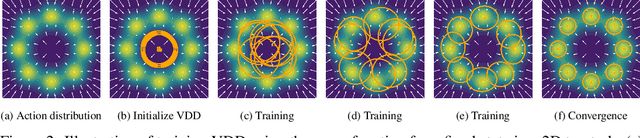
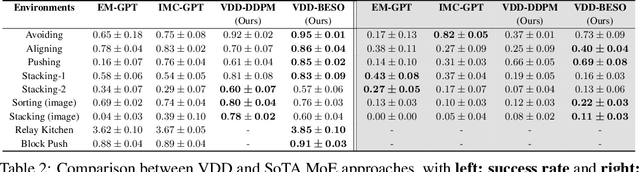
This work introduces Variational Diffusion Distillation (VDD), a novel method that distills denoising diffusion policies into Mixtures of Experts (MoE) through variational inference. Diffusion Models are the current state-of-the-art in generative modeling due to their exceptional ability to accurately learn and represent complex, multi-modal distributions. This ability allows Diffusion Models to replicate the inherent diversity in human behavior, making them the preferred models in behavior learning such as Learning from Human Demonstrations (LfD). However, diffusion models come with some drawbacks, including the intractability of likelihoods and long inference times due to their iterative sampling process. The inference times, in particular, pose a significant challenge to real-time applications such as robot control. In contrast, MoEs effectively address the aforementioned issues while retaining the ability to represent complex distributions but are notoriously difficult to train. VDD is the first method that distills pre-trained diffusion models into MoE models, and hence, combines the expressiveness of Diffusion Models with the benefits of Mixture Models. Specifically, VDD leverages a decompositional upper bound of the variational objective that allows the training of each expert separately, resulting in a robust optimization scheme for MoEs. VDD demonstrates across nine complex behavior learning tasks, that it is able to: i) accurately distill complex distributions learned by the diffusion model, ii) outperform existing state-of-the-art distillation methods, and iii) surpass conventional methods for training MoE.
MaIL: Improving Imitation Learning with Mamba
Jun 12, 2024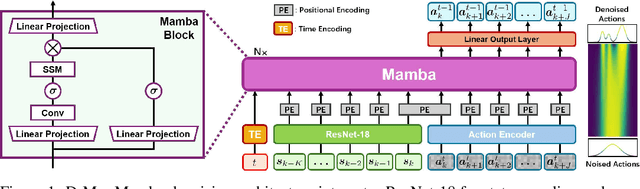
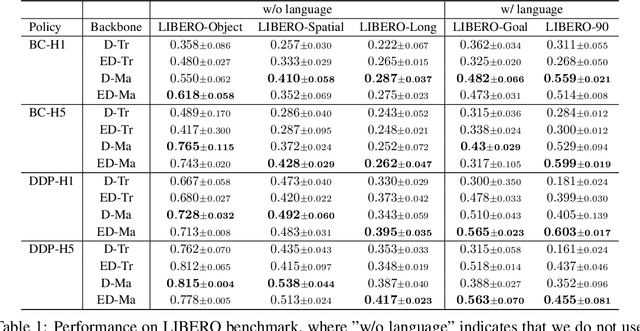
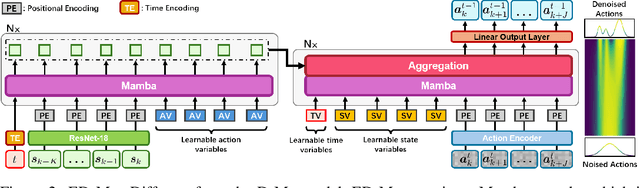

This work introduces Mamba Imitation Learning (MaIL), a novel imitation learning (IL) architecture that offers a computationally efficient alternative to state-of-the-art (SoTA) Transformer policies. Transformer-based policies have achieved remarkable results due to their ability in handling human-recorded data with inherently non-Markovian behavior. However, their high performance comes with the drawback of large models that complicate effective training. While state space models (SSMs) have been known for their efficiency, they were not able to match the performance of Transformers. Mamba significantly improves the performance of SSMs and rivals against Transformers, positioning it as an appealing alternative for IL policies. MaIL leverages Mamba as a backbone and introduces a formalism that allows using Mamba in the encoder-decoder structure. This formalism makes it a versatile architecture that can be used as a standalone policy or as part of a more advanced architecture, such as a diffuser in the diffusion process. Extensive evaluations on the LIBERO IL benchmark and three real robot experiments show that MaIL: i) outperforms Transformers in all LIBERO tasks, ii) achieves good performance even with small datasets, iii) is able to effectively process multi-modal sensory inputs, iv) is more robust to input noise compared to Transformers.