 Add to Chrome
 Add to Firefox
 Add to Edge
Trust-Region Diffusion Policies for Massively Parallel On-Policy RL
Jun 13, 2026
Reinforcement learning with massively parallel simulations has become a standard framework for developing robust, deployable policies; however, most existing approaches still rely on simple Gaussian policy parameterizations. Diffusion models provide a more expressive policy class and have shown strong performance on challenging control problems, yet most diffusion-based RL methods are designed for offline or off-policy training. In this work, we ask whether diffusion policies can be trained effectively in the massively parallel, on-policy regime. To this end, we introduce Trust-region Diffusion Policies (TruDi), which enables diffusion policies for on-policy RL with massively parallel simulations. This setting is particularly challenging because the data distribution changes quickly across updates, making stable training with complex policies difficult. TruDi addresses this by integrating a trust-region optimization rule to enforce a KL-divergence constraint over the entire diffusion trajectory. Empirically, we evaluate TruDi on a diverse set of 4 massively parallel RL benchmarks comprising a total of 73 tasks. Across these tasks, TruDi consistently outperforms or is on-par with strong baselines on standard tasks and achieves clear gains on more challenging humanoid control tasks, establishing a strong new baseline for massively parallel on-policy RL.

PAWS: Preference Learning with Advantage-Weighted Segments
Jun 10, 2026Preference-based reinforcement learning (PbRL) learns policies from human trajectory-level comparisons, avoiding explicit reward design and expert demonstrations. Existing methods typically train utility functions on trajectory or segment-level preferences while relying on per-step utility estimates during policy optimization. This training and inference mismatch induces a distribution shift that severely degrades temporal credit assignment and limits policy learning. We analyze this issue and propose PAWS, a segment-based preference learning method that performs policy updates directly using segment-level advantage functions. By aligning utility training with policy optimization, PAWS preserves trajectory-level preference information and avoids unreliable per-step learning signals. Experiments on simulated robotic manipulation and locomotion tasks demonstrate that PAWS consistently outperforms existing PbRL approaches, highlighting the importance of distribution-consistent preference learning.
How and What to Imagine? Visual Thinking in Unified Multimodal Models for Cross-View Spatial Reasoning
May 26, 2026Cross-view spatial reasoning remains a weak spot for vision-language models (VLMs): they often reason in language and lose the fine-grained geometry needed for the task. Thinking with images aims to address this by generating an intermediate thinking image, but recent work shows that models often ignore the visual evidence in these traces. We therefore ask how to make visual thinking matter, and what kind of visual thinking works best. We study these questions in unified multimodal models (UMMs), which natively support interleaved image-text generation. For the first question, we propose View Dropout (VDrop), a training-time intervention that hides parts of one input view from the answer span while keeping them visible to the thinking-image tokens. This encourages the model to use the thinking image when answering, instead of relying only on the input views. Once the thinking image is used for answer prediction, we study which type of visual thinking is most effective. We frame this as a learnability-informativeness tradeoff and compare three thinking-image variants: top-down, panoramic, and point-matching renderings. Trained on synthetic scenes and evaluated on five real-world out-of-domain benchmarks, panoramic visual thinking with VDrop is the only configuration that is both informative and learnable, and it achieves the best out-of-domain generalization.
Rethinking Progression of Memory State in Robotic Manipulation: An Object-Centric Perspective
Nov 18, 2025As embodied agents operate in increasingly complex environments, the ability to perceive, track, and reason about individual object instances over time becomes essential, especially in tasks requiring sequenced interactions with visually similar objects. In these non-Markovian settings, key decision cues are often hidden in object-specific histories rather than the current scene. Without persistent memory of prior interactions (what has been interacted with, where it has been, or how it has changed) visuomotor policies may fail, repeat past actions, or overlook completed ones. To surface this challenge, we introduce LIBERO-Mem, a non-Markovian task suite for stress-testing robotic manipulation under object-level partial observability. It combines short- and long-horizon object tracking with temporally sequenced subgoals, requiring reasoning beyond the current frame. However, vision-language-action (VLA) models often struggle in such settings, with token scaling quickly becoming intractable even for tasks spanning just a few hundred frames. We propose Embodied-SlotSSM, a slot-centric VLA framework built for temporal scalability. It maintains spatio-temporally consistent slot identities and leverages them through two mechanisms: (1) slot-state-space modeling for reconstructing short-term history, and (2) a relational encoder to align the input tokens with action decoding. Together, these components enable temporally grounded, context-aware action prediction. Experiments show Embodied-SlotSSM's baseline performance on LIBERO-Mem and general tasks, offering a scalable solution for non-Markovian reasoning in object-centric robotic policies.
NSL-MT: Linguistically Informed Negative Samples for Efficient Machine Translation in Low-Resource Languages
Nov 12, 2025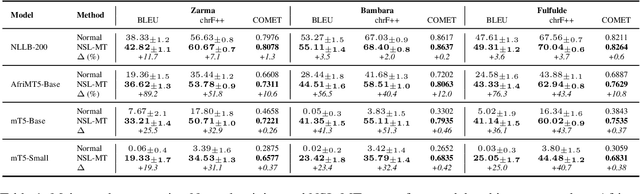
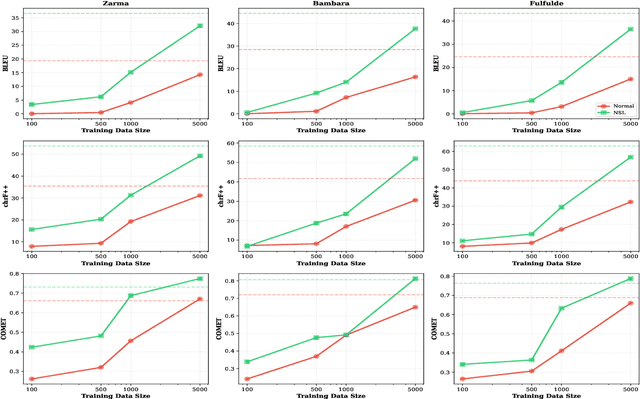

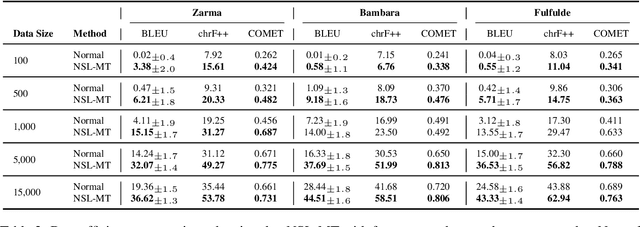
We introduce Negative Space Learning MT (NSL-MT), a training method that teaches models what not to generate by encoding linguistic constraints as severity-weighted penalties in the loss function. NSL-MT increases limited parallel data with synthetically generated violations of target language grammar, explicitly penalizing the model when it assigns high probability to these linguistically invalid outputs. We demonstrate that NSL-MT delivers improvements across all architectures: 3-12\% BLEU gains for well-performing models and 56-89\% gains for models lacking descent initial support. Furthermore, NSL-MT provides a 5x data efficiency multiplier -- training with 1,000 examples matches or exceeds normal training with 5,000 examples. Thus, NSL-MT provides a data-efficient alternative training method for settings where there is limited annotated parallel corporas.
SlotVLA: Towards Modeling of Object-Relation Representations in Robotic Manipulation
Nov 10, 2025Inspired by how humans reason over discrete objects and their relationships, we explore whether compact object-centric and object-relation representations can form a foundation for multitask robotic manipulation. Most existing robotic multitask models rely on dense embeddings that entangle both object and background cues, raising concerns about both efficiency and interpretability. In contrast, we study object-relation-centric representations as a pathway to more structured, efficient, and explainable visuomotor control. Our contributions are two-fold. First, we introduce LIBERO+, a fine-grained benchmark dataset designed to enable and evaluate object-relation reasoning in robotic manipulation. Unlike prior datasets, LIBERO+ provides object-centric annotations that enrich demonstrations with box- and mask-level labels as well as instance-level temporal tracking, supporting compact and interpretable visuomotor representations. Second, we propose SlotVLA, a slot-attention-based framework that captures both objects and their relations for action decoding. It uses a slot-based visual tokenizer to maintain consistent temporal object representations, a relation-centric decoder to produce task-relevant embeddings, and an LLM-driven module that translates these embeddings into executable actions. Experiments on LIBERO+ demonstrate that object-centric slot and object-relation slot representations drastically reduce the number of required visual tokens, while providing competitive generalization. Together, LIBERO+ and SlotVLA provide a compact, interpretable, and effective foundation for advancing object-relation-centric robotic manipulation.
Geometry-aware RL for Manipulation of Varying Shapes and Deformable Objects
Feb 12, 2025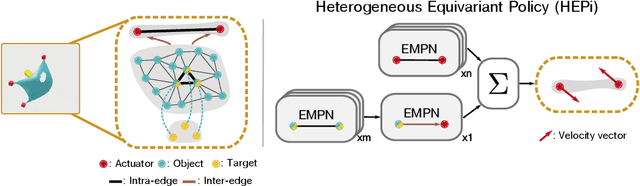
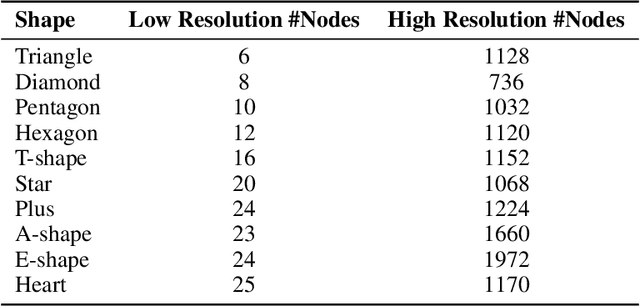
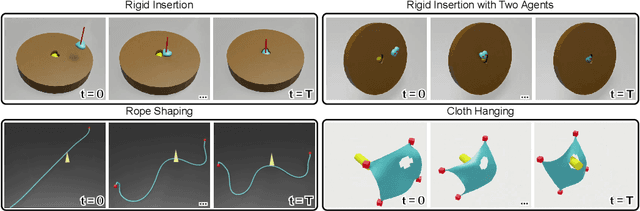
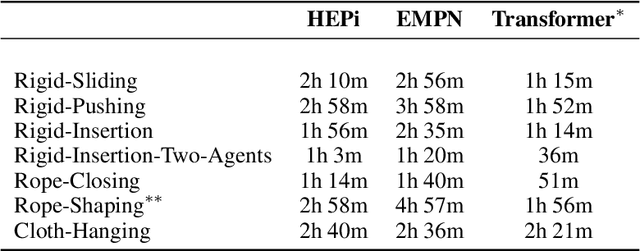
Manipulating objects with varying geometries and deformable objects is a major challenge in robotics. Tasks such as insertion with different objects or cloth hanging require precise control and effective modelling of complex dynamics. In this work, we frame this problem through the lens of a heterogeneous graph that comprises smaller sub-graphs, such as actuators and objects, accompanied by different edge types describing their interactions. This graph representation serves as a unified structure for both rigid and deformable objects tasks, and can be extended further to tasks comprising multiple actuators. To evaluate this setup, we present a novel and challenging reinforcement learning benchmark, including rigid insertion of diverse objects, as well as rope and cloth manipulation with multiple end-effectors. These tasks present a large search space, as both the initial and target configurations are uniformly sampled in 3D space. To address this issue, we propose a novel graph-based policy model, dubbed Heterogeneous Equivariant Policy (HEPi), utilizing $SE(3)$ equivariant message passing networks as the main backbone to exploit the geometric symmetry. In addition, by modeling explicit heterogeneity, HEPi can outperform Transformer-based and non-heterogeneous equivariant policies in terms of average returns, sample efficiency, and generalization to unseen objects.
RAPID: Retrieval-Augmented Parallel Inference Drafting for Text-Based Video Event Retrieval
Jan 27, 2025


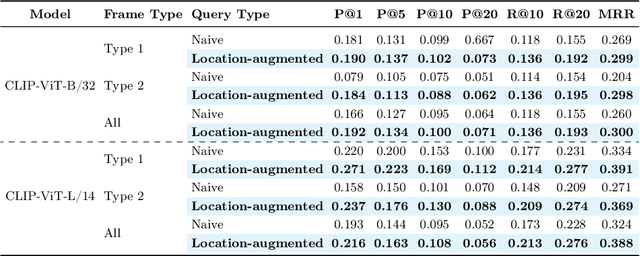
Retrieving events from videos using text queries has become increasingly challenging due to the rapid growth of multimedia content. Existing methods for text-based video event retrieval often focus heavily on object-level descriptions, overlooking the crucial role of contextual information. This limitation is especially apparent when queries lack sufficient context, such as missing location details or ambiguous background elements. To address these challenges, we propose a novel system called RAPID (Retrieval-Augmented Parallel Inference Drafting), which leverages advancements in Large Language Models (LLMs) and prompt-based learning to semantically correct and enrich user queries with relevant contextual information. These enriched queries are then processed through parallel retrieval, followed by an evaluation step to select the most relevant results based on their alignment with the original query. Through extensive experiments on our custom-developed dataset, we demonstrate that RAPID significantly outperforms traditional retrieval methods, particularly for contextually incomplete queries. Our system was validated for both speed and accuracy through participation in the Ho Chi Minh City AI Challenge 2024, where it successfully retrieved events from over 300 hours of video. Further evaluation comparing RAPID with the baseline proposed by the competition organizers demonstrated its superior effectiveness, highlighting the strength and robustness of our approach.
Enhancing Exploration with Diffusion Policies in Hybrid Off-Policy RL: Application to Non-Prehensile Manipulation
Nov 22, 2024


Learning diverse policies for non-prehensile manipulation is essential for improving skill transfer and generalization to out-of-distribution scenarios. In this work, we enhance exploration through a two-fold approach within a hybrid framework that tackles both discrete and continuous action spaces. First, we model the continuous motion parameter policy as a diffusion model, and second, we incorporate this into a maximum entropy reinforcement learning framework that unifies both the discrete and continuous components. The discrete action space, such as contact point selection, is optimized through Q-value function maximization, while the continuous part is guided by a diffusion-based policy. This hybrid approach leads to a principled objective, where the maximum entropy term is derived as a lower bound using structured variational inference. We propose the Hybrid Diffusion Policy algorithm (HyDo) and evaluate its performance on both simulation and zero-shot sim2real tasks. Our results show that HyDo encourages more diverse behavior policies, leading to significantly improved success rates across tasks - for example, increasing from 53% to 72% on a real-world 6D pose alignment task. Project page: https://leh2rng.github.io/hydo
Pseudo-Labeling and Contextual Curriculum Learning for Online Grasp Learning in Robotic Bin Picking
Mar 04, 2024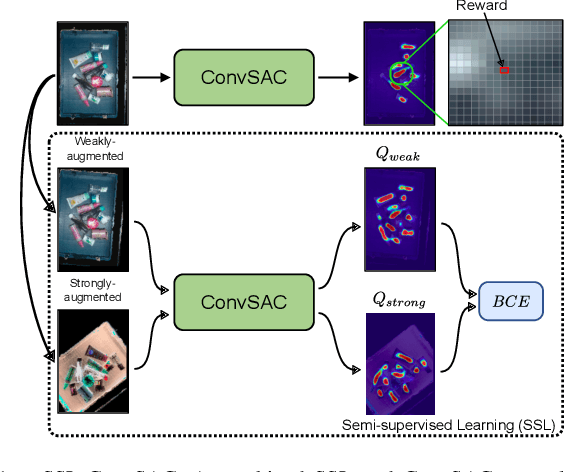
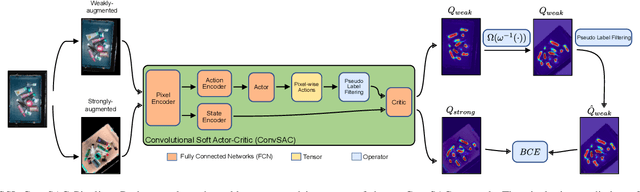

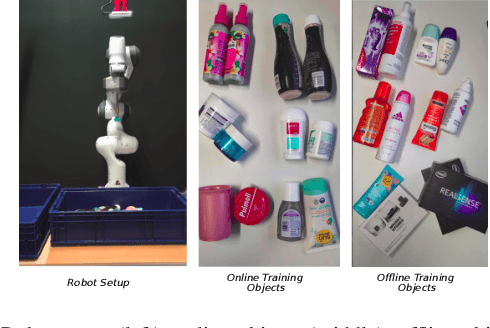
The prevailing grasp prediction methods predominantly rely on offline learning, overlooking the dynamic grasp learning that occurs during real-time adaptation to novel picking scenarios. These scenarios may involve previously unseen objects, variations in camera perspectives, and bin configurations, among other factors. In this paper, we introduce a novel approach, SSL-ConvSAC, that combines semi-supervised learning and reinforcement learning for online grasp learning. By treating pixels with reward feedback as labeled data and others as unlabeled, it efficiently exploits unlabeled data to enhance learning. In addition, we address the imbalance between labeled and unlabeled data by proposing a contextual curriculum-based method. We ablate the proposed approach on real-world evaluation data and demonstrate promise for improving online grasp learning on bin picking tasks using a physical 7-DoF Franka Emika robot arm with a suction gripper. Video: https://youtu.be/OAro5pg8I9U