 Add to Chrome
 Add to Firefox
 Add to Edge
From Keypoints to Predictive Distributions: Post-Hoc Uncertainty for YOLO-Pose Models
Jul 29, 2026
YOLO-Pose models provide efficient keypoint localization, but do not quantify the associated spatial uncertainty. We introduce a lightweight post-hoc probabilistic extension that augments a trained YOLO-Pose model with calibrated bivariate predictive distributions over keypoint locations, centered at the model's original predictions. Concretely, we train additional probabilistic heads with an importance-weighted negative log-likelihood to predict an input-dependent $2\times2$ dispersion matrix for each keypoint, followed by Gaussian calibration for broad downstream compatibility or Student-$t$ calibration for distributional fidelity. Complementing this, we propose an evaluation protocol that combines a suite of distributional calibration diagnostics with average keypoint precision (AKP), a keypoint-level extension of the COCO AP protocol for assessing reliability rankings. Experiments on COCO show that the learned uncertainty estimates enable effective keypoint-level reliability ranking, Student-$t$ calibration best captures the empirical residual distribution, and uncertainty-based pruning removes unreliable keypoints. A central application-level demonstration is vision-based aircraft landing, where calibrated covariances for runway keypoints support uncertainty-aware aircraft position estimation and downstream sensor fusion.

VLA-FAIL: Efficient Task Failure Detection for Finetuned Vision-Language-Action Models
Jun 19, 2026Vision-language-action models (VLAs) achieve state-of-the-art performance on many robotic manipulation tasks, yet they can still behave unpredictably in out-of-distribution scenarios. Runtime failure detection is therefore essential for the safe real-world deployment of VLAs. However, existing task failure detectors require computationally expensive action sampling, are based on architectural assumptions that limit their applicability to VLAs, or need access to failure rollouts. We propose VLA-FAIL, a lightweight and broadly applicable failure detection framework for VLAs that combines two novel failure detectors with minimal overhead, without requiring failure data. The first, last-layer Mahalanobis distance (LLMD), detects out-of-distribution states by measuring token-wise deviations in last-layer features relative to the training data. The second, action chunk consistency (ACC), exploits the temporal overlap induced by receding-horizon control and detects failures when consecutive action chunks become inconsistent. To capture the trade-off between detection accuracy and detection latency, we introduce AUCPDT, a threshold-independent metric that jointly evaluates precision, recall, and detection time. Through extensive real-world and simulation experiments, we demonstrate that LLMD and ACC capture complementary failure modes whose combination enables reliable and early failure detection across diverse tasks, frequently outperforming significantly more expensive baseline methods.
SEAR: Sample Efficient Action Chunking Reinforcement Learning
Mar 02, 2026Action chunking can improve exploration and value estimation in long horizon reinforcement learning, but makes learning substantially harder since the critic must evaluate action sequences rather than single actions, greatly increasing approximation and data efficiency challenges. As a result, existing action chunking methods, primarily designed for the offline and offline-to-online settings, have not achieved strong performance in purely online reinforcement learning. We introduce SEAR, an off policy online reinforcement learning algorithm for action chunking. It exploits the temporal structure of action chunks and operates with a receding horizon, effectively combining the benefits of small and large chunk sizes. SEAR outperforms state of the art online reinforcement learning methods on Metaworld, training with chunk sizes up to 20.
Beyond Deep Ensembles: A Large-Scale Evaluation of Bayesian Deep Learning under Distribution Shift
Jun 22, 2023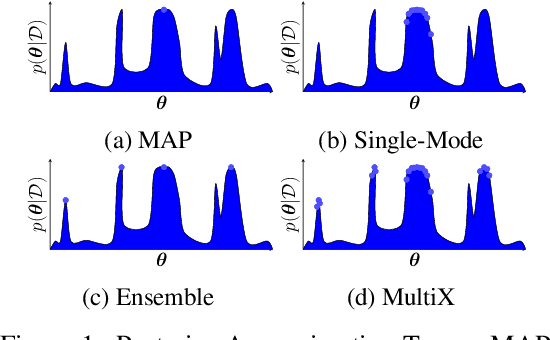


Bayesian deep learning (BDL) is a promising approach to achieve well-calibrated predictions on distribution-shifted data. Nevertheless, there exists no large-scale survey that evaluates recent SOTA methods on diverse, realistic, and challenging benchmark tasks in a systematic manner. To provide a clear picture of the current state of BDL research, we evaluate modern BDL algorithms on real-world datasets from the WILDS collection containing challenging classification and regression tasks, with a focus on generalization capability and calibration under distribution shift. We compare the algorithms on a wide range of large, convolutional and transformer-based neural network architectures. In particular, we investigate a signed version of the expected calibration error that reveals whether the methods are over- or under-confident, providing further insight into the behavior of the methods. Further, we provide the first systematic evaluation of BDL for fine-tuning large pre-trained models, where training from scratch is prohibitively expensive. Finally, given the recent success of Deep Ensembles, we extend popular single-mode posterior approximations to multiple modes by the use of ensembles. While we find that ensembling single-mode approximations generally improves the generalization capability and calibration of the models by a significant margin, we also identify a failure mode of ensembles when finetuning large transformer-based language models. In this setting, variational inference based approaches such as last-layer Bayes By Backprop outperform other methods in terms of accuracy by a large margin, while modern approximate inference algorithms such as SWAG achieve the best calibration.