 Add to Chrome
 Add to Firefox
 Add to Edge
SEAR: Sample Efficient Action Chunking Reinforcement Learning
Mar 02, 2026
Action chunking can improve exploration and value estimation in long horizon reinforcement learning, but makes learning substantially harder since the critic must evaluate action sequences rather than single actions, greatly increasing approximation and data efficiency challenges. As a result, existing action chunking methods, primarily designed for the offline and offline-to-online settings, have not achieved strong performance in purely online reinforcement learning. We introduce SEAR, an off policy online reinforcement learning algorithm for action chunking. It exploits the temporal structure of action chunks and operates with a receding horizon, effectively combining the benefits of small and large chunk sizes. SEAR outperforms state of the art online reinforcement learning methods on Metaworld, training with chunk sizes up to 20.

PointMapPolicy: Structured Point Cloud Processing for Multi-Modal Imitation Learning
Oct 23, 2025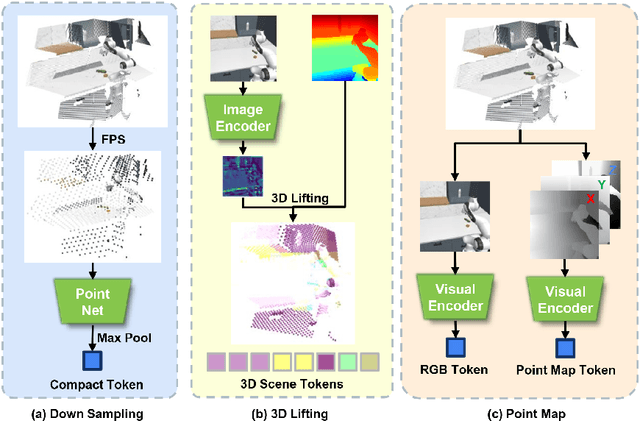
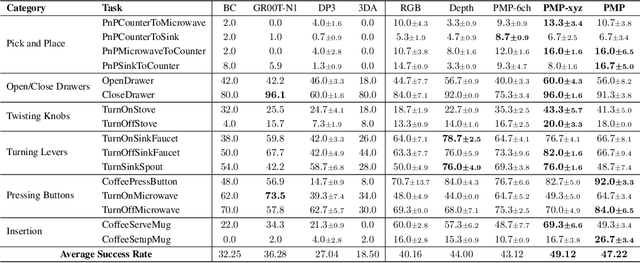
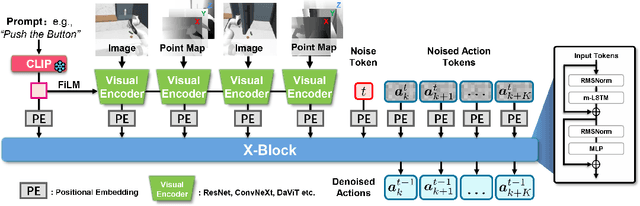
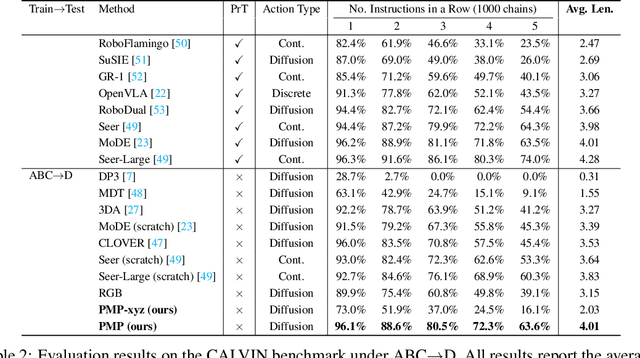
Robotic manipulation systems benefit from complementary sensing modalities, where each provides unique environmental information. Point clouds capture detailed geometric structure, while RGB images provide rich semantic context. Current point cloud methods struggle to capture fine-grained detail, especially for complex tasks, which RGB methods lack geometric awareness, which hinders their precision and generalization. We introduce PointMapPolicy, a novel approach that conditions diffusion policies on structured grids of points without downsampling. The resulting data type makes it easier to extract shape and spatial relationships from observations, and can be transformed between reference frames. Yet due to their structure in a regular grid, we enable the use of established computer vision techniques directly to 3D data. Using xLSTM as a backbone, our model efficiently fuses the point maps with RGB data for enhanced multi-modal perception. Through extensive experiments on the RoboCasa and CALVIN benchmarks and real robot evaluations, we demonstrate that our method achieves state-of-the-art performance across diverse manipulation tasks. The overview and demos are available on our project page: https://point-map.github.io/Point-Map/
Adaptive World Models: Learning Behaviors by Latent Imagination Under Non-Stationarity
Nov 02, 2024
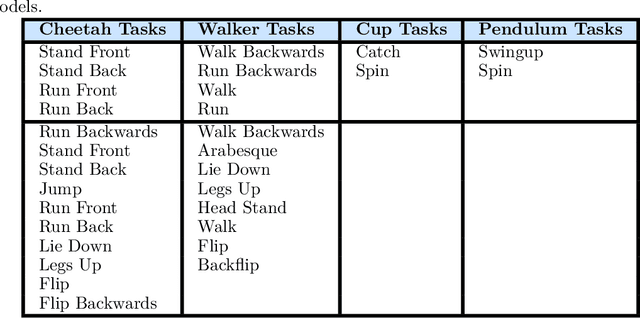
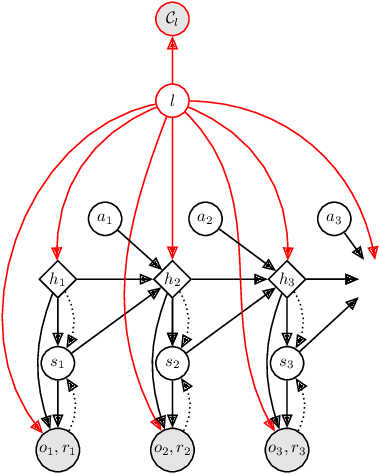

Developing foundational world models is a key research direction for embodied intelligence, with the ability to adapt to non-stationary environments being a crucial criterion. In this work, we introduce a new formalism, Hidden Parameter-POMDP, designed for control with adaptive world models. We demonstrate that this approach enables learning robust behaviors across a variety of non-stationary RL benchmarks. Additionally, this formalism effectively learns task abstractions in an unsupervised manner, resulting in structured, task-aware latent spaces.