 Add to Chrome
 Add to Firefox
 Add to Edge
Trust-Region Diffusion Policies for Massively Parallel On-Policy RL
Jun 13, 2026
Reinforcement learning with massively parallel simulations has become a standard framework for developing robust, deployable policies; however, most existing approaches still rely on simple Gaussian policy parameterizations. Diffusion models provide a more expressive policy class and have shown strong performance on challenging control problems, yet most diffusion-based RL methods are designed for offline or off-policy training. In this work, we ask whether diffusion policies can be trained effectively in the massively parallel, on-policy regime. To this end, we introduce Trust-region Diffusion Policies (TruDi), which enables diffusion policies for on-policy RL with massively parallel simulations. This setting is particularly challenging because the data distribution changes quickly across updates, making stable training with complex policies difficult. TruDi addresses this by integrating a trust-region optimization rule to enforce a KL-divergence constraint over the entire diffusion trajectory. Empirically, we evaluate TruDi on a diverse set of 4 massively parallel RL benchmarks comprising a total of 73 tasks. Across these tasks, TruDi consistently outperforms or is on-par with strong baselines on standard tasks and achieves clear gains on more challenging humanoid control tasks, establishing a strong new baseline for massively parallel on-policy RL.

MAD-TD: Model-Augmented Data stabilizes High Update Ratio RL
Oct 11, 2024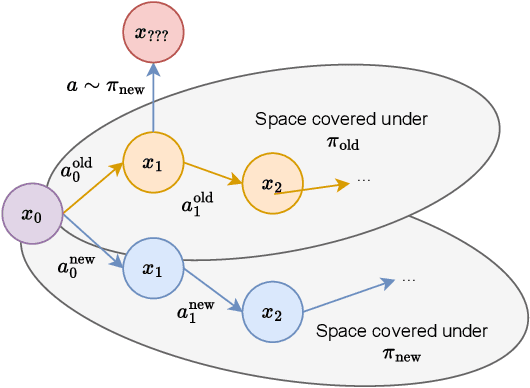
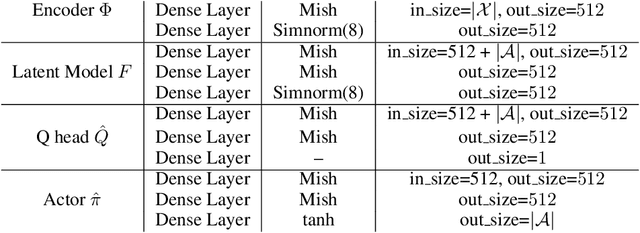
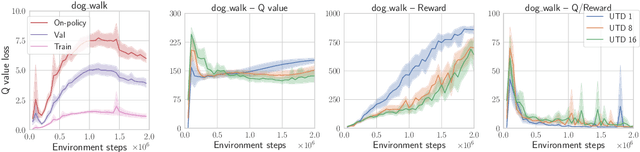
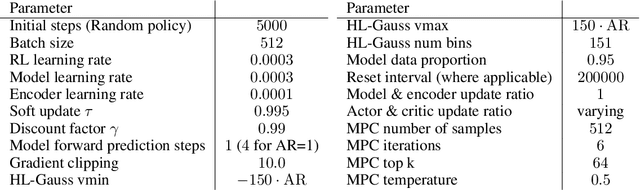
Building deep reinforcement learning (RL) agents that find a good policy with few samples has proven notoriously challenging. To achieve sample efficiency, recent work has explored updating neural networks with large numbers of gradient steps for every new sample. While such high update-to-data (UTD) ratios have shown strong empirical performance, they also introduce instability to the training process. Previous approaches need to rely on periodic neural network parameter resets to address this instability, but restarting the training process is infeasible in many real-world applications and requires tuning the resetting interval. In this paper, we focus on one of the core difficulties of stable training with limited samples: the inability of learned value functions to generalize to unobserved on-policy actions. We mitigate this issue directly by augmenting the off-policy RL training process with a small amount of data generated from a learned world model. Our method, Model-Augmented Data for Temporal Difference learning (MAD-TD) uses small amounts of generated data to stabilize high UTD training and achieve competitive performance on the most challenging tasks in the DeepMind control suite. Our experiments further highlight the importance of employing a good model to generate data, MAD-TD's ability to combat value overestimation, and its practical stability gains for continued learning.
Can we hop in general? A discussion of benchmark selection and design using the Hopper environment
Oct 11, 2024Empirical, benchmark-driven testing is a fundamental paradigm in the current RL community. While using off-the-shelf benchmarks in reinforcement learning (RL) research is a common practice, this choice is rarely discussed. Benchmark choices are often done based on intuitive ideas like "legged robots" or "visual observations". In this paper, we argue that benchmarking in RL needs to be treated as a scientific discipline itself. To illustrate our point, we present a case study on different variants of the Hopper environment to show that the selection of standard benchmarking suites can drastically change how we judge performance of algorithms. The field does not have a cohesive notion of what the different Hopper environments are representative - they do not even seem to be representative of each other. Our experimental results suggests a larger issue in the deep RL literature: benchmark choices are neither commonly justified, nor does there exist a language that could be used to justify the selection of certain environments. This paper concludes with a discussion of the requirements for proper discussion and evaluations of benchmarks and recommends steps to start a dialogue towards this goal.
$λ$-AC: Learning latent decision-aware models for reinforcement learning in continuous state-spaces
Jun 30, 2023
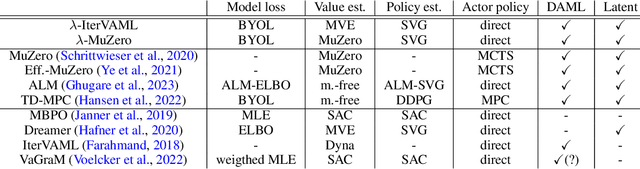

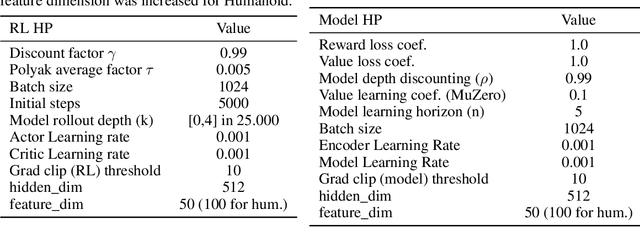
The idea of decision-aware model learning, that models should be accurate where it matters for decision-making, has gained prominence in model-based reinforcement learning. While promising theoretical results have been established, the empirical performance of algorithms leveraging a decision-aware loss has been lacking, especially in continuous control problems. In this paper, we present a study on the necessary components for decision-aware reinforcement learning models and we showcase design choices that enable well-performing algorithms. To this end, we provide a theoretical and empirical investigation into prominent algorithmic ideas in the field. We highlight that empirical design decisions established in the MuZero line of works are vital to achieving good performance for related algorithms, and we showcase differences in behavior between different instantiations of value-aware algorithms in stochastic environments. Using these insights, we propose the Latent Model-Based Decision-Aware Actor-Critic framework ($\lambda$-AC) for decision-aware model-based reinforcement learning in continuous state-spaces and highlight important design choices in different environments.