 Add to Chrome
 Add to Firefox
 Add to Edge
Argus: Reorchestrating Static Analysis via a Multi-Agent Ensemble for Full-Chain Security Vulnerability Detection
Apr 08, 2026
Recent advancements in Large Language Models (LLMs) have sparked interest in their application to Static Application Security Testing (SAST), primarily due to their superior contextual reasoning capabilities compared to traditional symbolic or rule-based methods. However, existing LLM-based approaches typically attempt to replace human experts directly without integrating effectively with existing SAST tools. This lack of integration results in ineffectiveness, including high rates of false positives, hallucinations, limited reasoning depth, and excessive token usage, making them impractical for industrial deployment. To overcome these limitations, we present a paradigm shift that reorchestrates the SAST workflow from current LLM-assisted structure to a new LLM-centered workflow. We introduce Argus (Agentic and Retrieval-Augmented Guarding System), the first multi-agent framework designed specifically for vulnerability detection. Argus incorporates three key novelties: comprehensive supply chain analysis, collaborative multi-agent workflows, and the integration of state-of-the-art techniques such as Retrieval-Augmented Generation (RAG) and ReAct to minimize hallucinations and enhance reasoning. Extensive empirical evaluation demonstrates that Argus significantly outperforms existing methods by detecting a higher volume of true vulnerabilities while simultaneously reducing false positives and operational costs. Notably, Argus has identified several critical zero-day vulnerabilities with CVE assignments.

How Vulnerable Are Edge LLMs?
Mar 25, 2026Large language models (LLMs) are increasingly deployed on edge devices under strict computation and quantization constraints, yet their security implications remain unclear. We study query-based knowledge extraction from quantized edge-deployed LLMs under realistic query budgets and show that, although quantization introduces noise, it does not remove the underlying semantic knowledge, allowing substantial behavioral recovery through carefully designed queries. To systematically analyze this risk, we propose \textbf{CLIQ} (\textbf{Cl}ustered \textbf{I}nstruction \textbf{Q}uerying), a structured query construction framework that improves semantic coverage while reducing redundancy. Experiments on quantized Qwen models (INT8/INT4) demonstrate that CLIQ consistently outperforms original queries across BERTScore, BLEU, and ROUGE, enabling more efficient extraction under limited budgets. These results indicate that quantization alone does not provide effective protection against query-based extraction, highlighting a previously underexplored security risk in edge-deployed LLMs.
FIT: Defying Catastrophic Forgetting in Continual LLM Unlearning
Jan 29, 2026Large language models (LLMs) demonstrate impressive capabilities across diverse tasks but raise concerns about privacy, copyright, and harmful materials. Existing LLM unlearning methods rarely consider the continual and high-volume nature of real-world deletion requests, which can cause utility degradation and catastrophic forgetting as requests accumulate. To address this challenge, we introduce \fit, a framework for continual unlearning that handles large numbers of deletion requests while maintaining robustness against both catastrophic forgetting and post-unlearning recovery. \fit mitigates degradation through rigorous data \underline{F}iltering, \underline{I}mportance-aware updates, and \underline{T}argeted layer attribution, enabling stable performance across long sequences of unlearning operations and achieving a favorable balance between forgetting effectiveness and utility retention. To support realistic evaluation, we present \textbf{PCH}, a benchmark covering \textbf{P}ersonal information, \textbf{C}opyright, and \textbf{H}armful content in sequential deletion scenarios, along with two symmetric metrics, Forget Degree (F.D.) and Retain Utility (R.U.), which jointly assess forgetting quality and utility preservation. Extensive experiments on four open-source LLMs with hundreds of deletion requests show that \fit achieves the strongest trade-off between F.D. and R.U., surpasses existing methods on MMLU, CommonsenseQA, and GSM8K, and remains resistant against both relearning and quantization recovery attacks.
How Much Information Can a Vision Token Hold? A Scaling Law for Recognition Limits in VLMs
Jan 28, 2026Recent vision-centric approaches have made significant strides in long-context modeling. Represented by DeepSeek-OCR, these models encode rendered text into continuous vision tokens, achieving high compression rates without sacrificing recognition precision. However, viewing the vision encoder as a lossy channel with finite representational capacity raises a fundamental question: what is the information upper bound of visual tokens? To investigate this limit, we conduct controlled stress tests by progressively increasing the information quantity (character count) within an image. We observe a distinct phase-transition phenomenon characterized by three regimes: a near-perfect Stable Phase, an Instability Phase marked by increased error variance, and a total Collapse Phase. We analyze the mechanical origins of these transitions and identify key factors. Furthermore, we formulate a probabilistic scaling law that unifies average vision token load and visual density into a latent difficulty metric. Extensive experiments across various Vision-Language Models demonstrate the universality of this scaling law, providing critical empirical guidance for optimizing the efficiency-accuracy trade-off in visual context compression.
From Domains to Instances: Dual-Granularity Data Synthesis for LLM Unlearning
Jan 07, 2026Although machine unlearning is essential for removing private, harmful, or copyrighted content from LLMs, current benchmarks often fail to faithfully represent the true "forgetting scope" learned by the model. We formalize two distinct unlearning granularities, domain-level and instance-level, and propose BiForget, an automated framework for synthesizing high-quality forget sets. Unlike prior work relying on external generators, BiForget exploits the target model per se to elicit data that matches its internal knowledge distribution through seed-guided and adversarial prompting. Our experiments across diverse benchmarks show that it achieves a superior balance of relevance, diversity, and efficiency. Quantitatively, in the Harry Potter domain, it improves relevance by ${\sim}20$ and diversity by ${\sim}$0.05 while halving the total data size compared to SOTAs. Ultimately, it facilitates more robust forgetting and better utility preservation, providing a more rigorous foundation for evaluating LLM unlearning.
Class-feature Watermark: A Resilient Black-box Watermark Against Model Extraction Attacks
Nov 16, 2025Machine learning models constitute valuable intellectual property, yet remain vulnerable to model extraction attacks (MEA), where adversaries replicate their functionality through black-box queries. Model watermarking counters MEAs by embedding forensic markers for ownership verification. Current black-box watermarks prioritize MEA survival through representation entanglement, yet inadequately explore resilience against sequential MEAs and removal attacks. Our study reveals that this risk is underestimated because existing removal methods are weakened by entanglement. To address this gap, we propose Watermark Removal attacK (WRK), which circumvents entanglement constraints by exploiting decision boundaries shaped by prevailing sample-level watermark artifacts. WRK effectively reduces watermark success rates by at least 88.79% across existing watermarking benchmarks. For robust protection, we propose Class-Feature Watermarks (CFW), which improve resilience by leveraging class-level artifacts. CFW constructs a synthetic class using out-of-domain samples, eliminating vulnerable decision boundaries between original domain samples and their artifact-modified counterparts (watermark samples). CFW concurrently optimizes both MEA transferability and post-MEA stability. Experiments across multiple domains show that CFW consistently outperforms prior methods in resilience, maintaining a watermark success rate of at least 70.15% in extracted models even under the combined MEA and WRK distortion, while preserving the utility of protected models.
Reminiscence Attack on Residuals: Exploiting Approximate Machine Unlearning for Privacy
Jul 28, 2025Machine unlearning enables the removal of specific data from ML models to uphold the right to be forgotten. While approximate unlearning algorithms offer efficient alternatives to full retraining, this work reveals that they fail to adequately protect the privacy of unlearned data. In particular, these algorithms introduce implicit residuals which facilitate privacy attacks targeting at unlearned data. We observe that these residuals persist regardless of model architectures, parameters, and unlearning algorithms, exposing a new attack surface beyond conventional output-based leakage. Based on this insight, we propose the Reminiscence Attack (ReA), which amplifies the correlation between residuals and membership privacy through targeted fine-tuning processes. ReA achieves up to 1.90x and 1.12x higher accuracy than prior attacks when inferring class-wise and sample-wise membership, respectively. To mitigate such residual-induced privacy risk, we develop a dual-phase approximate unlearning framework that first eliminates deep-layer unlearned data traces and then enforces convergence stability to prevent models from "pseudo-convergence", where their outputs are similar to retrained models but still preserve unlearned residuals. Our framework works for both classification and generation tasks. Experimental evaluations confirm that our approach maintains high unlearning efficacy, while reducing the adaptive privacy attack accuracy to nearly random guess, at the computational cost of 2-12% of full retraining from scratch.
United Minds or Isolated Agents? Exploring Coordination of LLMs under Cognitive Load Theory
Jun 07, 2025Large Language Models (LLMs) exhibit a notable performance ceiling on complex, multi-faceted tasks, as they often fail to integrate diverse information or adhere to multiple constraints. We posit that such limitation arises when the demands of a task exceed the LLM's effective cognitive load capacity. This interpretation draws a strong analogy to Cognitive Load Theory (CLT) in cognitive science, which explains similar performance boundaries in the human mind, and is further supported by emerging evidence that reveals LLMs have bounded working memory characteristics. Building upon this CLT-grounded understanding, we introduce CoThinker, a novel LLM-based multi-agent framework designed to mitigate cognitive overload and enhance collaborative problem-solving abilities. CoThinker operationalizes CLT principles by distributing intrinsic cognitive load through agent specialization and managing transactional load via structured communication and a collective working memory. We empirically validate CoThinker on complex problem-solving tasks and fabricated high cognitive load scenarios, demonstrating improvements over existing multi-agent baselines in solution quality and efficiency. Our analysis reveals characteristic interaction patterns, providing insights into the emergence of collective cognition and effective load management, thus offering a principled approach to overcoming LLM performance ceilings.
Does Low Rank Adaptation Lead to Lower Robustness against Training-Time Attacks?
May 19, 2025Low rank adaptation (LoRA) has emerged as a prominent technique for fine-tuning large language models (LLMs) thanks to its superb efficiency gains over previous methods. While extensive studies have examined the performance and structural properties of LoRA, its behavior upon training-time attacks remain underexplored, posing significant security risks. In this paper, we theoretically investigate the security implications of LoRA's low-rank structure during fine-tuning, in the context of its robustness against data poisoning and backdoor attacks. We propose an analytical framework that models LoRA's training dynamics, employs the neural tangent kernel to simplify the analysis of the training process, and applies information theory to establish connections between LoRA's low rank structure and its vulnerability against training-time attacks. Our analysis indicates that LoRA exhibits better robustness to backdoor attacks than full fine-tuning, while becomes more vulnerable to untargeted data poisoning due to its over-simplified information geometry. Extensive experimental evaluations have corroborated our theoretical findings.
How Vital is the Jurisprudential Relevance: Law Article Intervened Legal Case Retrieval and Matching
Feb 25, 2025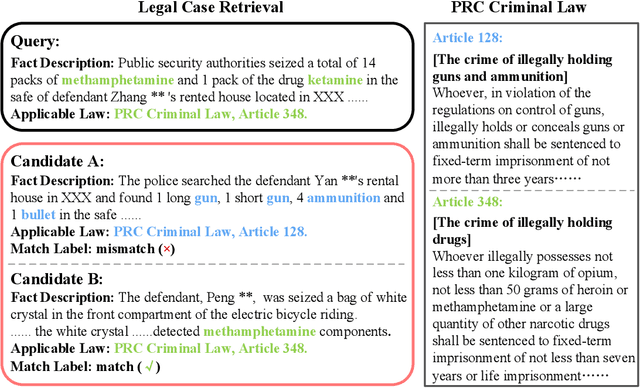
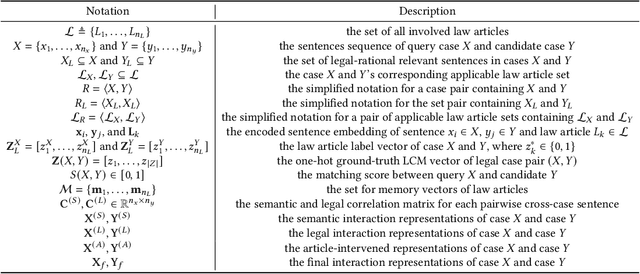
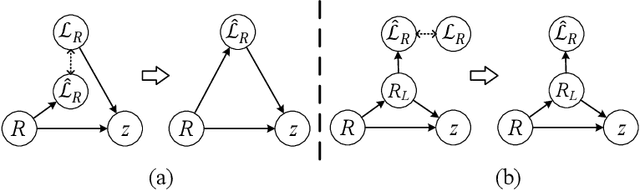
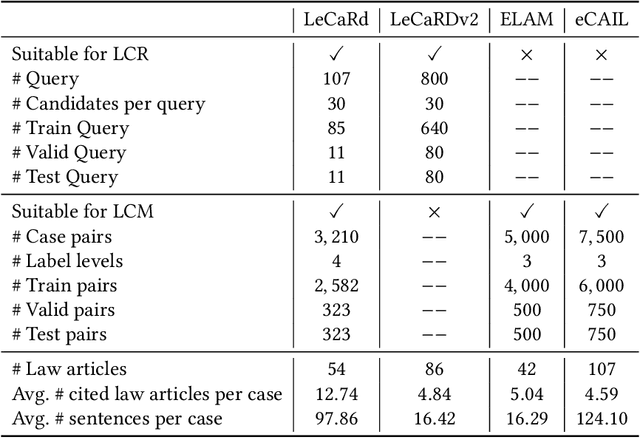
Legal case retrieval (LCR) aims to automatically scour for comparable legal cases based on a given query, which is crucial for offering relevant precedents to support the judgment in intelligent legal systems. Due to similar goals, it is often associated with a similar case matching (LCM) task. To address them, a daunting challenge is assessing the uniquely defined legal-rational similarity within the judicial domain, which distinctly deviates from the semantic similarities in general text retrieval. Past works either tagged domain-specific factors or incorporated reference laws to capture legal-rational information. However, their heavy reliance on expert or unrealistic assumptions restricts their practical applicability in real-world scenarios. In this paper, we propose an end-to-end model named LCM-LAI to solve the above challenges. Through meticulous theoretical analysis, LCM-LAI employs a dependent multi-task learning framework to capture legal-rational information within legal cases by a law article prediction (LAP) sub-task, without any additional assumptions in inference. Besides, LCM-LAI proposes an article-aware attention mechanism to evaluate the legal-rational similarity between across-case sentences based on law distribution, which is more effective than conventional semantic similarity. Weperform a series of exhaustive experiments including two different tasks involving four real-world datasets. Results demonstrate that LCM-LAI achieves state-of-the-art performance.