 Add to Chrome
 Add to Firefox
 Add to Edge
Deepfake Forensics Adapter: A Dual-Stream Network for Generalizable Deepfake Detection
Mar 02, 2026
The rapid advancement of deepfake generation techniques poses significant threats to public safety and causes societal harm through the creation of highly realistic synthetic facial media. While existing detection methods demonstrate limitations in generalizing to emerging forgery patterns, this paper presents Deepfake Forensics Adapter (DFA), a novel dual-stream framework that synergizes vision-language foundation models with targeted forensics analysis. Our approach integrates a pre-trained CLIP model with three core components to achieve specialized deepfake detection by leveraging the powerful general capabilities of CLIP without changing CLIP parameters: 1) A Global Feature Adapter is used to identify global inconsistencies in image content that may indicate forgery, 2) A Local Anomaly Stream enhances the model's ability to perceive local facial forgery cues by explicitly leveraging facial structure priors, and 3) An Interactive Fusion Classifier promotes deep interaction and fusion between global and local features using a transformer encoder. Extensive evaluations of frame-level and video-level benchmarks demonstrate the superior generalization capabilities of DFA, particularly achieving state-of-the-art performance in the challenging DFDC dataset with frame-level AUC/EER of 0.816/0.256 and video-level AUC/EER of 0.836/0.251, representing a 4.8% video AUC improvement over previous methods. Our framework not only demonstrates state-of-the-art performance, but also points out a feasible and effective direction for developing a robust deepfake detection system with enhanced generalization capabilities against the evolving deepfake threats. Our code is available at https://github.com/Liao330/DFA.git

Garbage Segmentation and Attribute Analysis by Robotic Dogs
Apr 28, 2024
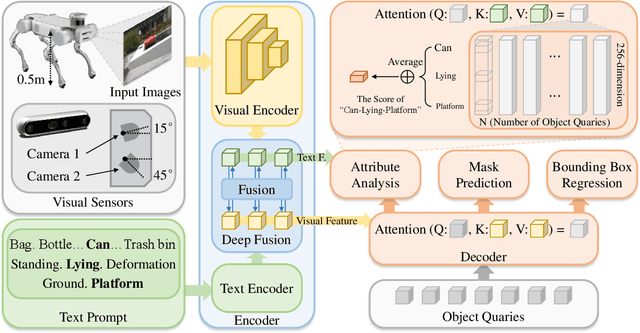


Efficient waste management and recycling heavily rely on garbage exploration and identification. In this study, we propose GSA2Seg (Garbage Segmentation and Attribute Analysis), a novel visual approach that utilizes quadruped robotic dogs as autonomous agents to address waste management and recycling challenges in diverse indoor and outdoor environments. Equipped with advanced visual perception system, including visual sensors and instance segmentators, the robotic dogs adeptly navigate their surroundings, diligently searching for common garbage items. Inspired by open-vocabulary algorithms, we introduce an innovative method for object attribute analysis. By combining garbage segmentation and attribute analysis techniques, the robotic dogs accurately determine the state of the trash, including its position and placement properties. This information enhances the robotic arm's grasping capabilities, facilitating successful garbage retrieval. Additionally, we contribute an image dataset, named GSA2D, to support evaluation. Through extensive experiments on GSA2D, this paper provides a comprehensive analysis of GSA2Seg's effectiveness. Dataset available: \href{https://www.kaggle.com/datasets/hellob/gsa2d-2024}{https://www.kaggle.com/datasets/hellob/gsa2d-2024}.