 Add to Chrome
 Add to Firefox
 Add to Edge
Scaling Diffusion Policy in Transformer to 1 Billion Parameters for Robotic Manipulation
Sep 22, 2024

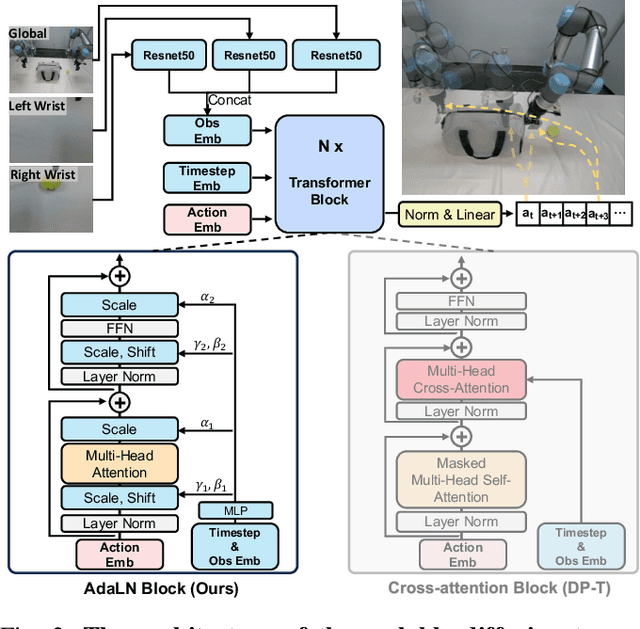


Diffusion Policy is a powerful technique tool for learning end-to-end visuomotor robot control. It is expected that Diffusion Policy possesses scalability, a key attribute for deep neural networks, typically suggesting that increasing model size would lead to enhanced performance. However, our observations indicate that Diffusion Policy in transformer architecture (\DP) struggles to scale effectively; even minor additions of layers can deteriorate training outcomes. To address this issue, we introduce Scalable Diffusion Transformer Policy for visuomotor learning. Our proposed method, namely \textbf{\methodname}, introduces two modules that improve the training dynamic of Diffusion Policy and allow the network to better handle multimodal action distribution. First, we identify that \DP~suffers from large gradient issues, making the optimization of Diffusion Policy unstable. To resolve this issue, we factorize the feature embedding of observation into multiple affine layers, and integrate it into the transformer blocks. Additionally, our utilize non-causal attention which allows the policy network to \enquote{see} future actions during prediction, helping to reduce compounding errors. We demonstrate that our proposed method successfully scales the Diffusion Policy from 10 million to 1 billion parameters. This new model, named \methodname, can effectively scale up the model size with improved performance and generalization. We benchmark \methodname~across 50 different tasks from MetaWorld and find that our largest \methodname~outperforms \DP~with an average improvement of 21.6\%. Across 7 real-world robot tasks, our ScaleDP demonstrates an average improvement of 36.25\% over DP-T on four single-arm tasks and 75\% on three bimanual tasks. We believe our work paves the way for scaling up models for visuomotor learning. The project page is available at scaling-diffusion-policy.github.io.

Nonlocal Attention Operator: Materializing Hidden Knowledge Towards Interpretable Physics Discovery
Aug 14, 2024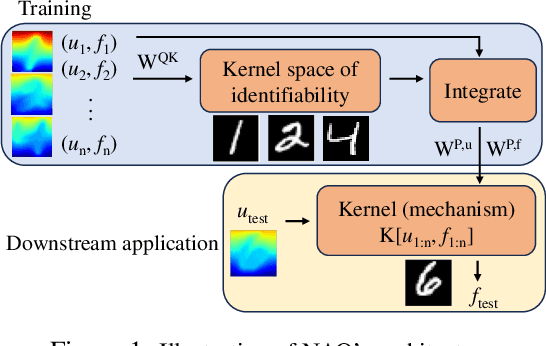
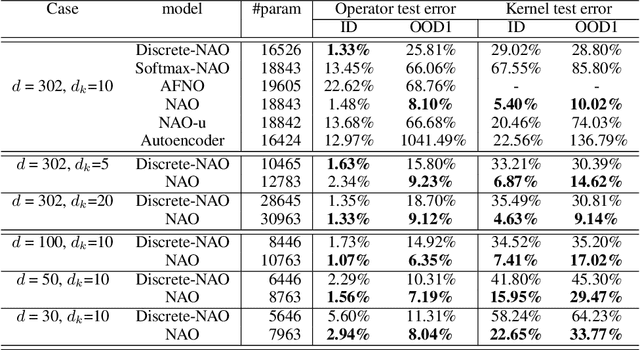
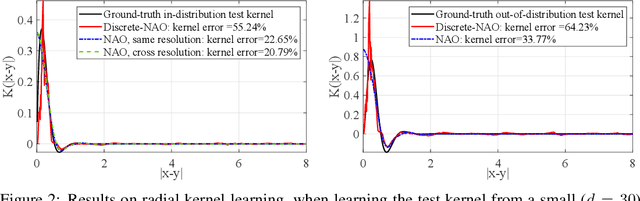
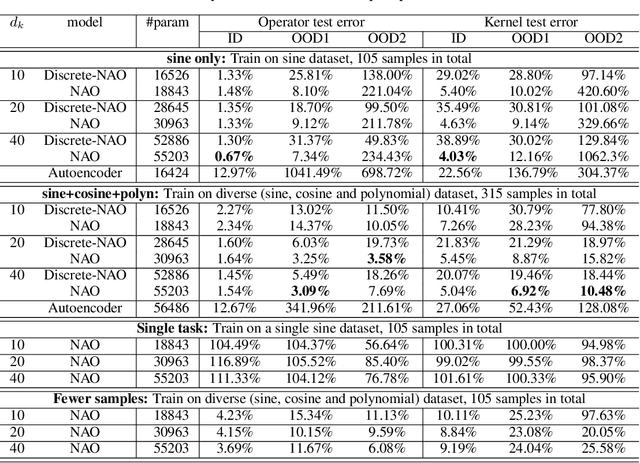
Despite the recent popularity of attention-based neural architectures in core AI fields like natural language processing (NLP) and computer vision (CV), their potential in modeling complex physical systems remains under-explored. Learning problems in physical systems are often characterized as discovering operators that map between function spaces based on a few instances of function pairs. This task frequently presents a severely ill-posed PDE inverse problem. In this work, we propose a novel neural operator architecture based on the attention mechanism, which we coin Nonlocal Attention Operator (NAO), and explore its capability towards developing a foundation physical model. In particular, we show that the attention mechanism is equivalent to a double integral operator that enables nonlocal interactions among spatial tokens, with a data-dependent kernel characterizing the inverse mapping from data to the hidden parameter field of the underlying operator. As such, the attention mechanism extracts global prior information from training data generated by multiple systems, and suggests the exploratory space in the form of a nonlinear kernel map. Consequently, NAO can address ill-posedness and rank deficiency in inverse PDE problems by encoding regularization and achieving generalizability. We empirically demonstrate the advantages of NAO over baseline neural models in terms of generalizability to unseen data resolutions and system states. Our work not only suggests a novel neural operator architecture for learning interpretable foundation models of physical systems, but also offers a new perspective towards understanding the attention mechanism.
Autoregressive Enzyme Function Prediction with Multi-scale Multi-modality Fusion
Aug 11, 2024Accurate prediction of enzyme function is crucial for elucidating biological mechanisms and driving innovation across various sectors. Existing deep learning methods tend to rely solely on either sequence data or structural data and predict the EC number as a whole, neglecting the intrinsic hierarchical structure of EC numbers. To address these limitations, we introduce MAPred, a novel multi-modality and multi-scale model designed to autoregressively predict the EC number of proteins. MAPred integrates both the primary amino acid sequence and the 3D tokens of proteins, employing a dual-pathway approach to capture comprehensive protein characteristics and essential local functional sites. Additionally, MAPred utilizes an autoregressive prediction network to sequentially predict the digits of the EC number, leveraging the hierarchical organization of EC classifications. Evaluations on benchmark datasets, including New-392, Price, and New-815, demonstrate that our method outperforms existing models, marking a significant advance in the reliability and granularity of protein function prediction within bioinformatics.
Large language models, physics-based modeling, experimental measurements: the trinity of data-scarce learning of polymer properties
Jul 03, 2024Large language models (LLMs) bear promise as a fast and accurate material modeling paradigm for evaluation, analysis, and design. Their vast number of trainable parameters necessitates a wealth of data to achieve accuracy and mitigate overfitting. However, experimental measurements are often limited and costly to obtain in sufficient quantities for finetuning. To this end, we present a physics-based training pipeline that tackles the pathology of data scarcity. The core enabler is a physics-based modeling framework that generates a multitude of synthetic data to align the LLM to a physically consistent initial state before finetuning. Our framework features a two-phase training strategy: (1) utilizing the large-in-amount while less accurate synthetic data for supervised pretraining, and (2) finetuning the phase-1 model with limited experimental data. We empirically demonstrate that supervised pretraining is vital to obtaining accurate finetuned LLMs, via the lens of learning polymer flammability metrics where cone calorimeter data is sparse.
MMRo: Are Multimodal LLMs Eligible as the Brain for In-Home Robotics?
Jun 28, 2024

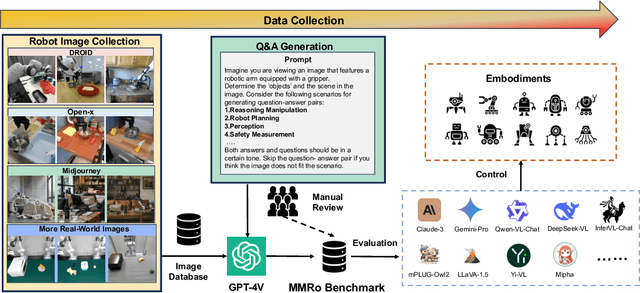
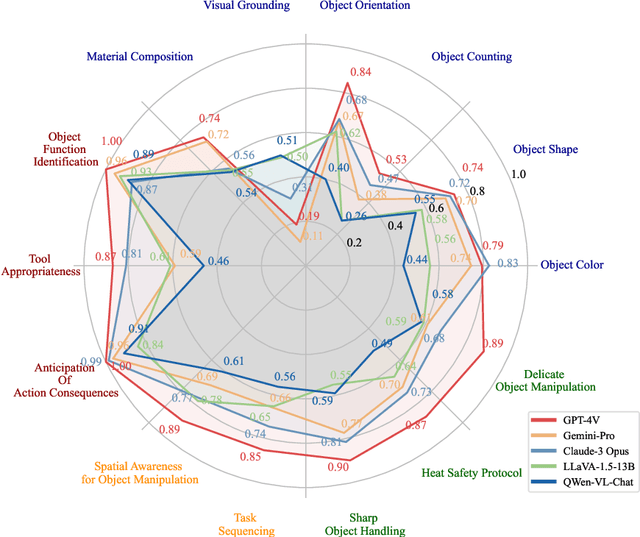
It is fundamentally challenging for robots to serve as useful assistants in human environments because this requires addressing a spectrum of sub-problems across robotics, including perception, language understanding, reasoning, and planning. The recent advancements in Multimodal Large Language Models (MLLMs) have demonstrated their exceptional abilities in solving complex mathematical problems, mastering commonsense and abstract reasoning. This has led to the recent utilization of MLLMs as the brain in robotic systems, enabling these models to conduct high-level planning prior to triggering low-level control actions for task execution. However, it remains uncertain whether existing MLLMs are reliable in serving the brain role of robots. In this study, we introduce the first benchmark for evaluating Multimodal LLM for Robotic (MMRo) benchmark, which tests the capability of MLLMs for robot applications. Specifically, we identify four essential capabilities perception, task planning, visual reasoning, and safety measurement that MLLMs must possess to qualify as the robot's central processing unit. We have developed several scenarios for each capability, resulting in a total of 14 metrics for evaluation. We present experimental results for various MLLMs, including both commercial and open-source models, to assess the performance of existing systems. Our findings indicate that no single model excels in all areas, suggesting that current MLLMs are not yet trustworthy enough to serve as the cognitive core for robots. Our data can be found in https://mm-robobench.github.io/.
SelfDefend: LLMs Can Defend Themselves against Jailbreaking in a Practical Manner
Jun 08, 2024Jailbreaking is an emerging adversarial attack that bypasses the safety alignment deployed in off-the-shelf large language models (LLMs) and has evolved into four major categories: optimization-based attacks such as Greedy Coordinate Gradient (GCG), jailbreak template-based attacks such as "Do-Anything-Now", advanced indirect attacks like DrAttack, and multilingual jailbreaks. However, delivering a practical jailbreak defense is challenging because it needs to not only handle all the above jailbreak attacks but also incur negligible delay to user prompts, as well as be compatible with both open-source and closed-source LLMs. Inspired by how the traditional security concept of shadow stacks defends against memory overflow attacks, this paper introduces a generic LLM jailbreak defense framework called SelfDefend, which establishes a shadow LLM defense instance to concurrently protect the target LLM instance in the normal stack and collaborate with it for checkpoint-based access control. The effectiveness of SelfDefend builds upon our observation that existing LLMs (both target and defense LLMs) have the capability to identify harmful prompts or intentions in user queries, which we empirically validate using the commonly used GPT-3.5/4 models across all major jailbreak attacks. Our measurements show that SelfDefend enables GPT-3.5 to suppress the attack success rate (ASR) by 8.97-95.74% (average: 60%) and GPT-4 by even 36.36-100% (average: 83%), while incurring negligible effects on normal queries. To further improve the defense's robustness and minimize costs, we employ a data distillation approach to tune dedicated open-source defense models. These models outperform four SOTA defenses and match the performance of GPT-4-based SelfDefend, with significantly lower extra delays. We also empirically show that the tuned models are robust to targeted GCG and prompt injection attacks.
Deep Neural Operator Enabled Digital Twin Modeling for Additive Manufacturing
May 13, 2024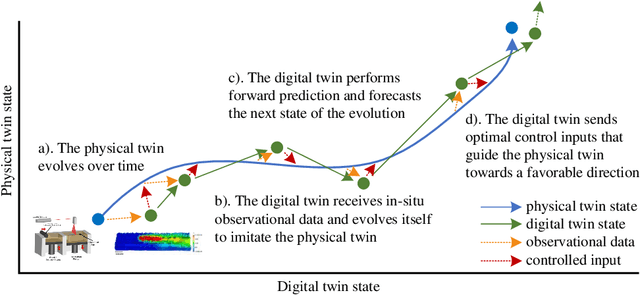
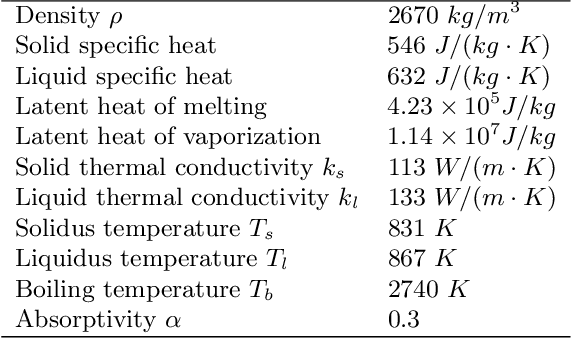
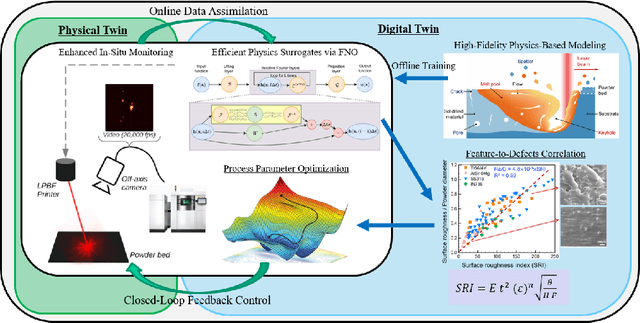
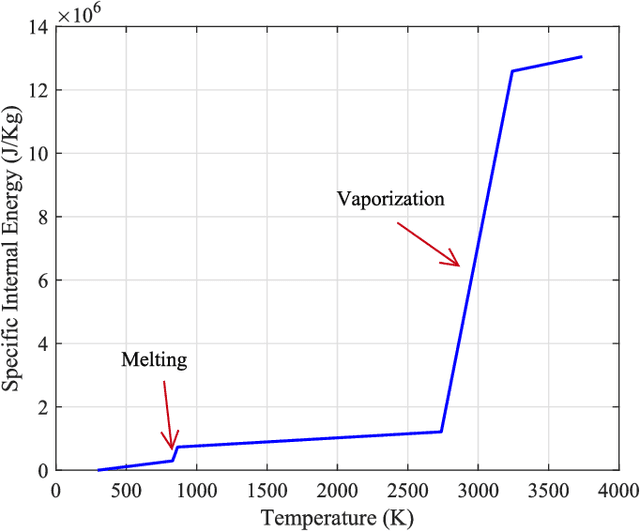
A digital twin (DT), with the components of a physics-based model, a data-driven model, and a machine learning (ML) enabled efficient surrogate, behaves as a virtual twin of the real-world physical process. In terms of Laser Powder Bed Fusion (L-PBF) based additive manufacturing (AM), a DT can predict the current and future states of the melt pool and the resulting defects corresponding to the input laser parameters, evolve itself by assimilating in-situ sensor data, and optimize the laser parameters to mitigate defect formation. In this paper, we present a deep neural operator enabled computational framework of the DT for closed-loop feedback control of the L-PBF process. This is accomplished by building a high-fidelity computational model to accurately represent the melt pool states, an efficient surrogate model to approximate the melt pool solution field, followed by an physics-based procedure to extract information from the computed melt pool simulation that can further be correlated to the defect quantities of interest (e.g., surface roughness). In particular, we leverage the data generated from the high-fidelity physics-based model and train a series of Fourier neural operator (FNO) based ML models to effectively learn the relation between the input laser parameters and the corresponding full temperature field of the melt pool. Subsequently, a set of physics-informed variables such as the melt pool dimensions and the peak temperature can be extracted to compute the resulting defects. An optimization algorithm is then exercised to control laser input and minimize defects. On the other hand, the constructed DT can also evolve with the physical twin via offline finetuning and online material calibration. Finally, a probabilistic framework is adopted for uncertainty quantification. The developed DT is envisioned to guide the AM process and facilitate high-quality manufacturing.
STMGF: An Effective Spatial-Temporal Multi-Granularity Framework for Traffic Forecasting
Apr 08, 2024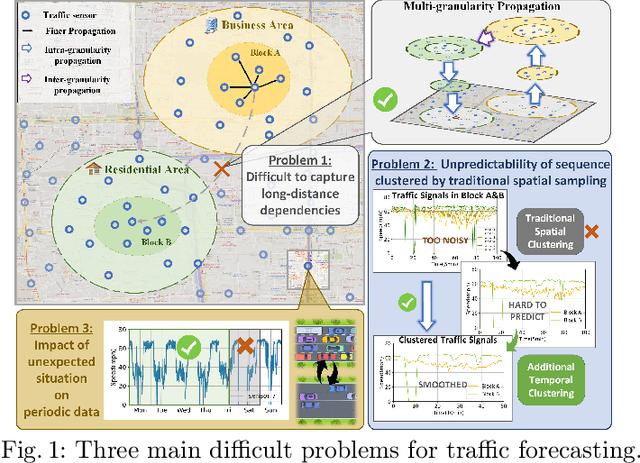
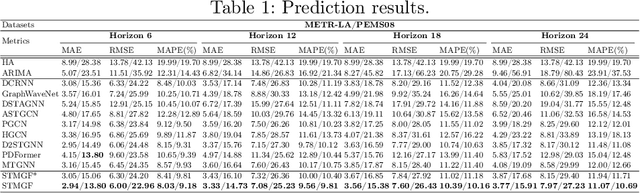
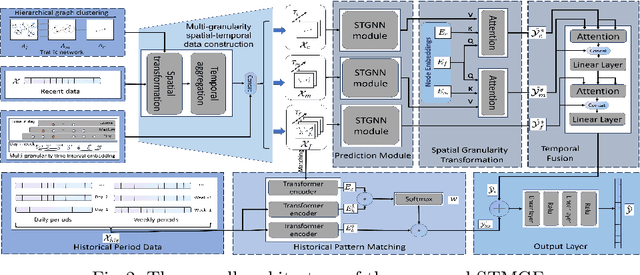
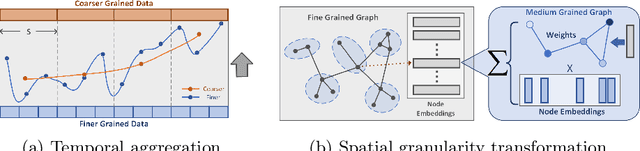
Accurate Traffic Prediction is a challenging task in intelligent transportation due to the spatial-temporal aspects of road networks. The traffic of a road network can be affected by long-distance or long-term dependencies where existing methods fall short in modeling them. In this paper, we introduce a novel framework known as Spatial-Temporal Multi-Granularity Framework (STMGF) to enhance the capture of long-distance and long-term information of the road networks. STMGF makes full use of different granularity information of road networks and models the long-distance and long-term information by gathering information in a hierarchical interactive way. Further, it leverages the inherent periodicity in traffic sequences to refine prediction results by matching with recent traffic data. We conduct experiments on two real-world datasets, and the results demonstrate that STMGF outperforms all baseline models and achieves state-of-the-art performance.
Subjective-Aligned Dataset and Metric for Text-to-Video Quality Assessment
Mar 28, 2024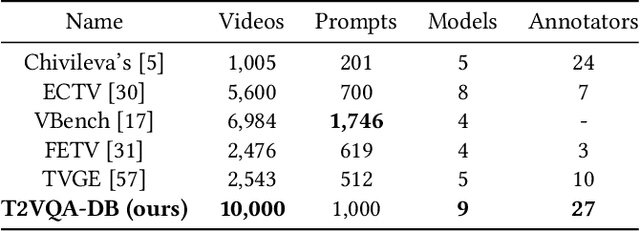
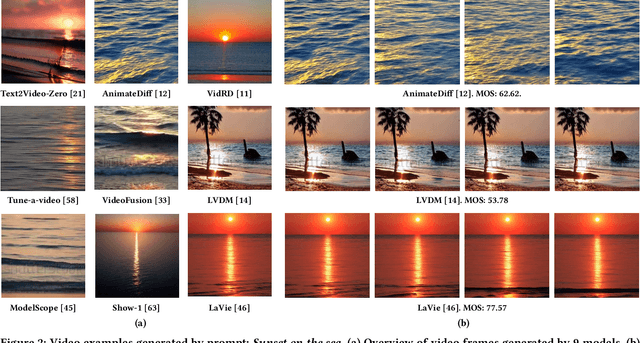
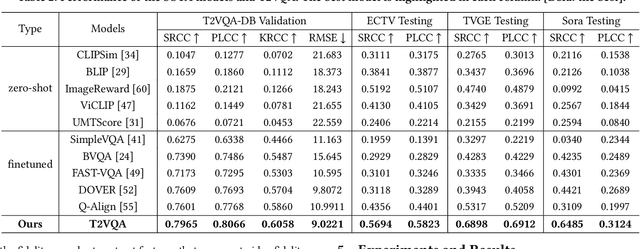
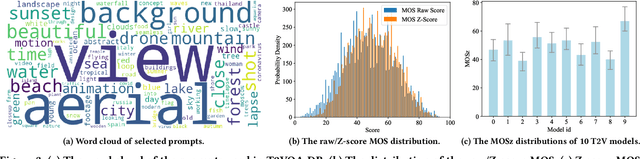
With the rapid development of generative models, Artificial Intelligence-Generated Contents (AIGC) have exponentially increased in daily lives. Among them, Text-to-Video (T2V) generation has received widespread attention. Though many T2V models have been released for generating high perceptual quality videos, there is still lack of a method to evaluate the quality of these videos quantitatively. To solve this issue, we establish the largest-scale Text-to-Video Quality Assessment DataBase (T2VQA-DB) to date. The dataset is composed of 10,000 videos generated by 9 different T2V models. We also conduct a subjective study to obtain each video's corresponding mean opinion score. Based on T2VQA-DB, we propose a novel transformer-based model for subjective-aligned Text-to-Video Quality Assessment (T2VQA). The model extracts features from text-video alignment and video fidelity perspectives, then it leverages the ability of a large language model to give the prediction score. Experimental results show that T2VQA outperforms existing T2V metrics and SOTA video quality assessment models. Quantitative analysis indicates that T2VQA is capable of giving subjective-align predictions, validating its effectiveness. The dataset and code will be released at https://github.com/QMME/T2VQA.
Mipha: A Comprehensive Overhaul of Multimodal Assistant with Small Language Models
Mar 15, 2024Multimodal Large Language Models (MLLMs) have showcased impressive skills in tasks related to visual understanding and reasoning. Yet, their widespread application faces obstacles due to the high computational demands during both the training and inference phases, restricting their use to a limited audience within the research and user communities. In this paper, we investigate the design aspects of Multimodal Small Language Models (MSLMs) and propose an efficient multimodal assistant named Mipha, which is designed to create synergy among various aspects: visual representation, language models, and optimization strategies. We show that without increasing the volume of training data, our Mipha-3B outperforms the state-of-the-art large MLLMs, especially LLaVA-1.5-13B, on multiple benchmarks. Through detailed discussion, we provide insights and guidelines for developing strong MSLMs that rival the capabilities of MLLMs. Our code is available at https://github.com/zhuyiche/Mipha.