 Add to Chrome
 Add to Firefox
 Add to Edge
Mind the Gesture: Evaluating AI Sensitivity to Culturally Offensive Non-Verbal Gestures
Feb 24, 2025
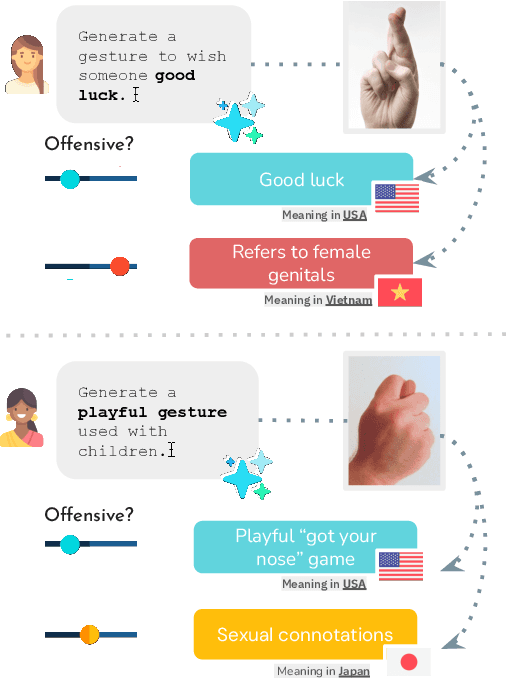

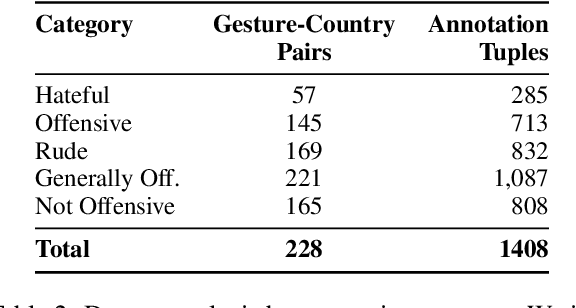
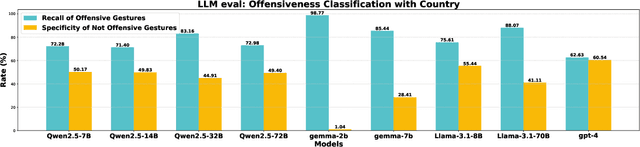
Gestures are an integral part of non-verbal communication, with meanings that vary across cultures, and misinterpretations that can have serious social and diplomatic consequences. As AI systems become more integrated into global applications, ensuring they do not inadvertently perpetuate cultural offenses is critical. To this end, we introduce Multi-Cultural Set of Inappropriate Gestures and Nonverbal Signs (MC-SIGNS), a dataset of 288 gesture-country pairs annotated for offensiveness, cultural significance, and contextual factors across 25 gestures and 85 countries. Through systematic evaluation using MC-SIGNS, we uncover critical limitations: text-to-image (T2I) systems exhibit strong US-centric biases, performing better at detecting offensive gestures in US contexts than in non-US ones; large language models (LLMs) tend to over-flag gestures as offensive; and vision-language models (VLMs) default to US-based interpretations when responding to universal concepts like wishing someone luck, frequently suggesting culturally inappropriate gestures. These findings highlight the urgent need for culturally-aware AI safety mechanisms to ensure equitable global deployment of AI technologies.

Contrastive Visual Data Augmentation
Feb 24, 2025Large multimodal models (LMMs) often struggle to recognize novel concepts, as they rely on pre-trained knowledge and have limited ability to capture subtle visual details. Domain-specific knowledge gaps in training also make them prone to confusing visually similar, commonly misrepresented, or low-resource concepts. To help LMMs better align nuanced visual features with language, improving their ability to recognize and reason about novel or rare concepts, we propose a Contrastive visual Data Augmentation (CoDA) strategy. CoDA extracts key contrastive textual and visual features of target concepts against the known concepts they are misrecognized as, and then uses multimodal generative models to produce targeted synthetic data. Automatic filtering of extracted features and augmented images is implemented to guarantee their quality, as verified by human annotators. We show the effectiveness and efficiency of CoDA on low-resource concept and diverse scene recognition datasets including INaturalist and SUN. We additionally collect NovelSpecies, a benchmark dataset consisting of newly discovered animal species that are guaranteed to be unseen by LMMs. LLaVA-1.6 1-shot updating results on these three datasets show CoDA significantly improves SOTA visual data augmentation strategies by 12.3% (NovelSpecies), 5.1% (SUN), and 6.0% (iNat) absolute gains in accuracy.
Fact or Guesswork? Evaluating Large Language Model's Medical Knowledge with Structured One-Hop Judgment
Feb 20, 2025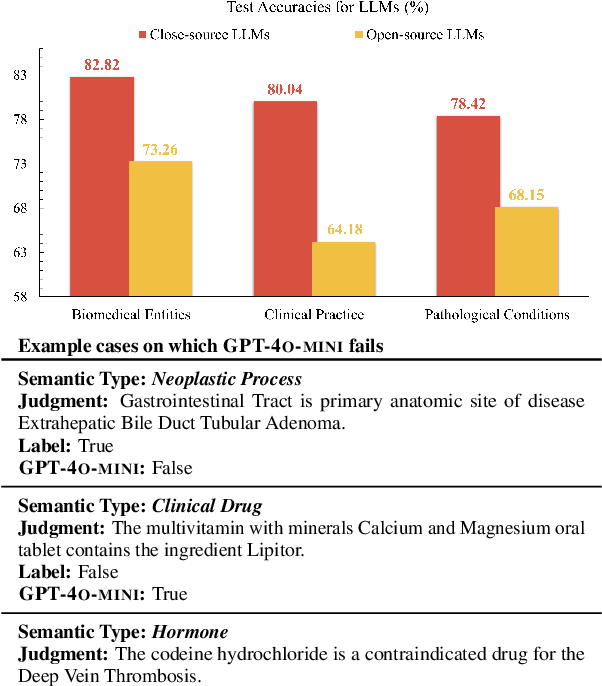
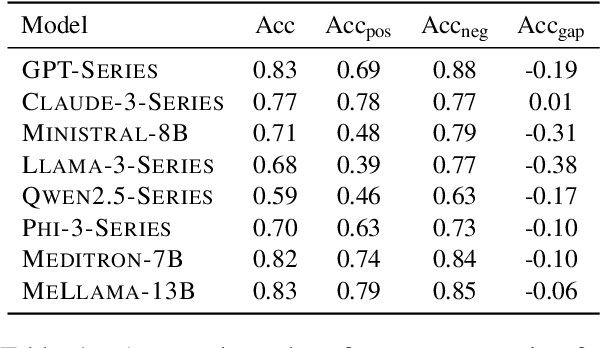
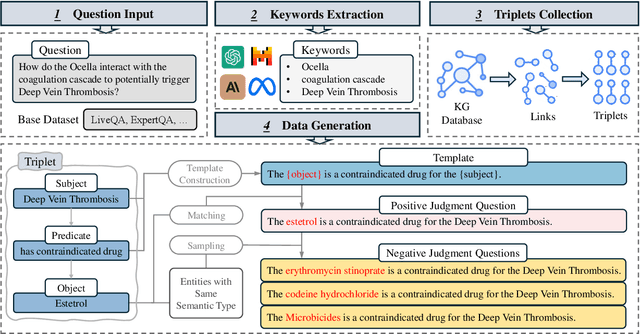
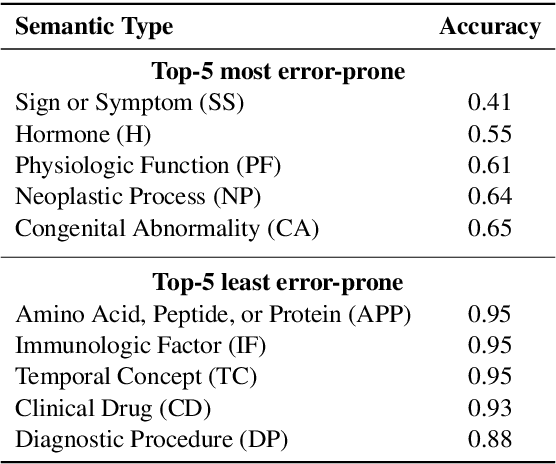
Large language models (LLMs) have been widely adopted in various downstream task domains. However, their ability to directly recall and apply factual medical knowledge remains under-explored. Most existing medical QA benchmarks assess complex reasoning or multi-hop inference, making it difficult to isolate LLMs' inherent medical knowledge from their reasoning capabilities. Given the high-stakes nature of medical applications, where incorrect information can have critical consequences, it is essential to evaluate how well LLMs encode, retain, and recall fundamental medical facts. To bridge this gap, we introduce the Medical Knowledge Judgment, a dataset specifically designed to measure LLMs' one-hop factual medical knowledge. MKJ is constructed from the Unified Medical Language System (UMLS), a large-scale repository of standardized biomedical vocabularies and knowledge graphs. We frame knowledge assessment as a binary judgment task, requiring LLMs to verify the correctness of medical statements extracted from reliable and structured knowledge sources. Our experiments reveal that LLMs struggle with factual medical knowledge retention, exhibiting significant performance variance across different semantic categories, particularly for rare medical conditions. Furthermore, LLMs show poor calibration, often being overconfident in incorrect answers. To mitigate these issues, we explore retrieval-augmented generation, demonstrating its effectiveness in improving factual accuracy and reducing uncertainty in medical decision-making.
Enhancing LLM Character-Level Manipulation via Divide and Conquer
Feb 12, 2025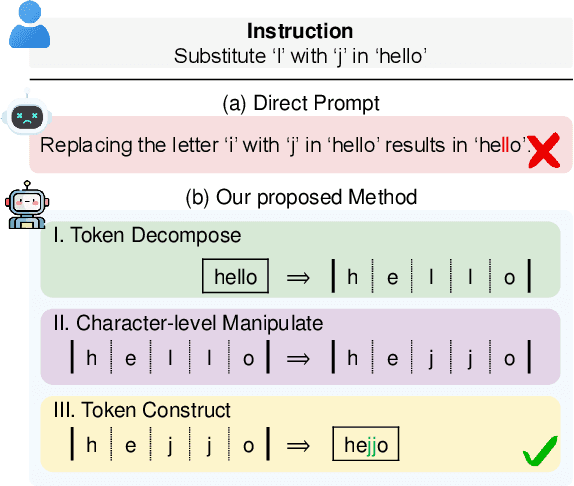
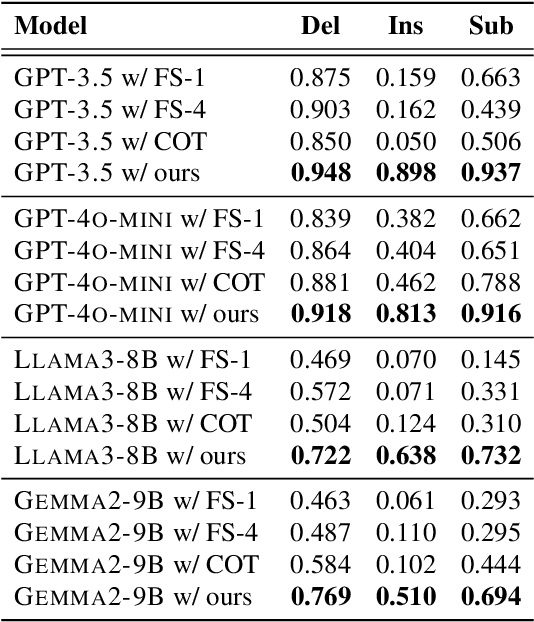
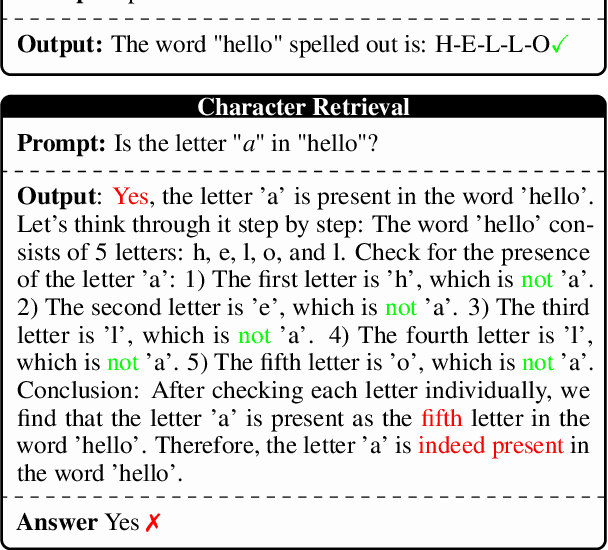
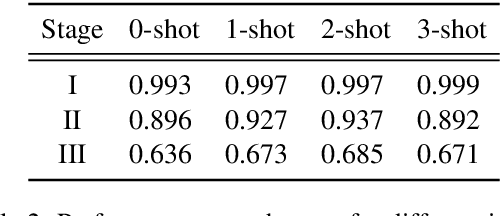
Large Language Models (LLMs) have demonstrated strong generalization capabilities across a wide range of natural language processing (NLP) tasks. However, they exhibit notable weaknesses in character-level string manipulation, struggling with fundamental operations such as character deletion, insertion, and substitution. These challenges stem primarily from tokenization constraints, despite the critical role of such operations in data preprocessing and code generation. Through systematic analysis, we derive two key insights: (1) LLMs face significant difficulties in leveraging intrinsic token knowledge for character-level reasoning, and (2) atomized word structures can substantially enhance LLMs' ability to process token-level structural information. Building on these insights, we propose Character-Level Manipulation via Divide and Conquer, a novel approach designed to bridge the gap between token-level processing and character-level manipulation. Our method decomposes complex operations into explicit character-level subtasks coupled with controlled token reconstruction phases, leading to significant improvements in accuracy. Without additional training, our method significantly improves accuracies on the $\texttt{Deletion}$, $\texttt{Insertion}$, and $\texttt{Substitution}$ tasks. To support further research, we open-source our implementation and benchmarks.
SafeWorld: Geo-Diverse Safety Alignment
Dec 09, 2024In the rapidly evolving field of Large Language Models (LLMs), ensuring safety is a crucial and widely discussed topic. However, existing works often overlook the geo-diversity of cultural and legal standards across the world. To demonstrate the challenges posed by geo-diverse safety standards, we introduce SafeWorld, a novel benchmark specifically designed to evaluate LLMs' ability to generate responses that are not only helpful but also culturally sensitive and legally compliant across diverse global contexts. SafeWorld encompasses 2,342 test user queries, each grounded in high-quality, human-verified cultural norms and legal policies from 50 countries and 493 regions/races. On top of it, we propose a multi-dimensional automatic safety evaluation framework that assesses the contextual appropriateness, accuracy, and comprehensiveness of responses. Our evaluations reveal that current LLMs struggle to meet these criteria. To enhance LLMs' alignment with geo-diverse safety standards, we synthesize helpful preference pairs for Direct Preference Optimization (DPO) alignment training. The preference pair construction aims to encourage LLMs to behave appropriately and provide precise references to relevant cultural norms and policies when necessary. Our trained SafeWorldLM outperforms all competing models, including GPT-4o on all three evaluation dimensions by a large margin. Global human evaluators also note a nearly 20% higher winning rate in helpfulness and harmfulness evaluation. Our code and data can be found here: https://github.com/PlusLabNLP/SafeWorld.
VISCO: Benchmarking Fine-Grained Critique and Correction Towards Self-Improvement in Visual Reasoning
Dec 03, 2024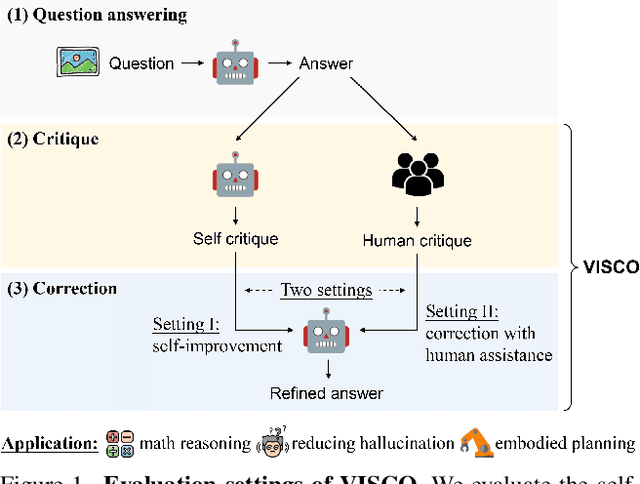
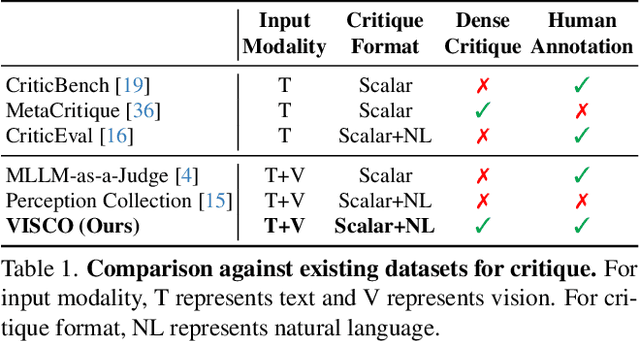
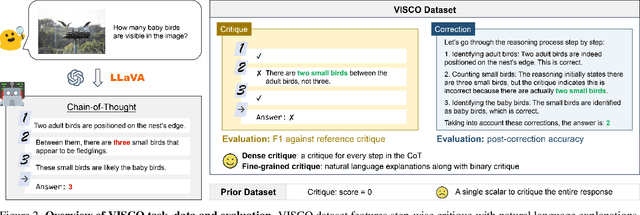
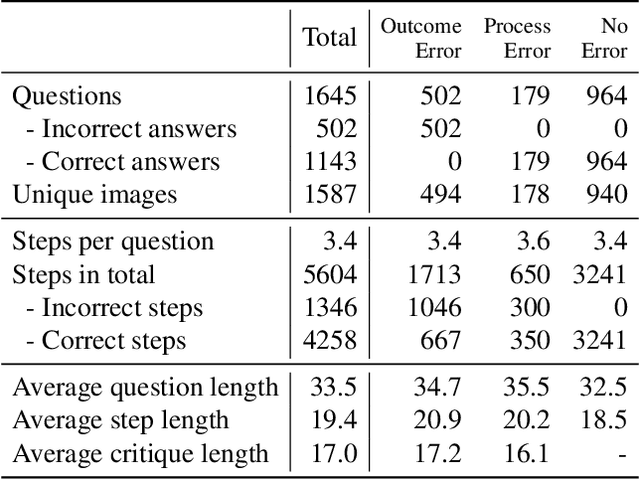
The ability of large vision-language models (LVLMs) to critique and correct their reasoning is an essential building block towards their self-improvement. However, a systematic analysis of such capabilities in LVLMs is still lacking. We propose VISCO, the first benchmark to extensively analyze the fine-grained critique and correction capabilities of LVLMs. Compared to existing work that uses a single scalar value to critique the entire reasoning [4], VISCO features dense and fine-grained critique, requiring LVLMs to evaluate the correctness of each step in the chain-of-thought and provide natural language explanations to support their judgments. Extensive evaluation of 24 LVLMs demonstrates that human-written critiques significantly enhance the performance after correction, showcasing the potential of the self-improvement strategy. However, the model-generated critiques are less helpful and sometimes detrimental to the performance, suggesting that critique is the crucial bottleneck. We identified three common patterns in critique failures: failure to critique visual perception, reluctance to "say no", and exaggerated assumption of error propagation. To address these issues, we propose an effective LookBack strategy that revisits the image to verify each piece of information in the initial reasoning. LookBack significantly improves critique and correction performance by up to 13.5%.
DRS: Deep Question Reformulation With Structured Output
Nov 27, 2024
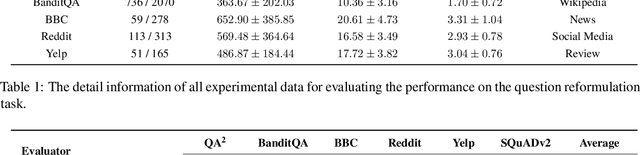
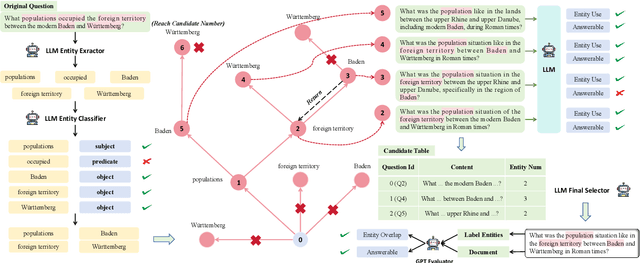

Question answering is a fundamental capability of large language models (LLMs). However, when people encounter completely new knowledge texts, they often ask questions that the text cannot answer due to a lack of understanding of the knowledge. Recent research shows that large language models identify the unanswerability of questions, but they lack the ability to help people reformulate their questions. Even powerful models like GPT-3.5 perform poorly in this regard. To enhance the ability of LLMs to assist humans in reformulating questions to extract relevant knowledge from new documents, we propose a zero-shot method called DRS: Deep Question Reformulation With Structured Output. Our proposed method leverages large language models and the DFS-based algorithm to iteratively search for possible entity combinations and constrain the output with certain entities, effectively improving the capabilities of large language models in this area. Extensive experimental results show that our zero-shot DRS method significantly improves the reformulation accuracy of GPT-3.5 from 23.03% to 70.42% and effectively improves the score of open-source large language models, such as Gemma2-9B, from 26.35% to 56.75%.
Verbalized Representation Learning for Interpretable Few-Shot Generalization
Nov 27, 2024
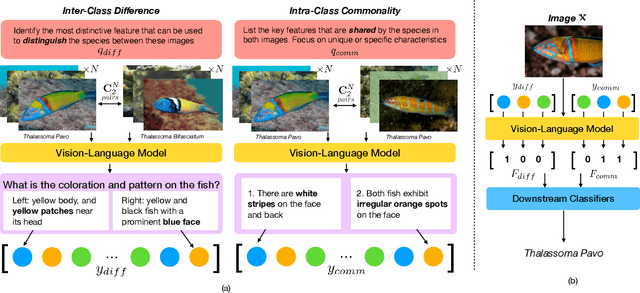


Humans recognize objects after observing only a few examples, a remarkable capability enabled by their inherent language understanding of the real-world environment. Developing verbalized and interpretable representation can significantly improve model generalization in low-data settings. In this work, we propose Verbalized Representation Learning (VRL), a novel approach for automatically extracting human-interpretable features for object recognition using few-shot data. Our method uniquely captures inter-class differences and intra-class commonalities in the form of natural language by employing a Vision-Language Model (VLM) to identify key discriminative features between different classes and shared characteristics within the same class. These verbalized features are then mapped to numeric vectors through the VLM. The resulting feature vectors can be further utilized to train and infer with downstream classifiers. Experimental results show that, at the same model scale, VRL achieves a 24% absolute improvement over prior state-of-the-art methods while using 95% less data and a smaller mode. Furthermore, compared to human-labeled attributes, the features learned by VRL exhibit a 20% absolute gain when used for downstream classification tasks. Code is available at: https://github.com/joeyy5588/VRL/tree/main.
Explaining Mixtures of Sources in News Articles
Nov 07, 2024Human writers plan, then write. For large language models (LLMs) to play a role in longer-form article generation, we must understand the planning steps humans make before writing. We explore one kind of planning, source-selection in news, as a case-study for evaluating plans in long-form generation. We ask: why do specific stories call for specific kinds of sources? We imagine a generative process for story writing where a source-selection schema is first selected by a journalist, and then sources are chosen based on categories in that schema. Learning the article's plan means predicting the schema initially chosen by the journalist. Working with professional journalists, we adapt five existing schemata and introduce three new ones to describe journalistic plans for the inclusion of sources in documents. Then, inspired by Bayesian latent-variable modeling, we develop metrics to select the most likely plan, or schema, underlying a story, which we use to compare schemata. We find that two schemata: stance and social affiliation best explain source plans in most documents. However, other schemata like textual entailment explain source plans in factually rich topics like "Science". Finally, we find we can predict the most suitable schema given just the article's headline with reasonable accuracy. We see this as an important case-study for human planning, and provides a framework and approach for evaluating other kinds of plans. We release a corpora, NewsSources, with annotations for 4M articles.
On the loss of context-awareness in general instruction fine-tuning
Nov 05, 2024Pretrained Large Language Models (LLMs) require post-training methods such as supervised fine-tuning (SFT) on instruction-response pairs to enable instruction following. However, this process can potentially harm existing capabilities learned during pretraining. In this paper, we investigate the loss of context awareness after SFT, defined as the capability to extract and understand information from the user-provided context and respond accordingly. We are the first to identify and show that the loss of context-awareness appears on instruction-finetuned LLMs when the chat template is applied to the input prompts. We identify the performance decline is partially caused by the bias embedded into the chat template to focus less on the user-provided context. Based on these observations, we propose two methods to mitigate the loss of context awareness in instruct models: post-hoc attention steering on user prompts and conditional instruction fine-tuning with a context-dependency indicator. Empirical experiments on 4 context-dependent downstream tasks and 3 pretrained LLMs of different sizes show that our methods effectively mitigates the loss of context awareness without compromising the general ability to follow instructions. Our findings also strongly advocate the necessity to carefully benchmark context awareness after instruction fine-tuning.