 Add to Chrome
 Add to Firefox
 Add to Edge
EAGG: Embodiment-Aligned Grasp Generation via Geometry-Aware Graph Conditioning
Jun 16, 2026
Cross-end-effector grasp generation seeks a unified model that generalizes across objects and across embodiments ranging from parallel grippers to dexterous end effectors. Existing grasp generators are typically designed for a fixed embodiment or encode embodiment identity with a static descriptor, which weakens transfer when topology, actuation coupling, and contact geometry differ substantially. We present EAGG, an embodiment-aligned grasp generator that represents each embodiment with a topology-aware end-effector graph and an embodiment-specific low-dimensional end-effector control space. A frozen end-effector-cognition backbone converts the current articulated state into geometry-aware tokens that act as a reusable morphology prior, and iterative geometry injection refreshes these tokens throughout sampling so that conditioning remains synchronized with the evolving end-effector geometry. On the MultiGripperGrasp benchmark, EAGG reaches 56.17% average success across six training end effectors, remaining within 1.10 percentage points of specialized training while preserving transfer to finetuning and zero-shot end effectors. Iterative geometry injection further reduces the pooled median contact distance from 0.239 cm to 0.189 cm. These results show that cross-end-effector grasp generation is strengthened by aligning embodiment structure inside a shared generator rather than suppressing embodiment differences. Code is available at https://github.com/wanhaoniu/EAGG.

Ensuring Interaction Safety in Multitask Exoskeleton Control: A Simulation-Trained Variable Impedance Framework
Jun 04, 2026Wearable exoskeletons can augment human phys ical capabilities during complex activities. However, ensuring adaptation across diverse tasks while guaranteeing interaction safety remains a critical challenge. To address this, a simulation trained variable impedance control approach with stability guarantees is proposed. First, a simulation-based human exoskeleton motion data generation pipeline is established, utilizing Proximal Policy Optimization (PPO) to synthesize human muscle activations while the exoskeleton provides direct compensation for human biological joint torques. Subsequently, the generated dataset is used to train a dual modality policy that fuses semantic instructions with proprioceptive history, enabling the prediction of reference trajectories and variable impedance gains for nine different motion tasks. To guarantee safety, the network outputs are constrained by a stability criterion derived from Lyapunov stability theory, which bounds stiffness variations to ensure the asymptotic stability of the coupled system. Experimental results indicate that the proposed framework reduces metabolic cost in real-world scenarios com pared with standard baseline methods. These findings suggest the feasibility of the proposed framework for safe, multitask exoskeleton control.
From Reach to Insert: Tactile-Augmented Precision Assembly under Sub-Millimeter Tolerances
May 06, 2026High-precision assembly frequently involves tight-tolerance insertions, where even slight pose errors can cause jamming or excessive interaction forces, making robust and safe insertion policies difficult to obtain. This paper proposes a tactile-augmented two-stage method that combines Imitation Learning (IL) and Reinforcement Learning (RL) for precision insertion tasks. In the first stage, IL learns a reaching policy with position generalization that grasps the peg and brings it to the vicinity of the target region. In the second stage, RL executes the insertion and enables recovery from failures during contact-rich interactions. To better exploit tactile feedback, we introduce tactile group sampling to increase coverage of critical contact segments during training, and design a tactile critic to more accurately evaluate policy values, improving insertion performance while maintaining low contact forces. We conduct systematic experiments across five hole geometries and three clearance settings. Results show that our method substantially improves insertion performance across all settings; under the most challenging 0.05\,mm clearance, it achieves a 67\% success rate while keeping contact forces low, reducing the maximum interaction force by 60\% and torque by 44\%, thereby validating both effectiveness and safety for precision assembly.
Locate Anything on Earth: Advancing Open-Vocabulary Object Detection for Remote Sensing Community
Aug 17, 2024Object detection, particularly open-vocabulary object detection, plays a crucial role in Earth sciences, such as environmental monitoring, natural disaster assessment, and land-use planning. However, existing open-vocabulary detectors, primarily trained on natural-world images, struggle to generalize to remote sensing images due to a significant data domain gap. Thus, this paper aims to advance the development of open-vocabulary object detection in remote sensing community. To achieve this, we first reformulate the task as Locate Anything on Earth (LAE) with the goal of detecting any novel concepts on Earth. We then developed the LAE-Label Engine which collects, auto-annotates, and unifies up to 10 remote sensing datasets creating the LAE-1M - the first large-scale remote sensing object detection dataset with broad category coverage. Using the LAE-1M, we further propose and train the novel LAE-DINO Model, the first open-vocabulary foundation object detector for the LAE task, featuring Dynamic Vocabulary Construction (DVC) and Visual-Guided Text Prompt Learning (VisGT) modules. DVC dynamically constructs vocabulary for each training batch, while VisGT maps visual features to semantic space, enhancing text features. We comprehensively conduct experiments on established remote sensing benchmark DIOR, DOTAv2.0, as well as our newly introduced 80-class LAE-80C benchmark. Results demonstrate the advantages of the LAE-1M dataset and the effectiveness of the LAE-DINO method.
PIR: Remote Sensing Image-Text Retrieval with Prior Instruction Representation Learning
May 16, 2024Remote sensing image-text retrieval constitutes a foundational aspect of remote sensing interpretation tasks, facilitating the alignment of vision and language representations. This paper introduces a prior instruction representation (PIR) learning paradigm that draws on prior knowledge to instruct adaptive learning of vision and text representations. Based on PIR, a domain-adapted remote sensing image-text retrieval framework PIR-ITR is designed to address semantic noise issues in vision-language understanding tasks. However, with massive additional data for pre-training the vision-language foundation model, remote sensing image-text retrieval is further developed into an open-domain retrieval task. Continuing with the above, we propose PIR-CLIP, a domain-specific CLIP-based framework for remote sensing image-text retrieval, to address semantic noise in remote sensing vision-language representations and further improve open-domain retrieval performance. In vision representation, Vision Instruction Representation (VIR) based on Spatial-PAE utilizes the prior-guided knowledge of the remote sensing scene recognition by building a belief matrix to select key features for reducing the impact of semantic noise. In text representation, Language Cycle Attention (LCA) based on Temporal-PAE uses the previous time step to cyclically activate the current time step to enhance text representation capability. A cluster-wise Affiliation Loss (AL) is proposed to constrain the inter-classes and to reduce the semantic confusion zones in the common subspace. Comprehensive experiments demonstrate that PIR could enhance vision and text representations and outperform the state-of-the-art methods of closed-domain and open-domain retrieval on two benchmark datasets, RSICD and RSITMD.
AI-GOMS: Large AI-Driven Global Ocean Modeling System
Aug 10, 2023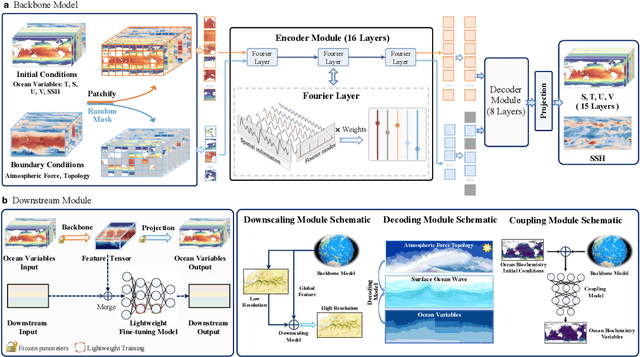
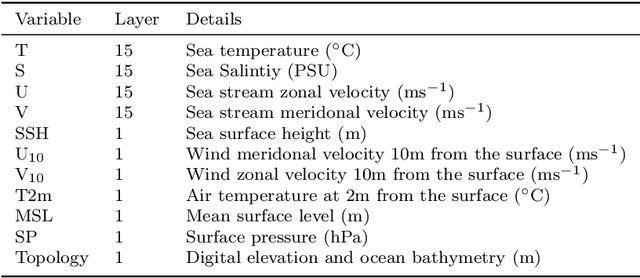
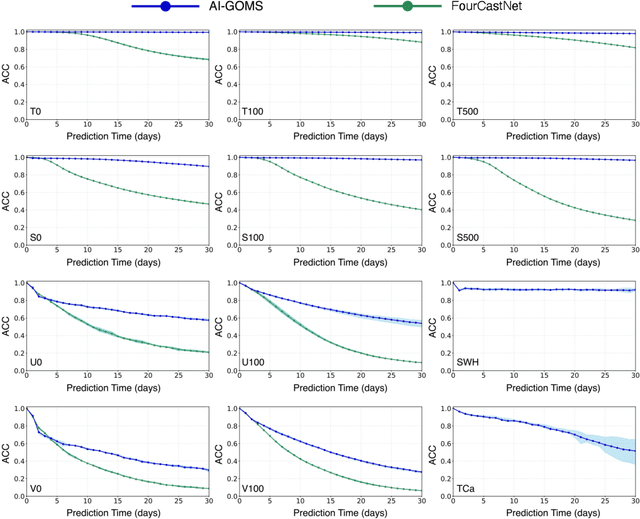
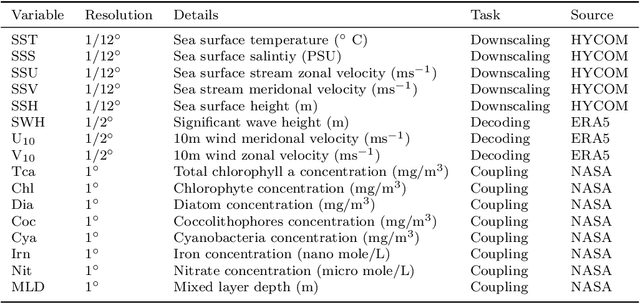
Ocean modeling is a powerful tool for simulating the physical, chemical, and biological processes of the ocean, which is the foundation for marine science research and operational oceanography. Modern numerical ocean modeling mainly consists of governing equations and numerical algorithms. Nonlinear instability, computational expense, low reusability efficiency and high coupling costs have gradually become the main bottlenecks for the further development of numerical ocean modeling. Recently, artificial intelligence-based modeling in scientific computing has shown revolutionary potential for digital twins and scientific simulations, but the bottlenecks of numerical ocean modeling have not been further solved. Here, we present AI-GOMS, a large AI-driven global ocean modeling system, for accurate and efficient global ocean daily prediction. AI-GOMS consists of a backbone model with the Fourier-based Masked Autoencoder structure for basic ocean variable prediction and lightweight fine-tuning models incorporating regional downscaling, wave decoding, and biochemistry coupling modules. AI-GOMS has achieved the best performance in 30 days of prediction for the global ocean basic variables with 15 depth layers at 1/4{\deg} spatial resolution. Beyond the good performance in statistical metrics, AI-GOMS realizes the simulation of mesoscale eddies in the Kuroshio region at 1/12{\deg} spatial resolution and ocean stratification in the tropical Pacific Ocean. AI-GOMS provides a new backbone-downstream paradigm for Earth system modeling, which makes the system transferable, scalable and reusable.
KoopmanLab: machine learning for solving complex physics equations
Jan 17, 2023Numerous physics theories are rooted in partial differential equations (PDEs). However, the increasingly intricate physics equations, especially those that lack analytic solutions or closed forms, have impeded the further development of physics. Computationally solving PDEs by classic numerical approaches suffers from the trade-off between accuracy and efficiency and is not applicable to the empirical data generated by unknown latent PDEs. To overcome this challenge, we present KoopmanLab, an efficient module of the Koopman neural operator family, for learning PDEs without analytic solutions or closed forms. Our module consists of multiple variants of the Koopman neural operator (KNO), a kind of mesh-independent neural-network-based PDE solvers developed following dynamic system theory. The compact variants of KNO can accurately solve PDEs with small model sizes while the large variants of KNO are more competitive in predicting highly complicated dynamic systems govern by unknown, high-dimensional, and non-linear PDEs. All variants are validated by mesh-independent and long-term prediction experiments implemented on representative PDEs (e.g., the Navier-Stokes equation and the Bateman-Burgers equation in fluid mechanics) and ERA5 (i.e., one of the largest high-resolution global-scale climate data sets in earth physics). These demonstrations suggest the potential of KoopmanLab to be a fundamental tool in diverse physics studies related to equations or dynamic systems.