 Add to Chrome
 Add to Firefox
 Add to Edge
Parallel Cascaded Recursive Filtering on Multi-Core CPUs and GPUs
Jul 26, 2026
The companion of this paper reformulated cascaded second-order (biquad) recursive filtering as a block-tridiagonal linear system and developed two parallel solution algorithms, PH factorization and cyclic reduction, reaching over 600 Megasamples per second on a single SIMD core. This paper scales that framework to multi-core CPUs and GPUs, where a new obstacle appears: the terminal outputs of each signal block group are the initial conditions of the next, so naively distributed groups serialize. The dependency is resolved by superposition -- each group's output splits into a zero-state response, computable immediately, and a homogeneous correction applied when the state arrives -- and by a divide-and-conquer form of cyclic reduction that exposes both terminal blocks before back substitution, as asynchronous state propagation requires. Two implementations pair the two dominant deployment scenarios with opposite treatments of the dependency. For real-time streaming, a wavefront pipeline realized with TBB flow graphs parallelizes across cascade sections, preserves first-in-first-out order, and achieves 3.95x scaling on six performance cores, about 2.4 Gigasamples per second for a 16th-order filter. For batched processing, a single-kernel GPU implementation carries each group through the entire cascade in registers and parallelizes across groups with a decoupled look-back protocol; a communication-based cost model, comprising a memory roof, a barrier price, and a latency-hiding floor, reduces tuning to two parameters and predicts the measured behavior across two GPU generations. The best kernels reach 38.2 Gigasamples per second for a single second-order section on an RTX~3060, 85% of the memory-bandwidth roof, exceed the strongest published parallel recurrence baseline at every filter order, and remain numerically valid at order 16, where the direct-form baseline fails.

Fast Cascaded Recursive Filtering via a Block-Matrix Reformulation
Jul 15, 2026Recursive (IIR) filters realized as cascaded second-order sections (biquads) offer both design generality and robustness against coefficient quantization. However, their inherent sample-to-sample feedback dependency poses a fundamental obstacle to parallel computation. This paper reformulates the biquad difference equation as a banded block-Toeplitz linear system and introduces a stride-$N$ permutation that maps a group of $NL$ samples into a block-tridiagonal structure whose entries are scalar multiples of identity and shift matrices. Within this framework, two parallel algorithms are developed for the recursive solution: a partial LU (PH) factorization that preserves the sparse block structure and a cyclic reduction that is applied to recursive filtering, to the best of our knowledge, for the first time. It reduces the sequential dependency depth from $\mathcal{O}(N)$ to $\mathcal{O}(\log_2 N)$. For a cascade of $K$ biquads, the intermediate permutations between successive sections cancel exactly, so that only a single permutation/de-permutation pair is required for the entire cascade, eliminating $2(K{-}1)$ redundant stages. Exact block-level operation counts are derived for every algorithmic stage and validated against cycle-accurate measurements on three Intel micro-architectures supporting AVX2 SIMD instructions. Experimental results for a 16th-order system show that the proposed multi-block algorithms reduce clock cycles per sample by up to $10\times$ compared to scalar filtering, with both algorithms scaling favorably on newer architectures. On a single Meteor Lake core, cyclic reduction achieves approximately 618 MS/s -- an $8\times$ throughput improvement over scipy.signal.sosfilt.
Ensuring Interaction Safety in Multitask Exoskeleton Control: A Simulation-Trained Variable Impedance Framework
Jun 04, 2026Wearable exoskeletons can augment human phys ical capabilities during complex activities. However, ensuring adaptation across diverse tasks while guaranteeing interaction safety remains a critical challenge. To address this, a simulation trained variable impedance control approach with stability guarantees is proposed. First, a simulation-based human exoskeleton motion data generation pipeline is established, utilizing Proximal Policy Optimization (PPO) to synthesize human muscle activations while the exoskeleton provides direct compensation for human biological joint torques. Subsequently, the generated dataset is used to train a dual modality policy that fuses semantic instructions with proprioceptive history, enabling the prediction of reference trajectories and variable impedance gains for nine different motion tasks. To guarantee safety, the network outputs are constrained by a stability criterion derived from Lyapunov stability theory, which bounds stiffness variations to ensure the asymptotic stability of the coupled system. Experimental results indicate that the proposed framework reduces metabolic cost in real-world scenarios com pared with standard baseline methods. These findings suggest the feasibility of the proposed framework for safe, multitask exoskeleton control.
Evaluating Stochasticity in Deep Research Agents
Feb 26, 2026Deep Research Agents (DRAs) are promising agentic systems that gather and synthesize information to support research across domains such as financial decision-making, medical analysis, and scientific discovery. Despite recent improvements in research quality (e.g., outcome accuracy when ground truth is available), DRA system design often overlooks a critical barrier to real-world deployment: stochasticity. Under identical queries, repeated executions of DRAs can exhibit substantial variability in terms of research outcome, findings, and citations. In this paper, we formalize the study of stochasticity in DRAs by modeling them as information acquisition Markov Decision Processes. We introduce an evaluation framework that quantifies variance in the system and identify three sources of it: information acquisition, information compression, and inference. Through controlled experiments, we investigate how stochasticity from these modules across different decision steps influences the variance of DRA outputs. Our results show that reducing stochasticity can improve research output quality, with inference and early-stage stochasticity contributing the most to DRA output variance. Based on these findings, we propose strategies for mitigating stochasticity while maintaining output quality via structured output and ensemble-based query generation. Our experiments on DeepSearchQA show that our proposed mitigation methods reduce average stochasticity by 22% while maintaining high research quality.
FAST-CAD: A Fairness-Aware Framework for Non-Contact Stroke Diagnosis
Nov 14, 2025Stroke is an acute cerebrovascular disease, and timely diagnosis significantly improves patient survival. However, existing automated diagnosis methods suffer from fairness issues across demographic groups, potentially exacerbating healthcare disparities. In this work we propose FAST-CAD, a theoretically grounded framework that combines domain-adversarial training (DAT) with group distributionally robust optimization (Group-DRO) for fair and accurate non-contact stroke diagnosis. Our approach is built on domain adaptation and minimax fairness theory and provides convergence guarantees and fairness bounds. We curate a multimodal dataset covering 12 demographic subgroups defined by age, gender, and posture. FAST-CAD employs self-supervised encoders with adversarial domain discrimination to learn demographic-invariant representations, while Group-DRO optimizes worst-group risk to ensure robust performance across all subgroups. Extensive experiments show that our method achieves superior diagnostic performance while maintaining fairness across demographic groups, and our theoretical analysis supports the effectiveness of the unified DAT + Group-DRO framework. This work provides both practical advances and theoretical insights for fair medical AI systems.
EquivaMap: Leveraging LLMs for Automatic Equivalence Checking of Optimization Formulations
Feb 20, 2025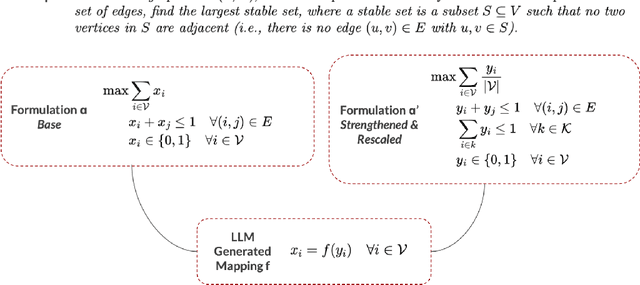
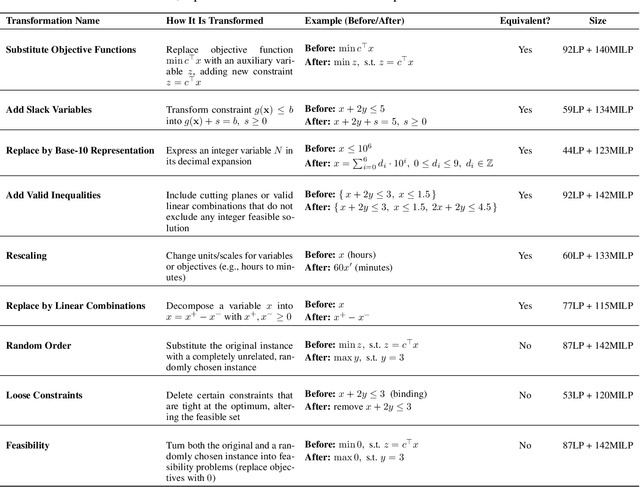
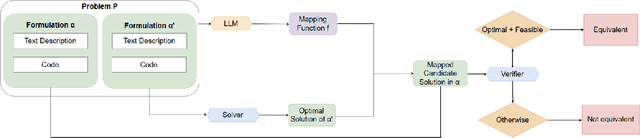
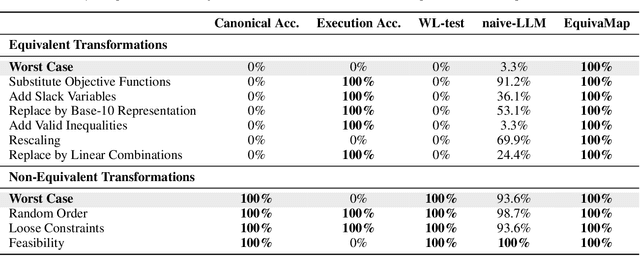
A fundamental problem in combinatorial optimization is identifying equivalent formulations, which can lead to more efficient solution strategies and deeper insights into a problem's computational complexity. The need to automatically identify equivalence between problem formulations has grown as optimization copilots--systems that generate problem formulations from natural language descriptions--have proliferated. However, existing approaches to checking formulation equivalence lack grounding, relying on simple heuristics which are insufficient for rigorous validation. Inspired by Karp reductions, in this work we introduce quasi-Karp equivalence, a formal criterion for determining when two optimization formulations are equivalent based on the existence of a mapping between their decision variables. We propose EquivaMap, a framework that leverages large language models to automatically discover such mappings, enabling scalable and reliable equivalence verification. To evaluate our approach, we construct the first open-source dataset of equivalent optimization formulations, generated by applying transformations such as adding slack variables or valid inequalities to existing formulations. Empirically, EquivaMap significantly outperforms existing methods, achieving substantial improvements in correctly identifying formulation equivalence.