 Add to Chrome
 Add to Firefox
 Add to Edge
Prune Once: Retraining-Free Task-Agnostic Pruning for Vision-Language Models
Aug 07, 2026
Vision-language models (VLMs) have achieved remarkable generalization across diverse multimodal tasks through large-scale pre-training, yet their rapidly increasing computational and memory requirements pose significant challenges for deployment in constrained environments. Existing pruning strategies often depend on task-specific criteria or LLM-oriented importance measures, making them unsuitable for task-agnostic pruning, where no task-specific samples are available at pruning time and the pruned model remains broadly applicable. We introduce a retraining-free VLM pruning framework called PORTA that derives a task- and modality-agnostic importance formulation based on activation variation, estimated from generic calibration data, which reliably captures feature-level representation utility across modalities. PORTA further incorporates an adaptive sparsity allocation mechanism that assigns layer-wise pruning ratios based on output feature variability, avoiding the limitations of uniform sparsity and reducing performance degradation at high compression levels. Extensive experiments across VLM architectures, such as CLIP, BLIP, and Qwen2-VL, demonstrate that PORTA achieves competitive downstream performance under high sparsity without requiring any retraining, supporting efficient VLM compression. Code is available at https://github.com/cau-hai-lab/PORTA.git.

Towards Direct Evaluation of Harness Optimizers via Priority Ranking
May 21, 2026Harness optimization enables automated agent creation by having an optimizer agent iteratively update the harness of target agents. Despite its success, current studies evaluate optimizers solely by observing target agents' performance gains. This indirect end-improvement evaluation neglects optimizers' actions at intermediate steps, which are often erroneous and hinder agent performance. Therefore, it is unclear whether harness optimization is driven by optimizers' informed update actions or simply trial-and-error. This necessitates direct evaluation of harness optimizers. However, evaluating harness optimizers directly is non-trivial and costly due to the lack of oracle harnesses. To address this, we present a simple, low-cost design to directly evaluate them, namely priority ranking. By asking harness optimizers to rank components (e.g., tools) in a given harness by their potential to improve/hinder agent performance when updated, our design quantifies optimizer ability at the step level without expensive rollouts or manual examination. More importantly, optimizers' ranking performance correlates with their ability to improve agents in actual multi-step harness optimization, establishing priority ranking as a reliable predictor of optimization ability. Priority ranking is enabled by Shor, a collection of 182 human-verified optimization scenarios spanning across domains, designs, and time stages. Codes and data can be found at https://github.com/k59118/Harness_Optimizer_Evaluation.
OTT-Vid: Optimal Transport Temporal Token Compression for Video Large Language Models
May 12, 2026As Video Large Language Models (Video-LLMs) scale to longer and more complex videos, their inference cost grows rapidly due to the large volume of visual tokens accumulated across frames. Training-free token compression has emerged as a practical solution to this bottleneck. However, existing temporal compression methods rely primarily on cross-frame token similarity or segmentation heuristics, overlooking each token's semantic role within its frame and failing to adapt compression strength to the compressibility of each frame pair. In this work, we propose OTT-Vid, a transport-derived allocation framework for temporal token compression. Our approach consists of two stages: spatial pruning identifies representative content within each frame, and optimal transport (OT) is then solved between neighboring frames to estimate temporal compressibility. We formulate this OT with non-uniform token mass, which protects semantically important tokens from aggressive compression, and a locality-aware cost that captures both feature and spatial disparities. The resulting transport plan jointly balances token importance and matching cost, while its total cost defines the transport difficulty of each frame pair, which we use to allocate compression budgets dynamically. Experiments on six benchmarks spanning video question answering and temporal grounding show that OTT-Vid preserves 95.8% of VQA and 73.9% of VTG performance while retaining only 10% of tokens, consistently outperforming existing state-of-the-art training-free compression methods.
Seen-to-Scene: Keep the Seen, Generate the Unseen for Video Outpainting
Apr 16, 2026Video outpainting aims to expand the visible content of a video beyond the original frame boundaries while preserving spatial fidelity and temporal coherence across frames. Existing methods primarily rely on large-scale generative models, such as diffusion models. However, generationbased approaches suffer from implicit temporal modeling and limited spatial context. These limitations lead to intraframe and inter-frame inconsistencies, which become particularly pronounced in dynamic scenes and large outpainting scenarios. To overcome these challenges, we propose Seen-to-Scene, a novel framework that unifies propagationbased and generation-based paradigms for video outpainting. Specifically, Seen-to-Scene leverages flow-based propagation with a flow completion network pre-trained for video inpainting, which is fine-tuned in an end-to-end manner to bridge the domain gap and reconstruct coherent motion fields. To further improve the efficiency and reliability of propagation, we introduce a reference-guided latent propagation that effectively propagates source content across frames. Extensive experiments demonstrate that our method achieves superior temporal coherence and visual realism with efficient inference, surpassing even prior state-of-the-art methods that require input-specific adaptation.
CMTM: Cross-Modal Token Modulation for Unsupervised Video Object Segmentation
Apr 16, 2026Recent advances in unsupervised video object segmentation have highlighted the potential of two-stream architectures that integrate appearance and motion cues. However, fully leveraging these complementary sources of information requires effectively modeling their interdependencies. In this paper, we introduce cross-modality token modulation, a novel approach designed to strengthen the interaction between appearance and motion cues. Our method establishes dense connections between tokens from each modality, enabling efficient intra-modal and inter-modal information propagation through relation transformer blocks. To improve learning efficiency, we incorporate a token masking strategy that addresses the limitations of relying solely on increased model complexity. Our approach achieves state-of-the-art performance across all public benchmarks, outperforming existing methods.
LIBERO-Para: A Diagnostic Benchmark and Metrics for Paraphrase Robustness in VLA Models
Mar 30, 2026Vision-Language-Action (VLA) models achieve strong performance in robotic manipulation by leveraging pre-trained vision-language backbones. However, in downstream robotic settings, they are typically fine-tuned with limited data, leading to overfitting to specific instruction formulations and leaving robustness to paraphrased instructions underexplored. To study this gap, we introduce LIBERO-Para, a controlled benchmark that independently varies action expressions and object references for fine-grained analysis of linguistic generalization. Across seven VLA configurations (0.6B-7.5B), we observe consistent performance degradation of 22-52 pp under paraphrasing. This degradation is primarily driven by object-level lexical variation: even simple synonym substitutions cause large drops, indicating reliance on surface-level matching rather than semantic grounding. Moreover, 80-96% of failures arise from planning-level trajectory divergence rather than execution errors, showing that paraphrasing disrupts task identification. Binary success rate treats all paraphrases equally, obscuring whether models perform consistently across difficulty levels or rely on easier cases. To address this, we propose PRIDE, a metric that quantifies paraphrase difficulty using semantic and syntactic factors. Our benchmark and corresponding code are available at: https://github.com/cau-hai-lab/LIBERO-Para
Revisiting Weakly-Supervised Video Scene Graph Generation via Pair Affinity Learning
Mar 23, 2026Weakly-supervised video scene graph generation (WS-VSGG) aims to parse video content into structured relational triplets without bounding box annotations and with only sparse temporal labeling, significantly reducing annotation costs. Without ground-truth bounding boxes, these methods rely on off-the-shelf detectors to generate object proposals, yet largely overlook a fundamental discrepancy from fullysupervised pipelines. Fully-supervised detectors implicitly filter out noninteractive objects, while off-the-shelf detectors indiscriminately detect all visible objects, overwhelming relation models with noisy pairs.We address this by introducing a learnable pair affinity that estimates the likelihood of interaction between subject-object pairs. Through Pair Affinity Learning and Scoring (PALS), pair affinity is incorporated into inferencetime ranking and further integrated into contextual reasoning through Pair Affinity Modulation (PAM), enabling the model to suppress noninteractive pairs and focus on relationally meaningful ones. To provide cleaner supervision for pair affinity learning, we further propose Relation- Aware Matching (RAM), which leverages vision-language grounding to resolve class-level ambiguity in pseudo-label generation. Extensive experiments on Action Genome demonstrate that our approach consistently yields substantial improvements across different baselines and backbones, achieving state-of-the-art WS-VSGG performance.
Web-Shepherd: Advancing PRMs for Reinforcing Web Agents
May 21, 2025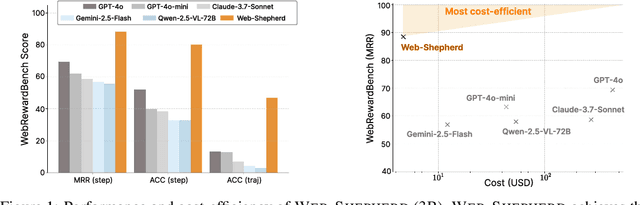
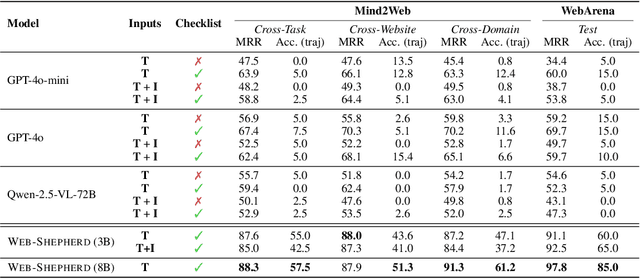
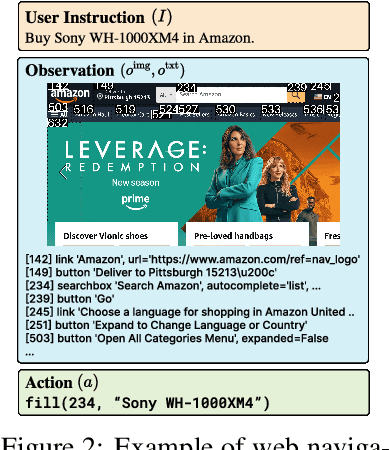
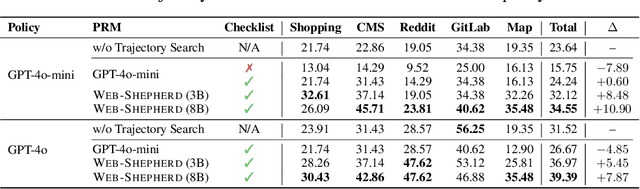
Web navigation is a unique domain that can automate many repetitive real-life tasks and is challenging as it requires long-horizon sequential decision making beyond typical multimodal large language model (MLLM) tasks. Yet, specialized reward models for web navigation that can be utilized during both training and test-time have been absent until now. Despite the importance of speed and cost-effectiveness, prior works have utilized MLLMs as reward models, which poses significant constraints for real-world deployment. To address this, in this work, we propose the first process reward model (PRM) called Web-Shepherd which could assess web navigation trajectories in a step-level. To achieve this, we first construct the WebPRM Collection, a large-scale dataset with 40K step-level preference pairs and annotated checklists spanning diverse domains and difficulty levels. Next, we also introduce the WebRewardBench, the first meta-evaluation benchmark for evaluating PRMs. In our experiments, we observe that our Web-Shepherd achieves about 30 points better accuracy compared to using GPT-4o on WebRewardBench. Furthermore, when testing on WebArena-lite by using GPT-4o-mini as the policy and Web-Shepherd as the verifier, we achieve 10.9 points better performance, in 10 less cost compared to using GPT-4o-mini as the verifier. Our model, dataset, and code are publicly available at LINK.
GenCLIP: Generalizing CLIP Prompts for Zero-shot Anomaly Detection
Apr 21, 2025Zero-shot anomaly detection (ZSAD) aims to identify anomalies in unseen categories by leveraging CLIP's zero-shot capabilities to match text prompts with visual features. A key challenge in ZSAD is learning general prompts stably and utilizing them effectively, while maintaining both generalizability and category specificity. Although general prompts have been explored in prior works, achieving their stable optimization and effective deployment remains a significant challenge. In this work, we propose GenCLIP, a novel framework that learns and leverages general prompts more effectively through multi-layer prompting and dual-branch inference. Multi-layer prompting integrates category-specific visual cues from different CLIP layers, enriching general prompts with more comprehensive and robust feature representations. By combining general prompts with multi-layer visual features, our method further enhances its generalization capability. To balance specificity and generalization, we introduce a dual-branch inference strategy, where a vision-enhanced branch captures fine-grained category-specific features, while a query-only branch prioritizes generalization. The complementary outputs from both branches improve the stability and reliability of anomaly detection across unseen categories. Additionally, we propose an adaptive text prompt filtering mechanism, which removes irrelevant or atypical class names not encountered during CLIP's training, ensuring that only meaningful textual inputs contribute to the final vision-language alignment.
Cactus: Towards Psychological Counseling Conversations using Cognitive Behavioral Theory
Jul 03, 2024

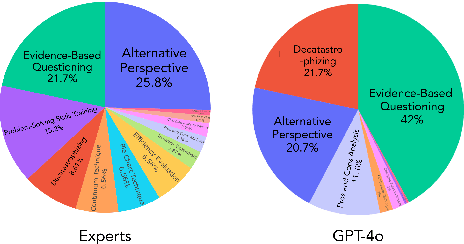
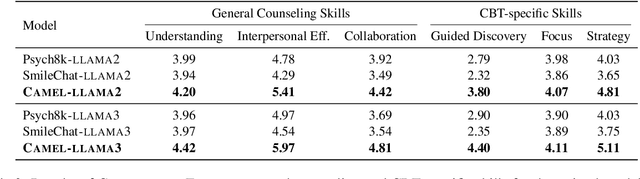
Recently, the demand for psychological counseling has significantly increased as more individuals express concerns about their mental health. This surge has accelerated efforts to improve the accessibility of counseling by using large language models (LLMs) as counselors. To ensure client privacy, training open-source LLMs faces a key challenge: the absence of realistic counseling datasets. To address this, we introduce Cactus, a multi-turn dialogue dataset that emulates real-life interactions using the goal-oriented and structured approach of Cognitive Behavioral Therapy (CBT). We create a diverse and realistic dataset by designing clients with varied, specific personas, and having counselors systematically apply CBT techniques in their interactions. To assess the quality of our data, we benchmark against established psychological criteria used to evaluate real counseling sessions, ensuring alignment with expert evaluations. Experimental results demonstrate that Camel, a model trained with Cactus, outperforms other models in counseling skills, highlighting its effectiveness and potential as a counseling agent. We make our data, model, and code publicly available.