 Add to Chrome
 Add to Firefox
 Add to Edge
EMBGuard: Constructing Hazard-Aware Guardrails for Safe Planning in Embodied Agents
May 29, 2026
MLLM-powered embodied agents deployed in real-world environments encounter physical hazards. However, existing approaches lack explicit mechanisms for identifying hazards and reasoning about action-conditioned risks, leading agents to either miss risky interactions or over-identify risks. To address this, we propose EMBGuard, the first MLLM-based safety guardrail for embodied agents designed to decouple physical risk reasoning from agent policy. By evaluating a (visual observation, action) pair, EMBGuard identifies hazardous configurations and provides natural language explanations of potential risks. Alongside EMBGuard, we contribute EMBHazard, a training dataset of 15.1K action-conditioned pairs, and EMBGuardTest, a benchmark of 329 manually curated real-world scenarios spanning seven physical risk categories. Through compositional variation of hazards and actions, we generate diverse risky and benign scenarios that agents may encounter during planning. Despite its compact size (2B, 4B), EMBGuard achieves performance competitive with proprietary MLLMs (e.g., GPT-5.1, Gemini-2.5-Pro) while significantly reducing the false-positive rates that hinder real-time deployment. We make the code, data, and models publicly available at https://github.com/dongwxxkchoi/EMBGuard

CONDESION-BENCH: Conditional Decision-Making of Large Language Models in Compositional Action Space
Apr 10, 2026Large language models have been widely explored as decision-support tools in high-stakes domains due to their contextual understanding and reasoning capabilities. However, existing decision-making benchmarks rely on two simplifying assumptions: actions are selected from a finite set of pre-defined candidates, and explicit conditions restricting action feasibility are not incorporated into the decision-making process. These assumptions fail to capture the compositional structure of real-world actions and the explicit conditions that constrain their validity. To address these limitations, we introduce CONDESION-BENCH, a benchmark designed to evaluate conditional decision-making in compositional action space. In CONDESION-BENCH, actions are defined as allocations to decision variables and are restricted by explicit conditions at the variable, contextual, and allocation levels. By employing oracle-based evaluation of both decision quality and condition adherence, we provide a more rigorous assessment of LLMs as decision-support tools.
Web-Shepherd: Advancing PRMs for Reinforcing Web Agents
May 21, 2025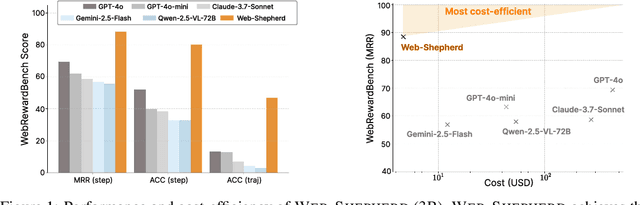
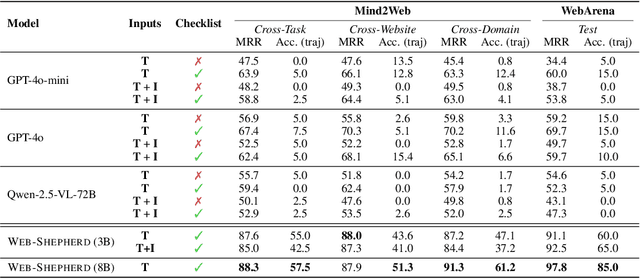
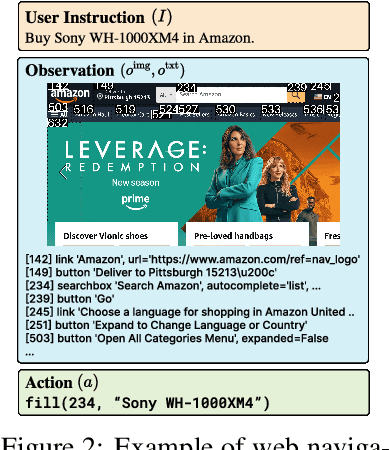
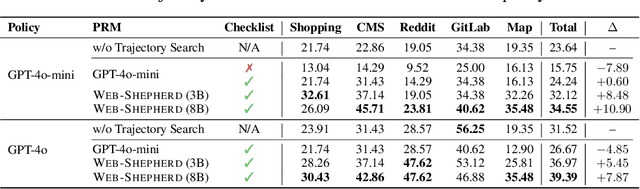
Web navigation is a unique domain that can automate many repetitive real-life tasks and is challenging as it requires long-horizon sequential decision making beyond typical multimodal large language model (MLLM) tasks. Yet, specialized reward models for web navigation that can be utilized during both training and test-time have been absent until now. Despite the importance of speed and cost-effectiveness, prior works have utilized MLLMs as reward models, which poses significant constraints for real-world deployment. To address this, in this work, we propose the first process reward model (PRM) called Web-Shepherd which could assess web navigation trajectories in a step-level. To achieve this, we first construct the WebPRM Collection, a large-scale dataset with 40K step-level preference pairs and annotated checklists spanning diverse domains and difficulty levels. Next, we also introduce the WebRewardBench, the first meta-evaluation benchmark for evaluating PRMs. In our experiments, we observe that our Web-Shepherd achieves about 30 points better accuracy compared to using GPT-4o on WebRewardBench. Furthermore, when testing on WebArena-lite by using GPT-4o-mini as the policy and Web-Shepherd as the verifier, we achieve 10.9 points better performance, in 10 less cost compared to using GPT-4o-mini as the verifier. Our model, dataset, and code are publicly available at LINK.