 Add to Chrome
 Add to Firefox
 Add to Edge
Wan-Animate-2: Pushing the Application Boundaries of Character Animation
Aug 06, 2026
Character image animation remains a foundational yet challenging task in computer vision. Existing approaches can be broadly categorized into three paradigms: methods based on explicit motion representations suffer from extraction errors and identity drift; methods based on implicit motion features lose fine-grained dynamics through compression; and in-context learning approaches avoid intermediate representations but incur prohibitive computational costs. Furthermore, all current systems are designed for offline synthesis, unable to meet the real-time requirements of interactive applications such as digital avatars and live-streaming hosts. To address these limitations, we present Wan-Animate-2, an end-to-end character animation framework that directly consumes the driving video within a redesigned Diffusion Transformer. Our architecture achieves superior motion fidelity and identity preservation by eliminating intermediate motion extractors entirely. We further introduce text driven viewpoint control that decouples the output camera perspective from the driving video--a capability rarely supported by prior character animation methods that rely on explicit motion representations. Beyond generation quality, we present Wan-Animate-2-Lite, an efficient variant that reduces inference latency to real-time thresholds through a three-stage training paradigm: teacher forcing pretraining with error buffer mechanism, and Self-Forcing distillation with chunk-wise backpropagation. This enables streaming character animation for interactive applications, opening new deployment scenarios that were previously infeasible. Qualitative evaluations and user studies demonstrate that Wan-Animate-2 achieves high-fidelity animation results across diverse characters and motion patterns. To foster further research and community development, we will release the Wan-Animate-2-Base model weights to the public.

MultiAnimate: A Unified Framework for Controllable Multi-Character Animation
Jul 15, 2026Recent advances in generative models and technological innovations have significantly addressed the fundamental challenges of character image animation. However, existing approaches predominantly focus on character animation from a single reference image, substantially limiting their applicability in scenarios such as multiple character interaction animation. To fill this gap, this paper introduces MultiAnimate, a comprehensive framework that enables concurrent animation of multiple characters within a shared environment while preserving both identity consistency and spatial relationships. The framework achieves these objectives through multiple well-designed mechanisms. First, we incorporate an identity-specific reference net that enables appearance extraction from multiple reference images, distinguishing MultiAnimate from existing approaches constrained to single reference inputs. Second, we implement an identity-aware pose encoder to address the character-pose binding challenge, wherein an attention mechanism enables the network to accurately differentiate and process multiple pose sequences during generation. Third, we introduce an interaction guider module that enhances the framework's capability to handle complex inter-character interactions by leveraging character-specific mask information, serving as an optional component that refines the pose sequences. Extensive experiments and ablation analyses demonstrate our framework's superiority in multiple character animation, particularly in scenarios involving complex motion sequences.
WanToFight: Real-Time Generative Game Engine for Multi-Player Combat Interaction
Jul 14, 2026We present WanToFight, a generative game engine that simulates real-time, two-player The King of Fighters '97 (KOF~'97) gameplay from keyboard input. Prior generative game engines target either single-player first-person settings or non-real-time cooperative scenarios; multi-player control, real-time inference, complex physical interaction, and adversarial gameplay have not been jointly addressed. WanToFight closes this gap with three components built on the Wan-1.3B video diffusion transformer: a streaming autoregressive generator with block-causal attention and a rolling KV cache; a visually grounded Player Association module that binds each player's keyboard signal to a character identity; and a gated, locally causal keyboard injection module trained with a single-player-to-full-gameplay curriculum. A four-step DMD-distilled student paired with a pruned VAE decoder sustains 30FPS at 512x384 on a single NVIDIA RTX 5090 over the duration of a complete match. To our knowledge, WanToFight is the first generative game engine to combine multi-player control, real-time inference, complex physical interaction, and adversarial gameplay in one system.
Wan-Dancer: A Hierarchical Framework for Minute-scale Coherent Music-to-Dance Generation
Jul 13, 2026Generating long-duration, high-definition, and rhythmically synchronized dance videos directly from music remains a significant challenge, primarily due to the temporal constraints of current diffusion models, which typically fail beyond 20 seconds. Existing approaches, whether they rely on intermediate 3D skeletons or on end-to-end video synthesis, suffer from temporal drift, identity inconsistency, and repetitive motion patterns when extended to longer horizons. To address these limitations, we propose a novel hierarchical framework for minute-scale coherent music-to-dance generation. Our method decouples the process into global keyframe planning and local temporal refinement, leveraging full-track musical context to ensure long-range coherence. Key innovations include dynamic frame rate adaptation via time-mapped RoPE embeddings for precise alignment, an optical-flow-based loss function to enhance motion continuity, and motion-speed control to preserve high-fidelity details during rapid movements. Extensive experiments demonstrate that our framework surpasses the conventional duration barrier, generating stable, 720p/30fps videos exceeding one minute with superior temporal stability. Furthermore, the model exhibits robust versatility across five distinct dance genres, conditioned on both audio and textual prompts, establishing a new state-of-the-art in coherent, long-form dance video synthesis.
Phases of Muon: When Muon Eclipses SignSGD
May 10, 2026Recently, Muon and related spectral optimizers have demonstrated strong empirical performance as scalable stochastic methods, often outperforming Adam. Yet their behaviour remains poorly understood. We analyze stochastic spectral optimizers, including Muon, on a high-dimensional matrix-valued least squares problem. We derive explicit deterministic dynamics that provide a tractable framework for studying learning behaviour with a focus on (stochastic) SignSVD, which Muon approximates, and (stochastic) SignSGD, the latter serving as a proxy for Adam. Our analysis shows that for large batch size, SignSVD performs a square-root preconditioning with respect to the data covariance spectrum, while for small batch size smaller eigenmodes behave like SGD, slowing down convergence. We contrast with SignSGD which for generic covariance performs no preconditioning and has no transition, leading to different optimal learning rates and convergence characteristics. The two methods match up to a constant factor with isotropic data, but behave differently with anisotropic data. An analysis of a power law covariance model with data exponent $α$ and target exponent $β$ shows there are three phases in the $(α,β)$ plane: one where SignSGD is uniformly favored, one where SignSVD is uniformly favored, and a third where the two methods exhibit a trade-off in performance.
UCM: Unifying Camera Control and Memory with Time-aware Positional Encoding Warping for World Models
Feb 26, 2026World models based on video generation demonstrate remarkable potential for simulating interactive environments but face persistent difficulties in two key areas: maintaining long-term content consistency when scenes are revisited and enabling precise camera control from user-provided inputs. Existing methods based on explicit 3D reconstruction often compromise flexibility in unbounded scenarios and fine-grained structures. Alternative methods rely directly on previously generated frames without establishing explicit spatial correspondence, thereby constraining controllability and consistency. To address these limitations, we present UCM, a novel framework that unifies long-term memory and precise camera control via a time-aware positional encoding warping mechanism. To reduce computational overhead, we design an efficient dual-stream diffusion transformer for high-fidelity generation. Moreover, we introduce a scalable data curation strategy utilizing point-cloud-based rendering to simulate scene revisiting, facilitating training on over 500K monocular videos. Extensive experiments on real-world and synthetic benchmarks demonstrate that UCM significantly outperforms state-of-the-art methods in long-term scene consistency, while also achieving precise camera controllability in high-fidelity video generation.
Wan-Animate: Unified Character Animation and Replacement with Holistic Replication
Sep 17, 2025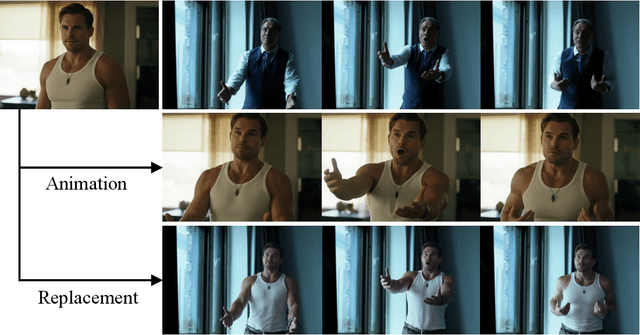
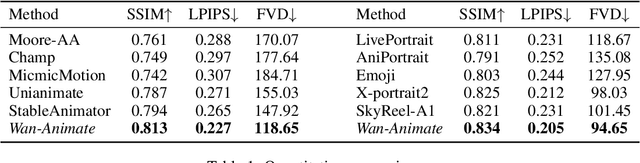
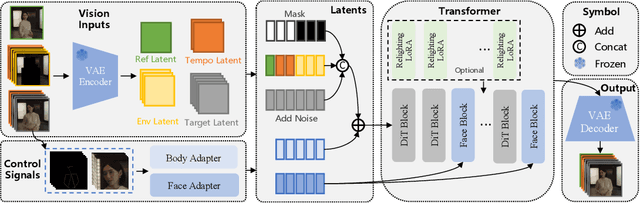
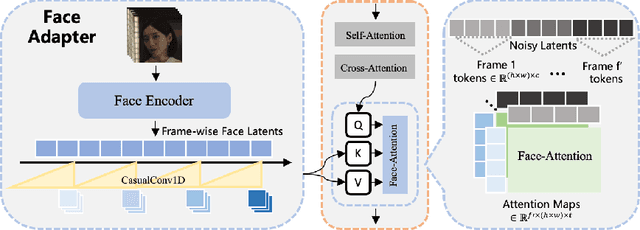
We introduce Wan-Animate, a unified framework for character animation and replacement. Given a character image and a reference video, Wan-Animate can animate the character by precisely replicating the expressions and movements of the character in the video to generate high-fidelity character videos. Alternatively, it can integrate the animated character into the reference video to replace the original character, replicating the scene's lighting and color tone to achieve seamless environmental integration. Wan-Animate is built upon the Wan model. To adapt it for character animation tasks, we employ a modified input paradigm to differentiate between reference conditions and regions for generation. This design unifies multiple tasks into a common symbolic representation. We use spatially-aligned skeleton signals to replicate body motion and implicit facial features extracted from source images to reenact expressions, enabling the generation of character videos with high controllability and expressiveness. Furthermore, to enhance environmental integration during character replacement, we develop an auxiliary Relighting LoRA. This module preserves the character's appearance consistency while applying the appropriate environmental lighting and color tone. Experimental results demonstrate that Wan-Animate achieves state-of-the-art performance. We are committed to open-sourcing the model weights and its source code.
Animate Anyone 2: High-Fidelity Character Image Animation with Environment Affordance
Feb 10, 2025
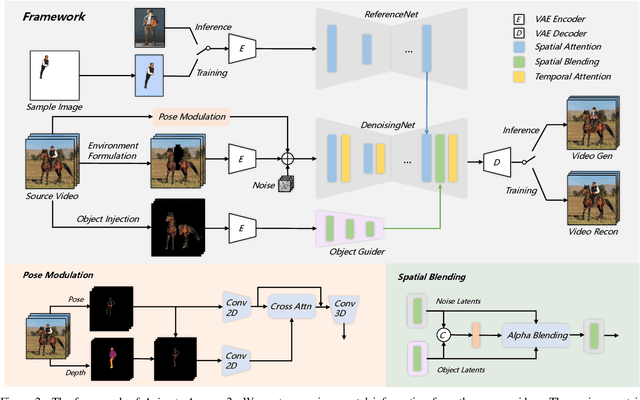
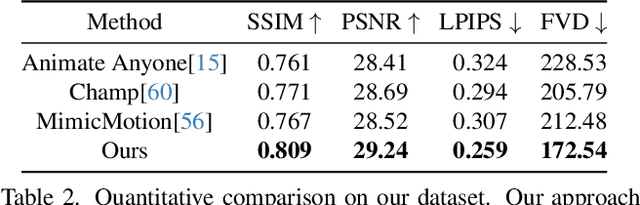

Recent character image animation methods based on diffusion models, such as Animate Anyone, have made significant progress in generating consistent and generalizable character animations. However, these approaches fail to produce reasonable associations between characters and their environments. To address this limitation, we introduce Animate Anyone 2, aiming to animate characters with environment affordance. Beyond extracting motion signals from source video, we additionally capture environmental representations as conditional inputs. The environment is formulated as the region with the exclusion of characters and our model generates characters to populate these regions while maintaining coherence with the environmental context. We propose a shape-agnostic mask strategy that more effectively characterizes the relationship between character and environment. Furthermore, to enhance the fidelity of object interactions, we leverage an object guider to extract features of interacting objects and employ spatial blending for feature injection. We also introduce a pose modulation strategy that enables the model to handle more diverse motion patterns. Experimental results demonstrate the superior performance of the proposed method.
Langevin Soft Actor-Critic: Efficient Exploration through Uncertainty-Driven Critic Learning
Jan 29, 2025

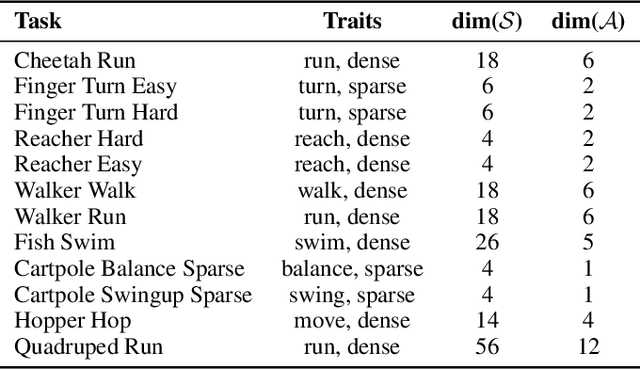

Existing actor-critic algorithms, which are popular for continuous control reinforcement learning (RL) tasks, suffer from poor sample efficiency due to lack of principled exploration mechanism within them. Motivated by the success of Thompson sampling for efficient exploration in RL, we propose a novel model-free RL algorithm, Langevin Soft Actor Critic (LSAC), which prioritizes enhancing critic learning through uncertainty estimation over policy optimization. LSAC employs three key innovations: approximate Thompson sampling through distributional Langevin Monte Carlo (LMC) based $Q$ updates, parallel tempering for exploring multiple modes of the posterior of the $Q$ function, and diffusion synthesized state-action samples regularized with $Q$ action gradients. Our extensive experiments demonstrate that LSAC outperforms or matches the performance of mainstream model-free RL algorithms for continuous control tasks. Notably, LSAC marks the first successful application of an LMC based Thompson sampling in continuous control tasks with continuous action spaces.
High-Resolution Volumetric Reconstruction for Clothed Humans
Jul 25, 2023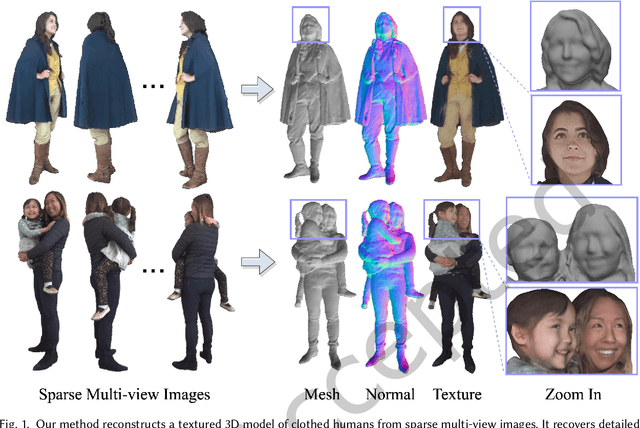

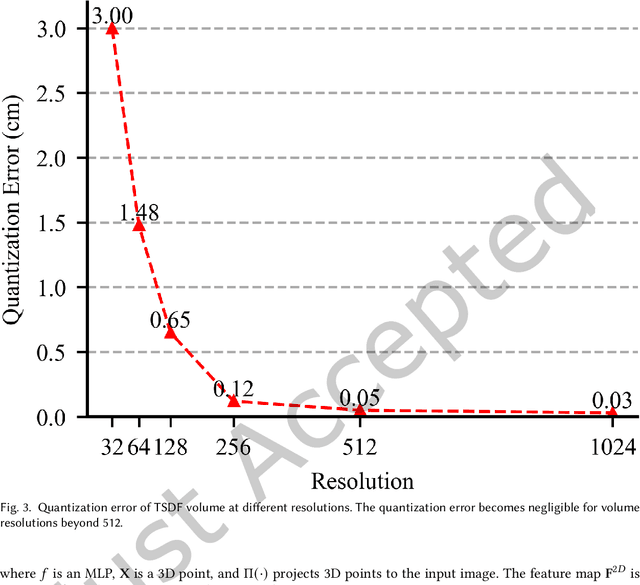

We present a novel method for reconstructing clothed humans from a sparse set of, e.g., 1 to 6 RGB images. Despite impressive results from recent works employing deep implicit representation, we revisit the volumetric approach and demonstrate that better performance can be achieved with proper system design. The volumetric representation offers significant advantages in leveraging 3D spatial context through 3D convolutions, and the notorious quantization error is largely negligible with a reasonably large yet affordable volume resolution, e.g., 512. To handle memory and computation costs, we propose a sophisticated coarse-to-fine strategy with voxel culling and subspace sparse convolution. Our method starts with a discretized visual hull to compute a coarse shape and then focuses on a narrow band nearby the coarse shape for refinement. Once the shape is reconstructed, we adopt an image-based rendering approach, which computes the colors of surface points by blending input images with learned weights. Extensive experimental results show that our method significantly reduces the mean point-to-surface (P2S) precision of state-of-the-art methods by more than 50% to achieve approximately 2mm accuracy with a 512 volume resolution. Additionally, images rendered from our textured model achieve a higher peak signal-to-noise ratio (PSNR) compared to state-of-the-art methods.