 Add to Chrome
 Add to Firefox
 Add to Edge
BatchSampler: Sampling Mini-Batches for Contrastive Learning in Vision, Language, and Graphs
Jun 06, 2023
In-Batch contrastive learning is a state-of-the-art self-supervised method that brings semantically-similar instances close while pushing dissimilar instances apart within a mini-batch. Its key to success is the negative sharing strategy, in which every instance serves as a negative for the others within the mini-batch. Recent studies aim to improve performance by sampling hard negatives \textit{within the current mini-batch}, whose quality is bounded by the mini-batch itself. In this work, we propose to improve contrastive learning by sampling mini-batches from the input data. We present BatchSampler\footnote{The code is available at \url{https://github.com/THUDM/BatchSampler}} to sample mini-batches of hard-to-distinguish (i.e., hard and true negatives to each other) instances. To make each mini-batch have fewer false negatives, we design the proximity graph of randomly-selected instances. To form the mini-batch, we leverage random walk with restart on the proximity graph to help sample hard-to-distinguish instances. BatchSampler is a simple and general technique that can be directly plugged into existing contrastive learning models in vision, language, and graphs. Extensive experiments on datasets of three modalities show that BatchSampler can consistently improve the performance of powerful contrastive models, as shown by significant improvements of SimCLR on ImageNet-100, SimCSE on STS (language), and GraphCL and MVGRL on graph datasets.
* 17 pages, 16 figures

Learn to Unlearn: A Survey on Machine Unlearning
May 12, 2023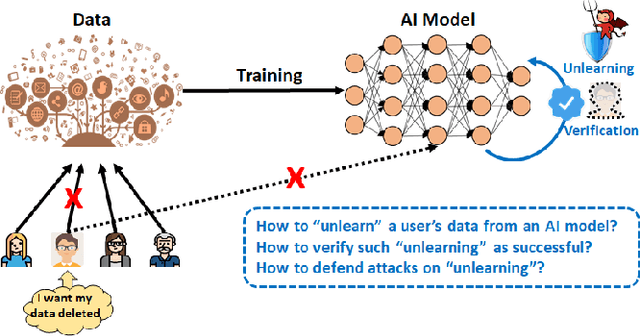
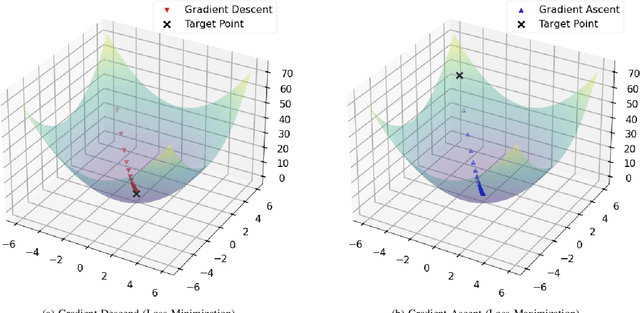
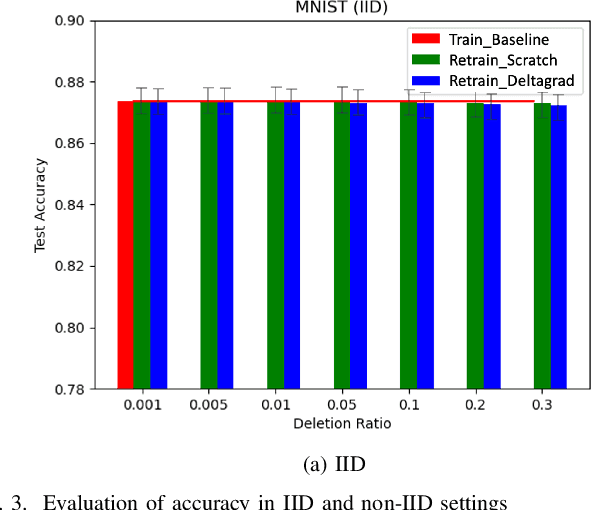
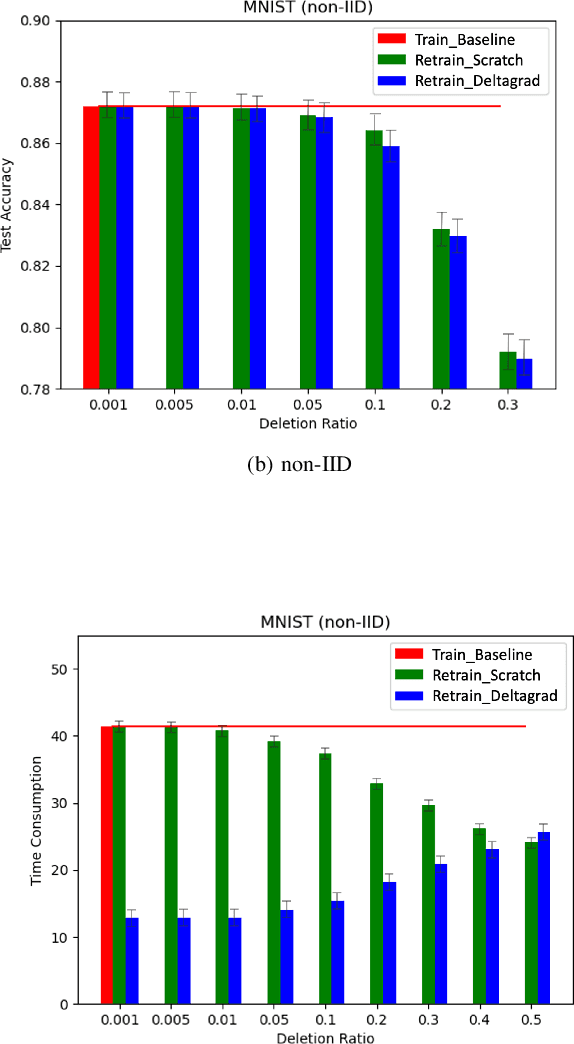
Machine Learning (ML) models contain private information, and implementing the right to be forgotten is a challenging privacy issue in many data applications. Machine unlearning has emerged as an alternative to remove sensitive data from a trained model, but completely retraining ML models is often not feasible. This survey provides a concise appraisal of Machine Unlearning techniques, encompassing both exact and approximate methods, probable attacks, and verification approaches. The survey compares the merits and limitations each method and evaluates their performance using the Deltagrad exact machine unlearning method. The survey also highlights challenges like the pressing need for a robust model for non-IID deletion to mitigate fairness issues. Overall, the survey provides a thorough synopsis of machine unlearning techniques and applications, noting future research directions in this evolving field. The survey aims to be a valuable resource for researchers and practitioners seeking to provide privacy and equity in ML systems.
ImageReward: Learning and Evaluating Human Preferences for Text-to-Image Generation
Apr 13, 2023
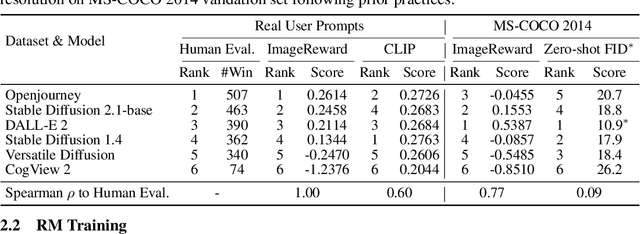
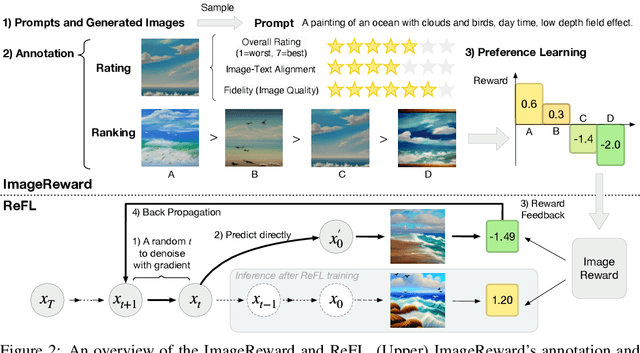
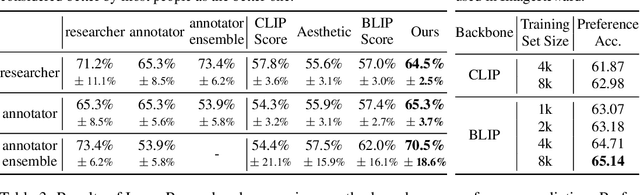
We present ImageReward -- the first general-purpose text-to-image human preference reward model -- to address various prevalent issues in generative models and align them with human values and preferences. Its training is based on our systematic annotation pipeline that covers both the rating and ranking components, collecting a dataset of 137k expert comparisons to date. In human evaluation, ImageReward outperforms existing scoring methods (e.g., CLIP by 38.6\%), making it a promising automatic metric for evaluating and improving text-to-image synthesis. The reward model is publicly available via the \texttt{image-reward} package at \url{https://github.com/THUDM/ImageReward}.
Gradient Sparsification for Efficient Wireless Federated Learning with Differential Privacy
Apr 09, 2023Federated learning (FL) enables distributed clients to collaboratively train a machine learning model without sharing raw data with each other. However, it suffers the leakage of private information from uploading models. In addition, as the model size grows, the training latency increases due to limited transmission bandwidth and the model performance degrades while using differential privacy (DP) protection. In this paper, we propose a gradient sparsification empowered FL framework over wireless channels, in order to improve training efficiency without sacrificing convergence performance. Specifically, we first design a random sparsification algorithm to retain a fraction of the gradient elements in each client's local training, thereby mitigating the performance degradation induced by DP and and reducing the number of transmission parameters over wireless channels. Then, we analyze the convergence bound of the proposed algorithm, by modeling a non-convex FL problem. Next, we formulate a time-sequential stochastic optimization problem for minimizing the developed convergence bound, under the constraints of transmit power, the average transmitting delay, as well as the client's DP requirement. Utilizing the Lyapunov drift-plus-penalty framework, we develop an analytical solution to the optimization problem. Extensive experiments have been implemented on three real life datasets to demonstrate the effectiveness of our proposed algorithm. We show that our proposed algorithms can fully exploit the interworking between communication and computation to outperform the baselines, i.e., random scheduling, round robin and delay-minimization algorithms.
Amplitude-Varying Perturbation for Balancing Privacy and Utility in Federated Learning
Mar 07, 2023While preserving the privacy of federated learning (FL), differential privacy (DP) inevitably degrades the utility (i.e., accuracy) of FL due to model perturbations caused by DP noise added to model updates. Existing studies have considered exclusively noise with persistent root-mean-square amplitude and overlooked an opportunity of adjusting the amplitudes to alleviate the adverse effects of the noise. This paper presents a new DP perturbation mechanism with a time-varying noise amplitude to protect the privacy of FL and retain the capability of adjusting the learning performance. Specifically, we propose a geometric series form for the noise amplitude and reveal analytically the dependence of the series on the number of global aggregations and the $(\epsilon,\delta)$-DP requirement. We derive an online refinement of the series to prevent FL from premature convergence resulting from excessive perturbation noise. Another important aspect is an upper bound developed for the loss function of a multi-layer perceptron (MLP) trained by FL running the new DP mechanism. Accordingly, the optimal number of global aggregations is obtained, balancing the learning and privacy. Extensive experiments are conducted using MLP, supporting vector machine, and convolutional neural network models on four public datasets. The contribution of the new DP mechanism to the convergence and accuracy of privacy-preserving FL is corroborated, compared to the state-of-the-art Gaussian noise mechanism with a persistent noise amplitude.
Efficient and Low Overhead Website Fingerprinting Attacks and Defenses based on TCP/IP Traffic
Feb 27, 2023Website fingerprinting attack is an extensively studied technique used in a web browser to analyze traffic patterns and thus infer confidential information about users. Several website fingerprinting attacks based on machine learning and deep learning tend to use the most typical features to achieve a satisfactory performance of attacking rate. However, these attacks suffer from several practical implementation factors, such as a skillfully pre-processing step or a clean dataset. To defend against such attacks, random packet defense (RPD) with a high cost of excessive network overhead is usually applied. In this work, we first propose a practical filter-assisted attack against RPD, which can filter out the injected noises using the statistical characteristics of TCP/IP traffic. Then, we propose a list-assisted defensive mechanism to defend the proposed attack method. To achieve a configurable trade-off between the defense and the network overhead, we further improve the list-based defense by a traffic splitting mechanism, which can combat the mentioned attacks as well as save a considerable amount of network overhead. In the experiments, we collect real-life traffic patterns using three mainstream browsers, i.e., Microsoft Edge, Google Chrome, and Mozilla Firefox, and extensive results conducted on the closed and open-world datasets show the effectiveness of the proposed algorithms in terms of defense accuracy and network efficiency.
Differentially Private Vertical Federated Learning
Nov 13, 2022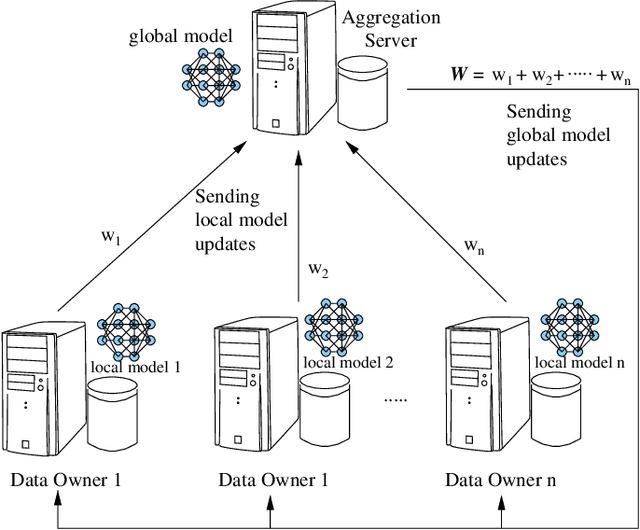
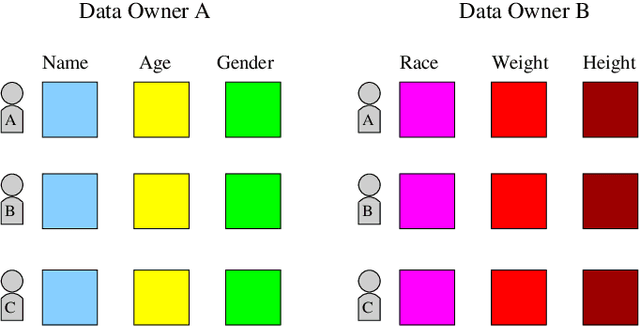
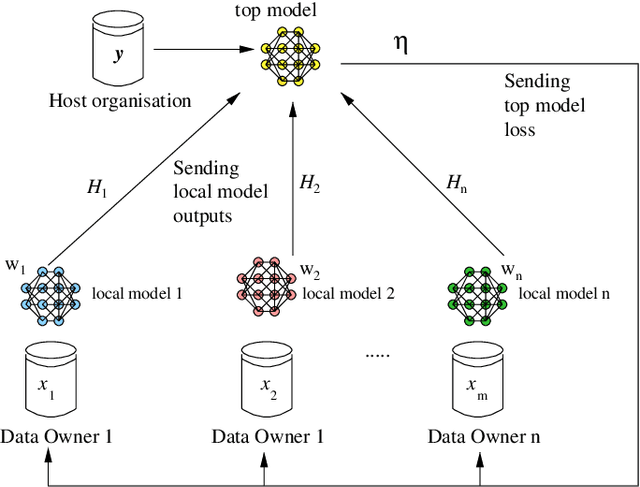
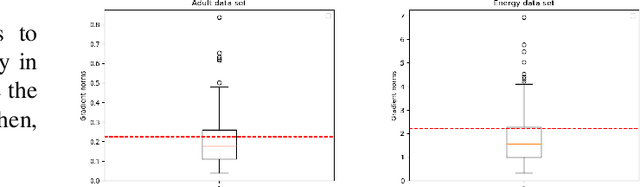
A successful machine learning (ML) algorithm often relies on a large amount of high-quality data to train well-performed models. Supervised learning approaches, such as deep learning techniques, generate high-quality ML functions for real-life applications, however with large costs and human efforts to label training data. Recent advancements in federated learning (FL) allow multiple data owners or organisations to collaboratively train a machine learning model without sharing raw data. In this light, vertical FL allows organisations to build a global model when the participating organisations have vertically partitioned data. Further, in the vertical FL setting the participating organisation generally requires fewer resources compared to sharing data directly, enabling lightweight and scalable distributed training solutions. However, privacy protection in vertical FL is challenging due to the communication of intermediate outputs and the gradients of model update. This invites adversary entities to infer other organisations underlying data. Thus, in this paper, we aim to explore how to protect the privacy of individual organisation data in a differential privacy (DP) setting. We run experiments with different real-world datasets and DP budgets. Our experimental results show that a trade-off point needs to be found to achieve a balance between the vertical FL performance and privacy protection in terms of the amount of perturbation noise.
Decentralized Federated Reinforcement Learning for User-Centric Dynamic TFDD Control
Nov 04, 2022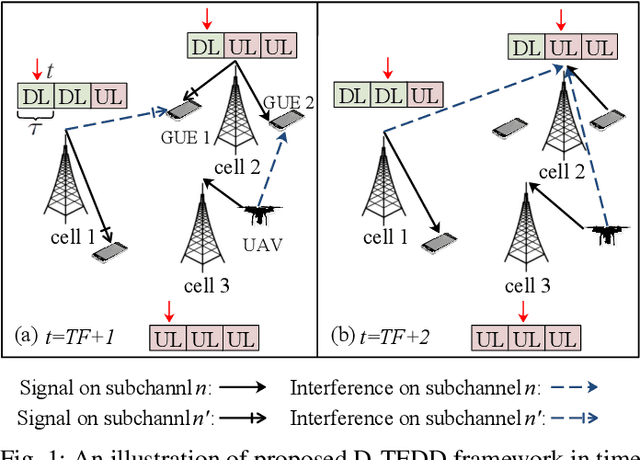
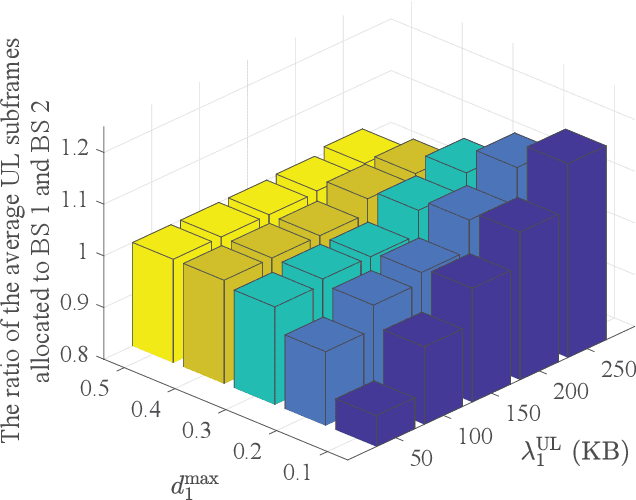
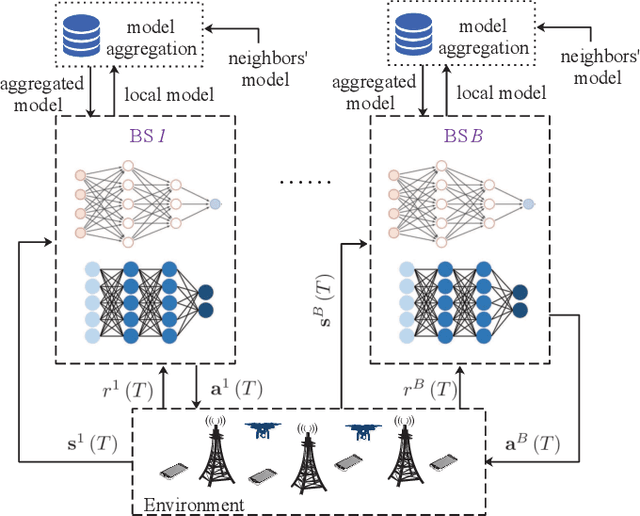
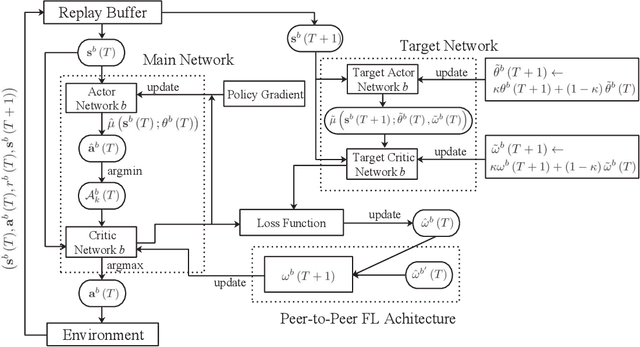
The explosive growth of dynamic and heterogeneous data traffic brings great challenges for 5G and beyond mobile networks. To enhance the network capacity and reliability, we propose a learning-based dynamic time-frequency division duplexing (D-TFDD) scheme that adaptively allocates the uplink and downlink time-frequency resources of base stations (BSs) to meet the asymmetric and heterogeneous traffic demands while alleviating the inter-cell interference. We formulate the problem as a decentralized partially observable Markov decision process (Dec-POMDP) that maximizes the long-term expected sum rate under the users' packet dropping ratio constraints. In order to jointly optimize the global resources in a decentralized manner, we propose a federated reinforcement learning (RL) algorithm named federated Wolpertinger deep deterministic policy gradient (FWDDPG) algorithm. The BSs decide their local time-frequency configurations through RL algorithms and achieve global training via exchanging local RL models with their neighbors under a decentralized federated learning framework. Specifically, to deal with the large-scale discrete action space of each BS, we adopt a DDPG-based algorithm to generate actions in a continuous space, and then utilize Wolpertinger policy to reduce the mapping errors from continuous action space back to discrete action space. Simulation results demonstrate the superiority of our proposed algorithm to benchmark algorithms with respect to system sum rate.
Privacy-preserving Deep Learning based Record Linkage
Nov 03, 2022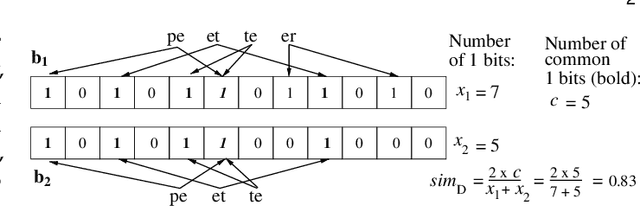
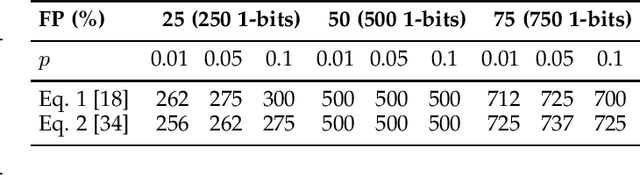
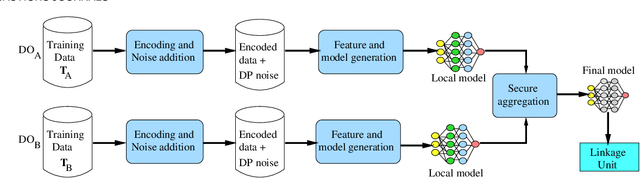

Deep learning-based linkage of records across different databases is becoming increasingly useful in data integration and mining applications to discover new insights from multiple sources of data. However, due to privacy and confidentiality concerns, organisations often are not willing or allowed to share their sensitive data with any external parties, thus making it challenging to build/train deep learning models for record linkage across different organizations' databases. To overcome this limitation, we propose the first deep learning-based multi-party privacy-preserving record linkage (PPRL) protocol that can be used to link sensitive databases held by multiple different organisations. In our approach, each database owner first trains a local deep learning model, which is then uploaded to a secure environment and securely aggregated to create a global model. The global model is then used by a linkage unit to distinguish unlabelled record pairs as matches and non-matches. We utilise differential privacy to achieve provable privacy protection against re-identification attacks. We evaluate the linkage quality and scalability of our approach using several large real-world databases, showing that it can achieve high linkage quality while providing sufficient privacy protection against existing attacks.
Parameter-Efficient Tuning Makes a Good Classification Head
Oct 30, 2022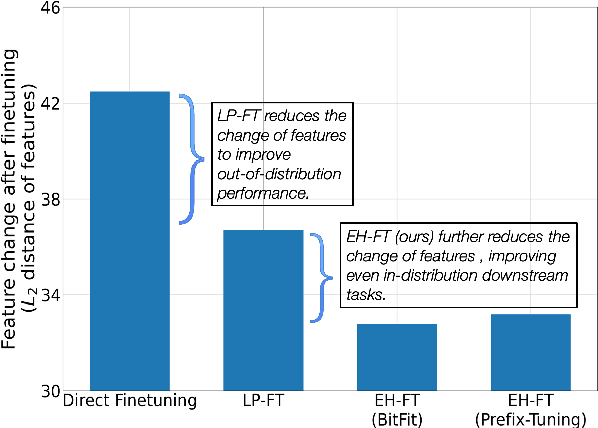
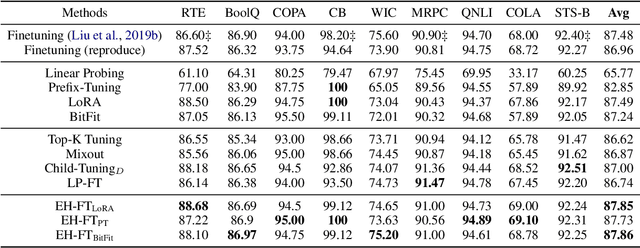
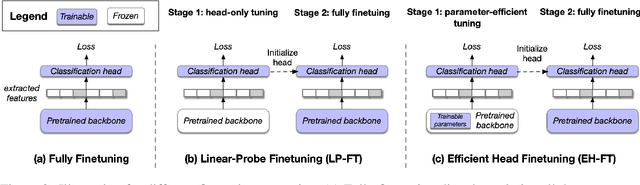

In recent years, pretrained models revolutionized the paradigm of natural language understanding (NLU), where we append a randomly initialized classification head after the pretrained backbone, e.g. BERT, and finetune the whole model. As the pretrained backbone makes a major contribution to the improvement, we naturally expect a good pretrained classification head can also benefit the training. However, the final-layer output of the backbone, i.e. the input of the classification head, will change greatly during finetuning, making the usual head-only pretraining (LP-FT) ineffective. In this paper, we find that parameter-efficient tuning makes a good classification head, with which we can simply replace the randomly initialized heads for a stable performance gain. Our experiments demonstrate that the classification head jointly pretrained with parameter-efficient tuning consistently improves the performance on 9 tasks in GLUE and SuperGLUE.