 Add to Chrome
 Add to Firefox
 Add to Edge
OAMP-Aided Joint Channel Estimation and Data Detection for ODDM Systems
Jun 24, 2026
In this work, to address the challenge of joint channel estimation and data detection (JED) for orthogonal delay-Doppler (DD) division multiplexing (ODDM) in doubly selective channels, we propose an orthogonal approximate message passing (OAMP)-aided JED (OAMP-JED) receiver. We first formulate a bilinear cross-domain JED model, which can be linearized into separate channel estimation and data detection subproblems. The proposed OAMP-JED receiver alternately executes two OAMP modules for these subproblems, effectively coupled through a variational noise term to account for model uncertainty. Leveraging OAMP's error orthogonality, we derive closed-form scalar-variance updates to enable efficient and principled soft information exchange between the modules, thereby mitigating error propagation during JED. Simulation results show that, for both uncoded and coded ODDM, OAMP-JED achieves a lower bit error rate (BER) than benchmark schemes. Moreover, its BER performance closely approaches that of OAMP with perfect CSI.

Design of APSK Constellations Approaching the Communication-Sensing Pareto Boundary for ISAC
May 24, 2026We propose a semi-analytical amplitude phase shift keying (APSK) signaling framework for integrated sensing and communication (ISAC), focusing on i.i.d. uniform discrete input distributions for practicality and analytical tractability. First, we establish APSK design criteria in which communication performance is measured by the gap to capacity and linked to the minimum Euclidean distance, while sensing performance is characterized by the symbol-energy variance. Based on these criteria, we propose a family of APSK constellations whose key parameters follow explicit scaling laws. Then we prove that this design achieves a constant gap to capacity independent of the signal-to-noise ratio. Building upon this foundation, we further construct a parametric APSK family that bridges the communication-optimal and sensing-optimal designs, with the communication and sensing (C&S) tradeoff controlled by the number of rings and energy allocation among rings. Simulation results show that the proposed APSK achieves C&S performance very close to the Pareto boundary achieved with time-independent, circularly symmetric, and otherwise unconstrained continuous input distributions.
IndusAgent: Reinforcing Open-Vocabulary Industrial Anomaly Detection with Agentic Tools
May 20, 2026Multimodal large language models (MLLMs) have shown remarkable capability in bridging visual perception and textual reasoning, enabling zero-shot understanding across diverse industrial scenarios. However, their performance in open-vocabulary industrial anomaly detection (IAD) is often limited by domain-misaligned reasoning and hallucinated structural inferences. To address these challenges, we propose \textbf{IndusAgent}, a tool-augmented agentic framework for open-vocabulary IAD. Specifically, we first construct \textbf{Indus-CoT}, a structured dataset that integrates global visual observations, high-resolution local patches, and expert normalcy priors, providing supervision for fine-tuning the model on rigorous industrial inspection trajectories. Building on this, IndusAgent dynamically orchestrates a set of external tools, including dynamic region cropping, high-frequency feature enhancement, and prior retrieval, thus enabling the agent to actively resolve visual ambiguities and disentangle subtle anomalies. Furthermore, we introduce a gated reinforcement learning objective that jointly optimizes anomaly classification, localization accuracy, anomaly type reasoning, and efficient tool usage, ensuring that tool invocation occurs only when beneficial. Extensive evaluations on five industrial anomaly benchmarks, including MVTec-AD, VisA, MPDD, DTD, and SDD, demonstrate that IndusAgent achieves state-of-the-art zero-shot performance among all existing methods, validating our robustness and generalization capacity.
Recent Advances in Spatially Coupled Codes: Overview and Outlook
May 12, 2026The concept of spatial coupling is among the most significant breakthroughs in coding theory over the past decade. The excellent waterfall and error floor performance of spatially coupled codes has positioned them as promising coding candidates for future communication and data storage systems. This article presents an overview of recent advances in spatially coupled codes. In particular, we first review several representative examples of recently proposed spatially coupled codes and highlight their unique features that make them appealing for different applications. Next, we discuss the useful properties of spatially coupled codes and how to design good spatially coupled codes. The article concludes with some future research directions and open problems.
On the Rate Region of I.I.D. Discrete Signaling and Treating Interference as Noise for the Gaussian Broadcast Channel
Apr 05, 2026We revisit the Gaussian broadcast channel (GBC) and explore the rate region achieved by purely discrete inputs with treating interference as noise (TIN) decoding. Specifically, we introduce a simple scheme based on superposition coding with identically and independently distributed (i.i.d.) inputs drawn from discrete constellations, e.g., pulse amplitude modulations (PAM). Most importantly, we prove that the resulting achievable rate region under TIN decoding is within a constant gap to the capacity region of the GBC, where the gap is independent of all channel parameters. In addition, we show via simulation that the weak user can achieve a higher rate with PAM than with Gaussian signaling in some cases.
Guaranteed Image Classification via Goal-oriented Joint Semantic Source and Channel Coding
Mar 02, 2026To enable critical applications such as remote diagnostics, image classification must be guaranteed under bandwidth constraints and unreliable wireless channels through joint source and channel coding (JSCC) design. However, most existing JSCC methods focus on minimizing image distortion, implicitly assuming that all image regions contribute equally to classification performance, thereby overlooking their varying importance for the task. In this paper, we propose a goal-oriented joint semantic source and channel coding (G-JSSCC) framework that applies \emph{various} levels of source coding compression and channel coding protection across image regions based on their semantic importance. Specifically, we design a semantic information extraction method that identifies and ranks various image regions based on their contributions to classification, where the contribution is measured by the shapely value from explainable artificial intelligence (AI). Based on that, we design a semantic source coding and a semantic channel coding method, which allocates higher-quality compression and stronger error protection to image regions of great semantic importance. In addition, we define a new metric, termed coding efficiency, to evaluate the effectiveness of the source and channel coding in the classification task. Simulations show that our proposed G-JSSCC framework improves classification probability by 2.70 times, reduces transmission cost by 38%, and enhances coding efficiency by 5.91 times, compared to the benchmark scheme using uniform compression and an idealized channel code to uniformly protect the whole image.
A Novel ISAC Waveform Based on Orthogonal Delay-Doppler Division Multiplexing with FMCW
Feb 02, 2026In this work, we propose the orthogonal delay-Doppler (DD) division multiplexing (ODDM) modulation with frequency modulated continuous wave (FMCW) (ODDM-FMCW) waveform to enable integrated sensing and communication (ISAC) with a low peak-to-average power ratio (PAPR). We first propose a square-root-Nyquist-filtered FMCW (SRN-FMCW) waveform to address limitations of conventional linear FMCW waveforms in ISAC systems. To better integrate with ODDM, we generate SRN-FMCW by embedding symbols in the DD domain, referred to as a DD-SRN-FMCW frame. A DD chirp compression receiver is designed to obtain the channel response efficiently. Next, we construct the proposed ODDM-FMCW waveform for ISAC by superimposing a DD-SRN-FMCW frame onto an ODDM data frame. A comprehensive performance analysis of the ODDM-FMCW waveform is presented, covering peak-to-average power ratio, spectrum, ambiguity function, and Cramer-Rao bound for delay and Doppler estimation. Numerical results show that the proposed ODDM-FMCW waveform delivers excellent ISAC performance in terms of root mean square error for sensing and bit error rate for communications.
Parallel Coding for Orthogonal Delay-Doppler Division Multiplexing
Feb 03, 2025This paper proposes a novel parallel coding transmission strategy and an iterative detection and decoding receiver signal processing technique for orthogonal delay-Doppler division multiplexing (ODDM) modulation. Specifically, the proposed approach employs a parallel channel encoding (PCE) scheme that consists of multiple short-length codewords for each delay-Doppler multicarrier (DDMC) symbol. Building upon such a PCE transmission framework, we then introduce an iterative detection and decoding algorithm incorporating a successive decoding feedback (SDF) technique, which enables instant information exchange between the detector and decoder for each DDMC symbol. To characterize the error performance of the proposed scheme, we perform density evolution analysis considering the finite blocklength effects. Our analysis results, coupled with extensive simulations, demonstrate that the proposed PCE scheme with the SDF algorithm not only showcases a better overall performance but also requires much less decoding complexity to implement, compared to the conventional benchmark scheme that relies on a single long channel code for coding the entire ODDM frame.
Uplink Multiple Access with Heterogeneous Blocklength and Reliability Constraints: Discrete Signaling with Treating Interference as Noise
Nov 23, 2024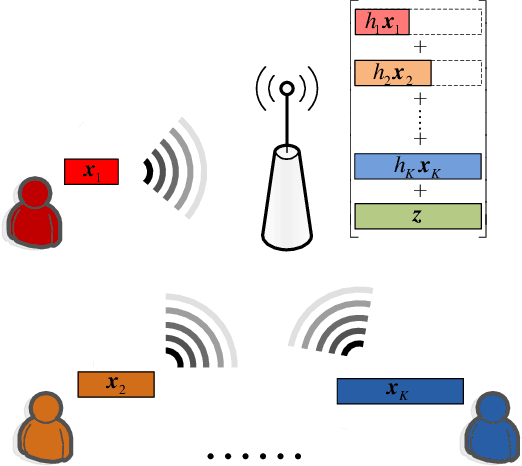
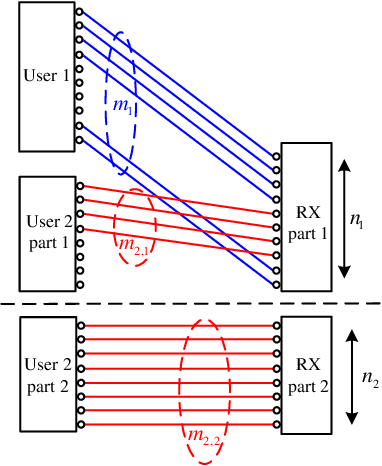
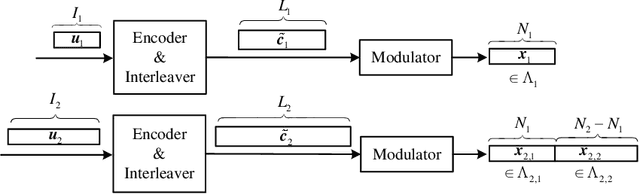
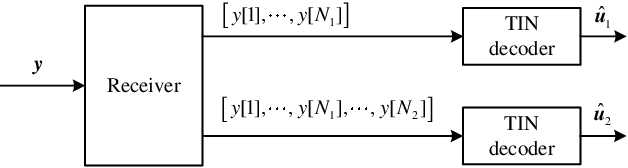
We consider the uplink multiple access of heterogeneous users, e.g., ultra-reliable low-latency communications (URLLC) and enhanced mobile broadband (eMBB) users. Each user has its own reliability requirement and blocklength constraint, and users transmitting longer blocks suffer from heterogeneous interference. On top of that, the decoding of URLLC messages cannot leverage successive interference cancellation (SIC) owing to the stringent latency requirements. This can significantly degrade the spectral efficiency of all URLLC users when the interference is strong. To overcome this issue, we propose a new multiple access scheme employing discrete signaling and treating interference as noise (TIN) decoding, i.e., without SIC. Specifically, to handle heterogeneous interference while maintaining the single-user encoding and decoding complexities, each user uses a single channel code and maps its coded bits onto sub-blocks of symbols, where the underlying constellations can be different. We demonstrate theoretically and numerically that the proposed scheme employing quadrature amplitude modulations and TIN decoding can perform very close to the benchmark scheme based on Gaussian signaling with perfect SIC decoding. Interestingly, we show that the proposed scheme does not need to use all the transmit power budget, but also can sometimes even outperform the benchmark scheme.
Performance of orthogonal delay-doppler division multiplexing modulation with imperfect channel estimation
Oct 23, 2024The orthogonal delay-Doppler division multiplexing (ODDM) modulation is a recently proposed multi-carrier modulation that features a realizable pulse orthogonal with respect to the delay-Doppler (DD) plane's fine resolutions. In this paper, we investigate the performance of ODDM systems with imperfect channel estimation considering three detectors, namely the message passing algorithm (MPA) detector, iterative maximum-ratio combining (MRC) detector, and successive interference cancellation with minimum mean square error (SIC-MMSE) detector. We derive the post-equalization signal-to-interference-plus-noise ratio (SINR) for MRC and SIC-MMSE and analyze their bit error rate (BER) performance. Based on this analysis, we propose the MRC with subtractive dither (MRC-SD) and soft SIC-MMSE initialized MRC (SSMI-MRC) detector to improve the BER of iterative MRC. Our results demonstrate that soft SIC-MMSE consistently outperforms the other detectors in BER performance under perfect and imperfect CSI. While MRC exhibits a BER floor above $10^{-5}$, MRC-SD effectively lowers the BER with a negligible increase in detection complexity. SSMI-MRC achieves better BER than hard SIC-MMSE with the same detection complexity order. Additionally, we show that MPA has an error floor and is sensitive to imperfect CSI.