 Add to Chrome
 Add to Firefox
 Add to Edge
Fundamental Limits of MIMO-OTFS and MIMO-OFDM in High-Dynamics ISAC: An Antenna Array Architecture Perspective
Jul 22, 2026
This paper investigates the fundamental limits of MIMO-OTFS and MIMO-OFDM integrated sensing and communications (ISAC) systems in high-mobility environments, specifically comparing sparse arrays (SA) against conventional uniform linear arrays (ULA). High-dynamics scenarios, such as V2X and satellite networks, suffer from severe Doppler shifts and rapidly time-varying channels, necessitating robust modulation schemes and efficient array geometries. A unified theoretical analysis of ergodic channel capacity and the Cramér$\unicode{x2013}$Rao bound (CRB) for angle estimation is provided. Utilizing the framework of stochastic majorization, the study reveals that SAs consistently outperform ULAs by creating a more $\unicode{x201C}$uniform$\unicode{x201D}$ spatial eigenvalue distribution, which decorrelates the multipath environment and increases communication capacity. For sensing, the paper proves that the angle CRB is inversely proportional to the array's second-order moment of antenna positions asymptotically, demonstrating that SAs achieve superior accuracy$\unicode{x2014}$improving by up to the square of the number of antennas$\unicode{x2014}$due to their increased physical aperture. Notably, the analysis shows that under relatively ideal conditions, MIMO-OTFS and MIMO-OFDM share similar fundamental limits for both capacity and angle estimation, suggesting that spatial geometry, rather than waveform, is the primary driver of fundamental performance gains in the spatial dimension.

Design of APSK Constellations Approaching the Communication-Sensing Pareto Boundary for ISAC
May 24, 2026We propose a semi-analytical amplitude phase shift keying (APSK) signaling framework for integrated sensing and communication (ISAC), focusing on i.i.d. uniform discrete input distributions for practicality and analytical tractability. First, we establish APSK design criteria in which communication performance is measured by the gap to capacity and linked to the minimum Euclidean distance, while sensing performance is characterized by the symbol-energy variance. Based on these criteria, we propose a family of APSK constellations whose key parameters follow explicit scaling laws. Then we prove that this design achieves a constant gap to capacity independent of the signal-to-noise ratio. Building upon this foundation, we further construct a parametric APSK family that bridges the communication-optimal and sensing-optimal designs, with the communication and sensing (C&S) tradeoff controlled by the number of rings and energy allocation among rings. Simulation results show that the proposed APSK achieves C&S performance very close to the Pareto boundary achieved with time-independent, circularly symmetric, and otherwise unconstrained continuous input distributions.
Pairing Regularization for Mitigating Many-to-One Collapse in GANs
Apr 22, 2026Mode collapse remains a fundamental challenge in training generative adversarial networks (GANs). While existing works have primarily focused on inter-mode collapse, such as mode dropping, intra-mode collapse-where many latent variables map to the same or highly similar outputs-has received significantly less attention. In this work, we propose a pairing regularizer jointly optimized with the generator to mitigate the many-to-one collapse by enforcing local consistency between latent variables and generated samples. We show that the effect of pairing regularization depends on the dominant failure mode of training. In collapse-prone regimes with limited exploration, pairing encourages structured local exploration, leading to improved coverage and higher recall. In contrast, under stabilized training with sufficient exploration, pairing refines the generator's induced data density by discouraging redundant mappings, thereby improving precision without sacrificing recall. Extensive experiments on both toy distributions and real-image benchmarks demonstrate that the proposed regularizer effectively complements existing stabilization techniques by directly addressing intra-mode collapse.
A Modularized Framework for Piecewise-Stationary Restless Bandits
Apr 11, 2026We study the piecewise-stationary restless multi-armed bandit (PS-RMAB) problem, where each arm evolves as a Markov chain but \emph{mean rewards may change across unknown segments}. To address the resulting exploration--detection delay trade-off, we propose a modular framework that integrates arbitrary RMAB base algorithms with change detection and a novel diminishing exploration mechanism. This design enables flexible plug-and-play use of existing solvers and detectors, while efficiently adapting to mean changes without prior knowledge of their number. To evaluate performance, we introduce a refined regret notion that measures the \emph{excess regret due to exploration and detection}, benchmarked against an oracle that restarts the base algorithm at the true change points. Under this metric, we prove a regret bound of $\tilde{O}(\sqrt{LMKT})$, where $L$ denotes the maximum mixing time of the Markov chains across all arms and segments, $M$ the number of segments, $K$ the number of arms, and $T$ the horizon. Simulations confirm that our framework achieves regret close to that of the segment oracle and consistently outperforms base solvers that do not incorporate any mechanism to handle environmental changes.
Uplink Multiple Access with Heterogeneous Blocklength and Reliability Constraints: Discrete Signaling with Treating Interference as Noise
Nov 23, 2024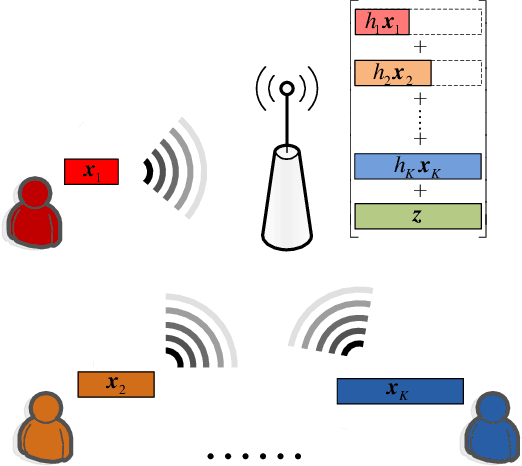
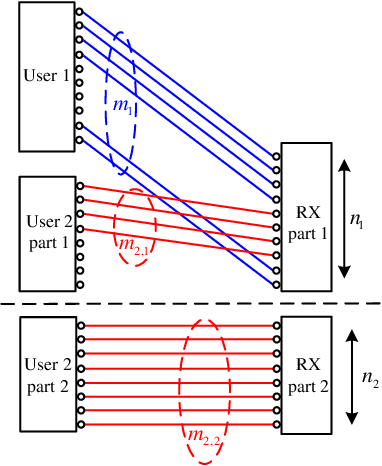
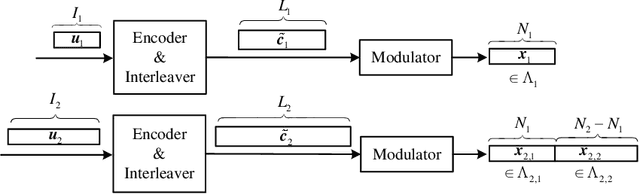
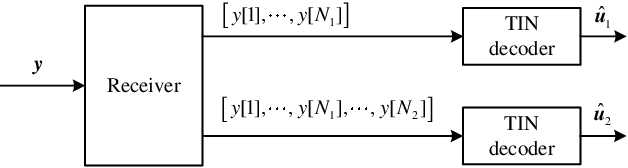
We consider the uplink multiple access of heterogeneous users, e.g., ultra-reliable low-latency communications (URLLC) and enhanced mobile broadband (eMBB) users. Each user has its own reliability requirement and blocklength constraint, and users transmitting longer blocks suffer from heterogeneous interference. On top of that, the decoding of URLLC messages cannot leverage successive interference cancellation (SIC) owing to the stringent latency requirements. This can significantly degrade the spectral efficiency of all URLLC users when the interference is strong. To overcome this issue, we propose a new multiple access scheme employing discrete signaling and treating interference as noise (TIN) decoding, i.e., without SIC. Specifically, to handle heterogeneous interference while maintaining the single-user encoding and decoding complexities, each user uses a single channel code and maps its coded bits onto sub-blocks of symbols, where the underlying constellations can be different. We demonstrate theoretically and numerically that the proposed scheme employing quadrature amplitude modulations and TIN decoding can perform very close to the benchmark scheme based on Gaussian signaling with perfect SIC decoding. Interestingly, we show that the proposed scheme does not need to use all the transmit power budget, but also can sometimes even outperform the benchmark scheme.
Diminishing Exploration: A Minimalist Approach to Piecewise Stationary Multi-Armed Bandits
Oct 08, 2024


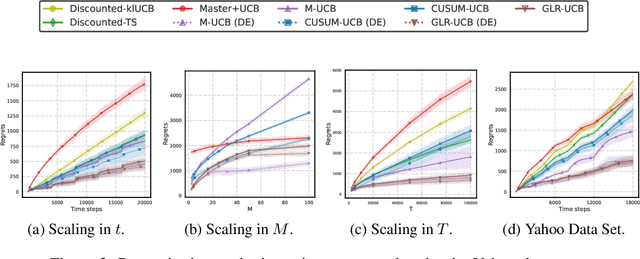
The piecewise-stationary bandit problem is an important variant of the multi-armed bandit problem that further considers abrupt changes in the reward distributions. The main theme of the problem is the trade-off between exploration for detecting environment changes and exploitation of traditional bandit algorithms. While this problem has been extensively investigated, existing works either assume knowledge about the number of change points $M$ or require extremely high computational complexity. In this work, we revisit the piecewise-stationary bandit problem from a minimalist perspective. We propose a novel and generic exploration mechanism, called diminishing exploration, which eliminates the need for knowledge about $M$ and can be used in conjunction with an existing change detection-based algorithm to achieve near-optimal regret scaling. Simulation results show that despite oblivious of $M$, equipping existing algorithms with the proposed diminishing exploration generally achieves better empirical regret than the traditional uniform exploration.
Age Aware Scheduling for Differentially-Private Federated Learning
May 09, 2024


This paper explores differentially-private federated learning (FL) across time-varying databases, delving into a nuanced three-way tradeoff involving age, accuracy, and differential privacy (DP). Emphasizing the potential advantages of scheduling, we propose an optimization problem aimed at meeting DP requirements while minimizing the loss difference between the aggregated model and the model obtained without DP constraints. To harness the benefits of scheduling, we introduce an age-dependent upper bound on the loss, leading to the development of an age-aware scheduling design. Simulation results underscore the superior performance of our proposed scheme compared to FL with classic DP, which does not consider scheduling as a design factor. This research contributes insights into the interplay of age, accuracy, and DP in federated learning, with practical implications for scheduling strategies.
Coexistence of Heterogeneous Services in the Uplink with Discrete Signaling and Treating Interference as Noise
Aug 17, 2023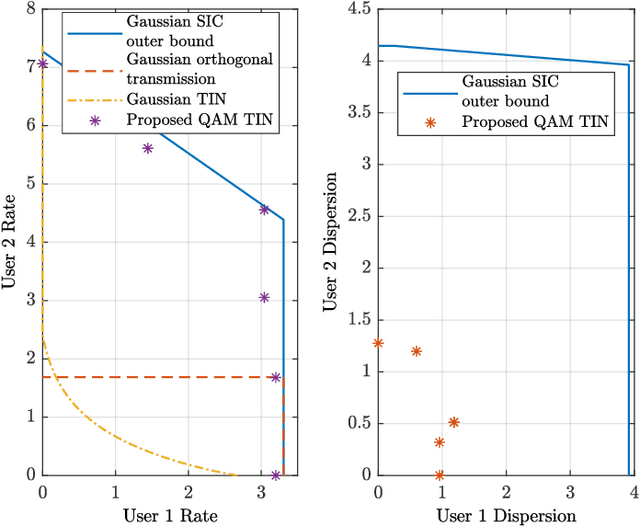
The problem of enabling the coexistence of heterogeneous services, e.g., different ultra-reliable low-latency communications (URLLC) services and/or enhanced mobile broadband (eMBB) services, in the uplink is studied. Each service has its own error probability and blocklength constraints and the longer transmission block suffers from heterogeneous interference. Due to the latency concern, the decoding of URLLC messages cannot leverage successive interference cancellation (SIC) and should always be performed before the decoding of eMBB messages. This can significantly degrade the achievable rates of URLLC users when the interference from other users is strong. To overcome this issue, we propose a new transmission scheme based on discrete signaling and treating interference as noise decoding, i.e., without SIC. Guided by the deterministic model, we provide a systematic way to construct discrete signaling for handling heterogeneous interference effectively. We demonstrate theoretically and numerically that the proposed scheme can perform close to the benchmark scheme based on capacity-achieving Gaussian signaling with the assumption of perfect SIC.
Committed Private Information Retrieval
Feb 03, 2023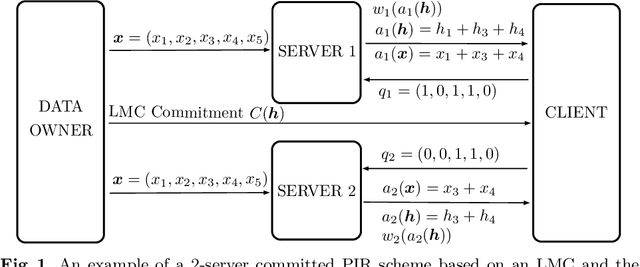


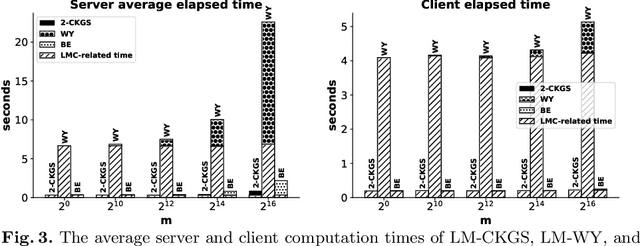
A private information retrieval (PIR) scheme allows a client to retrieve a data item $x_i$ among $n$ items $x_1,x_2,...,x_n$ from $k$ servers, without revealing what $i$ is even when $t < k$ servers collude and try to learn $i$. Such a PIR scheme is said to be $t$-private. A PIR scheme is $v$-verifiable if the client can verify the correctness of the retrieved $x_i$ even when $v \leq k$ servers collude and try to fool the client by sending manipulated data. Most of the previous works in the literature on PIR assumed that $v < k$, leaving the case of all-colluding servers open. We propose a generic construction that combines a linear map commitment (LMC) and an arbitrary linear PIR scheme to produce a $k$-verifiable PIR scheme, termed a committed PIR scheme. Such a scheme guarantees that even in the worst scenario, when all servers are under the control of an attacker, although the privacy is unavoidably lost, the client won't be fooled into accepting an incorrect $x_i$. We demonstrate the practicality of our proposal by implementing the committed PIR schemes based on the Lai-Malavolta LMC and three well-known PIR schemes using the GMP library and \texttt{blst}, the current fastest C library for elliptic curve pairings.
Downlink Transmission under Heterogeneous Blocklength Constraints: Discrete Signaling with Single-User Decoding
Jan 23, 2023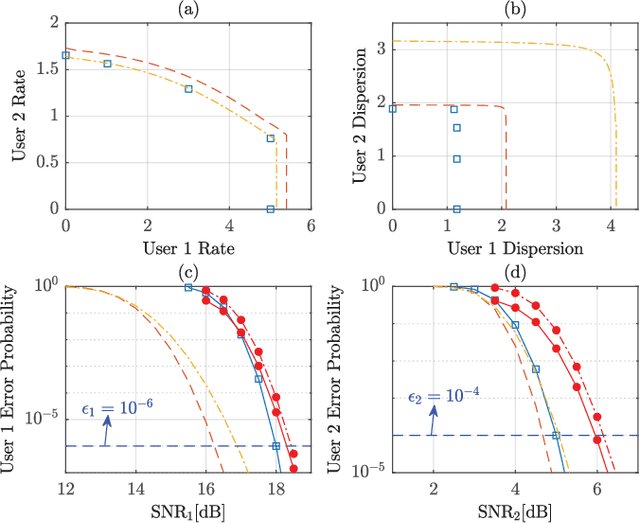
In this paper, we consider the downlink broadcast channel under heterogenous blocklength constraints, where each user experiences different interference statistics across its received symbols. Different from the homogeneous blocklength case, the strong users with short blocklength transmitted symbol blocks usually cannot wait to receive the entire transmission frame and perform successive interference cancellation (SIC) owing to their stringent latency requirements. Even if SIC is feasible, it may not be perfect under finite blocklength constraints. To cope with the heterogeneity in latency and reliability requirements, we propose a practical downlink transmission scheme with discrete signaling and single-user decoding, i.e., without SIC. In addition, we derive the finite blocklength achievable rate and use it for guiding the design of channel coding and modulations. Both achievable rate and error probability simulation show that the proposed scheme can operate close to the benchmark scheme which assumes capacity-achieving signaling and perfect SIC.