 Add to Chrome
 Add to Firefox
 Add to Edge
Analog RF Computing: A New Paradigm for Energy-Efficient Edge AI Over MU-MIMO Systems
May 14, 2026
Modern edge devices increasingly rely on neural networks for intelligent applications. However, conventional digital computing-based edge inference requires substantial memory and energy consumption. In analog radio frequency (RF) computing, a base station (BS) encodes the weights of the neural networks and broadcasts the RF waveforms to the clients. Each client reuses its passive mixer to multiply the received weight-encoded waveform with a locally generated input-encoded waveform. This enables wireless receivers to perform the matrix-vector multiplications (MVMs) that account for most of the computation burden in edge inference with ultra-low energy consumption. Unlike conventional downlink transmissions which are optimized for communications, analog RF computing requires a computing-centric physical layer that controls both the analog MVM accuracy and the energy consumption for inference. Motivated by this, in this paper, we propose a physical layer design framework for analog RF computing in MU-MIMO wireless systems. We derive tractable models for computing accuracy and energy consumption for inference, formulate a joint BS beamforming and client-side scaling problem subject to computing accuracy, transmit power, and hardware constraints, and develop a low-complexity algorithm to solve the non-convex problem. The proposed design provides client- and layer-specific accuracy control for both uniform- and mixed-precision inference. Simulations under 3GPP specifications show that analog RF computing can significantly reduce client-side energy consumption by nearly two orders of magnitude compared to digital computing, while mixed-precision inference requires even lower energy consumption than uniform-precision inference. Overall, these results establish analog RF computing over wireless networks as a promising paradigm for energy-efficient edge inference.

Agentic AI for Intent-driven Optimization in Cell-free O-RAN
Feb 26, 2026Agentic artificial intelligence (AI) is emerging as a key enabler for autonomous radio access networks (RANs), where multiple large language model (LLM)-based agents reason and collaborate to achieve operator-defined intents. The open RAN (O-RAN) architecture enables the deployment and coordination of such agents. However, most existing works consider simple intents handled by independent agents, while complex intents that require coordination among agents remain unexplored. In this paper, we propose an agentic AI framework for intent translation and optimization in cell-free O-RAN. A supervisor agent translates the operator intents into an optimization objective and minimum rate requirements. Based on this information, a user weighting agent retrieves relevant prior experience from a memory module to determine the user priority weights for precoding. If the intent includes an energy-saving objective, then an open radio unit (O-RU) management agent will also be activated to determine the set of active O-RUs by using a deep reinforcement learning (DRL) algorithm. A monitoring agent measures and monitors the user data rates and coordinates with other agents to guarantee the minimum rate requirements are satisfied. To enhance scalability, we adopt a parameter-efficient fine-tuning (PEFT) method that enables the same underlying LLM to be used for different agents. Simulation results show that the proposed agentic AI framework reduces the number of active O-RUs by 41.93% when compared with three baseline schemes in energy-saving mode. Using the PEFT method, the proposed framework reduces the memory usage by 92% when compared with deploying separate LLM agents.
Cooperative ISAC for Joint Localization and Velocity Estimation in Cell-Free MIMO Systems
Feb 23, 2026In this paper, we explore a cooperative integrated sensing and communication (ISAC) framework that utilizes orthogonal frequency division multiplexing (OFDM) waveforms. Under the control of a central processing unit (CPU), multiple access points (APs) collaboratively perform multistatic sensing while providing communication service in a cell-free multiple-input multiple-output (MIMO) system. Achieving high sensing accuracy requires the collection of global sensing information at the CPU, which can lead to significant fronthaul signaling overhead due to the feedback of the sensing signals from each AP. To tackle this issue, we propose a collaborative processing scheme in which the APs locally compress and quantize the received sensing signals before forwarding them to the CPU. The CPU then aggregates the information from all APs to estimate the location and velocity of the targets. We develop a distributed vector-quantized variational autoencoder (D-VQVAE) to enable an end-to-end implementation of this scheme. D-VQVAE consists of distributed encoders at the APs to locally encode the received sensing signals, codebooks for quantizing the encoded results, and a decoder at the CPU for location and velocity estimation. It effectively reduces the amount of data transmitted from each AP to the CPU while maintaining a high sensing accuracy. We employ a collaborative learning-assisted scheme to train D-VQVAE in an end-to-end manner. Simulation results show that the proposed D-VQVAE network outperforms the baseline schemes in sensing accuracy and reduces fronthaul signaling overhead by 99% when compared with the centralized sensing approach.
FLoRG: Federated Fine-tuning with Low-rank Gram Matrices and Procrustes Alignment
Feb 19, 2026Parameter-efficient fine-tuning techniques such as low-rank adaptation (LoRA) enable large language models (LLMs) to adapt to downstream tasks efficiently. Federated learning (FL) further facilitates this process by enabling collaborative fine-tuning across distributed clients without sharing private data. However, the use of two separate low-rank matrices in LoRA for federated fine-tuning introduces two types of challenges. The first challenge arises from the error induced by separately aggregating those two low-rank matrices. The second challenge occurs even when the product of two low-rank matrices is aggregated. The server needs to recover factors via matrix decomposition, which is non-unique and can introduce decomposition drift. To tackle the aforementioned challenges, we propose FLoRG, a federated fine-tuning framework which employs a single low-rank matrix for fine-tuning and aggregates its Gram matrix (i.e., the matrix of inner products of its column vectors), eliminating the aggregation error while also reducing the communication overhead. FLoRG minimizes the decomposition drift by introducing a Procrustes alignment approach which aligns the decomposed matrix between consecutive fine-tuning rounds for consistent updates. We theoretically analyze the convergence of FLoRG and prove that adopting the Procrustes alignment results in a tighter convergence bound. Experimental results across multiple LLM fine-tuning benchmarks demonstrate that FLoRG outperforms five state-of-the-art baseline schemes in the downstream task accuracy and can reduce the communication overhead by up to 2041$\times$.
Distributed Precoding for Cell-free Massive MIMO in O-RAN: A Multi-agent Deep Reinforcement Learning Framework
Oct 31, 2025Cell-free massive multiple-input multiple-output (MIMO) is a key technology for next-generation wireless systems. The integration of cell-free massive MIMO within the open radio access network (O-RAN) architecture addresses the growing need for decentralized, scalable, and high-capacity networks that can support different use cases. Precoding is a crucial step in the operation of cell-free massive MIMO, where O-RUs steer their beams towards the intended users while mitigating interference to other users. Current precoding schemes for cell-free massive MIMO are either fully centralized or fully distributed. Centralized schemes are not scalable, whereas distributed schemes may lead to a high inter-O-RU interference. In this paper, we propose a distributed and scalable precoding framework for cell-free massive MIMO that uses limited information exchange among precoding agents to mitigate interference. We formulate an optimization problem for precoding that maximizes the aggregate throughput while guaranteeing the minimum data rate requirements of users. The formulated problem is nonconvex. We propose a multi-timescale framework that combines multi-agent deep reinforcement learning (DRL) with expert insights from an iterative algorithm to determine the precoding matrices efficiently. We conduct simulations and compare the proposed framework with the centralized precoding and distributed precoding methods for different numbers of O-RUs, users, and transmit antennas. The results show that the proposed framework achieves a higher aggregate throughput than the distributed regularized zero-forcing (D-RZF) scheme and the weighted minimum mean square error (WMMSE) algorithm. When compared with the centralized regularized zero-forcing (C-RZF) scheme, the proposed framework achieves similar aggregate throughput performance but with a lower signaling overhead.
Generalized Pinching-Antenna Systems: A Tutorial on Principles, Design Strategies, and Future Directions
Oct 15, 2025Pinching-antenna systems have emerged as a novel and transformative flexible-antenna architecture for next-generation wireless networks. They offer unprecedented flexibility and spatial reconfigurability by enabling dynamic positioning and activation of radiating elements along a signal-guiding medium (e.g., dielectric waveguides), which is not possible with conventional fixed antenna systems. In this paper, we introduce the concept of generalized pinching antenna systems, which retain the core principle of creating localized radiation points on demand, but can be physically realized in a variety of settings. These include implementations based on dielectric waveguides, leaky coaxial cables, surface-wave guiding structures, and other types of media, employing different feeding methods and activation mechanisms (e.g., mechanical, electronic, or hybrid). Despite differences in their physical realizations, they all share the same inherent ability to form, reposition, or deactivate radiation sites as needed, enabling user-centric and dynamic coverage. We first describe the underlying physical mechanisms of representative generalized pinching-antenna realizations and their associated wireless channel models, highlighting their unique propagation and reconfigurability characteristics compared with conventional antennas. Then, we review several representative pinching-antenna system architectures, ranging from single- to multiple-waveguide configurations, and discuss advanced design strategies tailored to these flexible deployments. Furthermore, we examine their integration with emerging wireless technologies to enable synergistic, user-centric solutions. Finally, we identify key open research challenges and outline future directions, charting a pathway toward the practical deployment of generalized pinching antennas in next-generation wireless networks.
Generalized User-Oriented Image Semantic Coding Empowered by Large Vision-Language Model
Sep 10, 2025Semantic communication has shown outstanding performance in preserving the overall source information in wireless transmission. For semantically rich content such as images, human users are often interested in specific regions depending on their intent. Moreover, recent semantic coding models are mostly trained on specific datasets. However, real-world applications may involve images out of the distribution of training dataset, which makes generalization a crucial but largely unexplored problem. To incorporate user's intent into semantic coding, in this paper, we propose a generalized user-oriented image semantic coding (UO-ISC) framework, where the user provides a text query indicating its intent. The transmitter extracts features from the source image which are relevant to the user's query. The receiver reconstructs an image based on those features. To enhance the generalization ability, we integrate contrastive language image pre-training (CLIP) model, which is a pretrained large vision-language model (VLM), into our proposed UO-ISC framework. To evaluate the relevance between the reconstructed image and the user's query, we introduce the user-intent relevance loss, which is computed by using a pretrained large VLM, large language-and-vision assistant (LLaVA) model. When performing zero-shot inference on unseen objects, simulation results show that the proposed UO-ISC framework outperforms the state-of-the-art query-aware image semantic coding in terms of the answer match rate.
QoS-Aware NOMA Design for Downlink Pinching-Antenna Systems
Apr 18, 2025Pinching antennas, implemented by applying small dielectric particles on a waveguide, have emerged as a promising flexible-antenna technology ideal for next-generation wireless communications systems. Unlike conventional flexible-antenna systems, pinching antennas offer the advantage of creating line-of-sight links by enabling antennas to be activated on the waveguide at a location close to the user. This paper investigates a typical two-user non-orthogonal multiple access (NOMA) downlink scenario, where multiple pinching antennas are activated on a single dielectric waveguide to assist NOMA transmission. We formulate the problem of maximizing the data rate of one user subject to the quality-of-service requirement of the other user by jointly optimizing the antenna locations and power allocation coefficients. The formulated problem is nonconvex and difficult to solve due to the impact of antenna locations on large-scale path loss and two types of phase shifts, namely in-waveguide phase shifts and free space propagation phase shifts. To this end, we propose an iterative algorithm based on block coordinate descent and successive convex approximation techniques. Moreover, we consider the special case with a single pinching antenna, which is a simplified version of the multi-antenna case. Although the formulated problem is still nonconvex, by using the inherent features of the formulated problem, we derive the global optimal solution in closed-form, which offers important insights on the performance of pinching-antenna systems. Simulation results demonstrate that the pinching-antenna system significantly outperforms conventional fixed-position antenna systems, and the proposed algorithm achieves performance comparable to the computationally intensive exhaustive search based approach.
Leveraging MoE-based Large Language Model for Zero-Shot Multi-Task Semantic Communication
Mar 21, 2025Multi-task semantic communication (SC) can reduce the computational resources in wireless systems since retraining is not required when switching between tasks. However, existing approaches typically rely on task-specific embeddings to identify the intended task, necessitating retraining the entire model when given a new task. Consequently, this drives the need for a multi-task SC system that can handle new tasks without additional training, known as zero-shot learning. Inspired by the superior zero-shot capabilities of large language models (LLMs), we leverage pre-trained instruction-tuned LLMs, referred to as fine-tuned language net (FLAN), to improve the generalization capability. We incorporate a mixture-of-experts (MoE) architecture in the FLAN model and propose MoE-FLAN-SC architecture for multi-task SC systems. Our proposed MoE-FLAN-SC architecture can further improve the performance of FLAN-T5 model without increasing the computational cost. Moreover, we design a multi-task feature extraction module (FEM) which can adaptively extract relevant features across various tasks given the provided features and signal-to-noise ratio (SNR). Simulation results show that our proposed MoE-FLAN-SC architecture outperforms three state-of-the-art models in terms of the average accuracy on four different unseen tasks.
Pinching Antennas: Principles, Applications and Challenges
Jan 18, 2025


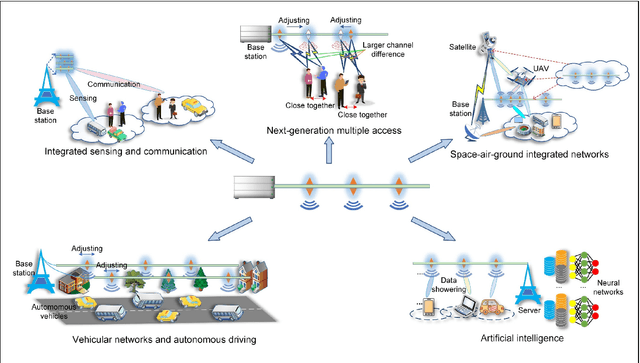
Flexible-antenna systems, such as fluid antennas and movable antennas, have been recognized as key enabling technologies for sixth-generation (6G) wireless networks, as they can intelligently reconfigure the effective channel gains of the users and hence significantly improve their data transmission capabilities. However, existing flexible-antenna systems have been designed to combat small-scale fading in non-line-of-sight (NLoS) conditions. As a result, they lack the ability to establish line-of-sight links, which are typically 100 times stronger than NLoS links. In addition, existing flexible-antenna systems have limited flexibility, where adding/removing an antenna is not straightforward. This article introduces an innovative flexible-antenna system called pinching antennas, which are realized by applying small dielectric particles to waveguides. We first describe the basics of pinching-antenna systems and their ability to provide strong LoS links by deploying pinching antennas close to the users as well as their capability to scale up/down the antenna system. We then focus on communication scenarios with different numbers of waveguides and pinching antennas, where innovative approaches to implement multiple-input multiple-output and non-orthogonal multiple access are discussed. In addition, promising 6G-related applications of pinching antennas, including integrated sensing and communication and next-generation multiple access, are presented. Finally, important directions for future research, such as waveguide deployment and channel estimation, are highlighted.