 Add to Chrome
 Add to Firefox
 Add to Edge
Design of APSK Constellations Approaching the Communication-Sensing Pareto Boundary for ISAC
May 24, 2026
We propose a semi-analytical amplitude phase shift keying (APSK) signaling framework for integrated sensing and communication (ISAC), focusing on i.i.d. uniform discrete input distributions for practicality and analytical tractability. First, we establish APSK design criteria in which communication performance is measured by the gap to capacity and linked to the minimum Euclidean distance, while sensing performance is characterized by the symbol-energy variance. Based on these criteria, we propose a family of APSK constellations whose key parameters follow explicit scaling laws. Then we prove that this design achieves a constant gap to capacity independent of the signal-to-noise ratio. Building upon this foundation, we further construct a parametric APSK family that bridges the communication-optimal and sensing-optimal designs, with the communication and sensing (C&S) tradeoff controlled by the number of rings and energy allocation among rings. Simulation results show that the proposed APSK achieves C&S performance very close to the Pareto boundary achieved with time-independent, circularly symmetric, and otherwise unconstrained continuous input distributions.

On the Rate Region of I.I.D. Discrete Signaling and Treating Interference as Noise for the Gaussian Broadcast Channel
Apr 05, 2026We revisit the Gaussian broadcast channel (GBC) and explore the rate region achieved by purely discrete inputs with treating interference as noise (TIN) decoding. Specifically, we introduce a simple scheme based on superposition coding with identically and independently distributed (i.i.d.) inputs drawn from discrete constellations, e.g., pulse amplitude modulations (PAM). Most importantly, we prove that the resulting achievable rate region under TIN decoding is within a constant gap to the capacity region of the GBC, where the gap is independent of all channel parameters. In addition, we show via simulation that the weak user can achieve a higher rate with PAM than with Gaussian signaling in some cases.
CMDAG: A Chinese Metaphor Dataset with Annotated Grounds as CoT for Boosting Metaphor Generation
Feb 21, 2024
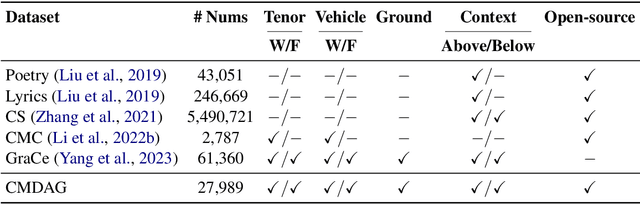
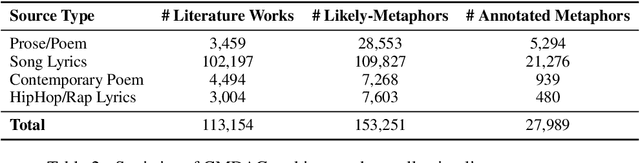

Metaphor is a prominent linguistic device in human language and literature, as they add color, imagery, and emphasis to enhance effective communication. This paper introduces a large-scale high quality annotated Chinese Metaphor Corpus, which comprises around 28K sentences drawn from a diverse range of Chinese literary sources, such as poems, prose, song lyrics, etc. To ensure the accuracy and consistency of our annotations, we introduce a comprehensive set of guidelines. These guidelines address the facets of metaphor annotation, including identifying tenors, vehicles, and grounds to handling the complexities of similes, personifications, juxtapositions, and hyperboles. Breaking tradition, our approach to metaphor generation emphasizes grounds and their distinct features rather than the conventional combination of tenors and vehicles. By integrating "ground" as a CoT (Chain of Thoughts) input, we are able to generate metaphors that resonate more with real-world intuition. We test generative models such as Belle, Baichuan, and Chinese-alpaca-33B using our annotated corpus. These models are able to generate creative and fluent metaphor sentences more frequently induced by selected samples from our dataset, demonstrating the value of our corpus for Chinese metaphor research. The code is available in https://github.com/JasonShao55/Chinese_Metaphor_Explanation.