 Add to Chrome
 Add to Firefox
 Add to Edge
OAMP-Aided Joint Channel Estimation and Data Detection for ODDM Systems
Jun 24, 2026
In this work, to address the challenge of joint channel estimation and data detection (JED) for orthogonal delay-Doppler (DD) division multiplexing (ODDM) in doubly selective channels, we propose an orthogonal approximate message passing (OAMP)-aided JED (OAMP-JED) receiver. We first formulate a bilinear cross-domain JED model, which can be linearized into separate channel estimation and data detection subproblems. The proposed OAMP-JED receiver alternately executes two OAMP modules for these subproblems, effectively coupled through a variational noise term to account for model uncertainty. Leveraging OAMP's error orthogonality, we derive closed-form scalar-variance updates to enable efficient and principled soft information exchange between the modules, thereby mitigating error propagation during JED. Simulation results show that, for both uncoded and coded ODDM, OAMP-JED achieves a lower bit error rate (BER) than benchmark schemes. Moreover, its BER performance closely approaches that of OAMP with perfect CSI.

A Novel One-tap Equalizer for Zero-Padded AFDM System over Doubly Selective Channels
Mar 03, 2026Recently, affine frequency division multiplexing (AFDM) has gained traction as a robust solution for doubly selective channels. In this paper, we present a novel low-complexity one-tap equalizer for zero-padded AFDM (ZP-AFDM) systems. We first select the AFDM parameters, $c_1$ and $c_2$, such that $c_1$ has a relatively high value, and $c_2$ depends on $c_1$, which simplifies the affine domain input-output relation (IOR). This selection also demonstrates that a phase term that varies slowly along the affine domain is experienced by all affine domain symbols and this variation is significantly slower compared to that experienced by the time domain symbols over doubly selective channels. To simplify the equalization, we then introduce zero padding to the transmitted affine domain symbols and reconstruction operation on the received affine domain symbols. By doing so, we convert the effective affine domain IOR of our ZP-AFDM system to be characterized using approximately circular convolution. Next, we transform the resulting affine domain symbols into a new domain called the frequency-of-affine (FoA) domain. We propose our one-tap equalizer in this FoA domain to efficiently recover the transmitted symbols. Numerical results demonstrate the effectiveness of our proposed one-tap equalizer, particularly when $c_1$ is high, without compromising performance robustness.
A Novel ISAC Waveform Based on Orthogonal Delay-Doppler Division Multiplexing with FMCW
Feb 02, 2026In this work, we propose the orthogonal delay-Doppler (DD) division multiplexing (ODDM) modulation with frequency modulated continuous wave (FMCW) (ODDM-FMCW) waveform to enable integrated sensing and communication (ISAC) with a low peak-to-average power ratio (PAPR). We first propose a square-root-Nyquist-filtered FMCW (SRN-FMCW) waveform to address limitations of conventional linear FMCW waveforms in ISAC systems. To better integrate with ODDM, we generate SRN-FMCW by embedding symbols in the DD domain, referred to as a DD-SRN-FMCW frame. A DD chirp compression receiver is designed to obtain the channel response efficiently. Next, we construct the proposed ODDM-FMCW waveform for ISAC by superimposing a DD-SRN-FMCW frame onto an ODDM data frame. A comprehensive performance analysis of the ODDM-FMCW waveform is presented, covering peak-to-average power ratio, spectrum, ambiguity function, and Cramer-Rao bound for delay and Doppler estimation. Numerical results show that the proposed ODDM-FMCW waveform delivers excellent ISAC performance in terms of root mean square error for sensing and bit error rate for communications.
Spectrum and Orthogonality of Orthogonal Delay-Doppler Division Multiplexing Modulation Waveforms
Nov 19, 2025Orthogonal delay-Doppler (DD) division multiplexing (ODDM) modulation has recently emerged as a promising paradigm for ensuring reliable communications in doubly-selective channels. This work investigates the spectra and orthogonality characteristics of analog (direct) and approximate digital implementations of ODDM systems. We first determine the time and frequency domain representations of the basis functions for waveform in analog and approximate digital ODDM systems. Thereafter, we derive their power spectral densities and show that while the spectrum of analog ODDM waveforms exhibits a step-wise behavior in its transition regions, the spectrum of approximate digital ODDM waveforms is confined to that of the ODDM sub-pulse. Next, we prove the orthogonality characteristics of approximate digital ODDM waveforms and show that, unlike analog ODDM waveforms, the approximate digital ODDM waveforms satisfy orthogonality without the need of additional time domain resources. Additionally, we examine the similarities and differences that implementations of approximate digital ODDM share with the other variants of DD modulations, focusing on the domain changes the symbols undergo, the type of pulse shaping and windowing used, and the domains and the sequence in which they are performed. Finally, we present numerical results to validate our findings and draw further insights.
On the Time-Frequency Localization Characteristics of the Delay-Doppler Plane Orthogonal Pulse
Dec 14, 2024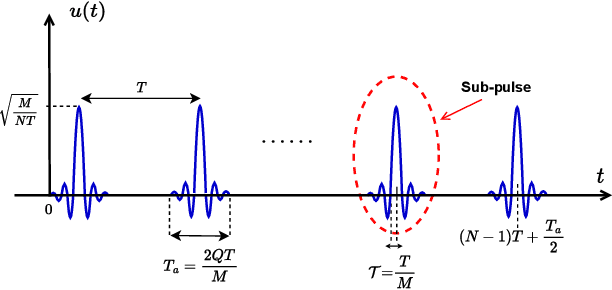
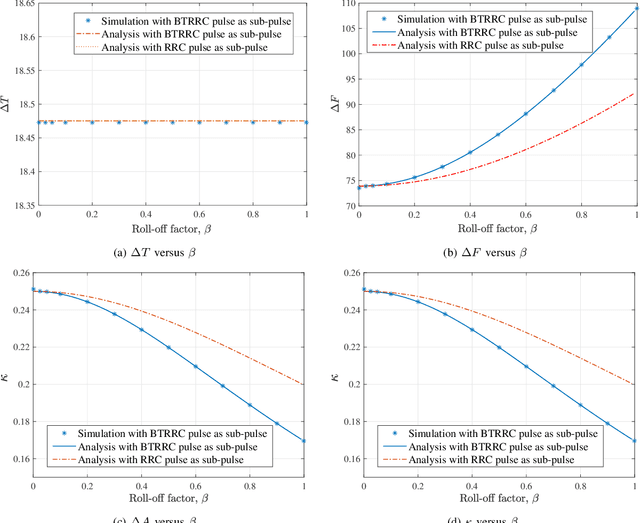
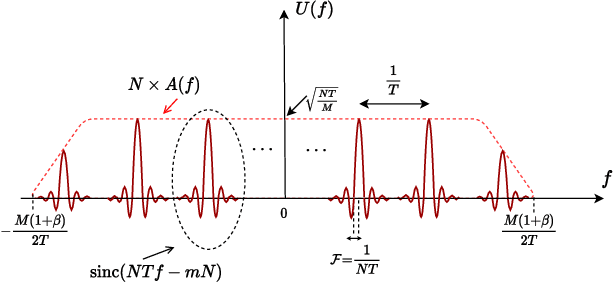
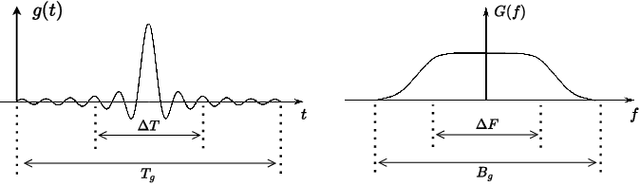
In this work, we study the time-frequency (TF) localization characteristics of the prototype pulse of orthogonal delay-Doppler (DD) division multiplexing modulation, namely, the DD plane orthogonal pulse (DDOP). The TF localization characteristics examine how concentrated or spread out the energy of a pulse is in the joint TF domain, the time domain (TD), and the frequency domain (FD). We first derive the TF localization metrics of the DDOP, including its TF area, its time and frequency dispersions, and its direction parameter. Based on these results, we demonstrate that the DDOP exhibits a high energy spread in the TD, FD, and the joint TF domain, while adhering to the Heisenberg uncertainty principle. Thereafter, we discuss the potential advantages brought by the energy spread of the DDOP, especially with regard to harnessing both time and frequency diversities and enabling fine-resolution sensing. Subsequently, we examine the relationships between the time and frequency dispersions of the DDOP and those of the envelope functions of DDOP's TD and FD representations, paving the way for simplified determination of the TF localization metrics for more generalized variants of the DDOP and the pulses used in other DD domain modulation schemes. Finally, using numerical results, we validate our analysis and find further insights.
Channel Spreading Function-Inspired Channel Transfer Function Estimation for OFDM Systems with High-Mobility
Dec 10, 2024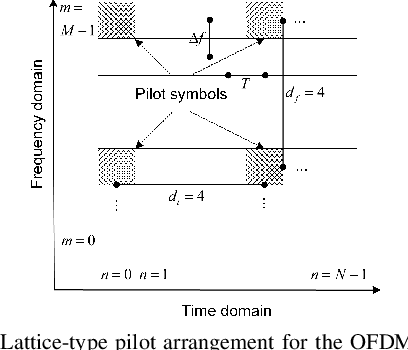
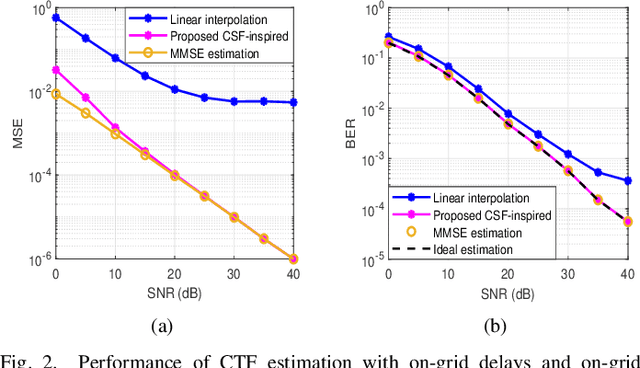
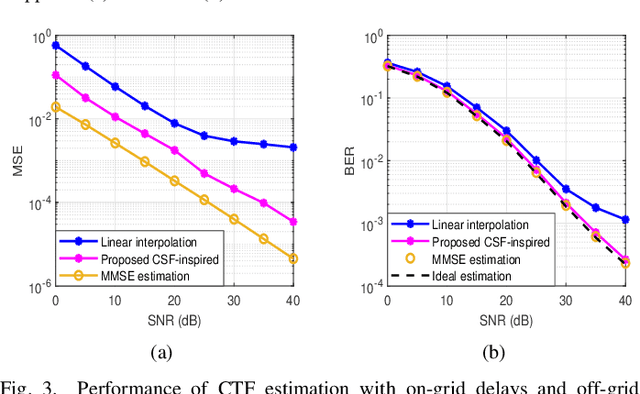
In this letter, we propose a novel channel transfer function (CTF) estimation approach for orthogonal frequency division multiplexing (OFDM) systems in high-mobility scenarios, that leverages the stationary properties of the delay-Doppler domain channel spreading function (CSF). First, we develop a CSF estimation model for OFDM systems that relies solely on discrete pilot symbols in the time-frequency (TF) domain, positioned at predefined resource elements. We then present theorems to elucidate the relationship between CSF compactness and pilot spacing in the TF domain for accurate CSF acquisition. Based on the estimated CSF, we finally estimate the CTF for data symbols. Numerical results show that, in high-mobility scenarios, the proposed approach outperforms traditional interpolation-based methods and closely matches the optimal estimator in terms of estimation accuracy. This work may pave the way for CSF estimation in commercial OFDM systems, benefiting high-mobility communications, integrated sensing and communications, and related applications.
Off-grid Channel Estimation for Orthogonal Delay-Doppler Division Multiplexing Using Grid Refinement and Adjustment
Jul 09, 2024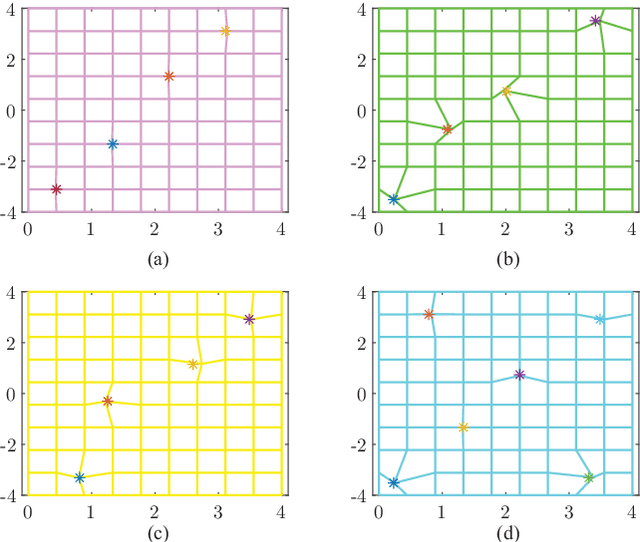
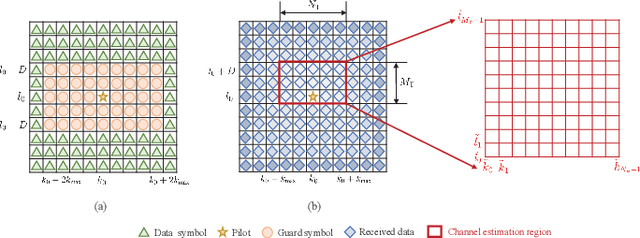
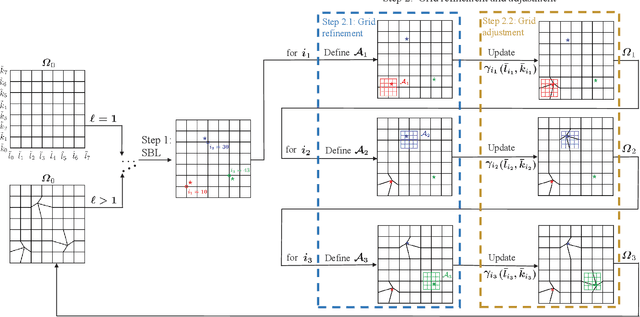
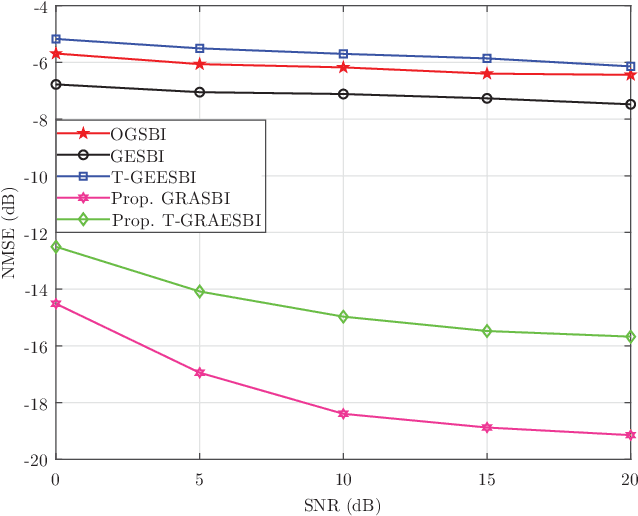
Orthogonal delay-Doppler (DD) division multiplexing (ODDM) has been recently proposed as a promising multicarrier modulation scheme to tackle Doppler spread in high-mobility environments. Accurate channel estimation is of paramount importance to guarantee reliable communication for the ODDM, especially when the delays and Dopplers of the propagation paths are off-grid. In this paper, we propose a novel grid refinement and adjustment-based sparse Bayesian inference (GRASBI) scheme for DD domain channel estimation. The GRASBI involves first formulating the channel estimation problem as a sparse signal recovery through the introduction of a virtual DD grid. Then, an iterative process is proposed that involves (i) sparse Bayesian learning to estimate the channel parameters and (ii) a novel grid refinement and adjustment process to adjust the virtual grid points. The grid adjustment in GRASBI relies on the maximum likelihood principle to attain the adjustment and utilizes refined grids that have much higher resolution than the virtual grid. Moreover, a low-complexity grid refinement and adjustment-based channel estimation scheme is proposed, that can provides a good tradeoff between the estimation accuracy and the complexity. Finally, numerical results are provided to demonstrate the accuracy and efficiency of the proposed channel estimation schemes.
Time-Frequency Localization Characteristics of the Delay-Doppler Plane Orthogonal Pulse
Nov 13, 2023The orthogonal delay-Doppler (DD) division multiplexing (ODDM) modulation has recently been proposed as a promising solution for ensuring reliable communications in high mobility scenarios. In this work, we investigate the time-frequency (TF) localization characteristics of the DD plane orthogonal pulse (DDOP), which is the prototype pulse of ODDM modulation. The TF localization characteristics examine how concentrated or spread out the energy of a pulse is in the joint TF domain. We first derive the TF localization metric, TF area (TFA), for the DDOP. Based on this result, we provide insights into the energy spread of the DDOP in the joint TF domain. Then, we delve into the potential advantages of the DDOP due to its energy spread, particularly in terms of leveraging both time and frequency diversities, and enabling high-resolution sensing. Furthermore, we determine the TFA for the recently proposed generalized design of the DDOP. Finally, we validate our analysis based on numerical results and show that the energy spread for the generalized design of the DDOP in the joint TF domain exhibits a step-wise increase as the duration of sub-pulses increases.
Coexistence of OTFS Modulation With OFDM-based Communication Systems
Nov 12, 2023This study examines the coexistence of orthogonal time-frequency space (OTFS) modulation with current fourth- and fifth-generation (4G/5G) wireless communication systems that primarily use orthogonal frequency-division multiplexing (OFDM) waveforms. We first derive the input-output-relation (IOR) of OTFS when it coexists with an OFDM system while considering the impact of unequal lengths of the cyclic prefixes (CPs) in the OTFS signal. We show analytically that the inclusion of multiple CPs to the OTFS signal results in the effective sampled delay-Doppler (DD) domain channel response to be less sparse. We also show that the effective DD domain channel coefficients for OTFS in coexisting systems are influenced by the unequal lengths of the CPs. Subsequently, we propose an embedded pilot-aided channel estimation (CE) technique for OTFS in coexisting systems that leverages the derived IOR for accurate channel characterization. Using numerical results, we show that ignoring the impact of unequal lengths of the CPs during signal detection can degrade the bit error rate performance of OTFS in coexisting systems. We also show that the proposed CE technique for OTFS in coexisting systems outperforms the state-of-the-art threshold-based CE technique.
Terahertz Communications for Massive Connectivity and Security in 6G and Beyond Era
Oct 25, 2022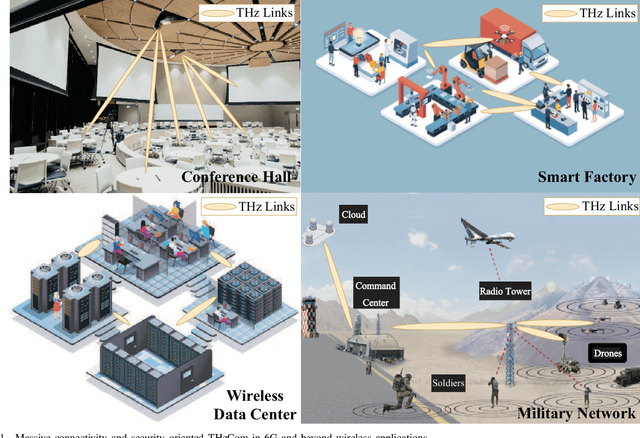
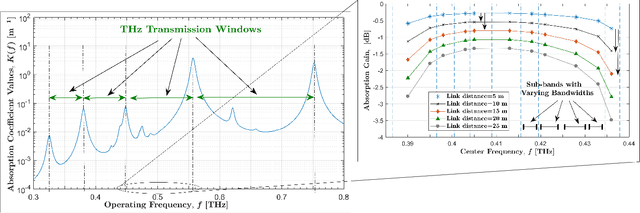
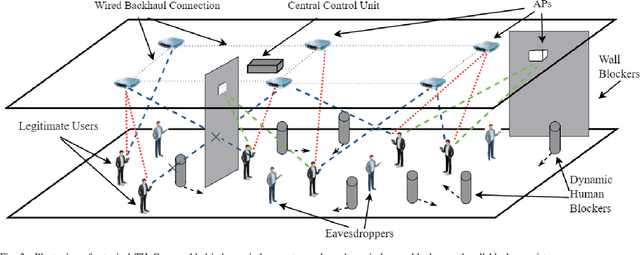
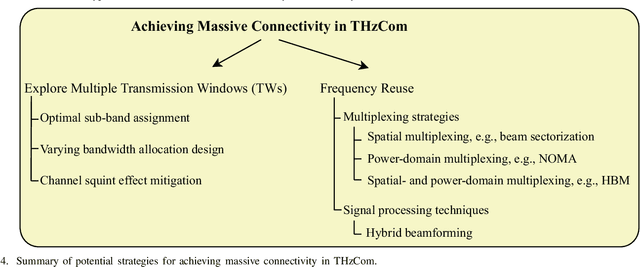
Terahertz (THz) communications (THzCom) has experienced a meteoric rise of interest, due to its benefits for ultra-high data rate transmission in the sixth generation (6G) and beyond era. Despite so, the research on exploring the potential of THzCom for other performance targets anticipated by 6G, including massive connectivity and security, is still in its infancy. In this article, we start with briefly describing the unique peculiarities of THz channels, and then discuss theoretical frameworks to facilitate the analysis and design of THz transmission for achieving massive connectivity and security. Then we discuss promising spectrum management strategies, including the exploration of multiple THz transmission windows and frequency reuse with multiplexing and signal processing, to substantially increase the number of supported users and identify to-be-tackled challenges. We further present important research directions based on the principles of physical layer security, such as new spectrum allocation policies and beamforming algorithms, to fight against eavesdropping in THzCom systems, ushering in secure THzCom systems.