 Add to Chrome
 Add to Firefox
 Add to Edge
PureLight: Learning Complex Luminaires with Light Tracing
Jun 03, 2026
We propose a neural formulation for estimating the appearance of complex luminaires. We focus on challenging luminaires with complex light transport (e.g., small emitters enclosed by multiple specular layers) that are difficult for (bidirectional) path tracing. To this end, we use light tracing to construct paths from emitters to the exit surfaces and formulate appearance estimation as a distribution learning problem. Specifically, we model the probability density function (pdf) of outgoing radiance on the exit surfaces using a large normalizing flow network, and recover the outgoing radiance as the product of the estimated pdf and flux. To enable efficient inference, we distill the learned appearance into a lightweight MLP that directly estimates radiance on the exit surfaces. We additionally train a sampling network for effective direct illumination computation from the luminaire, and a blending network to composite the luminaire into the scene. Our formulation makes it feasible to render challenging luminaires using low sample counts in arbitrary scenes.

Neural Importance Sampling of Many Lights
May 16, 2025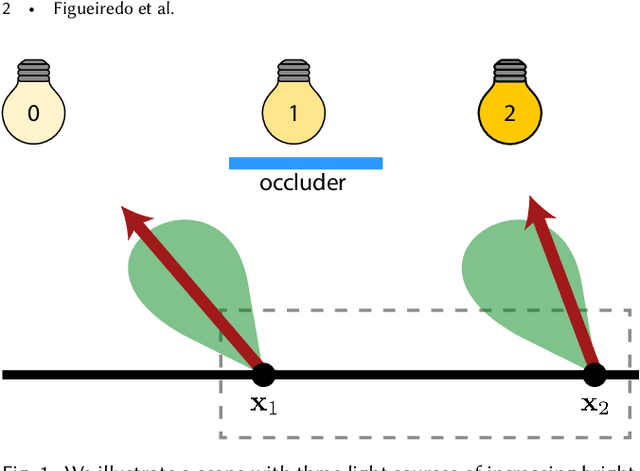
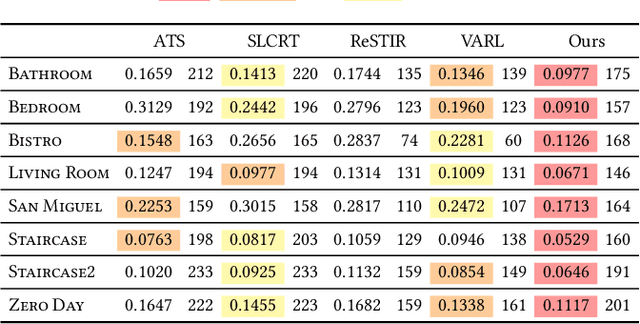

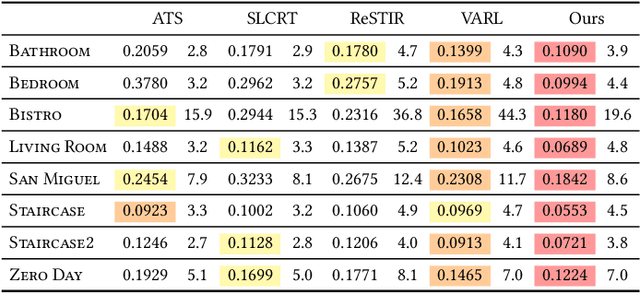
We propose a neural approach for estimating spatially varying light selection distributions to improve importance sampling in Monte Carlo rendering, particularly for complex scenes with many light sources. Our method uses a neural network to predict the light selection distribution at each shading point based on local information, trained by minimizing the KL-divergence between the learned and target distributions in an online manner. To efficiently manage hundreds or thousands of lights, we integrate our neural approach with light hierarchy techniques, where the network predicts cluster-level distributions and existing methods sample lights within clusters. Additionally, we introduce a residual learning strategy that leverages initial distributions from existing techniques, accelerating convergence during training. Our method achieves superior performance across diverse and challenging scenes.