 Add to Chrome
 Add to Firefox
 Add to Edge
GRNEdit: Efficient General Video Editing from a New Binary-Evidence Perspective in Generative Refinement Networks
Aug 17, 2026
Instruction-based general video editing seeks to unify diverse editing operations within a single, intuitive interface. Existing approaches often rely on resource-intensive conditioning, using either heavyweight branches or costly source concatenation. Is there any efficient way to model editing intent? Thus, we introduce GRNEdit, a lightweight two-stage framework. GRN inspires our approach by encoding visual semantics through combinations of bits. Through task-specific fine-tuning, we take this representation further and recast editing semantics as local retain-or-flip decisions over individual bits. Source information is consequently modeled as coordinate-wise evidence supporting the observed binary states, while the GRN backbone remains responsible for resolving their global composition into coherent generative semantics. In Stage I, a compact encoder translates discrete source codes into continuous evidence signals, which GRN assimilates throughout binary refinement. Inspired by null-prompt training for classifier-free guidance, we further assign the null condition an editing-specific meaning: an empty instruction denotes no edit and is supervised through source reconstruction. This identity pathway not only implicitly strengthens evidence utilization and content preservation in Stage I, but also produces a source-preserving state in the same representation space as the edited state. Stage II can therefore directly compare each edited state with its source-preserving counterpart and use their discrepancy to revise unresolved target-bit decisions. Trained on only 0.6M pairs with less than 3\% conditioning parameters, GRNEdit-2B and GRNEdit-8B achieve scores of 4.03 and 4.18 on OpenVE-Bench. The 2B model outperforms multiple 14B open-source editors, while the 8B model performs on par with leading open-source editors.

LycheeMemory V2: Efficient Long-Term Memory for LLM Agents via Semantic Segment-Level Consolidation
Aug 13, 2026Long-horizon LLM agents must preserve information from past interactions to support future tasks. Existing memory systems typically rely on eager consolidation, invoking LLMs after each interaction to extract, summarize, or update memories. This design makes memory construction increasingly costly as conversations grow. Coarse summarization can reduce construction cost but risks discarding fine-grained contextual evidence, whereas larger retrieval contexts or multi-hop LLM reasoning shift the overhead to query time. We present LycheeMemory V2, an efficient long-term memory framework that replaces turn-level consolidation with semantic segment-level consolidation. Instead of consolidating every interaction, LycheeMemory batches multiple exchanges into segments and encodes each finalized segment into context-independent typed memory records. Segment-level batching lowers LLM encoding frequency, while semantic boundary detection helps preserve coherent event-level and temporal evidence compared with fixed-window batching. The resulting records are organized with lightweight structured indexes for query-planned evidence retrieval. Experiments using GPT-4.1-Mini show that LycheeMemory achieves state-of-the-art performance, reaching 89.22% on LoCoMo and 92.20% on LongMemEval-S. Compared with A-Mem, it reduces construction tokens by 86.0% on LoCoMo and 75.9% on LongMemEval-S without increasing query-time token usage. More broadly, our results suggest that the accuracy--cost trade-off of long-term agent memory depends not only on what information is retained, but also on the granularity at which it is consolidated.
From Synthesis to Removal: Physics-Grounded Reflection Simulation and Diffusion-Based Video Dereflection
Aug 12, 2026Videos captured through glass often contain reflections that degrade visual quality and interfere with downstream vision tasks. Although single-image reflection removal has been extensively studied, video reflection removal remains largely underexplored due to the lack of paired video data, temporally coherent removal models, and dedicated evaluation benchmarks. We present a closed-loop framework that unifies physics-grounded reflection simulation, diffusion-based video dereflection, and benchmark evaluation. Our S2R-Synthesis pipeline generates paired reflected and reflection-free videos by performing physics-grounded augmentation in the structure space and rendering realistic reflected videos with a trained video diffusion renderer; the augmentation models key glass-related effects including roughness-induced blur, thickness-induced ghosting, and reflectance variation. Based on the synthesized data, we introduce S2R-Removal, the first diffusion-based video reflection removal model, which adapts a pretrained video diffusion prior through reflection-aware latent adaptation and one-step pixel-geometric refinement, recovering the clean transmission in a single denoising step. We further build S2R-Bench, the first benchmark for video reflection removal, supporting both full-reference evaluation and real-world human perceptual assessment. Experiments on S2R-Bench and multiple public image benchmarks demonstrate state-of-the-art performance and faster inference than even non-diffusion baselines, and validate the effectiveness of S2R-Synthesis. Project page: https://codingwzp.github.io/VideoDereflection_S2R.
MobileWAM: Bridging World Action Models to Mobile Manipulation with Chain-of-Foresight
Aug 06, 2026World action models (WAMs) built on video generation backbones are a rising recipe for robot learning, yet remain confined to tabletop manipulation. Mobile manipulation demands simultaneous locomotion and whole-body manipulation amid scene-scale dynamics, yet is still dominated by dynamics-blind visual encoders with hand-crafted coordination. We bridge this gap with MobileWAM, a mixture-of-transformers architecture that fuses a pretrained video diffusion transformer with a lightweight action expert through layerwise joint attention, translating internet-scale motion priors into whole-body control. To reconcile the heterogeneous dynamics of moving and manipulating, each feed-forward layer of the action expert becomes a three-expert mixture of shared, locomotion, and manipulation experts, softly routed by the motion intent in the action tokens. To densify supervision, we further propose Chain-of-Foresight (CoF): intermediate representations sequentially predict a chain of future latent chunks, each step conditioned on its predecessor. CoF pairs naturally with our decoupled video--action denoising scheme. At deployment, the WAM serves as a pure current-frame encoder; foresight acts only through gradients, so at inference the foresight chain and video generation are discarded, leaving only policy-level cost. MobileWAM surpasses state-of-the-art mobile manipulation policies on ManiSkill-HAB and fine-tunes to a real ARX Lift2 mobile manipulator across diverse tasks with strong generalization. Code will be released soon.
PROVE: A Perceptual RemOVal cohErence Benchmark for Visual Media
May 14, 2026Evaluating object removal in images and videos remains challenging because the task is inherently one-to-many, yet existing metrics frequently disagree with human perception. Full-reference metrics reward copy-paste behaviors over genuine erasure; no-reference metrics suffer from systematic biases such as favoring blurry results; and global temporal metrics are insensitive to localized artifacts within edited regions. To address these limitations, we propose RC (Removal Coherence), a pair of perception-aligned metrics: RC-S, which measures spatial coherence via sliding-window feature comparison between masked and background regions, and RC-T, which measures temporal consistency via distribution tracking within shared restored regions across adjacent frames. To validate RC and support community benchmarking, we further introduce PROVE-Bench, a two-tier real-world benchmark comprising PROVE-M, an 80-video paired dataset with motion augmentation, and PROVE-H, a 100-video challenging subset without ground truth. Together, RC metrics and PROVE-Bench form the PROVE (Perceptual RemOVal cohErence) evaluation framework for visual media. Experiments across diverse image and video benchmarks demonstrate that RC achieves substantially stronger alignment with human judgments than existing evaluation protocols. The code for RC metrics and PROVE-Bench are publicly available at: https://github.com/xiaomi-research/prove/.
CapVector: Learning Transferable Capability Vectors in Parametric Space for Vision-Language-Action Models
May 11, 2026This paper proposes a novel approach to address the challenge that pretrained VLA models often fail to effectively improve performance and reduce adaptation costs during standard supervised finetuning (SFT). Some advanced finetuning methods with auxiliary training objectives can improve performance and reduce the number of convergence steps. However, they typically incur significant computational overhead due to the additional losses from auxiliary objectives. To simultaneously achieve the enhanced capabilities of auxiliary training with the simplicity of standard SFT, we decouple the two objectives of auxiliary-objective SFT within the parameter space, namely, enhancing general capabilities and fitting task-specific action distributions. To deliver the goal, we only need to train the model to converge on a small-scale task set using two distinct training strategies, resulting in two finetuned models. The parameters' difference between the two models can then be interpreted as capability vectors provided by auxiliary objectives. These vectors are then merged with pretrained parameters to form a capability-enhanced meta model. Moreover, when standard SFT is augmented with a lightweight orthogonal regularization loss, the merged model attains performance comparable to auxiliary finetuned baselines with reduced computational overhead. Internal and external experiments demonstrate that our capability vectors (1) are effective and versatile across diverse models, (2) can generalize to novel environments and embodiments out of the box.
AutoAWG: Adverse Weather Generation with Adaptive Multi-Controls for Automotive Videos
Apr 21, 2026Perception robustness under adverse weather remains a critical challenge for autonomous driving, with the core bottleneck being the scarcity of real-world video data in adverse weather. Existing weather generation approaches struggle to balance visual quality and annotation reusability. We present AutoAWG, a controllable Adverse Weather video Generation framework for Autonomous driving. Our method employs a semantics-guided adaptive fusion of multiple controls to balance strong weather stylization with high-fidelity preservation of safety-critical targets; leverages a vanishing point-anchored temporal synthesis strategy to construct training sequences from static images, thereby reducing reliance on synthetic data; and adopts masked training to enhance long-horizon generation stability. On the nuScenes validation set, AutoAWG significantly outperforms prior state-of-the-art methods: without first-frame conditioning, FID and FVD are relatively reduced by 50.0% and 16.1%; with first-frame conditioning, they are further reduced by 8.7% and 7.2%, respectively. Extensive qualitative and quantitative results demonstrate advantages in style fidelity, temporal consistency, and semantic--structural integrity, underscoring the practical value of AutoAWG for improving downstream perception in autonomous driving. Our code is available at: https://github.com/higherhu/AutoAWG
From Ideal to Real: Stable Video Object Removal under Imperfect Conditions
Mar 10, 2026Removing objects from videos remains difficult in the presence of real-world imperfections such as shadows, abrupt motion, and defective masks. Existing diffusion-based video inpainting models often struggle to maintain temporal stability and visual consistency under these challenges. We propose Stable Video Object Removal (SVOR), a robust framework that achieves shadow-free, flicker-free, and mask-defect-tolerant removal through three key designs: (1) Mask Union for Stable Erasure (MUSE), a windowed union strategy applied during temporal mask downsampling to preserve all target regions observed within each window, effectively handling abrupt motion and reducing missed removals; (2) Denoising-Aware Segmentation (DA-Seg), a lightweight segmentation head on a decoupled side branch equipped with Denoising-Aware AdaLN and trained with mask degradation to provide an internal diffusion-aware localization prior without affecting content generation; and (3) Curriculum Two-Stage Training: where Stage I performs self-supervised pretraining on unpaired real-background videos with online random masks to learn realistic background and temporal priors, and Stage II refines on synthetic pairs using mask degradation and side-effect-weighted losses, jointly removing objects and their associated shadows/reflections while improving cross-domain robustness. Extensive experiments show that SVOR attains new state-of-the-art results across multiple datasets and degraded-mask benchmarks, advancing video object removal from ideal settings toward real-world applications.
NuGrounding: A Multi-View 3D Visual Grounding Framework in Autonomous Driving
Mar 28, 2025Multi-view 3D visual grounding is critical for autonomous driving vehicles to interpret natural languages and localize target objects in complex environments. However, existing datasets and methods suffer from coarse-grained language instructions, and inadequate integration of 3D geometric reasoning with linguistic comprehension. To this end, we introduce NuGrounding, the first large-scale benchmark for multi-view 3D visual grounding in autonomous driving. We present a Hierarchy of Grounding (HoG) method to construct NuGrounding to generate hierarchical multi-level instructions, ensuring comprehensive coverage of human instruction patterns. To tackle this challenging dataset, we propose a novel paradigm that seamlessly combines instruction comprehension abilities of multi-modal LLMs (MLLMs) with precise localization abilities of specialist detection models. Our approach introduces two decoupled task tokens and a context query to aggregate 3D geometric information and semantic instructions, followed by a fusion decoder to refine spatial-semantic feature fusion for precise localization. Extensive experiments demonstrate that our method significantly outperforms the baselines adapted from representative 3D scene understanding methods by a significant margin and achieves 0.59 in precision and 0.64 in recall, with improvements of 50.8% and 54.7%.
THUD++: Large-Scale Dynamic Indoor Scene Dataset and Benchmark for Mobile Robots
Dec 11, 2024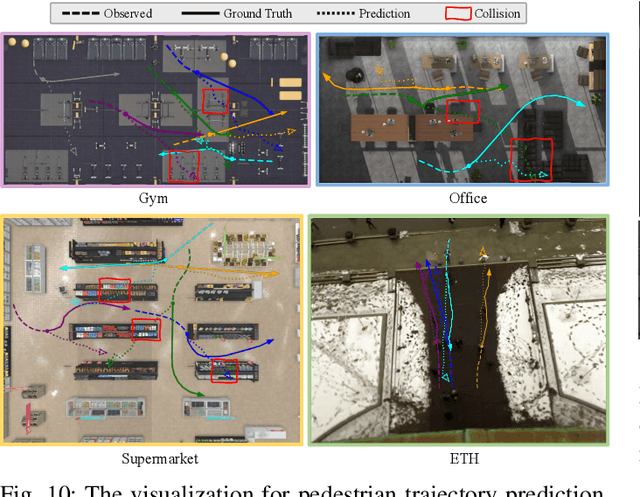
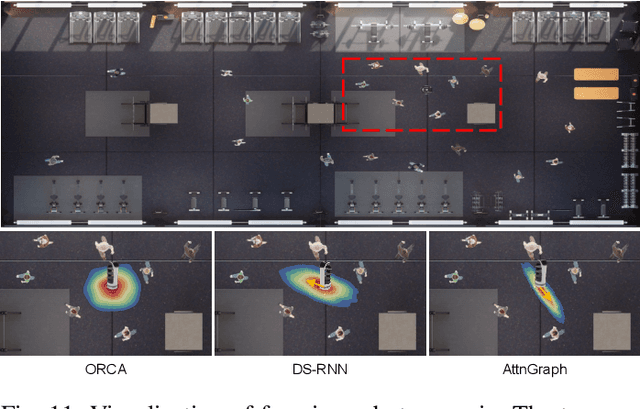

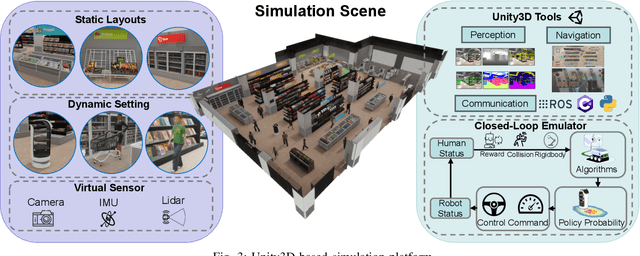
Most existing mobile robotic datasets primarily capture static scenes, limiting their utility for evaluating robotic performance in dynamic environments. To address this, we present a mobile robot oriented large-scale indoor dataset, denoted as THUD++ (TsingHua University Dynamic) robotic dataset, for dynamic scene understanding. Our current dataset includes 13 large-scale dynamic scenarios, combining both real-world and synthetic data collected with a real robot platform and a physical simulation platform, respectively. The RGB-D dataset comprises over 90K image frames, 20M 2D/3D bounding boxes of static and dynamic objects, camera poses, and IMU. The trajectory dataset covers over 6,000 pedestrian trajectories in indoor scenes. Additionally, the dataset is augmented with a Unity3D-based simulation platform, allowing researchers to create custom scenes and test algorithms in a controlled environment. We evaluate state-of-the-art methods on THUD++ across mainstream indoor scene understanding tasks, e.g., 3D object detection, semantic segmentation, relocalization, pedestrian trajectory prediction, and navigation. Our experiments highlight the challenges mobile robots encounter in indoor environments, especially when navigating in complex, crowded, and dynamic scenes. By sharing this dataset, we aim to accelerate the development and testing of mobile robot algorithms, contributing to real-world robotic applications.