 Add to Chrome
 Add to Firefox
 Add to Edge
ATG-MoE: Autoregressive trajectory generation with mixture-of-experts for assembly skill learning
Mar 19, 2026
Flexible manufacturing requires robot systems that can adapt to constantly changing tasks, objects, and environments. However, traditional robot programming is labor-intensive and inflexible, while existing learning-based assembly methods often suffer from weak positional generalization, complex multi-stage designs, and limited multi-skill integration capability. To address these issues, this paper proposes ATG-MoE, an end-to-end autoregressive trajectory generation method with mixture of experts for assembly skill learning from demonstration. The proposed method establishes a closed-loop mapping from multi-modal inputs, including RGB-D observations, natural language instructions, and robot proprioception to manipulation trajectories. It integrates multi-modal feature fusion for scene and task understanding, autoregressive sequence modeling for temporally coherent trajectory generation, and a mixture-of-experts architecture for unified multi-skill learning. In contrast to conventional methods that separate visual perception and control or train different skills independently, ATG-MoE directly incorporates visual information into trajectory generation and supports efficient multi-skill integration within a single model. We train and evaluate the proposed method on eight representative assembly skills from a pressure-reducing valve assembly task. Experimental results show that ATG-MoE achieves strong overall performance in simulation, with an average grasp success rate of 96.3% and an average overall success rate of 91.8%, while also demonstrating strong generalization and effective multi-skill integration. Real-world experiments further verify its practicality for multi-skill industrial assembly. The project page can be found at https://hwh23.github.io/ATG-MoE

Embodied Intelligent Industrial Robotics: Concepts and Techniques
May 15, 2025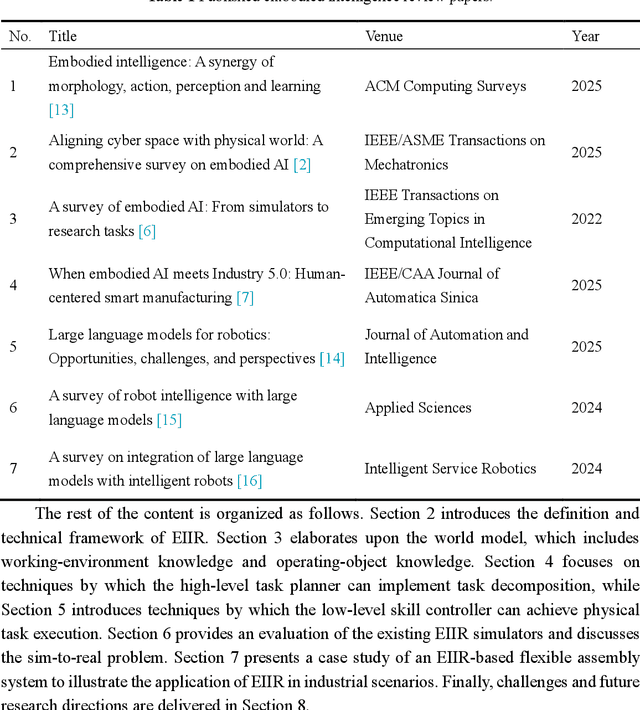
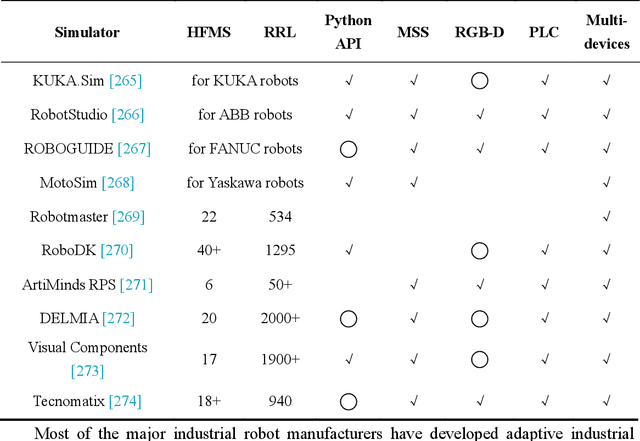
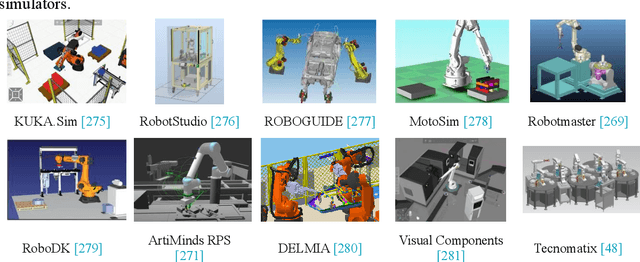
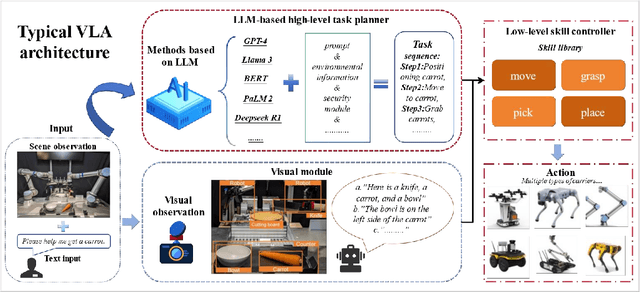
In recent years, embodied intelligent robotics (EIR) has made significant progress in multi-modal perception, autonomous decision-making, and physical interaction. Some robots have already been tested in general-purpose scenarios such as homes and shopping malls. We aim to advance the research and application of embodied intelligence in industrial scenes. However, current EIR lacks a deep understanding of industrial environment semantics and the normative constraints between industrial operating objects. To address this gap, this paper first reviews the history of industrial robotics and the mainstream EIR frameworks. We then introduce the concept of the embodied intelligent industrial robotics (EIIR) and propose a knowledge-driven EIIR technology framework for industrial environments. The framework includes four main modules: world model, high-level task planner, low-level skill controller, and simulator. We also review the current development of technologies related to each module and highlight recent progress in adapting them to industrial applications. Finally, we summarize the key challenges EIIR faces in industrial scenarios and suggest future research directions. We believe that EIIR technology will shape the next generation of industrial robotics. Industrial systems based on embodied intelligent industrial robots offer strong potential for enabling intelligent manufacturing. We will continue to track and summarize new research in this area and hope this review will serve as a valuable reference for scholars and engineers interested in industrial embodied intelligence. Together, we can help drive the rapid advancement and application of this technology. The associated project can be found at https://github.com/jackyzengl/EIIR.