 Add to Chrome
 Add to Firefox
 Add to Edge
Representational Similarity and Model Behavior in Multi-Agent Interaction
Jun 05, 2026
Researchers have shown that neural similarity among humans predicts social closeness and cooperative success, whereas innovation often emerges from interactions among dissimilar individuals. We investigate whether these principles extend to artificial intelligence by examining interactions between large language models. In our experiments, 276 model pairs interact across eight games spanning both cooperation and novelty. We find that pairs with more similar representation spaces achieve significantly higher cooperation but exhibit reduced novelty and creativity. The effects of representational similarity on cooperation and novelty remain robust even after controlling for other factors such as performance disparity and model size. We also find that similarity in the early layers consistently shows the strongest association with cooperation and novelty, compared to the middle and later layers. This suggests that a central factor underlying these patterns could be the extent to which the two models share lexical and semantic grounding. Overall, representational similarity can be an important consideration in multi-agent system design.

Long Chain-of-Thought Reasoning Across Languages
Aug 20, 2025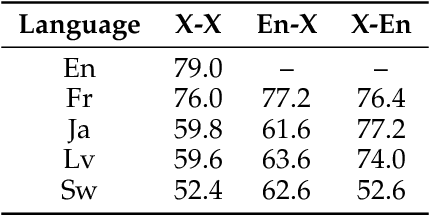
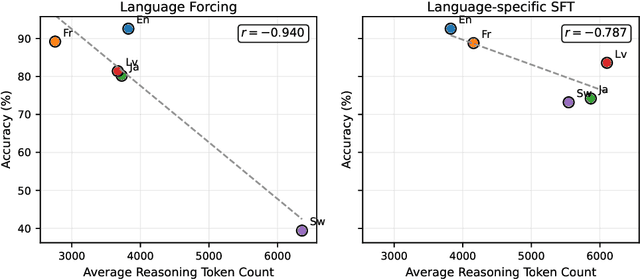
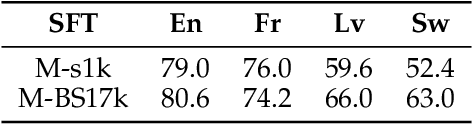
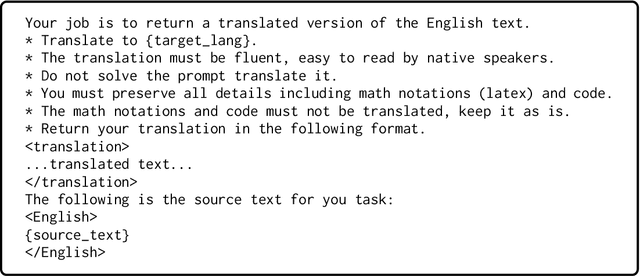
Scaling inference through long chains-of-thought (CoTs) has unlocked impressive reasoning capabilities in large language models (LLMs), yet the reasoning process remains almost exclusively English-centric. We construct translated versions of two popular English reasoning datasets, fine-tune Qwen 2.5 (7B) and Qwen 3 (8B) models, and present a systematic study of long CoT generation across French, Japanese, Latvian, and Swahili. Our experiments reveal three key findings. First, the efficacy of using English as a pivot language varies by language: it provides no benefit for French, improves performance when used as the reasoning language for Japanese and Latvian, and proves insufficient for Swahili where both task comprehension and reasoning remain poor. Second, extensive multilingual pretraining in Qwen 3 narrows but does not eliminate the cross-lingual performance gap. A lightweight fine-tune using only 1k traces still improves performance by over 30\% in Swahili. Third, data quality versus scale trade-offs are language dependent: small, carefully curated datasets suffice for English and French, whereas larger but noisier corpora prove more effective for Swahili and Latvian. Together, these results clarify when and why long CoTs transfer across languages and provide translated datasets to foster equitable multilingual reasoning research.
TULIP: Towards Unified Language-Image Pretraining
Mar 19, 2025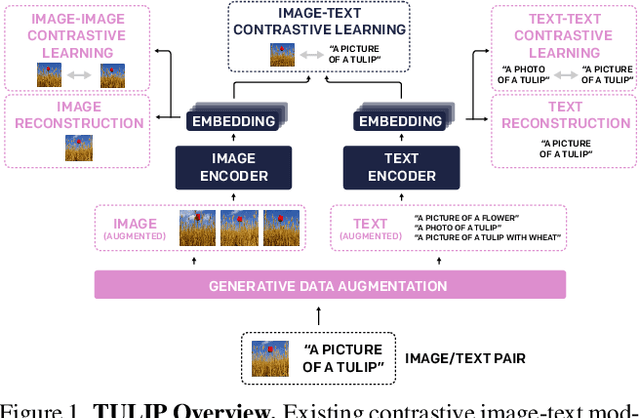
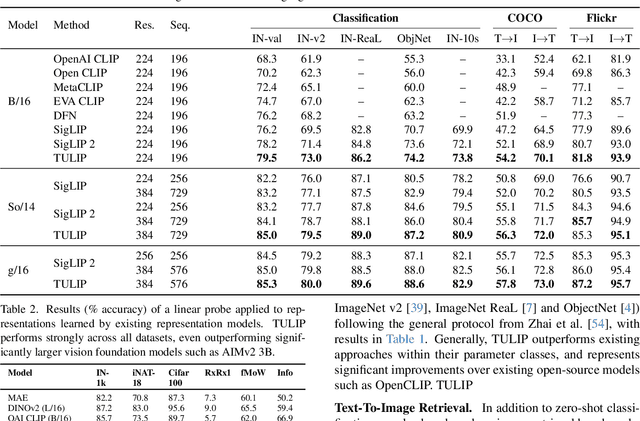
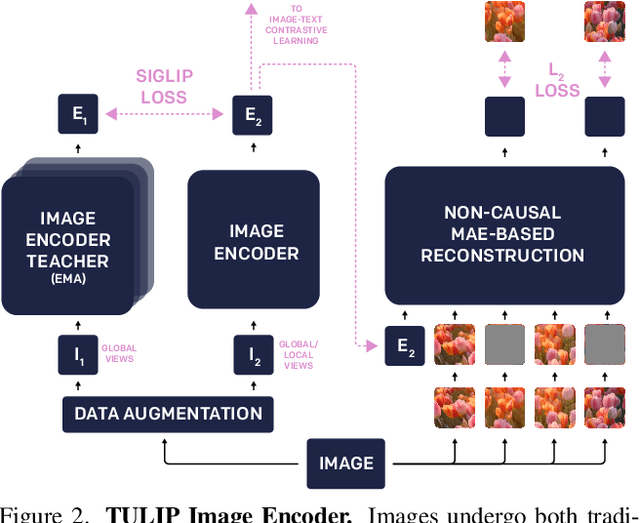
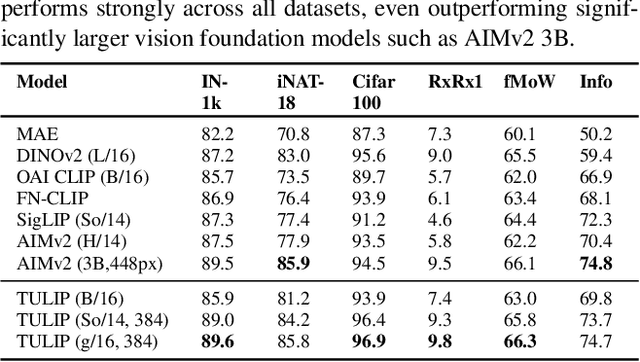
Despite the recent success of image-text contrastive models like CLIP and SigLIP, these models often struggle with vision-centric tasks that demand high-fidelity image understanding, such as counting, depth estimation, and fine-grained object recognition. These models, by performing language alignment, tend to prioritize high-level semantics over visual understanding, weakening their image understanding. On the other hand, vision-focused models are great at processing visual information but struggle to understand language, limiting their flexibility for language-driven tasks. In this work, we introduce TULIP, an open-source, drop-in replacement for existing CLIP-like models. Our method leverages generative data augmentation, enhanced image-image and text-text contrastive learning, and image/text reconstruction regularization to learn fine-grained visual features while preserving global semantic alignment. Our approach, scaling to over 1B parameters, outperforms existing state-of-the-art (SOTA) models across multiple benchmarks, establishing a new SOTA zero-shot performance on ImageNet-1K, delivering up to a $2\times$ enhancement over SigLIP on RxRx1 in linear probing for few-shot classification, and improving vision-language models, achieving over $3\times$ higher scores than SigLIP on MMVP. Our code/checkpoints are available at https://tulip-berkeley.github.io