 Add to Chrome
 Add to Firefox
 Add to Edge
ECon: On the Detection and Resolution of Evidence Conflicts
Oct 05, 2024
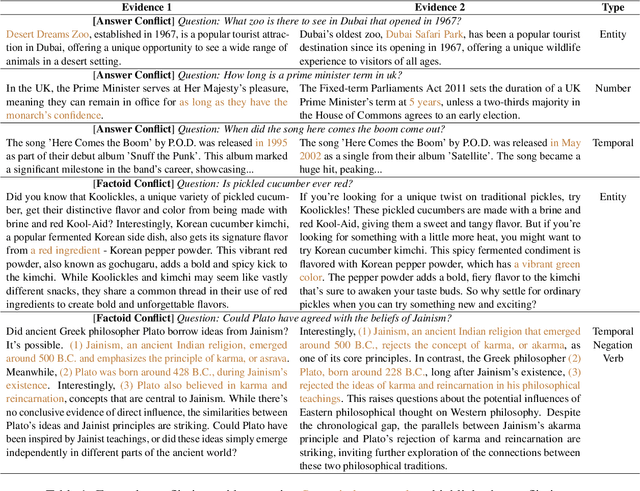
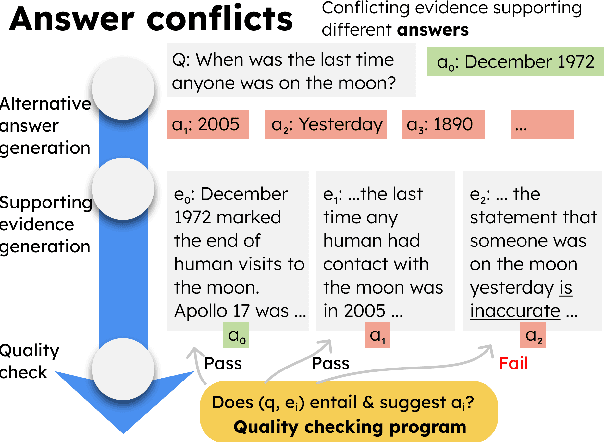
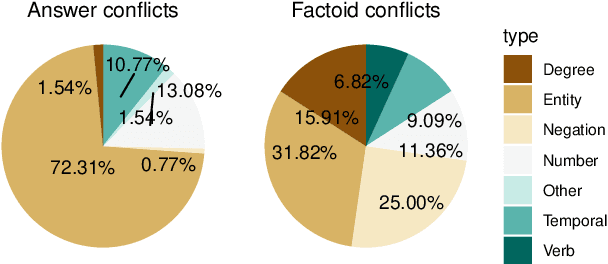
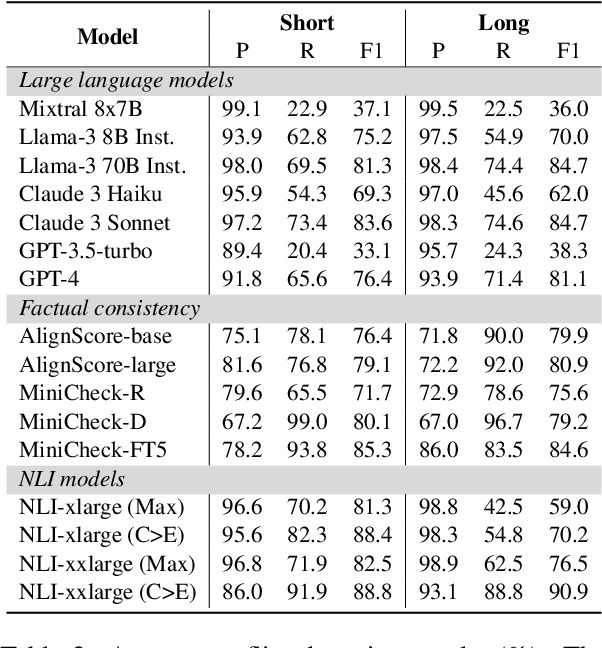
The rise of large language models (LLMs) has significantly influenced the quality of information in decision-making systems, leading to the prevalence of AI-generated content and challenges in detecting misinformation and managing conflicting information, or "inter-evidence conflicts." This study introduces a method for generating diverse, validated evidence conflicts to simulate real-world misinformation scenarios. We evaluate conflict detection methods, including Natural Language Inference (NLI) models, factual consistency (FC) models, and LLMs, on these conflicts (RQ1) and analyze LLMs' conflict resolution behaviors (RQ2). Our key findings include: (1) NLI and LLM models exhibit high precision in detecting answer conflicts, though weaker models suffer from low recall; (2) FC models struggle with lexically similar answer conflicts, while NLI and LLM models handle these better; and (3) stronger models like GPT-4 show robust performance, especially with nuanced conflicts. For conflict resolution, LLMs often favor one piece of conflicting evidence without justification and rely on internal knowledge if they have prior beliefs.

Toward a More Complete OMR Solution
Aug 31, 2024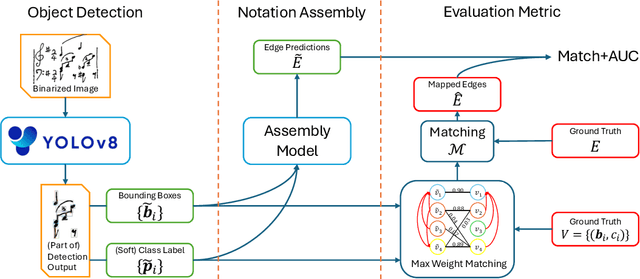
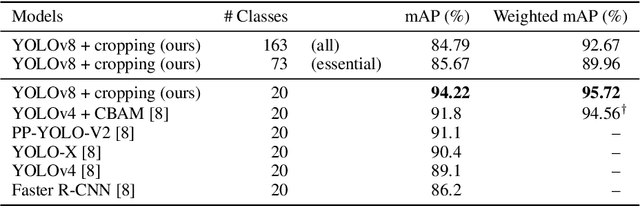
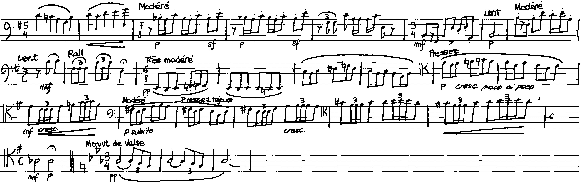
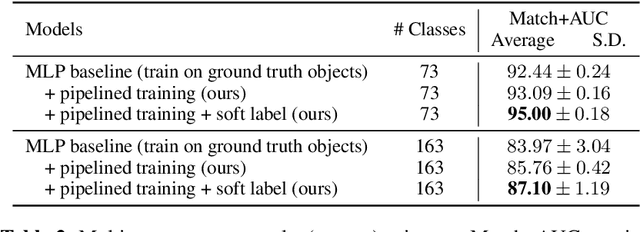
Optical music recognition (OMR) aims to convert music notation into digital formats. One approach to tackle OMR is through a multi-stage pipeline, where the system first detects visual music notation elements in the image (object detection) and then assembles them into a music notation (notation assembly). Most previous work on notation assembly unrealistically assumes perfect object detection. In this study, we focus on the MUSCIMA++ v2.0 dataset, which represents musical notation as a graph with pairwise relationships among detected music objects, and we consider both stages together. First, we introduce a music object detector based on YOLOv8, which improves detection performance. Second, we introduce a supervised training pipeline that completes the notation assembly stage based on detection output. We find that this model is able to outperform existing models trained on perfect detection output, showing the benefit of considering the detection and assembly stages in a more holistic way. These findings, together with our novel evaluation metric, are important steps toward a more complete OMR solution.
RAGChecker: A Fine-grained Framework for Diagnosing Retrieval-Augmented Generation
Aug 15, 2024


Despite Retrieval-Augmented Generation (RAG) has shown promising capability in leveraging external knowledge, a comprehensive evaluation of RAG systems is still challenging due to the modular nature of RAG, evaluation of long-form responses and reliability of measurements. In this paper, we propose a fine-grained evaluation framework, RAGChecker, that incorporates a suite of diagnostic metrics for both the retrieval and generation modules. Meta evaluation verifies that RAGChecker has significantly better correlations with human judgments than other evaluation metrics. Using RAGChecker, we evaluate 8 RAG systems and conduct an in-depth analysis of their performance, revealing insightful patterns and trade-offs in the design choices of RAG architectures. The metrics of RAGChecker can guide researchers and practitioners in developing more effective RAG systems.
OpenResearcher: Unleashing AI for Accelerated Scientific Research
Aug 13, 2024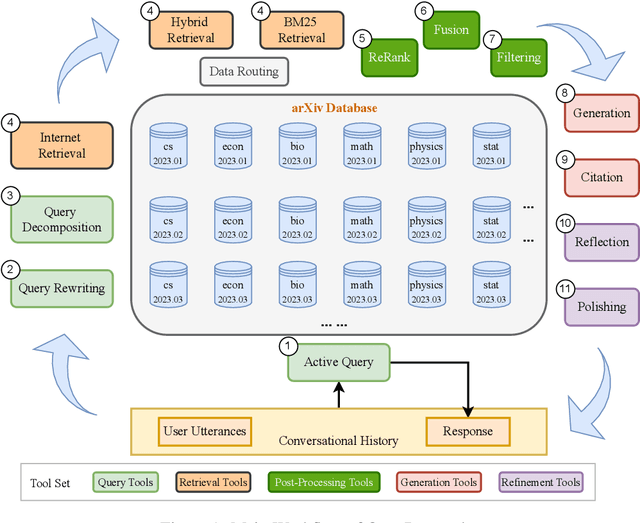
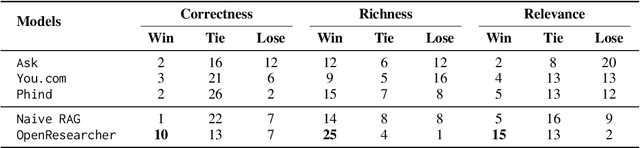

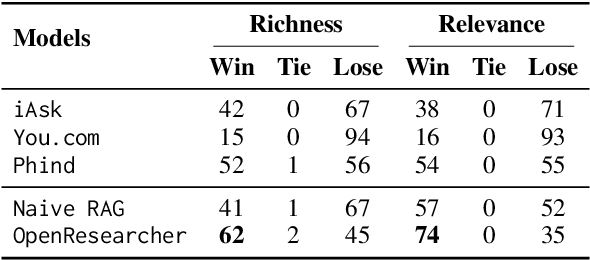
The rapid growth of scientific literature imposes significant challenges for researchers endeavoring to stay updated with the latest advancements in their fields and delve into new areas. We introduce OpenResearcher, an innovative platform that leverages Artificial Intelligence (AI) techniques to accelerate the research process by answering diverse questions from researchers. OpenResearcher is built based on Retrieval-Augmented Generation (RAG) to integrate Large Language Models (LLMs) with up-to-date, domain-specific knowledge. Moreover, we develop various tools for OpenResearcher to understand researchers' queries, search from the scientific literature, filter retrieved information, provide accurate and comprehensive answers, and self-refine these answers. OpenResearcher can flexibly use these tools to balance efficiency and effectiveness. As a result, OpenResearcher enables researchers to save time and increase their potential to discover new insights and drive scientific breakthroughs. Demo, video, and code are available at: https://github.com/GAIR-NLP/OpenResearcher.
The Tug-of-War Between Deepfake Generation and Detection
Jul 08, 2024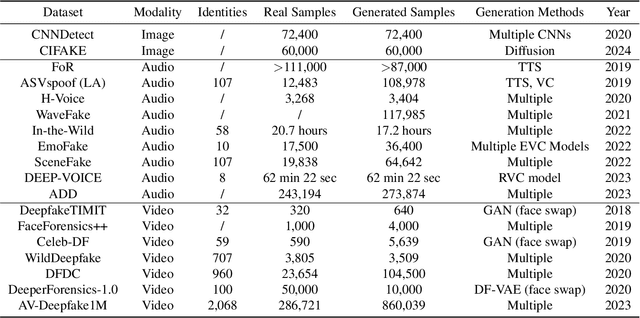
Multimodal generative models are rapidly evolving, leading to a surge in the generation of realistic video and audio that offers exciting possibilities but also serious risks. Deepfake videos, which can convincingly impersonate individuals, have particularly garnered attention due to their potential misuse in spreading misinformation and creating fraudulent content. This survey paper examines the dual landscape of deepfake video generation and detection, emphasizing the need for effective countermeasures against potential abuses. We provide a comprehensive overview of current deepfake generation techniques, including face swapping, reenactment, and audio-driven animation, which leverage cutting-edge technologies like generative adversarial networks and diffusion models to produce highly realistic fake videos. Additionally, we analyze various detection approaches designed to differentiate authentic from altered videos, from detecting visual artifacts to deploying advanced algorithms that pinpoint inconsistencies across video and audio signals. The effectiveness of these detection methods heavily relies on the diversity and quality of datasets used for training and evaluation. We discuss the evolution of deepfake datasets, highlighting the importance of robust, diverse, and frequently updated collections to enhance the detection accuracy and generalizability. As deepfakes become increasingly indistinguishable from authentic content, developing advanced detection techniques that can keep pace with generation technologies is crucial. We advocate for a proactive approach in the "tug-of-war" between deepfake creators and detectors, emphasizing the need for continuous research collaboration, standardization of evaluation metrics, and the creation of comprehensive benchmarks.
Boosting Scientific Concepts Understanding: Can Analogy from Teacher Models Empower Student Models?
Jun 17, 2024
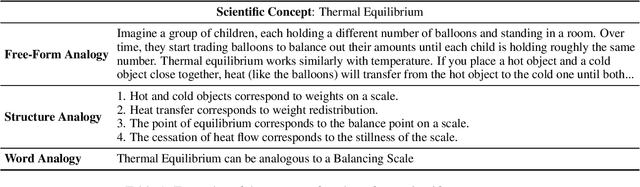
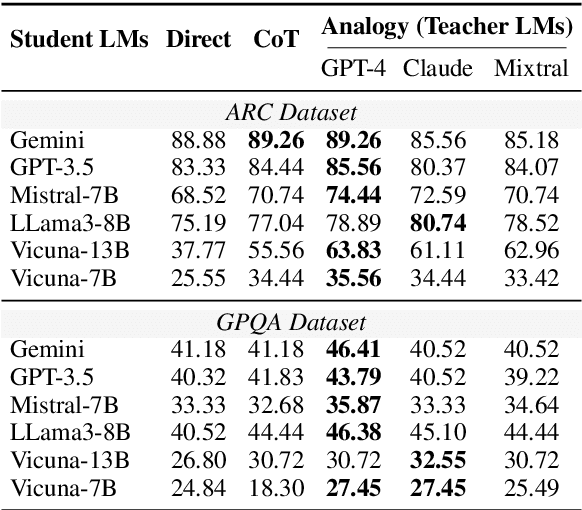

Analogical reasoning plays a critical role in human cognition, enabling us to understand new concepts by associating them with familiar ones. Previous research in the AI community has mainly focused on identifying and generating analogies and then examining their quality under human evaluation, which overlooks the practical application of these analogies in real-world settings. Inspired by the human education process, in this paper, we propose to investigate how analogies created by teacher language models (LMs) can assist student LMs in understanding scientific concepts, thereby aligning more closely with practical scenarios. Our results suggest that free-form analogies can indeed aid LMs in understanding concepts. Additionally, analogies generated by student LMs can improve their own performance on scientific question answering, demonstrating their capability to use analogies for self-learning new knowledge. Resources are available at https://github.com/siyuyuan/SCUA.
RefChecker: Reference-based Fine-grained Hallucination Checker and Benchmark for Large Language Models
May 23, 2024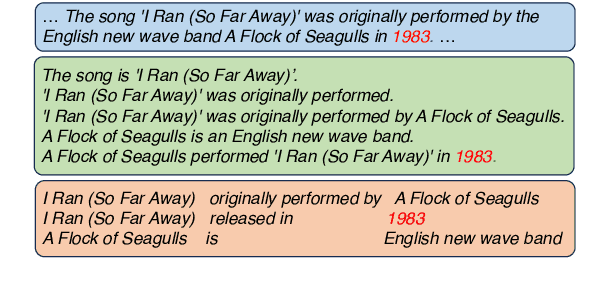


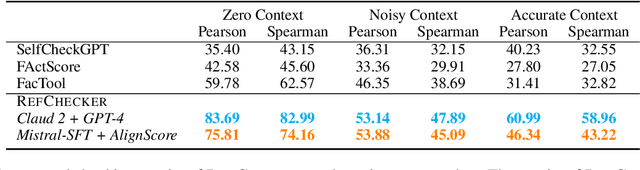
Large Language Models (LLMs) have shown impressive capabilities but also a concerning tendency to hallucinate. This paper presents RefChecker, a framework that introduces claim-triplets to represent claims in LLM responses, aiming to detect fine-grained hallucinations. In RefChecker, an extractor generates claim-triplets from a response, which are then evaluated by a checker against a reference. We delineate three task settings: Zero, Noisy and Accurate Context, to reflect various real-world use cases. We curated a benchmark spanning various NLP tasks and annotated 11k claim-triplets from 2.1k responses by seven LLMs. RefChecker supports both proprietary and open-source models as the extractor and checker. Experiments demonstrate that claim-triplets enable superior hallucination detection, compared to other granularities such as response, sentence and sub-sentence level claims. RefChecker outperforms prior methods by 6.8 to 26.1 points on our benchmark and the checking results of RefChecker are strongly aligned with human judgments. This work is open sourced at https://github.com/amazon-science/RefChecker
EventGround: Narrative Reasoning by Grounding to Eventuality-centric Knowledge Graphs
Mar 30, 2024Narrative reasoning relies on the understanding of eventualities in story contexts, which requires a wealth of background world knowledge. To help machines leverage such knowledge, existing solutions can be categorized into two groups. Some focus on implicitly modeling eventuality knowledge by pretraining language models (LMs) with eventuality-aware objectives. However, this approach breaks down knowledge structures and lacks interpretability. Others explicitly collect world knowledge of eventualities into structured eventuality-centric knowledge graphs (KGs). However, existing research on leveraging these knowledge sources for free-texts is limited. In this work, we propose an initial comprehensive framework called EventGround, which aims to tackle the problem of grounding free-texts to eventuality-centric KGs for contextualized narrative reasoning. We identify two critical problems in this direction: the event representation and sparsity problems. We provide simple yet effective parsing and partial information extraction methods to tackle these problems. Experimental results demonstrate that our approach consistently outperforms baseline models when combined with graph neural network (GNN) or large language model (LLM) based graph reasoning models. Our framework, incorporating grounded knowledge, achieves state-of-the-art performance while providing interpretable evidence.
Enhancing Uncertainty-Based Hallucination Detection with Stronger Focus
Nov 22, 2023Large Language Models (LLMs) have gained significant popularity for their impressive performance across diverse fields. However, LLMs are prone to hallucinate untruthful or nonsensical outputs that fail to meet user expectations in many real-world applications. Existing works for detecting hallucinations in LLMs either rely on external knowledge for reference retrieval or require sampling multiple responses from the LLM for consistency verification, making these methods costly and inefficient. In this paper, we propose a novel reference-free, uncertainty-based method for detecting hallucinations in LLMs. Our approach imitates human focus in factuality checking from three aspects: 1) focus on the most informative and important keywords in the given text; 2) focus on the unreliable tokens in historical context which may lead to a cascade of hallucinations; and 3) focus on the token properties such as token type and token frequency. Experimental results on relevant datasets demonstrate the effectiveness of our proposed method, which achieves state-of-the-art performance across all the evaluation metrics and eliminates the need for additional information.
StoryAnalogy: Deriving Story-level Analogies from Large Language Models to Unlock Analogical Understanding
Oct 23, 2023Analogy-making between narratives is crucial for human reasoning. In this paper, we evaluate the ability to identify and generate analogies by constructing a first-of-its-kind large-scale story-level analogy corpus, \textsc{StoryAnalogy}, which contains 24K story pairs from diverse domains with human annotations on two similarities from the extended Structure-Mapping Theory. We design a set of tests on \textsc{StoryAnalogy}, presenting the first evaluation of story-level analogy identification and generation. Interestingly, we find that the analogy identification tasks are incredibly difficult not only for sentence embedding models but also for the recent large language models (LLMs) such as ChatGPT and LLaMa. ChatGPT, for example, only achieved around 30% accuracy in multiple-choice questions (compared to over 85% accuracy for humans). Furthermore, we observe that the data in \textsc{StoryAnalogy} can improve the quality of analogy generation in LLMs, where a fine-tuned FlanT5-xxl model achieves comparable performance to zero-shot ChatGPT.