 Add to Chrome
 Add to Firefox
 Add to Edge
PLawBench: A Rubric-Based Benchmark for Evaluating LLMs in Real-World Legal Practice
Jan 23, 2026
As large language models (LLMs) are increasingly applied to legal domain-specific tasks, evaluating their ability to perform legal work in real-world settings has become essential. However, existing legal benchmarks rely on simplified and highly standardized tasks, failing to capture the ambiguity, complexity, and reasoning demands of real legal practice. Moreover, prior evaluations often adopt coarse, single-dimensional metrics and do not explicitly assess fine-grained legal reasoning. To address these limitations, we introduce PLawBench, a Practical Law Benchmark designed to evaluate LLMs in realistic legal practice scenarios. Grounded in real-world legal workflows, PLawBench models the core processes of legal practitioners through three task categories: public legal consultation, practical case analysis, and legal document generation. These tasks assess a model's ability to identify legal issues and key facts, perform structured legal reasoning, and generate legally coherent documents. PLawBench comprises 850 questions across 13 practical legal scenarios, with each question accompanied by expert-designed evaluation rubrics, resulting in approximately 12,500 rubric items for fine-grained assessment. Using an LLM-based evaluator aligned with human expert judgments, we evaluate 10 state-of-the-art LLMs. Experimental results show that none achieves strong performance on PLawBench, revealing substantial limitations in the fine-grained legal reasoning capabilities of current LLMs and highlighting important directions for future evaluation and development of legal LLMs. Data is available at: https://github.com/skylenage/PLawbench.

PhysicsMind: Sim and Real Mechanics Benchmarking for Physical Reasoning and Prediction in Foundational VLMs and World Models
Jan 22, 2026Modern foundational Multimodal Large Language Models (MLLMs) and video world models have advanced significantly in mathematical, common-sense, and visual reasoning, but their grasp of the underlying physics remains underexplored. Existing benchmarks attempting to measure this matter rely on synthetic, Visual Question Answer templates or focus on perceptual video quality that is tangential to measuring how well the video abides by physical laws. To address this fragmentation, we introduce PhysicsMind, a unified benchmark with both real and simulation environments that evaluates law-consistent reasoning and generation over three canonical principles: Center of Mass, Lever Equilibrium, and Newton's First Law. PhysicsMind comprises two main tasks: i) VQA tasks, testing whether models can reason and determine physical quantities and values from images or short videos, and ii) Video Generation(VG) tasks, evaluating if predicted motion trajectories obey the same center-of-mass, torque, and inertial constraints as the ground truth. A broad range of recent models and video generation models is evaluated on PhysicsMind and found to rely on appearance heuristics while often violating basic mechanics. These gaps indicate that current scaling and training are still insufficient for robust physical understanding, underscoring PhysicsMind as a focused testbed for physics-aware multimodal models. Our data will be released upon acceptance.
SGDrive: Scene-to-Goal Hierarchical World Cognition for Autonomous Driving
Jan 12, 2026Recent end-to-end autonomous driving approaches have leveraged Vision-Language Models (VLMs) to enhance planning capabilities in complex driving scenarios. However, VLMs are inherently trained as generalist models, lacking specialized understanding of driving-specific reasoning in 3D space and time. When applied to autonomous driving, these models struggle to establish structured spatial-temporal representations that capture geometric relationships, scene context, and motion patterns critical for safe trajectory planning. To address these limitations, we propose SGDrive, a novel framework that explicitly structures the VLM's representation learning around driving-specific knowledge hierarchies. Built upon a pre-trained VLM backbone, SGDrive decomposes driving understanding into a scene-agent-goal hierarchy that mirrors human driving cognition: drivers first perceive the overall environment (scene context), then attend to safety-critical agents and their behaviors, and finally formulate short-term goals before executing actions. This hierarchical decomposition provides the structured spatial-temporal representation that generalist VLMs lack, integrating multi-level information into a compact yet comprehensive format for trajectory planning. Extensive experiments on the NAVSIM benchmark demonstrate that SGDrive achieves state-of-the-art performance among camera-only methods on both PDMS and EPDMS, validating the effectiveness of hierarchical knowledge structuring for adapting generalist VLMs to autonomous driving.
Language as Prior, Vision as Calibration: Metric Scale Recovery for Monocular Depth Estimation
Jan 07, 2026Relative-depth foundation models transfer well, yet monocular metric depth remains ill-posed due to unidentifiable global scale and heightened domain-shift sensitivity. Under a frozen-backbone calibration setting, we recover metric depth via an image-specific affine transform in inverse depth and train only lightweight calibration heads while keeping the relative-depth backbone and the CLIP text encoder fixed. Since captions provide coarse but noisy scale cues that vary with phrasing and missing objects, we use language to predict an uncertainty-aware envelope that bounds feasible calibration parameters in an unconstrained space, rather than committing to a text-only point estimate. We then use pooled multi-scale frozen visual features to select an image-specific calibration within this envelope. During training, a closed-form least-squares oracle in inverse depth provides per-image supervision for learning the envelope and the selected calibration. Experiments on NYUv2 and KITTI improve in-domain accuracy, while zero-shot transfer to SUN-RGBD and DDAD demonstrates improved robustness over strong language-only baselines.
Empowering Small Language Models with Factual Hallucination-Aware Reasoning for Financial Classification
Jan 04, 2026Small language models (SLMs) are increasingly used for financial classification due to their fast inference and local deployability. However, compared with large language models, SLMs are more prone to factual hallucinations in reasoning and exhibit weaker classification performance. This raises a natural question: Can mitigating factual hallucinations improve SLMs' financial classification? To address this, we propose a three-step pipeline named AAAI (Association Identification, Automated Detection, and Adaptive Inference). Experiments on three representative SLMs reveal that: (1) factual hallucinations are positively correlated with misclassifications; (2) encoder-based verifiers effectively detect factual hallucinations; and (3) incorporating feedback on factual errors enables SLMs' adaptive inference that enhances classification performance. We hope this pipeline contributes to trustworthy and effective applications of SLMs in finance.
GeoTeacher: Geometry-Guided Semi-Supervised 3D Object Detection
Dec 29, 2025Semi-supervised 3D object detection, aiming to explore unlabeled data for boosting 3D object detectors, has emerged as an active research area in recent years. Some previous methods have shown substantial improvements by either employing heterogeneous teacher models to provide high-quality pseudo labels or enforcing feature-perspective consistency between the teacher and student networks. However, these methods overlook the fact that the model usually tends to exhibit low sensitivity to object geometries with limited labeled data, making it difficult to capture geometric information, which is crucial for enhancing the student model's ability in object perception and localization. In this paper, we propose GeoTeacher to enhance the student model's ability to capture geometric relations of objects with limited training data, especially unlabeled data. We design a keypoint-based geometric relation supervision module that transfers the teacher model's knowledge of object geometry to the student, thereby improving the student's capability in understanding geometric relations. Furthermore, we introduce a voxel-wise data augmentation strategy that increases the diversity of object geometries, thereby further improving the student model's ability to comprehend geometric structures. To preserve the integrity of distant objects during augmentation, we incorporate a distance-decay mechanism into this strategy. Moreover, GeoTeacher can be combined with different SS3D methods to further improve their performance. Extensive experiments on the ONCE and Waymo datasets indicate the effectiveness and generalization of our method and we achieve the new state-of-the-art results. Code will be available at https://github.com/SII-Whaleice/GeoTeacher
A Tri-Dynamic Preprocessing Framework for UGC Video Compression
Dec 18, 2025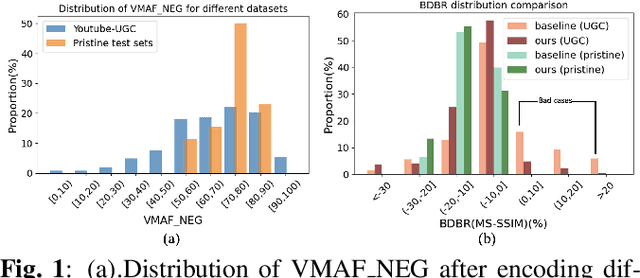
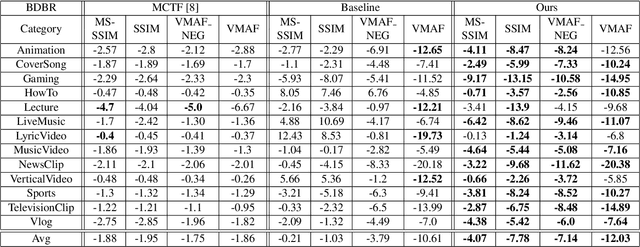
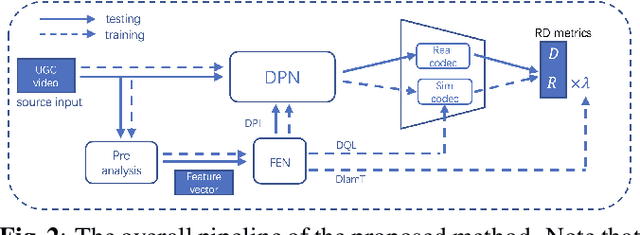
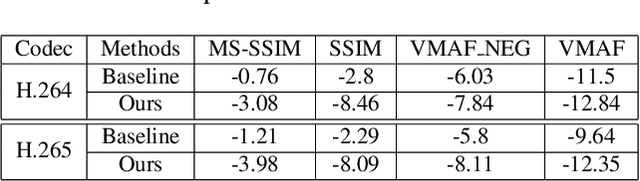
In recent years, user generated content (UGC) has become the dominant force in internet traffic. However, UGC videos exhibit a higher degree of variability and diverse characteristics compared to traditional encoding test videos. This variance challenges the effectiveness of data-driven machine learning algorithms for optimizing encoding in the broader context of UGC scenarios. To address this issue, we propose a Tri-Dynamic Preprocessing framework for UGC. Firstly, we employ an adaptive factor to regulate preprocessing intensity. Secondly, an adaptive quantization level is employed to fine-tune the codec simulator. Thirdly, we utilize an adaptive lambda tradeoff to adjust the rate-distortion loss function. Experimental results on large-scale test sets demonstrate that our method attains exceptional performance.
Generative Preprocessing for Image Compression with Pre-trained Diffusion Models
Dec 17, 2025Preprocessing is a well-established technique for optimizing compression, yet existing methods are predominantly Rate-Distortion (R-D) optimized and constrained by pixel-level fidelity. This work pioneers a shift towards Rate-Perception (R-P) optimization by, for the first time, adapting a large-scale pre-trained diffusion model for compression preprocessing. We propose a two-stage framework: first, we distill the multi-step Stable Diffusion 2.1 into a compact, one-step image-to-image model using Consistent Score Identity Distillation (CiD). Second, we perform a parameter-efficient fine-tuning of the distilled model's attention modules, guided by a Rate-Perception loss and a differentiable codec surrogate. Our method seamlessly integrates with standard codecs without any modification and leverages the model's powerful generative priors to enhance texture and mitigate artifacts. Experiments show substantial R-P gains, achieving up to a 30.13% BD-rate reduction in DISTS on the Kodak dataset and delivering superior subjective visual quality.
Audio-Visual Cross-Modal Compression for Generative Face Video Coding
Dec 17, 2025Generative face video coding (GFVC) is vital for modern applications like video conferencing, yet existing methods primarily focus on video motion while neglecting the significant bitrate contribution of audio. Despite the well-established correlation between audio and lip movements, this cross-modal coherence has not been systematically exploited for compression. To address this, we propose an Audio-Visual Cross-Modal Compression (AVCC) framework that jointly compresses audio and video streams. Our framework extracts motion information from video and tokenizes audio features, then aligns them through a unified audio-video diffusion process. This allows synchronized reconstruction of both modalities from a shared representation. In extremely low-rate scenarios, AVCC can even reconstruct one modality from the other. Experiments show that AVCC significantly outperforms the Versatile Video Coding (VVC) standard and state-of-the-art GFVC schemes in rate-distortion performance, paving the way for more efficient multimodal communication systems.
A Preprocessing Framework for Video Machine Vision under Compression
Dec 17, 2025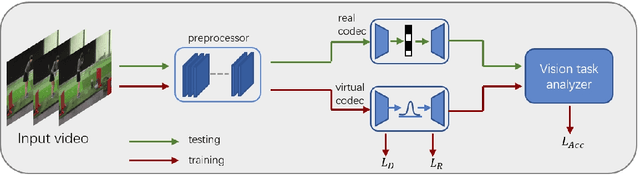
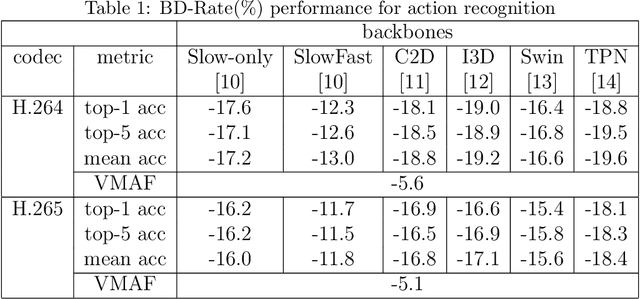
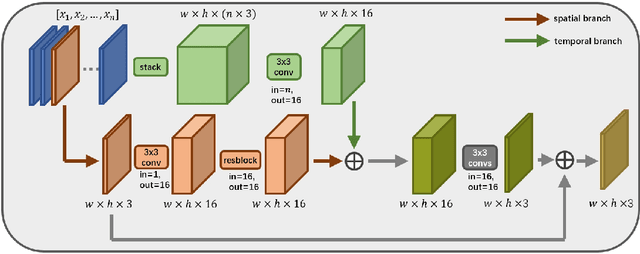
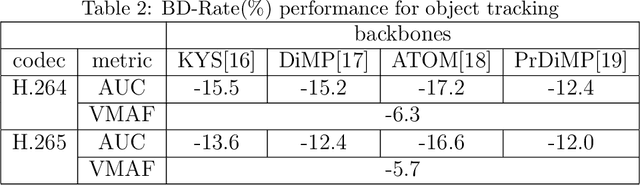
There has been a growing trend in compressing and transmitting videos from terminals for machine vision tasks. Nevertheless, most video coding optimization method focus on minimizing distortion according to human perceptual metrics, overlooking the heightened demands posed by machine vision systems. In this paper, we propose a video preprocessing framework tailored for machine vision tasks to address this challenge. The proposed method incorporates a neural preprocessor which retaining crucial information for subsequent tasks, resulting in the boosting of rate-accuracy performance. We further introduce a differentiable virtual codec to provide constraints on rate and distortion during the training stage. We directly apply widely used standard codecs for testing. Therefore, our solution can be easily applied to real-world scenarios. We conducted extensive experiments evaluating our compression method on two typical downstream tasks with various backbone networks. The experimental results indicate that our approach can save over 15% of bitrate compared to using only the standard codec anchor version.