 Add to Chrome
 Add to Firefox
 Add to Edge
On the Convergence Analysis of Over-Parameterized Variational Autoencoders: A Neural Tangent Kernel Perspective
Sep 09, 2024
Variational Auto-Encoders (VAEs) have emerged as powerful probabilistic models for generative tasks. However, their convergence properties have not been rigorously proven. The challenge of proving convergence is inherently difficult due to the highly non-convex nature of the training objective and the implementation of a Stochastic Neural Network (SNN) within VAE architectures. This paper addresses these challenges by characterizing the optimization trajectory of SNNs utilized in VAEs through the lens of Neural Tangent Kernel (NTK) techniques. These techniques govern the optimization and generalization behaviors of ultra-wide neural networks. We provide a mathematical proof of VAE convergence under mild assumptions, thus advancing the theoretical understanding of VAE optimization dynamics. Furthermore, we establish a novel connection between the optimization problem faced by over-parameterized SNNs and the Kernel Ridge Regression (KRR) problem. Our findings not only contribute to the theoretical foundation of VAEs but also open new avenues for investigating the optimization of generative models using advanced kernel methods. Our theoretical claims are verified by experimental simulations.

Federated Prototype-based Contrastive Learning for Privacy-Preserving Cross-domain Recommendation
Sep 05, 2024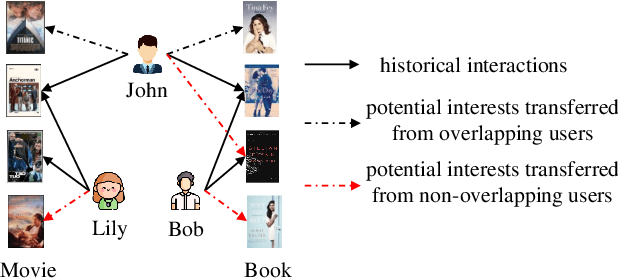


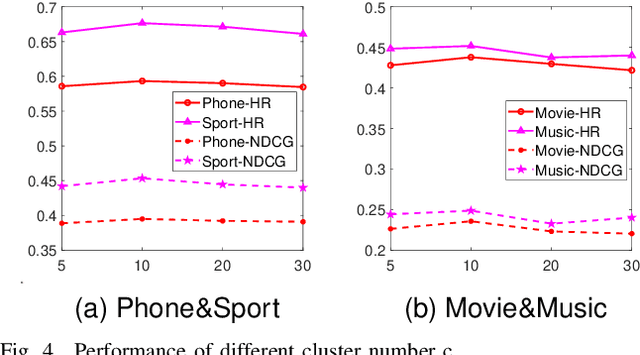
Cross-domain recommendation (CDR) aims to improve recommendation accuracy in sparse domains by transferring knowledge from data-rich domains. However, existing CDR methods often assume the availability of user-item interaction data across domains, overlooking user privacy concerns. Furthermore, these methods suffer from performance degradation in scenarios with sparse overlapping users, as they typically depend on a large number of fully shared users for effective knowledge transfer. To address these challenges, we propose a Federated Prototype-based Contrastive Learning (CL) method for Privacy-Preserving CDR, named FedPCL-CDR. This approach utilizes non-overlapping user information and prototypes to improve multi-domain performance while protecting user privacy. FedPCL-CDR comprises two modules: local domain (client) learning and global server aggregation. In the local domain, FedPCL-CDR clusters all user data to learn representative prototypes, effectively utilizing non-overlapping user information and addressing the sparse overlapping user issue. It then facilitates knowledge transfer by employing both local and global prototypes returned from the server in a CL manner. Simultaneously, the global server aggregates representative prototypes from local domains to learn both local and global prototypes. The combination of prototypes and federated learning (FL) ensures that sensitive user data remains decentralized, with only prototypes being shared across domains, thereby protecting user privacy. Extensive experiments on four CDR tasks using two real-world datasets demonstrate that FedPCL-CDR outperforms the state-of-the-art baselines.
Entropy Loss: An Interpretability Amplifier of 3D Object Detection Network for Intelligent Driving
Sep 01, 2024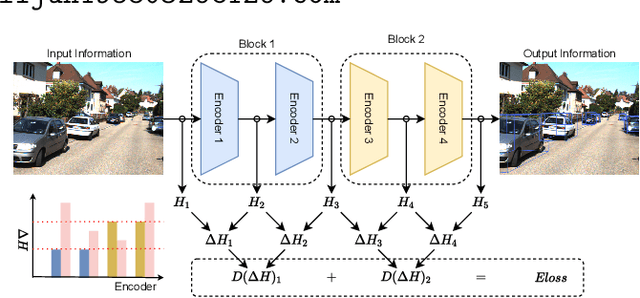
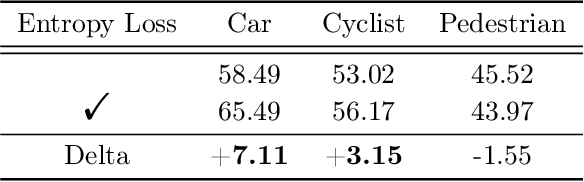
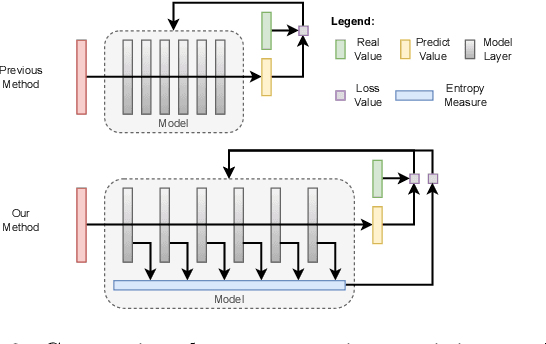
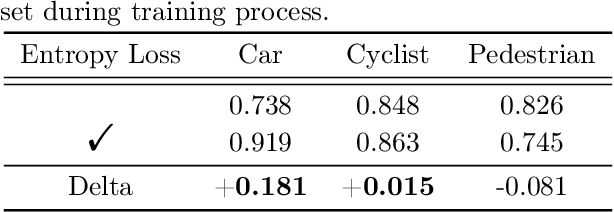
With the increasing complexity of the traffic environment, the significance of safety perception in intelligent driving is intensifying. Traditional methods in the field of intelligent driving perception rely on deep learning, which suffers from limited interpretability, often described as a "black box." This paper introduces a novel type of loss function, termed "Entropy Loss," along with an innovative training strategy. Entropy Loss is formulated based on the functionality of feature compression networks within the perception model. Drawing inspiration from communication systems, the information transmission process in a feature compression network is expected to demonstrate steady changes in information volume and a continuous decrease in information entropy. By modeling network layer outputs as continuous random variables, we construct a probabilistic model that quantifies changes in information volume. Entropy Loss is then derived based on these expectations, guiding the update of network parameters to enhance network interpretability. Our experiments indicate that the Entropy Loss training strategy accelerates the training process. Utilizing the same 60 training epochs, the accuracy of 3D object detection models using Entropy Loss on the KITTI test set improved by up to 4.47\% compared to models without Entropy Loss, underscoring the method's efficacy. The implementation code is available at \url{https://github.com/yhbcode000/Eloss-Interpretability}.
Federated User Preference Modeling for Privacy-Preserving Cross-Domain Recommendation
Aug 26, 2024


Cross-domain recommendation (CDR) aims to address the data-sparsity problem by transferring knowledge across domains. Existing CDR methods generally assume that the user-item interaction data is shareable between domains, which leads to privacy leakage. Recently, some privacy-preserving CDR (PPCDR) models have been proposed to solve this problem. However, they primarily transfer simple representations learned only from user-item interaction histories, overlooking other useful side information, leading to inaccurate user preferences. Additionally, they transfer differentially private user-item interaction matrices or embeddings across domains to protect privacy. However, these methods offer limited privacy protection, as attackers may exploit external information to infer the original data. To address these challenges, we propose a novel Federated User Preference Modeling (FUPM) framework. In FUPM, first, a novel comprehensive preference exploration module is proposed to learn users' comprehensive preferences from both interaction data and additional data including review texts and potentially positive items. Next, a private preference transfer module is designed to first learn differentially private local and global prototypes, and then privately transfer the global prototypes using a federated learning strategy. These prototypes are generalized representations of user groups, making it difficult for attackers to infer individual information. Extensive experiments on four CDR tasks conducted on the Amazon and Douban datasets validate the superiority of FUPM over SOTA baselines. Code is available at https://github.com/Lili1013/FUPM.
Model Based and Physics Informed Deep Learning Neural Network Structures
Aug 13, 2024
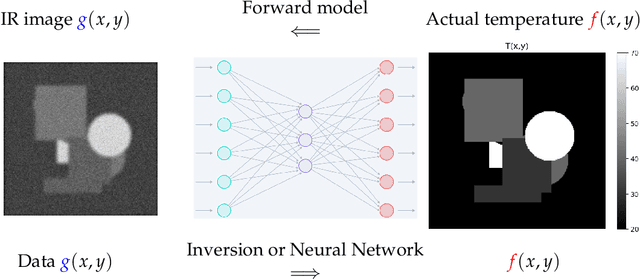
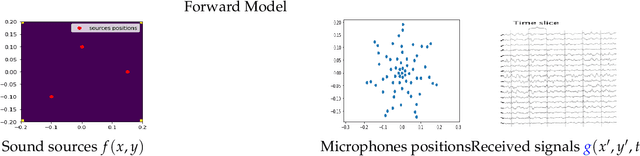
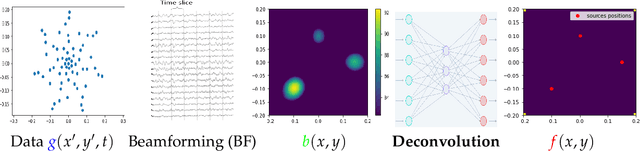
Neural Networks (NN) has been used in many areas with great success. When a NN's structure (Model) is given, during the training steps, the parameters of the model are determined using an appropriate criterion and an optimization algorithm (Training). Then, the trained model can be used for the prediction or inference step (Testing). As there are also many hyperparameters, related to the optimization criteria and optimization algorithms, a validation step is necessary before its final use. One of the great difficulties is the choice of the NN's structure. Even if there are many "on the shelf" networks, selecting or proposing a new appropriate network for a given data, signal or image processing, is still an open problem. In this work, we consider this problem using model based signal and image processing and inverse problems methods. We classify the methods in five classes, based on: i) Explicit analytical solutions, ii) Transform domain decomposition, iii) Operator Decomposition, iv) Optimization algorithms unfolding, and v) Physics Informed NN methods (PINN). Few examples in each category are explained.
Multimodal generative semantic communication based on latent diffusion model
Aug 10, 2024


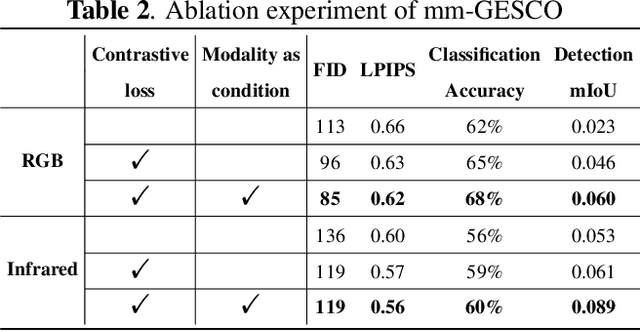
In emergencies, the ability to quickly and accurately gather environmental data and command information, and to make timely decisions, is particularly critical. Traditional semantic communication frameworks, primarily based on a single modality, are susceptible to complex environments and lighting conditions, thereby limiting decision accuracy. To this end, this paper introduces a multimodal generative semantic communication framework named mm-GESCO. The framework ingests streams of visible and infrared modal image data, generates fused semantic segmentation maps, and transmits them using a combination of one-hot encoding and zlib compression techniques to enhance data transmission efficiency. At the receiving end, the framework can reconstruct the original multimodal images based on the semantic maps. Additionally, a latent diffusion model based on contrastive learning is designed to align different modal data within the latent space, allowing mm-GESCO to reconstruct latent features of any modality presented at the input. Experimental results demonstrate that mm-GESCO achieves a compression ratio of up to 200 times, surpassing the performance of existing semantic communication frameworks and exhibiting excellent performance in downstream tasks such as object classification and detection.
Accuracy and Consistency of LLMs in the Registered Dietitian Exam: The Impact of Prompt Engineering and Knowledge Retrieval
Aug 06, 2024


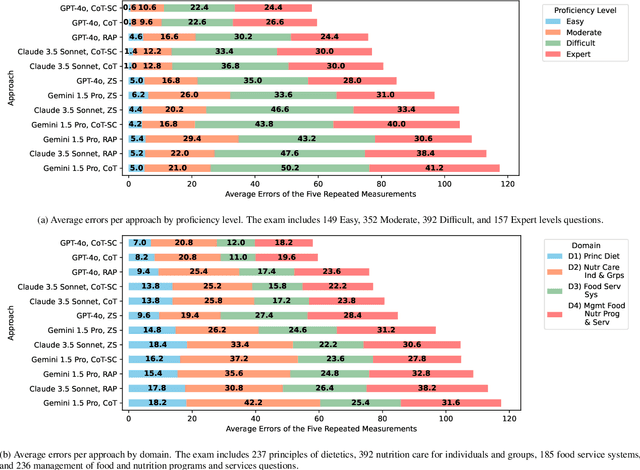
Large language models (LLMs) are fundamentally transforming human-facing applications in the health and well-being domains: boosting patient engagement, accelerating clinical decision-making, and facilitating medical education. Although state-of-the-art LLMs have shown superior performance in several conversational applications, evaluations within nutrition and diet applications are still insufficient. In this paper, we propose to employ the Registered Dietitian (RD) exam to conduct a standard and comprehensive evaluation of state-of-the-art LLMs, GPT-4o, Claude 3.5 Sonnet, and Gemini 1.5 Pro, assessing both accuracy and consistency in nutrition queries. Our evaluation includes 1050 RD exam questions encompassing several nutrition topics and proficiency levels. In addition, for the first time, we examine the impact of Zero-Shot (ZS), Chain of Thought (CoT), Chain of Thought with Self Consistency (CoT-SC), and Retrieval Augmented Prompting (RAP) on both accuracy and consistency of the responses. Our findings revealed that while these LLMs obtained acceptable overall performance, their results varied considerably with different prompts and question domains. GPT-4o with CoT-SC prompting outperformed the other approaches, whereas Gemini 1.5 Pro with ZS recorded the highest consistency. For GPT-4o and Claude 3.5, CoT improved the accuracy, and CoT-SC improved both accuracy and consistency. RAP was particularly effective for GPT-4o to answer Expert level questions. Consequently, choosing the appropriate LLM and prompting technique, tailored to the proficiency level and specific domain, can mitigate errors and potential risks in diet and nutrition chatbots.
MIMNet: Multi-Interest Meta Network with Multi-Granularity Target-Guided Attention for Cross-domain Recommendation
Jul 31, 2024Cross-domain recommendation (CDR) plays a critical role in alleviating the sparsity and cold-start problem and substantially boosting the performance of recommender systems. Existing CDR methods prefer to either learn a common preference bridge shared by all users or a personalized preference bridge tailored for each user to transfer user preference from the source domain to the target domain. Although these methods significantly improve the recommendation performance, there are still some limitations. First, these methods usually assume a user only has a unique interest, while ignoring the fact that a user may interact with items with different interest preferences. Second, they learn transformed preference representation mainly relies on the source domain signals, while neglecting the rich information available in the target domain. To handle these issues, in this paper, we propose a novel method named Multi-interest Meta Network with Multi-granularity Target-guided Attention (MIMNet) for cross-domain recommendation. To be specific, we employ the capsule network to learn user multiple interests in the source domain, which will be fed into a meta network to generate multiple interest-level preference bridges. Then, we transfer user representations from the source domain to the target domain based on these multi-interest bridges. In addition, we introduce both fine-grained and coarse-grained target signals to aggregate user transformed interest-level representations by incorporating a novel multi-granularity target-guided attention network. We conduct extensive experimental results on three real-world CDR tasks, and the results show that our proposed approach MIMNet consistently outperforms all baseline methods. The source code of MIMNet is released at https://github.com/marqu22/MIMNet.
Approximate Partially Decentralized Linear EZF Precoding for Massive MU-MIMO Systems
Jul 18, 2024Massive multi-user multiple-input multiple-output (MU-MIMO) systems enable high spatial resolution, high spectral efficiency, and improved link reliability compared to traditional MIMO systems due to the large number of antenna elements deployed at the base station (BS). Nevertheless, conventional massive MU-MIMO BS transceiver designs rely on centralized linear precoding algorithms, which entail high interconnect data rates and a prohibitive complexity at the centralized baseband processing unit. In this paper, we consider an MU-MIMO system, where each user device is served with multiple independent data streams in the downlink. To address the aforementioned challenges, we propose a novel decentralized BS architecture, and develop a novel decentralized precoding algorithm based on eigen-zero-forcing (EZF). Our proposed approach relies on parallelizing the baseband processing tasks across multiple antenna clusters at the BS, while minimizing the interconnection requirements between the clusters, and is shown to closely approach the performance of centralized EZF.
Generative AI for RF Sensing in IoT systems
Jul 10, 2024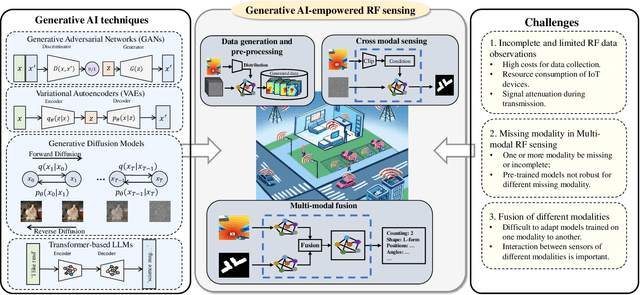
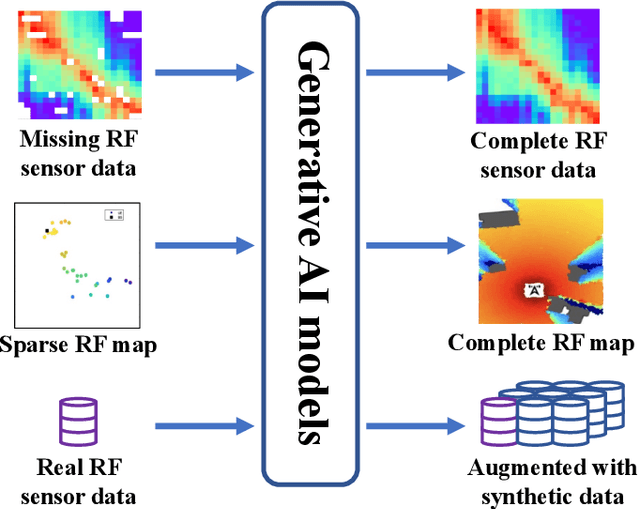
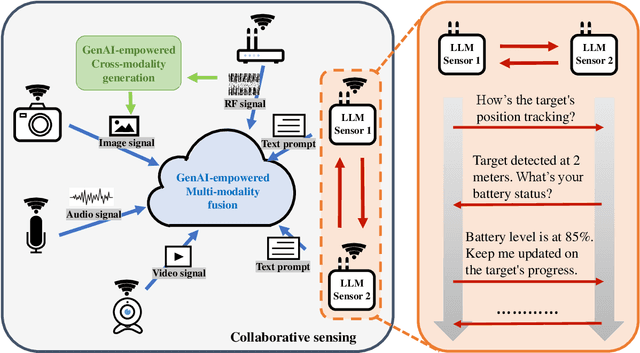
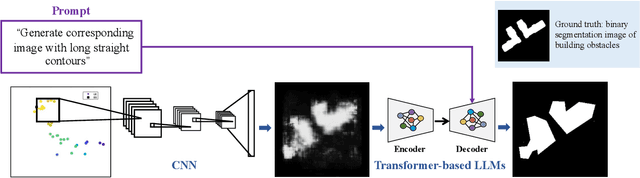
The development of wireless sensing technologies, using signals such as Wi-Fi, infrared, and RF to gather environmental data, has significantly advanced within Internet of Things (IoT) systems. Among these, Radio Frequency (RF) sensing stands out for its cost-effective and non-intrusive monitoring of human activities and environmental changes. However, traditional RF sensing methods face significant challenges, including noise, interference, incomplete data, and high deployment costs, which limit their effectiveness and scalability. This paper investigates the potential of Generative AI (GenAI) to overcome these limitations within the IoT ecosystem. We provide a comprehensive review of state-of-the-art GenAI techniques, focusing on their application to RF sensing problems. By generating high-quality synthetic data, enhancing signal quality, and integrating multi-modal data, GenAI offers robust solutions for RF environment reconstruction, localization, and imaging. Additionally, GenAI's ability to generalize enables IoT devices to adapt to new environments and unseen tasks, improving their efficiency and performance. The main contributions of this article include a detailed analysis of the challenges in RF sensing, the presentation of innovative GenAI-based solutions, and the proposal of a unified framework for diverse RF sensing tasks. Through case studies, we demonstrate the effectiveness of integrating GenAI models, leading to advanced, scalable, and intelligent IoT systems.